

Shenzhen Institute of Advanced Technology Unveils Patent for Magnetic Thin-Film Robot for Heart Failure Assistance
On April 30, 2024, the Shenzhen Institute of Advanced Technology had one additional patent published.This patent discloses a magnetic thin-film robot that generates a magnetic field via a control module, which drives an epicardial wrapping module to provide mechanical circulatory support for heart failure.
It is understood that this magnetic thin-film robot consists of interconnected epicardial wrapping modules and a control module. The epicardial wrapping module includes a non-magnetic support portion and a magnetic actuation portion, which are coupled to each other. The control module comprises interconnected patch-type magnetic field generators and power supply components. The extracorporeal magnetic field generator establishes a spatial correspondence with the intracorporeal magnetic actuation portion, thereby minimizing interference with normal tissues and reducing the incidence of postoperative complications.
Robots Penetrate Deeper into Medical Scenarios as Industry Giants Enter the Fray
Currently, surgical robots are being deeply integrated into various application scenarios.Classified by clinical application areas, surgical robots can be divided into six major categories: laparoscopic surgical robots, orthopedic surgical robots, percutaneous puncture surgical robots, pan-vascular surgical robots, natural orifice transluminal endoscopic surgical robots, and other (e.g., neurosurgical) surgical robots.
In practical applications, surgical robots have also achieved certain successes. On May 3, 2024, Corin Group announced that it had completed its first total knee arthroplasty using its Apollo surgical robot and ApolloKnee software.
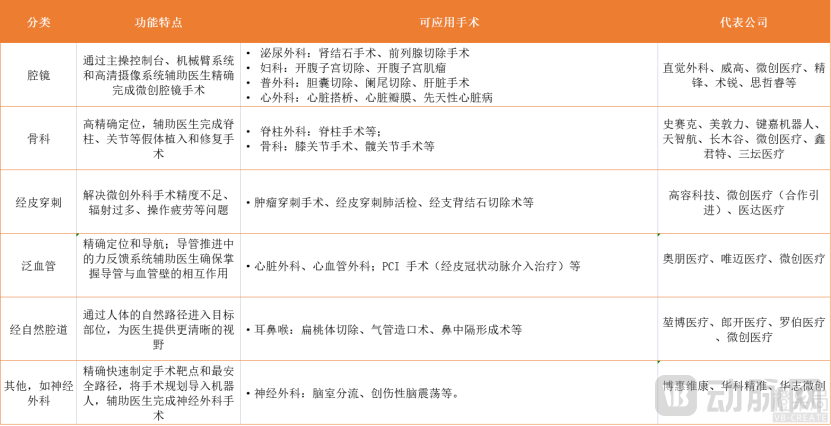
Figure: Classification of Surgical Robots
To compete for market share, medical technology giants such as Medtronic, Johnson & Johnson, Stryker, and Zimmer Biomet have long entered the fray., whether through direct acquisition, independent research and development, or joint development with upstream technology companies. In 2020, Johnson & Johnson unveiled the Ottava surgical robot (a laparoscopic surgical robot) equipped with six robotic arms; in 2023, Stryker announced its second-generation Mako surgical robot, which generates personalized surgical plans for patients and provides intraoperative dynamic adjustments, thereby maximizing the precision and personalization of joint surgery.
Driven by the strategic expansions of overseas giants in the medical device sector, the market has further heated up, with the global surgical robot market reaching $14.058 billion in 2022.
Promote Domestic Substitution and Intelligent Development
Surgical robotics features high technical barriers and significant entry challenges. Globally, the da Vinci system dominates the market, holding a 55% share of the entire surgical robotics industry and a 92% share of the laparoscopic robotics segment in 2021. However, through continuous technological accumulation, Chinese surgical robotics companies have been upgrading their technologies in recent years, aiming to break the monopoly held by imported systems.
"As one of the earliest companies in China to focus on surgical robots,"TinaviIn 2020, it completed its initial public offering (IPO) on the STAR Market, becoming the first listed surgical robotics company in China. In 2016, its third-generation product, the “Tiandi 1.0” Orthopedic Surgical Navigation and Positioning System, received registration approval from the former China Food and Drug Administration (CFDA), making it the first approved surgical robotic product in China. In July 2023, Tinavi Medical Technologies obtained a Class III medical device registration certificate for its “Knee Arthroplasty Surgical Navigation and Positioning System,” and is currently promoting product adoption through multiple channels.
andWith the rapid development of China’s surgical robotics industry, an increasing number of enterprises, universities, and research institutions have entered this field, driving continuous technological advancements and a growing diversity of surgical robot products.

Figure: Upstream, Midstream, and Downstream of the Surgical Robot Industry Chain
Some upstream companies combine imaging and consumables in various configurations to offer differentiated solutions. For instance, Aimui focuses on providing a series of products including optical positioning systems, optical positioning consumables, and supporting positioning tools, while also developing customized preoperative and intraoperative software for its clients. Midstream companies, on the other hand, place greater emphasis on original innovation and engineered mass production. For example, Yuanhua Intelligence, founded by Academician Meng Qinghu of Southern University of Science and Technology, launched “Kunwu,” an integrated hip-and-knee orthopedic surgical robot. This product features a proprietary high-precision navigation system and integrates procedures for both total knee arthroplasty and total hip arthroplasty.
Moreover, in the realm of basic scientific research, domestic surgical robot studies are advancing toward greater intelligence and precision. In 2023, Professor Wu Xinbao’s team at Beijing Jishuitan Hospital formulated a research protocol for intelligent planning and automatic control of fracture reduction robots, developing the world’s first surgical robot capable of performing pelvic fracture reduction.