

Shanghai Jiao Tong University Unveils Novel Capsule Endoscope Patent for Early Gastrointestinal Cancer Detection
Recently, Shanghai Jiao Tong University disclosed a new patent. The patent is for aCapsule Endoscopy System Based on White Light-Assisted Raman Signal Detection for Early Diagnosis of Gastrointestinal Cancer
This capsule endoscope integrates cutting-edge wireless power transfer technology with a precision optical detection module. It comprises an external wireless power supply unit and a combined Raman signal and white-light image reception module, enabling sensitive detection of Raman signals from gastrointestinal tissues under white-light assistance.
Compared with existing technologies, this endoscope offers advantages such as being non-invasive and having high diagnostic specificity. It enables label-free, quantitative, and objective gastrointestinal detection of biomolecules, assisting physicians in identifying biological changes from normal to malignant tissues.
The majority of the market share is held by foreign enterprises.
Medical endoscopes are medical devices that integrate optics, ergonomics, precision mechanics, modern electronics, and image processing software. They provide physicians with anatomical images of internal human structures under minimally invasive conditions. This has made endoscopes one of the fastest-growing product categories in terms of market share within the global medical device industry. The global market size for medical endoscopes grew from USD 11.3 billion in 2016 to USD 17.2 billion in 2022, representing a compound annual growth rate (CAGR) of 7.25%.
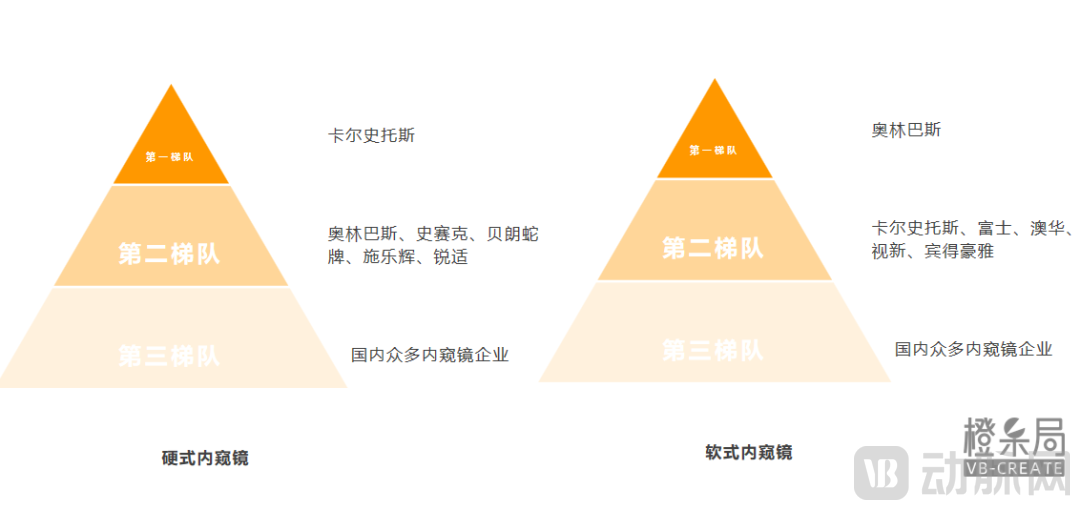
▲ Competitive Landscape of Medical Endoscopes in China; Data sourced from Qianzhan Industry Research Institute and China Galaxy Securities Research Institute
However, from the perspective of the current market situation, domestic endoscopes are monopolized by manufacturers from countries such as Japan and Germany. The market share of Chinese manufacturers is less than 10%, and they are basically concentrated in the mid-to-low-end market.
In the field of rigid endoscopy, German manufacturers have consistently maintained a leading position, as Karl Storz from Germany was the first to master rod lens technology. To date, Karl Storz’s endoscopic product portfolio spans three major application areas: human medicine, veterinary medicine, and industrial endoscopy, comprising over 15,000 products. Its related products have also penetrated various segments of the Chinese medical market.
Stryker also dominates the field of fluorescent rigid endoscopy. Stryker launched its fluorescent endoscope as early as 2015 and later acquired NOVADAQ, a developer of fluorescence imaging technology, leveraging its Pinpoint platform to expand product applications into a broader range of surgical procedures. With its strategic positioning in the fluorescent endoscopy sector, Stryker captured 78% of the global market share for fluorescent rigid endoscopes in 2019, thereby dominating the global market.
In the field of flexible endoscopy, as the development of image sensors for traditional flexible endoscopes has been driven by Japanese companies, the market is monopolized by Japanese firms such as Olympus, Fujifilm, and Pentax Medical.
Taking Olympus as an example, since the introduction of the Asahi 600x microscope in 1920, Olympus has successively launched a range of products, including biopsy endoscopes and endoscopic therapeutic devices, the EVIS EXERA endoscopic video system, the world’s first high-definition endoscopy system EVIS LUCERA, and THUNDERBEAT, the world’s first energy device integrating advanced bipolar and ultrasonic energy. In 2021, Olympus also introduced the EU-ME3 endoscopic ultrasound processor, which not only meets the medical staff’s demand for high-quality, clear images during endoscopic ultrasound procedures but also aids in the diagnosis of pancreatic and biliary lesions.
# Multi-Pronged Efforts Drive Gradual Increase in Domestic Production Rate
Compared with overseas markets, China’s endoscopy industry started later, but driven by factors such as expanding market demand and supportive domestic policies, the market share of domestically produced brands is steadily rising.
According to data from Frost & Sullivan’s 2023 “Blue Book on the Current Status and Development Trends of the Endoscopy Industry,” the market size of medical endoscopes in China was RMB 24.8 billion in 2021, with a domestic production rate of only 6.9%. By 2025, the market size of medical endoscopes in China is projected to reach RMB 39.0 billion, with the domestic production rate expected to rise to 18.3%.
Amid a favorable market environment, domestic endoscopy companies have been increasing their R&D investment and upgrading their technologies, striving to achieve import substitution with domestically produced alternatives.
In the field of flexible endoscopy, Aohua Endovision, the leading domestic manufacturer, has launched a 4K ultra-high-definition endoscopy system that enables high-speed laser transmission. This system not only provides richer detail in endoscopic images but also enhances the insulation strength and anti-interference capability of high-frequency signals, thereby ensuring more stable image transmission.
In the field of rigid endoscopy, Mindray Medical, the undisputed domestic leader in medical devices, launched the HyPixel™ R1 4K fluorescence endoscope in 2021. This system allows seamless switching between fluorescence and white light modes and features an ultra-wide color gamut, superior anti-fog performance, and a large depth of field ranging from 3 to 200 mm. Similarly, Haitai XinGuang, established in 2003, has also focused on the development of fluorescence rigid endoscopy technology, launching multiple products including the N700-C endoscopic fluorescence imaging system, hysteroscopes, and 4K anti-fog endoscopy systems.
Meanwhile, researchers in China are also tackling technical challenges in the field of endoscopy, starting from basic research.In the integration of “ultrasound + endoscopy,” Professor Guan Baiou’s team at Jinan University developed a high-sensitivity ultrasound sensor based on fiber-optic technology in 2022. This sensor converts ultrasound signals into laser frequency shifts and amplifies them, enabling signal readout via optical heterodyne detection. In the realm of endoscopic navigation, Professor Yang Jian’s team from the School of Optics and Photonics at Beijing Institute of Technology has developed an endoscopic navigation system for skull base surgery, enhancing the positioning accuracy of endoscopes in minimally invasive procedures. With continuous technological advancements and ongoing market expansion, the Chinese endoscopy industry holds promising prospects for the future.