

Xiangya Hospital Unveils Novel Zinc-Zirconium Alloy-Based Intestinal Stent with DLC Coating in Newly Published Patent
Recently, Xiangya Hospital had one additional patent published. The patent is for aIntestinal Stent, which can restore patency to the obstructed bowel.
This stent innovatively utilizes a zinc-zirconium alloy and features a DLC coating on its surface, serving toCorrosion-resistantfunction. Meanwhile, the zinc-zirconium alloy material'sBiocompatibilityhigher, which can reduce the risk of postoperative adverse reactions in patients.
In addition, traditional alloy materials, such as nickel-titanium alloys, exhibit good corrosion resistance and biocompatibility, but their mechanical properties are less than satisfactory. In contrast, the zinc-zirconium alloy material improved by the team demonstrates excellent mechanical properties,Its elongation at break exceeds 40%., which is significantly higher than the 25% required for intestinal applications. The improvement in mechanical properties can effectively reduce postoperative complications and the risk of secondary surgery in patients.
I. Most approved stents are made of metal materials
Intestinal stents are a commonly used medical device, primarily designed to expand the intestinal lumen and restore patency to narrowed or obstructed segments, making them suitable for the treatment ofIntestinal Tumors, Inflammatory Bowel Disease, Pancreatic Cancerand other intestinal diseases.
According toMordor Intelligence2024 Report on Intestinal Stents: Driven by the rising prevalence of gastrointestinal diseases and an aging population, the intestinal stent market continues to show an upward trend.
Currently, multiple intestinal stents have been approved both domestically and internationally, involving companies such asBoston Scientific, Cook Medical, Taewoong Medical, Medtronicetc. The main domestic manufacturers includeNanjing Micro-Tech, Changzhou Zhiye。
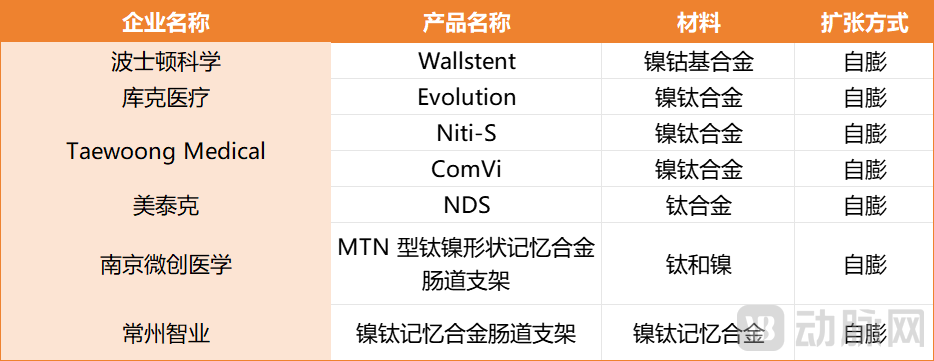
Partially Approved Intestinal Stents
As can be seen from the figure above, most of the approved intestinal stents areMetallic Materials, and employs a self-expanding deployment mechanism. This approach maintains consistent radial force, allowing the stent to flex with intestinal peristalsis, thereby rapidly relieving intestinal obstruction and reducing complications.
II. Advances in Biomaterials Drive Innovation in Intestinal Stents
As metal stents may interfere with magnetic resonance imaging (MRI) and pose a potential risk of intestinal wall perforation, most researchers are attempting to innovate raw materials in the development of intestinal stents.
In 2021,Professor Guan Shaokang's Team, Zhengzhou UniversityNew Progress Achieved in the Field of Biodegradable Magnesium Alloy Materials. The team developed a biodegradable Mg-Zn alloy by regulating protein adsorption on the alloy surface through zinc content modulation. When applied as an intestinal stent, this material effectively inhibits tissue restenosis and intestinal inflammation. Furthermore, its biocompatibility and biodegradability profiles demonstrate that degradation byproducts can be metabolized and excreted from the body.
In addition to modifying alloy materials, researchers have also attempted to fabricate intestinal stents using other materials.
In 2022,Academician Leng Jinsong’s Team at Harbin Institute of TechnologyUsing 3D printing technology, we have developed a biomimetic colorectal stent that simultaneously possesses anti-tumor, anti-migration, and drug-loading capabilities. This stent is fabricated from photothermal-functionalized biodegradable materials, which not only ensure tumor ablation but also enable personalized stent customization and facilitate precision medicine.
Furthermore, in 2023,The team led by Li Zongan at Nanjing Normal University and the team led by Huang Jinjian at Southeast UniversityCo-developed a multi-axis, multi-material 3D-printed personalized intestinal stent. Fabricated from flexible silicone combined with a shape-memory polypropylene mesh, this stent allows for personalized customization and enables the release of drug molecules to accelerate wound healing.
As research into biomaterials deepens, intestinal stents are poised to evolve toward multifunctionality and personalization, with their mechanical properties, biodegradability, and capacity for assisted sustained drug release becoming key competitive advantages.