

Tsinghua University and WeGene Factory Announce New Synthetic Biology Patent for Engineered Halomonas with Enhanced Industrial Applications
Recently,Tsinghua University and Beijing Weigou Workshop Biotechnology Co., Ltd. Announce New Patent Disclosure: Engineered Halomonas Strain and Its Applications. The team’s engineered Halomonas strain offers advantages such as high glucose catabolic efficiency, reduced carbon dioxide release during the conversion of glucose to acetyl-CoA, and efficient production of acetyl-CoA derivatives, holding significant importance and practical value for microbial growth and the development of the industrial microbiology sector.
According to public information, the patent application was filed on December 22, 2023, with Tsinghua University and Beijing Weigou Workshop Biotechnology Co., Ltd. as joint patent holders. The inventors are Professor Chen Guoqiang’s team from the School of Life Sciences at Tsinghua University. Professor Chen has long been engaged in research on “biosynthetic PHA materials and next-generation industrial biotechnology,” and the technologies he developed have been adopted by several companies for the large-scale production of microbial plastics, specifically polyhydroxyalkanoates (PHA).
Beijing Weigou Workshop Biotechnology Co., Ltd. is a synthetic biology enterprise established based on the scientific research achievements of Professor Chen Guoqiang. Founded in February 2021, Weigou Workshop has successfully carried out a series of innovative R&D and production activities in synthetic biology, including high value-added products such as biodegradable material PHA (polyhydroxyalkanoates), the pharmaceutical intermediate ectoine, and pentamethylenediamine, a precursor for nylon 56.
Synthetic Biology Concept Reignites Fervor
On May 9, synthetic biology concept stocks in the secondary market continued their rally, with industry leader Vland Biotech notching up its seventh consecutive daily limit gain after six previous limit-ups. Additionally, Xinghu Technology hit the daily limit for the third time in four trading days. Kanghui Pharmaceutical and Lukang Biochemical also closed at their daily limits.
The resurgence of the synthetic biology concept in the capital market is primarily driven by national policy guidance. At the Zhongguancun Forum 2024 held in late April, Tan Tianwei, President of Beijing University of Chemical Technology and an academician of the Chinese Academy of Engineering, publicly stated that the National Development and Reform Commission is currently leading the joint development of a National Action Plan for Biotechnology and Biomanufacturing in collaboration with other national ministries and commissions, including the Ministry of Industry and Information Technology and the Ministry of Science and Technology, and that the plan is expected to be released in the near future. ““Bio-manufacturing+” is a key component, and the bioeconomy is poised to become the Fourth Industrial Revolution of the future.。
Synthetic biology has broad applications, spanning agriculture, manufacturing, environmental protection, healthcare, and many other fields. In healthcare, for example, synthetic biology enables targeted design and modification of bacteria, shortening vaccine development cycles and enhancing vaccine efficacy. Yiguan Bio is actively developing synthetic biology-based vaccines against drug-resistant bacteria and is advancing its bacterial vaccine candidates into clinical trials.
Technology and Product Varieties Are Key to Breaking the Deadlock
Returning to industrial logic, the substantial development of synthetic biology still requires addressing two common industry challenges: technological breakthroughs and the mass production of selected products.From the perspective of the industrial chain, upstream companies focus on breakthroughs in foundational technologies, while downstream companies prioritize overcoming challenges in product selection.
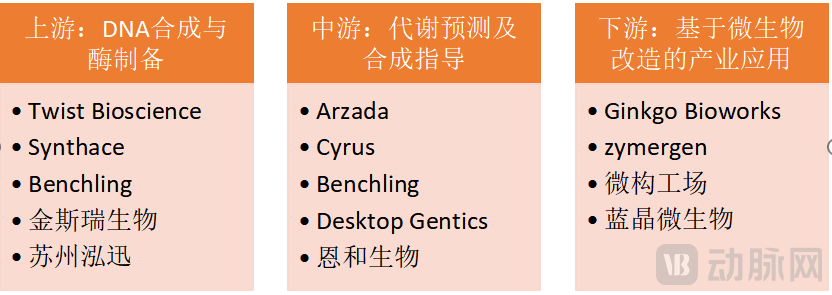 Figure: The Industry Chain of the Synthetic Biology Sector
On the one hand, upstream companies are primarily concentrated in core technologies such as DNA synthesis and enzyme preparation, as well as in the analysis and interpretation of omics data. For instance, Twist Bioscience’s DNA synthesis platform highly miniaturizes traditional chemical DNA synthesis reactions, reducing reaction volumes by a factor of one million while increasing throughput by 1,000-fold, thereby enabling the complete synthesis of 9,600 genes on a single silicon chip.
On the other hand, downstream enterprises are product-oriented and application-driven, extensively covering various aspects of human life, including pharmaceuticals, chemicals, food, and agriculture. Therefore, during product selection, particular attention must be paid to the mass production feasibility of flagship products. Taking the alanine series as an example, Huaheng Biology has developed and constructed a microbial cell factory that produces L-alanine through anaerobic fermentation using renewable glucose as the raw material, thereby reducing the production cost of L-alanine by approximately 50%.
Meanwhile,Domestic basic scientific research has also delved into the relevant R&D in the field of synthetic biology.. In 2023, Luo Xiaozhou’s team at the Shenzhen Institute of Advanced Technology proposed reconstructing the jasmonate biosynthetic pathway in Saccharomyces cerevisiae and establishing a microbial cell factory to achieve efficient and green production; meanwhile, a research team from Shanghai Jiao Tong University employed a modular design concept to construct an artificially synthesized intelligent bacterium capable of detecting and degrading salicylic acid and undergoing self-destruction under temporal control without reliance on exogenous inducers.
However, translating laboratory techniques into practical applications remains a significant challenge for the synthetic biology industry. Bridging the gap from the lab to industrial scale requires the involvement of many key players to accelerate industry development, such as the construction of foundational infrastructure and the interdisciplinary integration of metabolic engineering, software engineering, and bioengineering.