

Central South University: The Youngest '985' Institution Achieves Over ¥100 Million in Technology Transfer, Files IPO Prospectus
Recently, a report has drawn the attention of the technology transfer community:A Central South University project has been commercialized for over 100 million yuan!
In 2023, following the release of the Work Plan for Revitalizing Existing Patents in Universities and Research Institutions, major universities conducted comprehensive reviews of their existing patent portfolios, with Central South University identifying opportunities during this process.
In 2024,Professor Deng Dehua's TeamThe developed “Aerogel Crystal Insulation Materials, Related Building Materials, and Their Preparation Technologies” have attracted the attention of the Intellectual Property Center of Central South University. According to evaluations, this technology effectively addresses the current technical challenges in building insulation materials, namely the inability to simultaneously achieve fire resistance, water resistance, lightweight thermal insulation, and high strength.
With the support of the Center, this technology successfully partnered with a green building materials company and achieved commercialization through patent assignment and equity investment via technology capital contribution, with a total value exceeding RMB 100 million.
I. The Rapid Pace of Transformation: Policy and System Improvements
This “hundred-million-yuan commercialization” may seem to have come out of the blue, but in fact, its signs were evident long ago.
From patent inventory to the signing of project collaboration agreements, Central South University completed this technology transfer in just six months.The speed is, in fact, the result of years of experience accumulated by Central South University.
To refine the commercialization process, Central South University had issued 13 administrative measures focused on achievement transformation by mid-2023. These measures not only encourage and support professors in technology transfer but also standardize the collection and management of patents. Supported by a well-established technology transfer system, Central South University has developed a distinctive"Central South Model"and“Zhongnan System”。
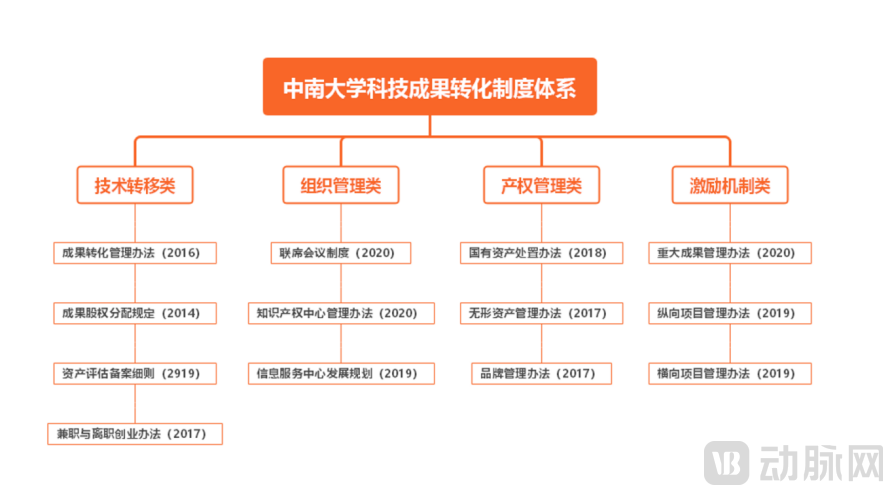
Central South University’s Technology Transfer Institutional Framework (Image source: VCBeat Orange Fruit Bureau)
1The Central South University Model: Igniting Researchers’ Enthusiasm for Translation
Taking the first step requires faculty involvement. To stimulate researchers’ enthusiasm for translation, Central South University has been seeking strategies since its establishment.
Central South University was formed through the merger of three institutions: Central South University of Technology, Hunan Medical University, and Changsha Railway Institute. Consequently, in its efforts to translate research achievements into practical applications, it has inherited and optimized the distinctive strengths of these three predecessor universities. In 2000, Central South University took the lead in proposing70% of the net income from the transfer (licensing) of scientific and technological achievements, or the shares obtained through equity participation via technology, shall be awarded to scientific researchers.Stimulate enthusiasm for translation by allowing researchers to “hold in their hands” the rewards.
Over the subsequent two decades, Central South University’s technology transfer system has gradually improved and matured, with various policies revised and refined; however, the “70%” incentive policy has been retained to this day.
Fourteen years later, Central South University has added another chapter to this policy.
In 2014, Central South University issued the "Regulations on Equity and Interest Distribution of Technological Achievements at Central South University," gradually beginning to explore“Cash + Equity” Hybrid Conversion Model.By introducing capital and establishing a company through equity contribution via technology to facilitate the commercialization of high-value patents, a collaborative mechanism of “patents + capital + platforms” has been established.
This policy not only maintains incentives for researchers but also enables them to participate in corporate growth and steer the direction of technology commercialization, thereby reducing the likelihood that technologies will fail to undergo market-oriented development after transfer or sale.
Furthermore, this policy alleviates the financial burden on enterprises associated with paying substantial transfer fees, closely aligns the personal interests of researchers with corporate development, and fosters innovation-driven growth. These measures make enterprises more willing to accept and commercialize patents from Central South University.
This model for translating favorable outcomes at both ends is also known as the “Zhongnan Model.””, many researchers have benefited from this. For example,Professor Zhao Zhongwei's TeamSuccessfully transferred the technology for “lithium extraction from salt lake brine via electrochemical deintercalation,” receiving RMB 24.8 million in cash and equity valued at RMB 80 million; additionally,Professor Lai Yanqing's TeamSuccessful development of "high-specific-energy lithium-sulfur battery technology," which generated RMB 40 million in cash proceeds and RMB 100 million in equity value following its transfer in collaboration with Zhongnan New Energy Investment (Shenzhen) Co., Ltd. These success stories inspire professors at Central South University to prioritize the commercialization of their research outcomes while pursuing scientific innovation.
2The Zhongnan System: “Intellectual Property+” Integrates Resources from All Parties
In this “hundred-million-yuan commercialization,” one role has built a critical bridge—Intellectual Property Center of Central South University.
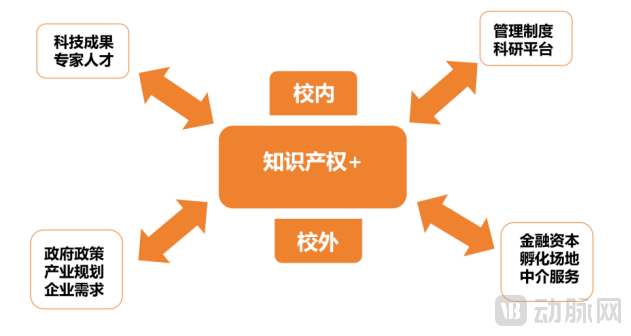 Central South University Intellectual Property+ (Image source: VCBeat Orange Bureau)
To efficiently integrate resources from all parties and streamline the cumbersome procedures faced by university researchers during the commercialization process, Central South University has established an “Intellectual Property Plus” operational model, with the Intellectual Property Center serving as a key component. In addition, departments such as the National University Science Park, the Intellectual Property Research Institute of the National Technology Transfer Center, and the Intellectual Property Information Service Center collaborate to jointly assist researchers in achieving successful technology transfer and commercialization.
They each perform their respective duties, forming the Central South system for intellectual property operations. Through collaboration, Central South University has also seen the emergence of"Tripartite Collaboration"、"Household Responsibility System"operating model.
So-called“Tripartite Collaboration”This involves a tripartite collaboration among the inventors, secondary colleges, and the Intellectual Property Center, with progressive implementation at each level to ensure high quality and efficiency.“Assign responsibilities to individuals and allocate production quotas to households”, is a team of more than ten technology managers from the Intellectual Property Center. Each manager is assigned to liaise with specific colleges and inventor teams. Once the patent inventory and registration process for a college is completed, the technology manager typically gains a comprehensive and in-depth understanding of the patent characteristics of that college.
Such “point-to-point” services can not only identify the optimal “commercialization pathway” for projects and teams, but also enable a rapid response to emerging market demands, thereby seizing commercialization opportunities.
Furthermore, improve the collective decision-making system for the transformation of scientific and technological achievements. Based on the prices for the transformation and transfer of scientific and technological achievements,Establish separate decision-making review processes and requirements for the leadership team based on the following tiers: RMB 5 million and above, RMB 2–5 million, RMB 100,000–2 million, and below RMB 100,000., to ensure that decision-making on the transfer and commercialization of research outcomes is standardized and scientifically sound.
Under the dual influence of the “Central South System” and the “Central South Model,” Central South University has seen 11 individual technology transfer projects each exceed RMB 100 million in transaction value. Amid this surge in commercialization, professors from Central South University have founded more than 350 companies, including seven Hunan-based firms—such as Boyun New Materials and Sunward Intelligent—that have successfully gone public.
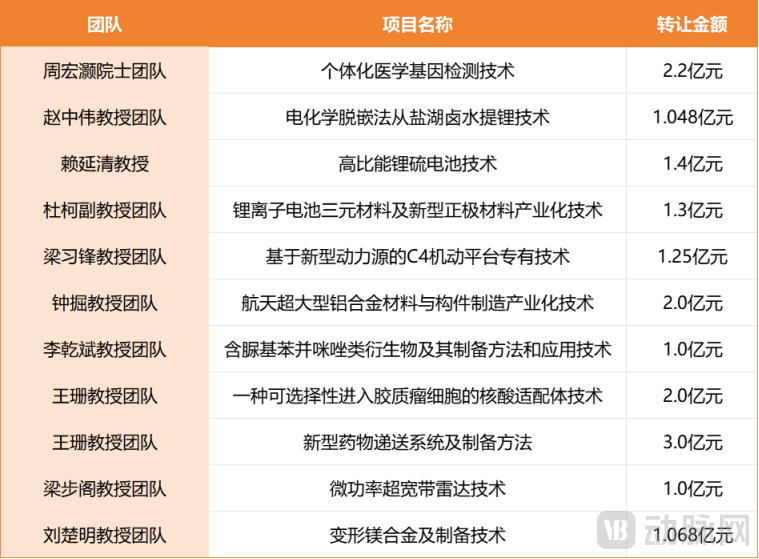 (Data source: Achievements and Reflections on Innovation and Entrepreneurship in the Transformation of Scientific and Technological Achievements at Central South University; Chart by: VCBeat Orange Bureau)
II. The Youngest “985” University with Profound Scientific Research Strength
However, excellent systems and institutions are merely means of translation; the core still depends on the quality of scientific research achievements.
Since its establishment in 2000, Central South University has existed for only 24 years. As the youngest “985” university in China, its academic strength has long been prominent.
1Carrying forward the legacy, advancing medicine, engineering, and materials science
As a comprehensive university, Central South University encompasses 11 major disciplinary categories, including literature, education, medicine, and interdisciplinary studies, with coverage extending to military science.
Meanwhile, Central South University has preserved the research strengths of its three predecessor institutions—Central South University of Technology, Hunan Medical University, and Changsha Railway Institute—and boasts a comprehensive disciplinary system in non-ferrous metals, medicine, rail transportation, and related fields. Its disciplines in materials science, engineering, clinical medicine, computer science, chemistry, and pharmacology & toxicology rank among theTop 1‰ Globally。
In addition to robust professional competencies, Central South University also provides students with programs that align closely with practical applications. Taking medicine as an example,Central South University operates three large tertiary Grade A general hospitals—Xiangya Hospital, the Second Xiangya Hospital, and the Third Xiangya Hospital—as well as Xiangya Stomatological Hospital.This not only allows students to engage directly with clinical practice but also enables them to obtain first-hand information, which is crucial for subsequent research and future clinical work.
As of 2023, Central South University has already producedAcademicians Ju Gong, Sun Yongfu, Deng Qidong, and more than 40 others.
To translate talent strength into high-quality projects, Central South University also focuses on cultivating students' innovation and entrepreneurship capabilities. In addition to organizing various entrepreneurship competitions, Central South University has established a student-oriented service system“Education and Training — Practical Training — Project Incubation — Outcome Generation”Full-chain service support mechanism. Meanwhile, Central South University grants student-founded startups the right to use the university’s scientific and technological achievements free of charge for a specified period, helping them navigate the critical early-stage risks.
However, starting a business is no easy task. To enable more students to participate, Central South University has also organized“Nursery Action”, “Hundreds, Thousands, and Tens of Thousands”such projects, even if the students ultimately fail to launch their own startups, they can still leverage their strengths to cultivate interdisciplinary competencies.
Thanks to this, Central South University has fostered a robust culture of innovation among its student body. As of 2023, the university had ranked first nationwide for five consecutive years in the number of national-level innovation and entrepreneurship projects approved for its students, with 18 student projects selected for the National College Students’ Innovation and Entrepreneurship Annual Conference over the past five years.
2“Dual-Enclave” Model: Expanding the Conversion Radius
Although Central South University boasts strong academic disciplines, it has not yet stood the test of time. To expand the reach of its scientific and technological achievements transfer, she proposed"Enclave Incubator"and"Enclave Industrial Park", while ensuring its own transformation and development, drive the surrounding areas.
First, the Intellectual Property Center of Central South University has already collaborated with regions including Jiangxi, Guangdong, Guangxi, and Henan.Government DepartmentsEstablish branch offices of professional centers to bridge the gap among innovative projects and enterprises across different regions at the government level. Furthermore, Central South University has alreadyMultiple Industrial ParksEstablish cooperative partnerships, gather more innovative projects, and provide commercialization services under the “Central South Model.” Finally, Central South University also collaborates withMajor EnterprisesCollaboration to break down the barriers between industry and scientific research.
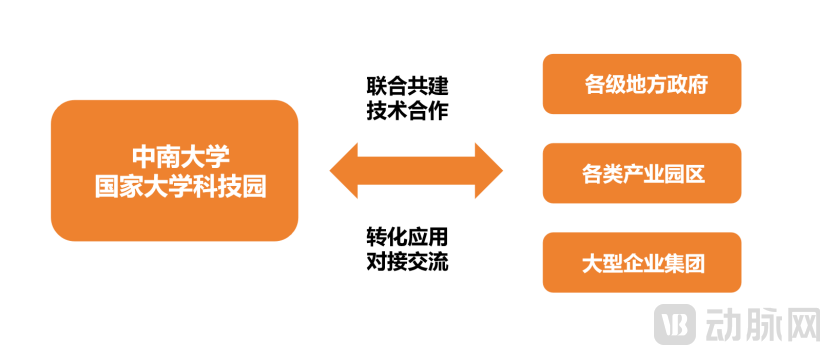 Central South University’s “Enclave Model” (Image source: VCBeat Orange Bureau)
In 2023, the National Technology Transfer (Xiangyin) Center of Central South University signed agreements for and implemented 16 key projects, covering fields such as new energy, modern equipment manufacturing, and electronic information. The total investment reached RMB 9.89 billion. By establishing operations in Xiangyin, these projects can leverage local“Five Verticals, Three Horizontals, Three Tracks, and One Port”...transportation network extends across China and even globally. Meanwhile, local new energy projects in Xiangyin, such as Lihe Houpu, Xinzheng New Energy, and Hengchuang Ruineng, will help fill the gap in high-tech capabilities, thereby fostering a cluster effect for the new energy industry in Xiangyin.
In addition to Xiangyin, the Yuelu “Enclave Industrial Park” has also achieved remarkable results, having already attracted 500 high-tech enterprises and surpassed an output value of RMB 30 billion by 2020. Other locations include Qingyuan and Huizhou in Guangdong Province, as well as Jinhua in Zhejiang Province,Central South University has leveraged its “enclave” model to establish a foothold in Hunan and extend the commercialization of its scientific and technological achievements across China.
III. In the Prime of Life, Surging Forward
As of April 2024, Central South University has completedOver 13,000 Patents University-wideInventory warehousing will undoubtedly accelerate the subsequent promotion of achievement transformation.
Compared with long-established prestigious universities, Central South University has been in existence for only two decades, and its seniority may indeed appear relatively young. Yet, by leveraging its exceptional scientific research capabilities and forward-thinking approach to translational innovation, it has successfully transferred numerous technological achievements from the laboratory to the marketplace, demonstrating its vigor and dynamism with confidence and authority.
Professor Deng Dehua’s team is not an isolated case; in the future, Central South University will continue to activate more “dormant patents,” and this river of transformation, converging wisdom and innovative power, will flow with even greater momentum.