

Nanfang Hospital Unveils Novel Hemostatic and Antibacterial Medical Material in Newly Published Patent
Recently,Nanfang Hospital, Southern Medical UniversityA new patent has been published. The patent discloses a hemostatic and antibacterial medical material composed of synergistic gel microspheres and a hydrogel matrix.
The team embeds synergistic gel microspheres within a hydrogel matrix, forming a hierarchical gel structure with high porosity and a large surface area. This enables more effective bacterial isolation, adhesion, and killing, thereby achievingHighly Effective Antibacterial Action, thereby endowing the gel system with enhanced adhesiveness and adsorption capacity, enabling it to"Enhance hemostatic efficacy"。
This antimicrobial hemostatic material can effectively reduce the risk of infections caused by medical devices, improve treatment outcomes, and enhance patients' quality of life.
I. Four Major Categories of Hemostatic Materials
Hemostatic materials are substances that facilitate wound healing and achieve rapid hemostasis. Originally designed solely for hemostasis, these materials have evolved in response to growing clinical demands to now incorporate additional functionalities, including antibacterial properties, biodegradability, angiogenesis promotion, and tissue regeneration capabilities.
Hemostatic materials can be broadly classified into four categories:Physical hemostasis, biological hemostasis, hybrid type, fibrin hemostasis.
Physical HemostasisThis forms a barrier at the wound site to halt blood flow and creates a surface that accelerates coagulation, thereby achieving hemostasis in a shorter time;Biological HemostasisIt provides condensed thrombin capable of converting fibrinogen into fibrin clots, thereby enhancing wound hemostasis, while also exhibiting certain biodegradability to reduce medical waste pollution.
Mixed Typecombines physical hemostasis with thrombin, resulting in reduced foreign body sensation for patients and superior efficacy; finallyFibrin GlueIt delivers fibrinogen and thrombin at the bleeding site at concentrations higher than those in the bloodstream, thereby accelerating clot formation. This approach eliminates the need for a second surgery, thus avoiding additional trauma to the patient.
In the hemostatic materials industry chain, the upstream sector consists of suppliers of synthetic or natural materials; the midstream sector comprises manufacturers engaged in production and processing; and the downstream sector serves end users such as hospitals, specialized clinics, and patients.
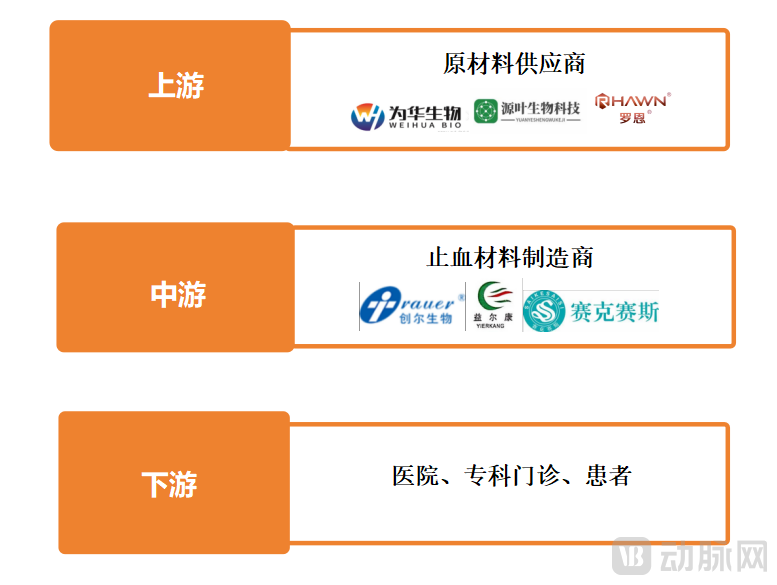
Upstream and Downstream of Hemostatic Materials
II. Intense Competition Among Domestic Products, with a High Degree of Homogenization
Compared with overseas markets, China’s hemostatic materials industry started later; however, with the rapid development of domestic materials, the gap has narrowed, and the sector is now showing a trend of stable growth.
There are five common types of hemostatic materials in the domestic market, namely:Absorbable Hemostatic Sponge, Absorbable Hemostatic Powder, Fibrin Glue, Absorbable Fluid, Absorbable Biomembrane.
Absorbable Hemostatic SpongeThe major manufacturers include Wusida, Trauer Biologics, Baidi Biologics, and Yierkang. These products all offer rapid hemostasis and sterilization, with limited innovation in manufacturing processes. For instance, both Trauer Biologics and Baidi Biologics utilize collagen sponges, while Wusida employs gelatin sponges; however, their efficacy and mechanisms of action are similar.
CanAbsorbable Hemostatic PowderThe major manufacturers include Union Medical, Deweilan, and Saikesaisi. Among them, Saikesaisi has obtained approval for two products (as of 2022), making it the Chinese domestic company with the highest number of approved products in this category of medical devices. However, from the perspectives of product manufacturing processes and technology, homogenization remains an issue.
Compared with the two products mentioned above, fewer companies are involved in fibrin sealants, absorbable fluids, and absorbable biological membranes, resulting in a smaller number of approved products. Companies that have obtained product approvals include Hualan Biological Engineering, Nash Biotech, and Zhonghui Shengxi.
Compared with traditional hemostatic products, these three categories feature higher technical barriers and more intense competition.Consequently, some companies have chosen to enter the market by focusing on specific application scenarios. For instance, Shaanxi Bio-A’s absorbable biological membrane (National Medical Device Registration No. 20223170027), approved in 2022, is specifically indicated for bone regeneration in extraction sockets and for bone regeneration in dental implant procedures. In conjunction with this product, the company’s “bone grafting material” also received approval in 2022.The most popular application scenarios currently are in the four major fields of orthopedics, cardiovascular and cerebrovascular diseases, dentistry and ophthalmology, and trauma repair.