

2024 VBEF Forum on Healthy Organizational Operations and Talent Recruitment in the Healthcare Industry Concludes Successfully
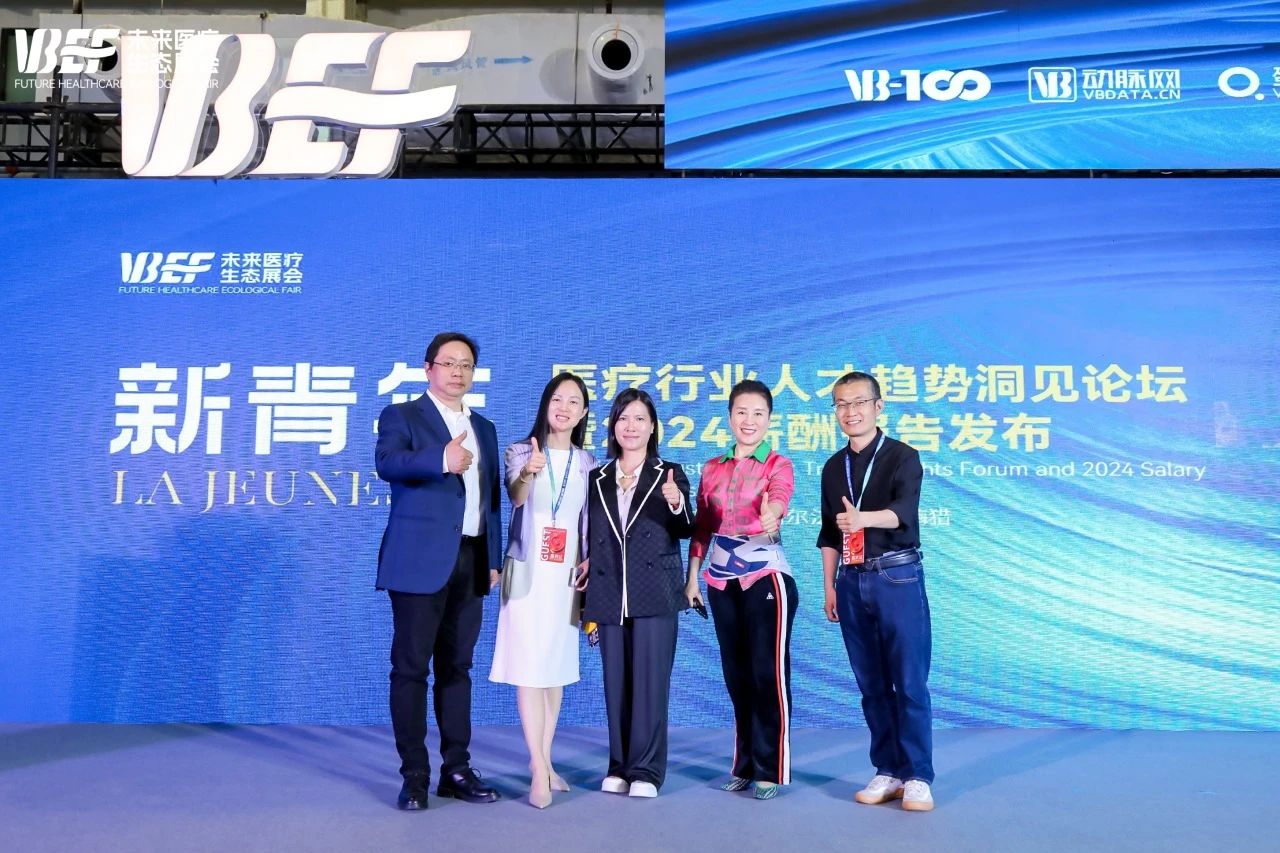
On May 10, 2024, co-hosted by Alpha Consulting and VCBeat VB-100, with Cyblue as a collaborating partner2024 VBEF Future Healthcare Ecosystem Conference · Healthcare Industry Talent Trends Forum; meanwhile"2024 White Paper on the Big Health Industry: Frontier Tracks & Best Practices"It was also officially released at the conference.
This is a discussion about the future and the present, the direction of industry development, and how to operate organizations and recruit talent in a healthy manner.
《Policy Interpretation for the Healthcare Industry After the Two Sessions》
Mr. Niu Zhengqian,Executive Vice President of the China Pharmaceutical Enterprise Management Association

occurred under the influence of top-level policies and guiding principles.
“The term most emphasized in 2024 is ‘new quality productive forces,’ and the pharmaceutical and healthcare industry is undoubtedly one of the most critical components of these new quality productive forces.”
“Paying close attention to central government policies, studying them, clearly understanding the current situation, and grasping emerging trends are responsibilities that each of us should uphold.”
“We must improve three major systems in our healthcare reform: a competitive system, a competitive medical service delivery system, and a competitive pharmaceutical supply assurance system.”
“Although the industry is currently under significant pressure, we must remain confident that the long-term fundamentals of the pharmaceutical and healthcare sector remain sound. Confidence is more valuable than gold; as long as humanity exists, so too will the demand for health.”
“Although the ecosystem of our industry is changing under the combined effects of various policies, the underlying logic of corporate competition remains unchanged. Behavioral choices at this fundamental level depend critically on comprehensive supporting reforms in mechanisms and institutions. So, what constitutes an appropriate underlying logic? It is one that meets fundamental human needs and aligns with human nature.”
During Chairman Niu’s presentation, audience members and guests in the auditorium repeatedly raised their smartphones to take photos and record the event.
"How AI Empowers Digital Recruitment to Save 80% of Time"
Ms. Jiang Miao,President of Alpha Consulting & Chairman of HiLie

“Over the next three years, AI empowerment will boost workforce productivity by at least threefold; this is now achievable because large language models represent a generational leap forward compared to the AI era of AlphaGo.”
“Even with the advanced capabilities of AIGC, the most critical competencies that top-tier companies prioritize in recruitment remain twofold: sales proficiency and build capability.”
“In the recruitment industry, what cannot be replaced by AI is influence and human warmth. This includes sensitivity to people, particularly the ability to manage soft variables and cognition based on personal experiences; in the future, high-end candidates will increasingly require communication with a human touch.”
“AI will replace 80% of jobs in the future, but this also allows us to dedicate 80% of our time to perfecting the remaining 20% that cannot be replaced. In this way, we will cultivate irreplaceable capabilities and have a greater opportunity to truly achieve flow and happiness in our work.”
《Enhancing Legal Acumen for Founders and Executives: Case Studies and Compliance Recommendations》
Ms. Li Cenyan,Director of Zhijin Law Firm, Director of the Legal Affairs Department of the Non-Public Medical Association

“Our sole ultimate objective is high-quality development. The second layer comprises two focal points of new quality productive forces. For market promotion in the pharmaceutical industry, where do these two focal points lie? One is the integration of scientific research and digitalization; the other is the recombination of factors of production. What should this entail for pharmaceutical companies’ market promotion? It should focus on key innovation, management innovation, and marketing model innovation. How can marketing models be innovated? By adopting models that enable the recombination of production relations and factors of production. However, a fundamental prerequisite throughout this process is adherence to core principles, as only by upholding these principles can true innovation occur. Upholding core principles means abiding by laws and regulations and operating in compliance, thereby laying the groundwork for innovation.”
“Among the five lines of defense for compliance, the first and second lines can isolate the risks associated with the general manager, actual controller, and business owner; then comes safeguarding employees; and most critically, ensuring physicians’ income stability. This constitutes our framework for building the five lines of defense.”
“Compliance is not a business issue; it is a life strategy issue.”
“Smart Tax Platforms and Tax-Related Risks for Pharmaceutical and Medical Device Companies in the Context of Golden Tax Phase IV”
Dr. Lu Yufeng,Chairman of the Board, Loge Technology Group
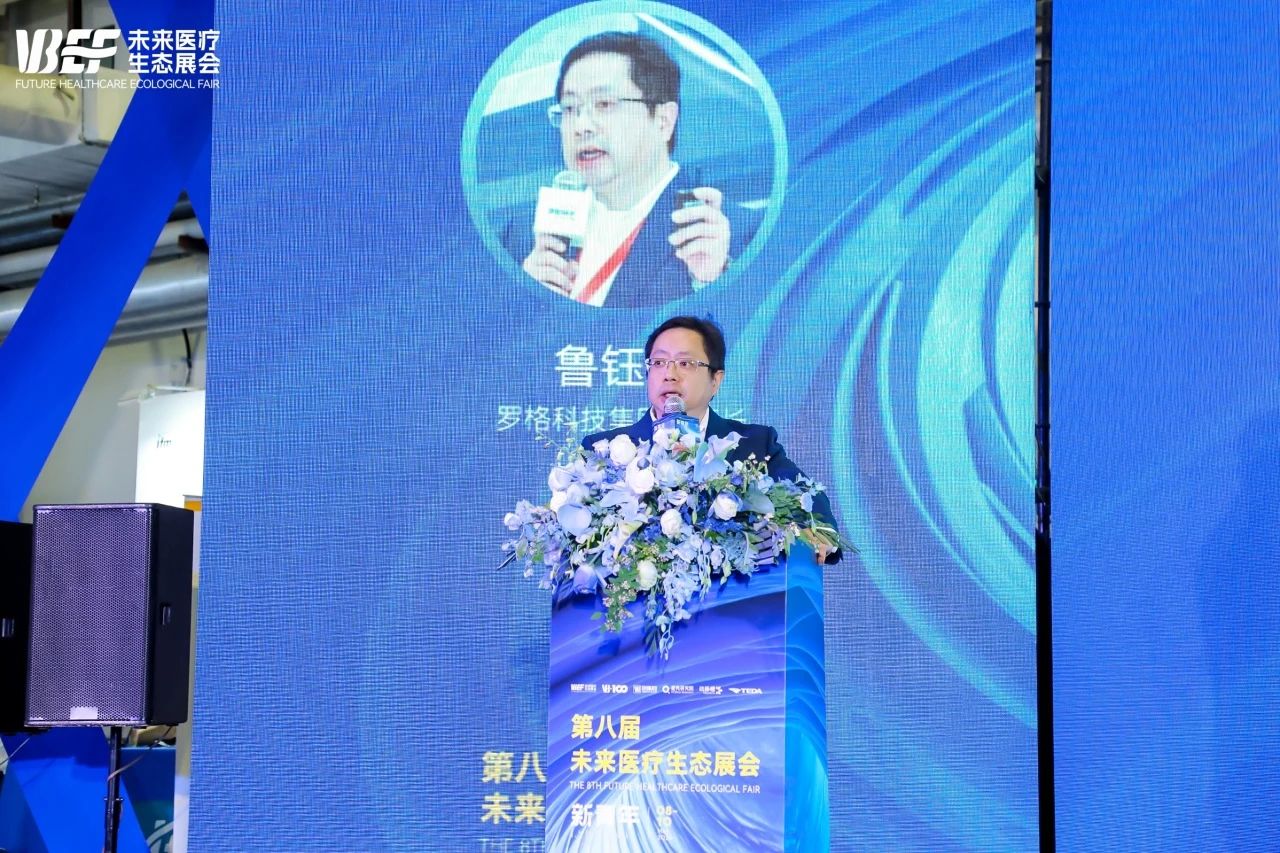
“What is the true Golden Tax Phase IV? It isDigitalization Reform of Value-Added Tax (VAT) Invoices, in fact, there are two key terms: the first is digitalization, and the second is intelligence-driven tax administration based on invoices. Against this backdrop, Golden Tax Phase IV is actually referred to as “Smart Taxation” within the tax sector.”
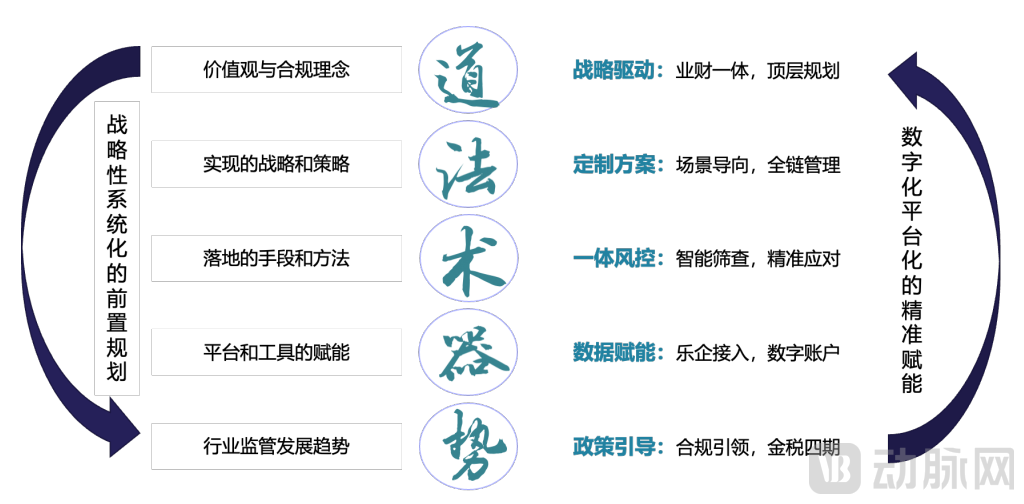
“Smart taxation signifies a disruptive transformation in the underlying logic and architecture of regulatory frameworks. First, it is essential to achieve deep integration of data volume, algorithms, and computing power. Second, technological informatization must be integrated with organizational structures within tax authorities. Third, there must be deep integration among taxation, finance, and business operations (tax-finance-business integration). Finally, internal control, tax administration, and governance within tax authorities must be deeply integrated.”
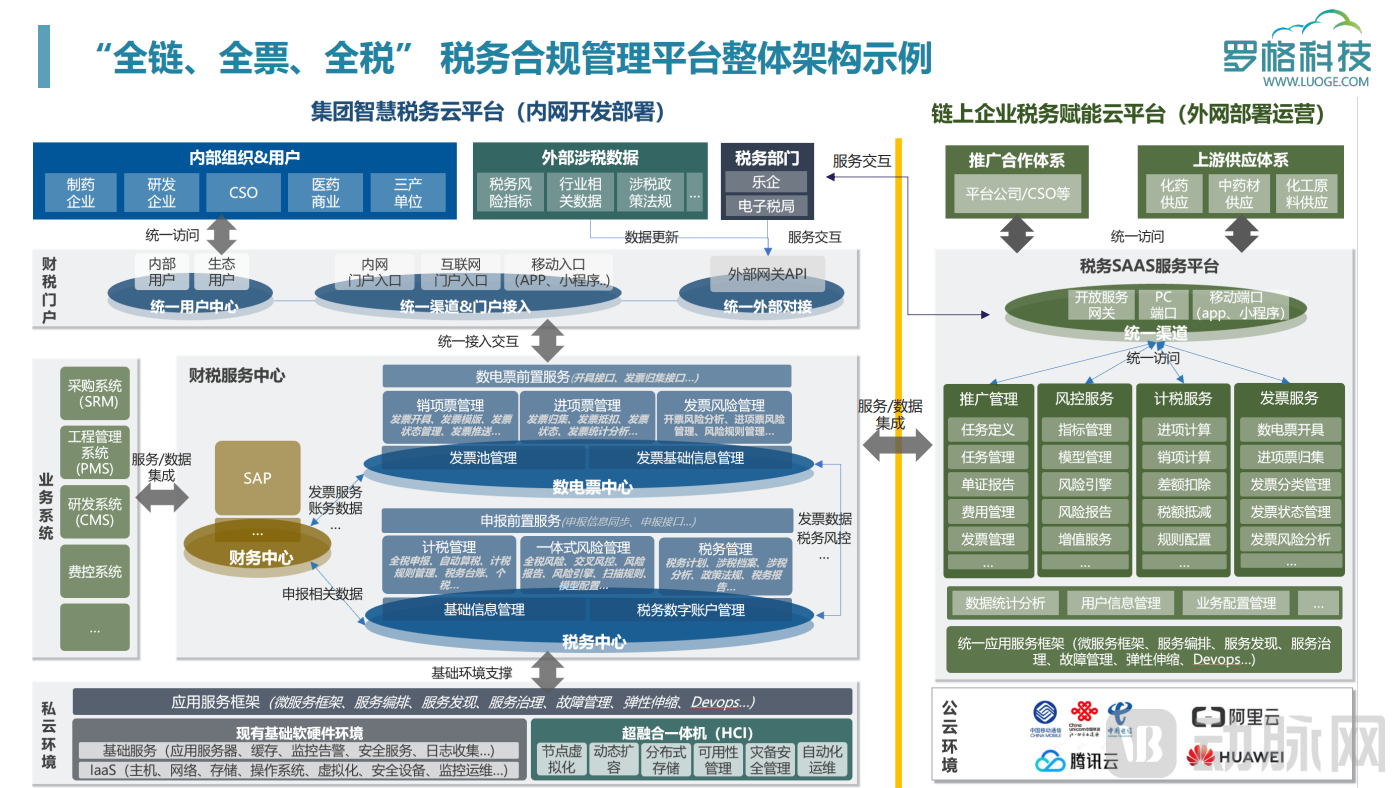
“How Can Pharmaceutical Enterprises Build a ‘New-Generation’ Integrated Business-Tax Management System? The term ‘new-generation’ primarily refers to a generational leap in the overall product architecture. It involves constructing a new-generation digital platform for corporate tax management, centered on a ‘Tax Digital Account’ and an ‘Intelligent Tax Brain.’ Unlike traditional financial or tax management system implementations—which merely stack numerous management tools, business functions, and software systems according to standardized business processes—this approach mirrors the architectural distinction between conventional fuel-powered vehicles and new-energy vehicles. It comprehensively avoids the risk of systems becoming obsolete upon deployment or requiring immediate upgrades after acceptance.”
“How can enterprises build an integrated risk prevention and control system? The core challenge lies in cross-regional collaboration capabilities, the integration of pre-, during-, and post-event monitoring, synchronized supervision of invoicing parties and invoice recipients, and penetrative analysis of legal entities and natural persons; each of these aspects can be further broken down into more detailed dimensions.”
“Empowering Decision-Making with Data, Driving Development with Talent: Trends and Solutions in Talent Compensation and Benefits”
Ms. Yuki Chen,Head of Biopharma and Life Sciences, Willis Towers Watson

“Amid rising GDP and falling CPI, our expected planned salary adjustments across multiple regions in 2024 will be equal to or lower than those in 2023. For the Asia-Pacific region as a whole, our expectation remains at 5.9%, while salary adjustment expectations are declining in the Middle East and Western Europe. Some clients expanding into Europe initially focused primarily on laboratory R&D; this year, we are hearing that they are gradually closing certain collaborative offices and laboratories in the European region.”
“Using China’s salary level as the baseline (1.0), a cross-country comparison within the Asia-Pacific region shows that Australia, Singapore, Hong Kong (China), and Japan have higher compensation levels, averaging 1.88 times that of China. This means salaries for equivalent positions in these regions are 88% higher than in China. In Hong Kong, where many roles are trade-oriented and sales teams predominate, wages stand at 1.73 times those in mainland China. Countries with lower salary levels include Thailand, Vietnam, and Malaysia. Recently, expanding into Vietnam has gained significant attention; however, Vietnam presents considerable challenges. Beyond being a low-cost labor destination, companies face difficulties in local recruitment. Despite lower wages, the workforce generally has lower educational attainment and limited production capabilities. India, on the other hand, is a market worth closer attention. As a market dominated by generic drugs with minimal patent protection, we are seeing a steady increase in its R&D expenditure, which now accounts for 40% of the global total.”
“In the Chinese market, what are the key areas of focus for our pharmaceutical and life sciences clients regarding market priorities and human resources? We have identified several points, the first being”Digital Innovation, second is what everyone is talking aboutQuality Improvement, Efficiency Enhancement, and Cost-Effectiveness, third is"Rooted in China, with a Global Vision". For human resources, we observe heightened requirements for organizational effectiveness and the composite capabilities of talent, while also demanding a very high degree of precision in resource allocation.”