

Shenzhen Aims for RMB 200 Billion Medical Device Industry, Targeting Over 20 New High-End MedTech IPOs
Shenzhen May Cultivate Over 20 More IPOs in the Medical Device Sector.
In June 2022, multiple Shenzhen municipal departments jointly issued the “Action Plan for Cultivating and Developing the High-End Medical Device Industry Cluster in Shenzhen (2022–2025).” The Action Plan states that by 2025, the added value of Shenzhen’s high-end medical device industry will reach RMB 65 billion, with operating revenue reaching RMB 200 billion.
According to incomplete statistics, by the end of 2022, Shenzhen had more than 1,800 medical device manufacturing enterprises, including three companies ranked among the Global Top 100 Medical Device Companies, 20 listed medical device companies, and 53 national-level “Little Giant” medical device enterprises.
Officially released data show that these high-end medical device companies achieved a revenue of RMB 80.5 billion in 2021, which is more than twofold short of the RMB 200 billion target.This means that if Shenzhen is to achieve its target, its high-end medical device enterprises must double their revenues within four years, or cultivate more than 20 additional high-end medical device companies for initial public offerings (IPOs), along with more enterprises achieving scaled-up revenues.。
Why Does Shenzhen Dare to Formulate Such an Ambitious Action Plan? It May Stem from Shenzhen’s Strategic Planning for Developing the High-End Medical Device Industry, as Well as Its Foundation as China’s Leading City in the Medical Device Sector.
In terms of policy, Shenzhen issued the “Opinions on Expanding and Strengthening Strategic Emerging Industry Clusters and Fostering Future Industries” in June 2022, listing high-end medical devices as one of the top 20 strategic emerging industries for future development.
In terms of foundational strength, Shenzhen’s medical device output value accounts for approximately 10% of the national total, with exports comprising 13%, ranking first among all major and medium-sized cities in China for many years. Meanwhile, Shenzhen leads all Chinese cities in the number of listed medical device companies, the number of medical device enterprises with annual revenues exceeding RMB 100 million, and the aggregate market capitalization of its listed medical device firms.
Leaving Behind a Glorious Past: How Will Shenzhen Achieve These Targets in the Future? What Opportunities Await Large, Medium, and Small High-End Medical Device Enterprises in Shenzhen?
To achieve the target of RMB 200 billion in output value, Shenzhen is systematically addressing the shortcomings in its high-end medical device industry.
In the past, Shenzhen had an insufficient number of specialized industrial parks that met the development needs of the medical device industry. Therefore, the Action Plan explicitly set forth the task: to establish several specialized parks with distinct characteristics and significant scale and economic benefits.Industrial Cluster, with more than three enterprises achieving annual sales revenue exceeding RMB 10 billion, and attracting more than five world-renowned medical device companies to establish production bases, regional headquarters, or R&D headquarters in Shenzhen, thereby forming oneA Professional Manufacturing Park with an Output Value of Hundreds of Billions。
The “Action Plan” further stipulates that the Municipal Development and Reform Commission, the Municipal Planning and Natural Resources Bureau, the Nanshan District Government, the Pingshan District Government, and other relevant departments shall, in accordance with their respective governmental functions, ensure land supply for major projects and establish a batch of industry-specific industrial parks in Nanshan, Pingshan, Longhua, Guangming, and Yantian.
Currently, district governments in Shenzhen have accelerated the development of specialized industrial parks for high-end medical devices. Taking Shenzhen International Medical Device City as an example, in February 2024, Longhua District of Shenzhen released the "Overall Development Plan for Shenzhen International Medical Device City (2024–2035)," proposingBuild Shenzhen International Medical Device City into a top-tier, world-class hub for the high-end medical device industry, with an output value exceeding RMB 100 billion.。
It is reported that the Shenzhen International Medical Device City is located in the core area of Shenzhen, with a total planned area of nearly 20 square kilometers. It will leverage innovative platforms such as the “National Center for Innovation in High-Performance Medical Devices” to empower all segments of the high-end medical device industry chain. Meanwhile, it will develop the Northern Life Science and Technology Innovation Zone, focusing on building scientific and technological innovation platforms for the translation of medical achievements, drug and medical device approval and testing, and digital life science research.
According to the plan, Shenzhen International Medical Device City will focus on eight major sectors: implantable and interventional devices, high-end medical imaging, in vitro diagnostics (IVD), patient monitoring and life support, medical consumables, radiation therapy, rehabilitation and elderly care devices, and smart healthcare. It aims to build a world-class industrial park for high-end medical devices through a three-phase development strategy.
Step 1: Preliminary completion of the industrial park, with the industrial cluster beginning to take shape. By 2025, Phase I of the Shenzhen International Medical Device City professional park is planned to be completed and put into operation, achieving a total output value of RMB 30 billion for the medical device industry within the park, and introducing and cultivating 150 key enterprises.
Step 2: Become the core leading area for Shenzhen’s high-end medical device industry and an important carrier for the “Healthy China” initiative. By 2030, the park aims to achieve a total output value of over RMB 60 billion in the high-end medical device sector, introduce and cultivate 250 key enterprises, and add 300 new Class II and Class III medical device registration certificates annually.
Step 3: Establish a National Medical Device Hub. By 2035, the total output value of the high-end medical device industry within the park will reach RMB 150 billion, with more than 500 key enterprises introduced and cultivated, and 500 new Class II and Class III medical device registration certificates issued annually.
To achieve the objectives at each stage, Shenzhen International Medical Device City continuously enhances its public support services: it established Guochuang Huikang to provide intelligent, precise, and cost-effective CDMO services for medical devices to domestic and international clients; it launched the first medical device industry fund, the Guochuang Zhiyuan Fund, with an initial size of RMB 300 million, leveraging additional social capital into the medical device sector and its upstream and downstream industries; and it advanced the construction of supporting facilities such as talent housing and schools to attract high-quality professionals to settle in the area.
To date, leading Chinese medical device companies—including Mindray Medical, United Imaging Healthcare, China Resources Sanjiu, Pumen Technology, Bona Precision, Lianxin Mobile, Anbao Medical, Silicon-Based Bionics, and Beixin Life—have established their presence in the Shenzhen International Medical Device City, firing the first shot in its bid to build a “world-class, trillion-yuan high-end medical device industry cluster.”
In addition to Longhua District’s efforts to build an International Medical Device City, Guangming District is also accelerating the development of specialized industrial parks. For instance, in the Yutang Advanced Manufacturing Park in Guangming District, Shenzhen, high-end medical device industries have been strategically concentrated, with eight specialized medical device industrial communities established, including Yunzhi Science Park, Tian’an Cloud Valley, and China Merchants Smart City.
It is worth noting that Shenzhen has made forward-looking plans for the industrial layout of high-end medical devices in its "Action Plan." It positions Longhua District as a manufacturing hub, Guangming District as an innovation pioneer area, Nanshan District as a headquarters-led zone, Pingshan District as a comprehensive development area, and Yantian District as an application demonstration zone.
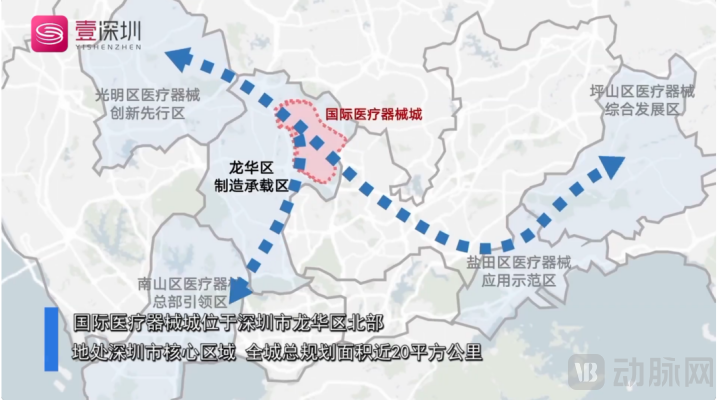
(Image source: iShenzhen)
As the plan gradually becomes a reality, Shenzhen’s high-end medical device industry is expected to unleash significant advantages from its industrial cluster.
A high-end medical device industrial cluster worth hundreds of billions of yuan requires not only a number of specialized, distinctive high-end medical device industrial parks but also the presence of leading medical device enterprises.。
The Action Plan states that efforts should be intensified to attract Fortune Global 500 companies, the world’s top 100 industry players, China’s top 50 industry enterprises, the top five enterprises in niche sectors, and key upstream and downstream supporting enterprises. It encourages leading domestic and foreign enterprises to establish regional headquarters or R&D centers in the city, thereby enhancing core headquarters functions such as R&D, marketing and settlement, and international trade.
To date, a number of leading enterprises that originated in Shenzhen have increased their investments in the city and established their global headquarters there.
For example, Mindray Medical has invested RMB 2.2 billion in constructing the Longhua Science and Technology Industrial Park, designating it as the global headquarters of its supply chain. Upon completion, this global supply chain hub will account for more than 60% of Mindray’s supply chain production capacity, helping the company achieve its goal of RMB 100 billion in annual output value by 2030.
For another example, Comen Medical previously planned to invest RMB 1.5 billion in the development of medical devices and industrial park construction, and announced the design proposal for its global headquarters in January 2024. It is reported that the Comen Medical Global Headquarters Tower is located in Guangming District, Shenzhen, with a total gross floor area of approximately 227,000 square meters. The complex comprises one 150-meter super high-rise R&D and office center and two 88.7-meter high-rise production facilities.
Besides the leading enterprises emerging from Shenzhen, the city has also promotedWorld-Renowned Medical Device Companyto establish production bases, regional headquarters, or R&D headquarters.
On April 25, 2024, the Shenzhen Municipal People’s Government and GE Healthcare Investment (China) Co., Ltd. signed a strategic cooperation framework agreement. Under the agreement, both parties will leverage their respective strengths to engage in comprehensive and in-depth collaboration focused on the high-end medical device industry. They will work together to advance industrial chain development, industry-academia-research partnerships, and talent recruitment and cultivation, jointly promoting Shenzhen’s establishment of a world-class medical device industrial and supply chain system.
Previously, in June 2023, GE Healthcare partnered with Sinopharm, a Fortune Global 500 company, to jointly establish an advanced manufacturing base for high-end medical imaging equipment in Guangming District, Shenzhen. The project reportedly broke ground in December 2023.
Siemens Healthineers is also refusing to lag behind. In May 2023, Siemens Healthineers signed a strategic cooperation framework agreement with the Nanshan District Government of Shenzhen, under which it will inject additional investments exceeding RMB 1 billion to establish a new R&D and manufacturing base for high-end medical equipment in Nanshan District. Currently, one out of every three Siemens magnetic resonance imaging (MRI) systems sold in the global market is produced at its Shenzhen facility.
In addition to Fortune Global 500 companies, leading enterprises in niche segments of China’s medical device industry are also key targets of Shenzhen’s investment attraction efforts. In November 2023, Sibionics, a leading company in the continuous glucose monitoring (CGM) sector, finally signed an agreement to establish its corporate headquarters at the Gaoshi Jiulongshan Science and Technology Park. Previously, Sibionics independently developed China’s first approved real-time CGM product requiring no fingerstick blood calibration, joining forces with other domestic CGM companies to drive the localization of CGM technology in China. Since its market launch, Sibionics’ products have served over one million users for blood glucose monitoring. Recently, Sibionics was successfully listed on the “China Medical Devices 2024 Rising Star Innovation List” and the “2024 Future Healthcare 100 – China Innovative Medical Devices and Intelligent Manufacturing List.”
Why Are These Renowned Medical Device Companies Choosing to Set Up Operations in Shenzhen?Shenzhen faces competition in terms of policy, location, transportation, and talent, as other cities also possess differentiated advantages. Yet these companies’ choice of Shenzhen may stem not merely from general factors such as policy and transportation, but from their recognition of Shenzhen’s pragmatic spirit and efficiency in problem-solving.
For example, the People’s Government of Pingshan District in Shenzhen explicitly stated in a policy document that each industrial cluster shall be overseen by a district-level leader, led by the corresponding industrial department, and supported by a district-level special task force to promptly formulate and update industrial policies. Meanwhile, a system for supervision, follow-up, and performance evaluation shall be established to decompose responsibilities for the goals, tasks, and measures related to the development of the “6+3” industrial clusters, incorporating them into the district’s key work supervision and performance evaluation framework.
To cite another example, recognizing that many local enterprises had limited understanding of clinical trial services offered by hospitals in Shenzhen, the city hosted a GCP (Good Clinical Practice) Clinical Trial Service Matchmaking Fair in April 2024. The event brought together government officials from the Municipal Development and Reform Commission and the Municipal Health Commission, as well as representatives from hospitals, research institutions, industry associations, industrial parks, and entrepreneurial ventures. This initiative aimed to help businesses gain a deeper understanding of local hospital-based clinical trial services, strengthen communication between clinical departments and medical device companies, and facilitate the translation and implementation of scientific research achievements from medical institutions into practical applications.
Perhaps it is precisely these thoughtful, proactive details—anticipating corporate needs and helping businesses resolve issues—that have attracted major enterprises to actively establish their presence.
In addition to attracting world-leading enterprises, Shenzhen also focuses on nurturing and incubating innovative startups while supporting “hidden champions” in niche sectors.
In the Action Plan, Shenzhen has decided to launch the selection and cultivation of high-growth enterprises.Annually roll over the selection of approximately 30 enterprises for key support, driving enterprises to rapidly expand and strengthen.
Meanwhile, Shenzhen also encourages medical device enterprises to acquire, merge with, and restructure upstream and downstream companies, aiming to build globally influential medical device industry groups. Today, a number of companies have already accelerated their growth through mergers and acquisitions.
For example,In April 2024, Shenzhen Hanxiang Brain Science announced the completion of its acquisition of the Italian company EB Neuro S.p.A. Through this acquisition, Hanxiang Brain Science has expanded its portfolio of application solutions in brain-computer interfaces, as well as the diagnosis, monitoring, and physical therapy of psychiatric disorders and neurological injuries. Previously, Hanxiang Brain Science had also successfully acquired Yingzhi Technology.
In addition to supporting the aforementioned medical device companies with an established foundation, Shenzhen also plans to incubate a batch of innovative medical device enterprises with strong competitiveness and high growth potential.
First, Shenzhen plans to vigorously support the development of the National Innovation Center for High-Performance Medical Devices (hereinafter referred to as the “National Innovation Center”), leveraging its network advantages as a national-level platform to identify, nurture, attract, and cluster a group of innovative enterprises.
It is understood that the National Innovation Center isThe Only National Manufacturing Innovation Center in the Field of Medical Devices, led by the Shenzhen Institute of Advanced Technology, Chinese Academy of Sciences, Mindray Medical, United Imaging Healthcare, Lifetech Scientific, Harbin Institute of Technology, and other institutions, was established in Shenzhen in April 2020.
With the support of the National Innovation Center, China’s first domestically produced Extracorporeal Membrane Oxygenation (ECMO) system and the world’s first 5.0T whole-body medical magnetic resonance imaging (MRI) system have been developed. Additionally, independently or jointly developed key generic technological achievements—including medical ceramic materials, high-performance medical nickel-titanium alloys, tissue regeneration microspheres, biodegradable polymer products, and core chips for medical ultrasound imaging equipment—were showcased at the 2024 China Medical Device Supply Chain Ecosystem Exhibition.
Looking to the future, the National Innovation Center has partnered with leading enterprises such as Sinopharm, Huawei, China Resources Medical Devices, Medcaptain, Angel, Raytelligence, Vito, and De Rucci to jointly tackle key generic technologies in the medical device industry and drive the development of the high-end medical device sector.
Secondly, Shenzhen will build a number of innovation platforms to promote the development of innovative medical technologies. It plans to establish 30 new provincial-level or higher key laboratories and engineering (technology) research centers by 2025. In terms of innovation priorities, Shenzhen intends to focus on the complete system development of major equipment such as high-end medical imaging systems, surgical robots, ECMO, compact proton therapy devices, and third-generation gene sequencers. Meanwhile, Shenzhen is also considering adopting mechanisms such as the “horse racing” system and the “open competition” mechanism to provide stable medium- to long-term financial support to key R&D institutions.
Additionally, Shenzhen will provide support for medical devices that enter the National Special Review Procedure for Innovative Medical Devices, and increase support for projects that have newly obtained Class II and Class III medical device registration certificates and are undergoing industrialization within the city.
Finally, Shenzhen will establish a batch of public service platforms dedicated to basic research, engineering technology, industrial pilot-scale trials, clinical research and trials, post-market evaluation and application demonstrations, as well as supply chain and trade, thereby improving the service system for the entire industry chain. Meanwhile, Shenzhen will leverage the platform role of the Greater Bay Area Branch of the Center for Medical Device Technical Review and Inspection under the National Medical Products Administration to support the development of innovative medical device enterprises in areas such as inspection, testing, review, and approval.
Overall, Shenzhen has made ample preparations in terms of its full-industry-chain service system, innovation spaces, technical support, and talent supply, and is now just waiting for the “phoenix” to arrive.