

Fujifilm Diosynth Biotechnologies Files for IPO: A Global CDMO Powerhouse Backed by $4.5 Billion Investment

Fujifilm Holdings
Cross-border Imaging Technology and Product Developer
FUJIFILM Diosynth Biotechnologies
Provider of Process Development and Manufacturing Services for Biologics
In 1934, Fujifilm Holdings Corporation (hereinafter referred to as “Fujifilm”) was established in Japan. After 90 years of development, this company, which started with photographic film business, has now grown into a global healthcare technology enterprise with an annual revenue of JPY 2960.9 billion (approximately USD 18.92 billion), operating in fields such as imaging, high-performance materials, and healthcare.
Among them, Fujifilm’s annual revenue in the healthcare sector reached JPY 975.1 billion (approximately USD 6.23 billion) in 2023, representing a year-on-year increase of 5.0%. According to its official website, this growth was primarily driven by increased revenues from its medical systems and biological CDMO businesses.
andA key factor driving revenue growth in Fujifilm’s biological CDMO business is its subsidiary CDMO, FUJIFILM Diosynth Biotechnologies.(hereinafter referred to as “Diosynth”).
Diosynth is a key outcome of Fujifilm’s strategic transformation from the photographic film sector to the biopharmaceutical CDMO sector.Diosynth, established in 2011, is dedicated to the development and manufacturing of biologics, vaccines, cell and gene therapies (CGT), and oncolytic viruses, with cGMP-compliant production facilities in the United States, the United Kingdom, and Denmark.. Currently, Diosynth has evolved into a global CDMO enterprise, providing comprehensive CDMO services to biopharmaceutical companies worldwide.
Diosynth is a company that was “born with a silver spoon in its mouth.”
In 2011,Diosynth was formed by Fujifilm’s acquisition of 100% equity stakes in two Merck & Co. subsidiaries, Diosynth RTP and MSD Biologics.. Notably, these two subsidiaries constitute a biomanufacturing network established by MSD to provide CDMO services across various fields, including recombinant proteins, monoclonal antibodies, and vaccines, featuring specialized and comprehensive hardware and software infrastructure. Upon completion of the acquisition, all their assets and facilities became the foundation for Diosynth’s operations. Furthermore, Diosynth benefits from Fujifilm’s more than 30 years of experience in the research, development, and manufacturing of recombinant proteins, vaccines, and monoclonal antibodies.
Meanwhile,Fujifilm has also assembled an experienced leadership team for DiosynthAmong them is Toshihisa Iida, Chairman of Diosynth. Mr. Iida has been with Fujifilm for over 30 years and previously served as President and Chief Executive Officer of both FUJIFILM Europe GmbH and FUJIFILM Europe BV, bringing extensive industry experience to his role.
Diosynth has also attracted Lars Petersen to serve as President and Chief Executive Officer.Lars Petersen: Lars is a leader with over 30 years of industry experience in the life sciences sector. Prior to joining FUJIFILM Diosynth Biotechnologies, he served as Chief Operating Officer of Biogen’s biologics manufacturing site in Denmark.. In addition, he has held leadership positions at Roche, Novo Nordisk, and Novozymes, successfully executing multiple projects. Lars Petersen has also become a key figure in Fujifilm CDMO’s expansion, driving the critical capacity expansion of Diosynth.
Importantly,Following its official establishment, FUJIFILM Diosynth Biotechnologies, backed by Fujifilm, embarked on an aggressive acquisition spree to rapidly expand its production capacity.In 2014, Fujifilm acquired a 49% stake in the U.S.-based Kalon Biotherapeutics for billions of yen, with an agreement for Diosynth to increase its equity ownership to 100% upon the achievement of certain milestone targets. In 2019, Fujifilm acquired Biogen’s biologics manufacturing facility in Denmark—the Hillerød site, which represents Europe’s largest end-to-end CDMO service base—for $850 million. At this point, Diosynth had four manufacturing sites. In 2021, Fujifilm invested $850 million to leverage its strengths in recombinant proteins and viral vaccines, expand gene therapy production capacity, and launch a proprietary system for continuous manufacturing capabilities.
Following a series of acquisitions and expansions, Diosynth’s production capacity has grown rapidly. With a global network comprising seven major manufacturing sites in the United States, the United Kingdom, and Denmark, its CDMO capabilities are now positioned among the world’s leading providers.
Leveraging Fujifilm’s accumulated expertise in the healthcare sector and its series of acquisitions and expansions, Diosynth rapidly completed the construction of its production facilities. Meanwhile, it draws on its extensive experience in the development and manufacturing of recombinant proteins, vaccines, monoclonal antibodies, other large-molecule products, and viral vectors.The company provides one-stop services ranging from cell culture and CMC development to commercial-scale manufacturing, covering multiple specialized sectors including cell and gene therapy (CGT), vaccines, antibody drugs, and recombinant proteins.。
FUJIFILM Diosynth Biotechnologies’ one-stop CDMO services can be categorized into seven major types: cell culture, microbial fermentation, cell therapy, gene therapy, vaccines, drug substances and finished products, and CMC support.
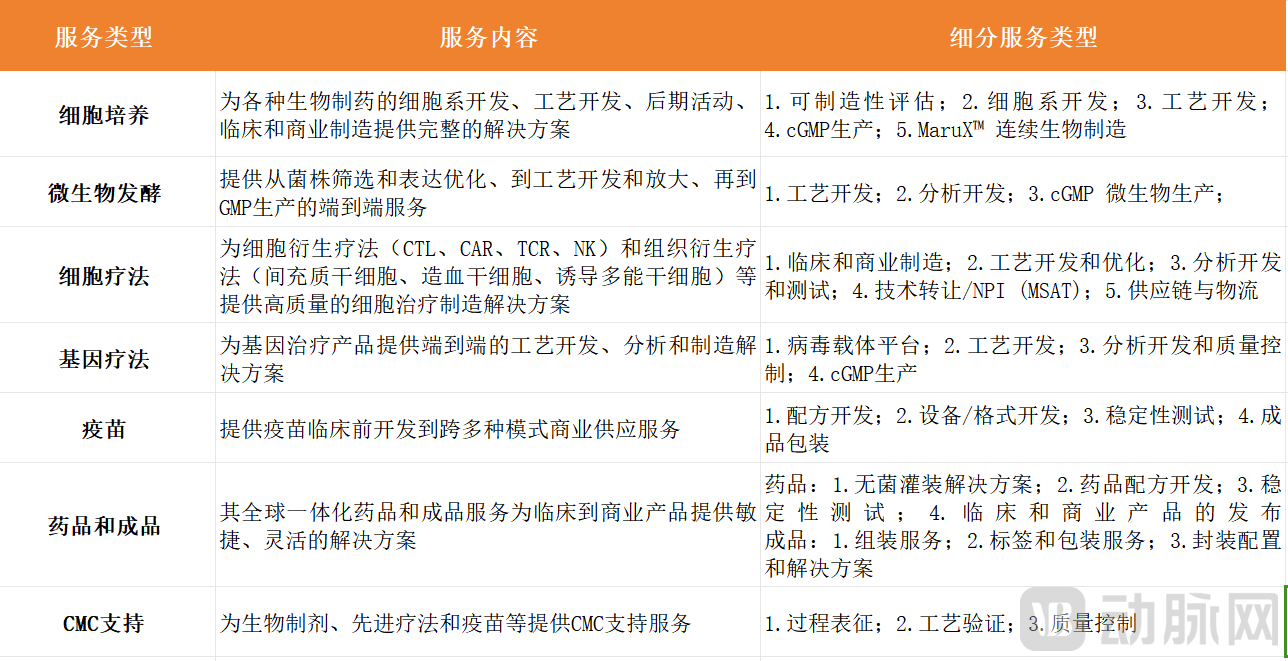
Diosynth’s One-Stop CDMO Services | Image source: Diosynth official website; graphic by VCBeat
It is worth noting that as a CDMO enterprise transformed from photographic film, FUJIFILM Diosynth Biotechnologies has rapidly established large-scale production capabilities and gained a certain degree of international brand trust. Meanwhile, the company has developed multiple core technology platforms, building a patent moat.
In terms of cell culture services, Diosynth has established a proprietary cell line development system—Apollo™X.Apollo™X is a highly efficient, scalable, and versatile mammalian expression system designed to enhance the quality and speed of delivery for monoclonal antibodies and various CHO-expressed molecules, including bispecific antibody formats and Fc fusion proteins. It supports chemically defined conditions throughout the entire cell line development process.Furthermore, Apollo™X achieves a monoclonality probability of over 99% in single-round cloning, with titers reaching up to 10 g/L and requiring only 10 weeks from transfection to the research cell bank, thereby helping customers reduce the costs and risks associated with cell culture.
In terms of microbial fermentation services, Diosynth has also established its proprietary Paveway™ PLUS microbial expression platform.Paveway™ is a validated technology platform that enables efficient microbial protein expression using novel recombinant Escherichia coli strains.. Paveway™ PLUS offers a modular workflow based on Paveway™, and this expression system delivers industry-leading titers along with a proven track record of successfully expressing over 130 proteins.
Furthermore, Paveway™ PLUS enables the development of lead strains for recombinant protein expression within four weeks through high-throughput, automated processes. Data indicate that recombinant strains created using Paveway™ technology exhibit extremely low levels of plasmid loss in the absence of antibiotic-based selection pressure. This means that Diosynth can develop antibiotic-free fermentation processes without compromising product potency.
Leveraging outstanding professional CDMO service capabilities,Diosynth has established partnerships with all of the top 20 global biopharmaceutical companies, driving continuous revenue growth and delivering significant financial gains for Fujifilm.. According to Fujifilm’s 2023 financial report, the company’s Healthcare segment generated revenue of JPY 975.1 billion, a year-on-year increase of 5.0%, driven by growth in its Medical Systems and Biological CDMO businesses.
Currently, Diosynth is implementing a “Life Partner Implementation Strategy” aimed at establishing large-scale manufacturing capabilities across the United States and Europe. This initiative is designed to support the end-to-end needs of biopharmaceutical customers, ensure supply chain resilience, and enable seamless integration of drug manufacturing operations regardless of customer location. Consequently, despite its CDMO production capacity already ranking among the world’s leading, Diosynth continues to expand its manufacturing footprint.
On April 11, 2024, FUJIFILM Diosynth Biotechnologies announced an additional investment of $1.2 billion to further expand its large-scale biologics manufacturing facility in Holly Springs, North Carolina. This investment will enable the expansion of the production site by 425,500 square feet (approximately 3.95 hectares) by 2028, adding eight 20,000-liter mammalian cell culture bioreactors to the existing eight 20,000-liter bioreactors.
This capital increase builds upon the $2 billion investment made in 2018, bringing Diosynth’s total investment in the facility to over $3.2 billion.. The plant’s new facilities can be flexibly expanded with additional bioreactors to accommodate new projects and meet partners’ emerging needs, positioning it as one of the largest cell-culture biopharmaceutical CDMO facilities in North America upon completion.
Diosynth expects the first batch of bioreactors to be commissioned in 2025, with additional production lines becoming operational by 2028. Upon full completion and commissioning, this expansion will further enable Diosynth to fully tap into the potential of the antibody drug market, including antibody-drug conjugates (ADCs) and bispecific antibodies.
Since 2022, a capital winter has swept through the entire innovative drug industry chain, and the CDMO sector, which is reliant on this chain, has not been spared. To survive in the fiercely competitive market, CDMO companies have resorted to closing plants and laying off staff to cut costs and streamline operations.
However, amidst the “cold” macroeconomic environment, FUJIFILM Diosynth Biotechnologies has bucked the trend by expanding its operations and achieving performance growth. Meanwhile,With Fujifilm's support, Diosynth will continue to implement its expansion strategy. Lars Petersen, President and Chief Executive Officer, once stated, “Ensuring sufficient capacity to support market demand is the cornerstone of our Life Partners strategy and a critical measure in helping our partners provide therapeutic medicines to patients.”
Furthermore, Fujifilm’s newly announced mid-term management plan, “VISION2030,” further supports the implementation of Diosynth’s expansion strategy. Fujifilm stated that the company will invest JPY 1.9 trillion in healthcare, chip manufacturing materials, and other growth-seeking sectors over the next three fiscal years. Among this,By 2028, the company’s investment in CDMO will reach JPY 700 billion (approximately USD 4.5 billion), aiming to expand the manufacturing capacity of its CDMO business fivefold from current levels; CDMO revenue is projected to reach JPY 200 billion (USD 1.28 billion) by 2025, and increase to JPY 500 billion (USD 3.2 billion) in fiscal year 2030, representing an annual growth rate of 20%.。
Behind Fujifilm’s significant investment in Diosynth lies its strategic aim to drive revenue growth through its CDMO and healthcare businesses, thereby offsetting declines in other segments such as materials. Currently, the CDMO business has become a key growth engine for Fujifilm’s revenue.
To sustain its momentum of continuous growth, Diosynth is pursuing restructuring and optimization alongside active expansion. While announcing an additional $1.2 billion investment to expand production capacity, Diosynth promptly revealed a restructuring plan targeting business units with sluggish order growth, such as those in cell and gene therapy (CGT), and laid off approximately 240 employees to improve financial operations and performance.
According to FUJIFILM Diosynth Biotechnologies, the antibody drug market is projected to grow at an annual rate of 8% by 2030, driven by rising demand for conventional antibody therapies and the expansion of antibody-drug conjugates (ADCs) and novel antibody-based drugs utilizing bispecific antibodies. In response, FUJIFILM Diosynth Biotechnologies is also strengthening its differentiated advantages in niche sectors such as antibody therapeutics.
Currently, the global CDMO industry is accelerating its structural adjustment. CDMO companies are experiencing a paradoxical situation of “layoffs and plant closures alongside capacity expansion.” As the industry continues to iterate and upgrade, simple restructuring and optimization will no longer suffice to help companies navigate successive challenges. To survive in this fiercely competitive and challenging market, CDMOs must possess core competencies such as robust technical and quality control capabilities, a portfolio of verifiable projects, and a wealth of proven success stories.