

National Healthcare Security Administration Promotes Nationwide Alliance Procurement: Shandong and Sanming Models Upgraded
On May 20, the National Healthcare Security Administration released the "Notice on Strengthening Regional Coordination to Improve the Quality and Expand the Coverage of Centralized Drug Procurement in 2024" (hereinafter referred to as the "Notice"), which clarifies that, building upon national centralized procurement, provincial alliance procurements with appropriate conditions will be elevated to national-level alliance procurements. Specifically, Shandong Province will lead the alliance procurement of traditional Chinese medicine decoction pieces, while the Sanming Alliance will conduct centralized procurement for medications used in the treatment of oncological and respiratory diseases.
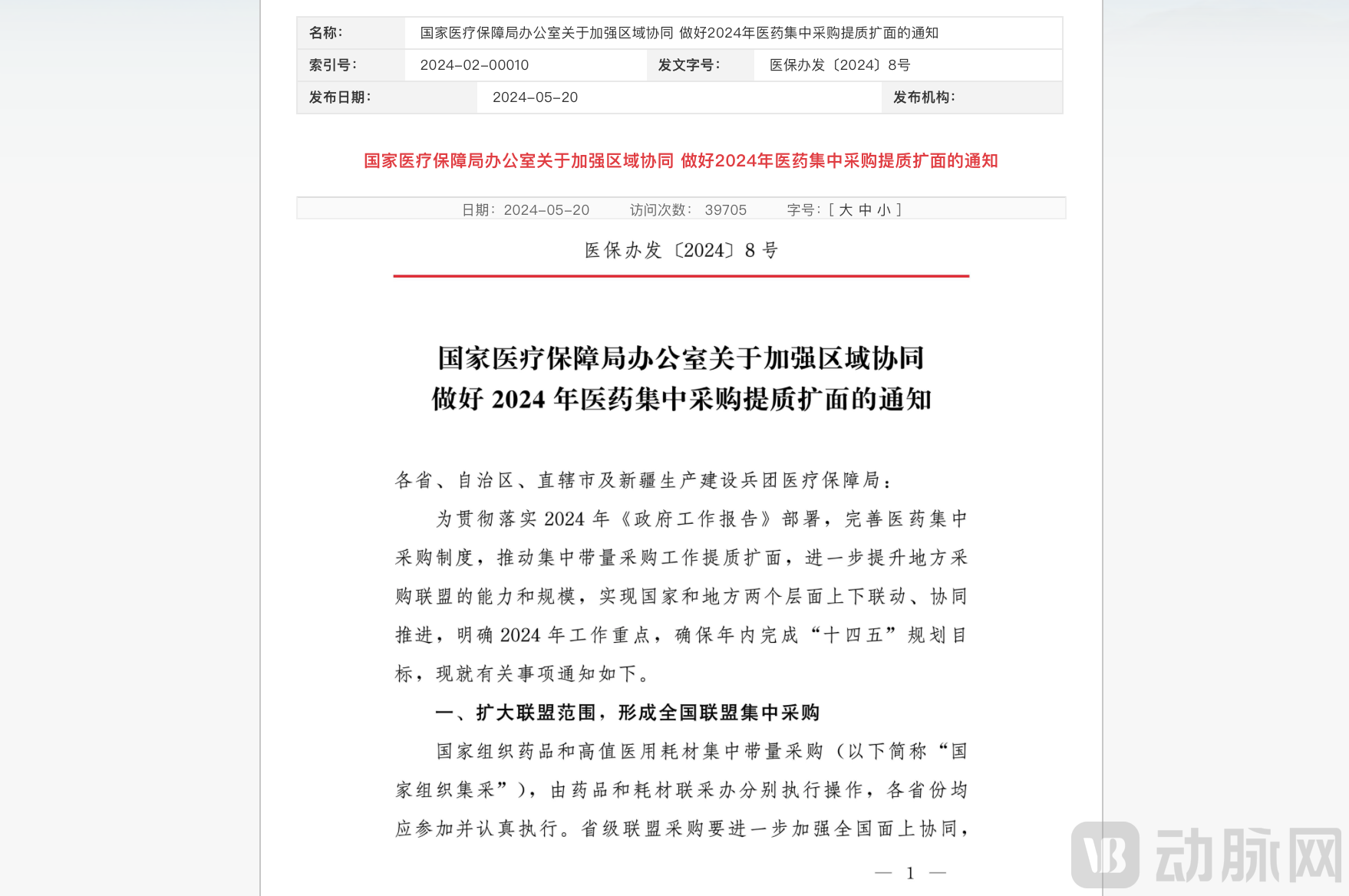
Figure | National Healthcare Security Administration Issues Notice on Enhancing Quality and Expanding Coverage of Centralized Drug and Medical Consumables Procurement in 2024
The release of the “Notice” has put a definitive end to the two-year period of intense scrutiny surrounding the centralized volume-based procurement (VBP) of traditional Chinese medicine (TCM) decoction pieces. Initiated in March 2022 under the leadership of Shandong Province, this pilot program initially covered 21 varieties of TCM decoction pieces and involved 15 provinces. After a year and a half, the selected results were implemented in September 2023, marking the successful completion of the procurement process. With strong support from the National Healthcare Security Administration, the initiative has been upgraded into a national alliance-based procurement program.
Meanwhile, the inaugural “disease-specific drug centralized procurement” has quickly drawn widespread attention. Previously, centralized procurement was categorized into two types: pharmaceuticals and medical consumables. With the Sanming Alliance now launching centralized procurement for drugs used in treating diseases such as cancer and respiratory conditions, key questions have arisen: How will the procurement be conducted? Which drugs are involved? How will it complement the existing national-level centralized procurement? Furthermore, speculation abounds as to whether disease-specific drug centralized procurement will emerge as a new direction, potentially expanding to cover a broader range of disease categories.
Significant Progress in the Pilot Program for Centralized Procurement of Traditional Chinese Medicine Decoction Pieces; Shandong Leads Efforts to Accelerate Expansion
In the pharmaceutical sector, centralized procurement of traditional Chinese medicine (TCM) decoction pieces has long been a challenging hurdle, with prominent pain points including difficulties in standard recognition, challenges in ensuring herbal quality, inconsistent herb pricing, and opaque distribution channels. Since March 2022, Shandong Province has taken the lead in exploring alliance-based procurement of TCM decoction pieces. Building on extensive consultation with stakeholders and drawing on the successful experiences of national centralized drug procurement, the initiative emphasizes quality assurance while guiding enterprises toward reasonable price reductions, establishing the core principles of “ensuring quality, upgrading standards, and stabilizing supply.”
The inaugural centralized procurement pilot for traditional Chinese medicine (TCM) decoction pieces involved over 6,000 medical institutions across 15 alliance regions, including Shandong, Shanxi, and Inner Mongolia, covering 21 varieties such as Astragali Radix. The winning bid results were announced in May 2023, with implementation commencing in September. The average price reduction for the 21 TCM decoction pieces reached 29.5%, successfully achieving the objectives of “ensuring quality, upgrading standards, and stabilizing supply.”
Breaking the Impasse in Centralized Procurement of TCM Decoction Pieces: Full-Process Quality Control and Traceability Support Provided by Digital Platforms as a Key Guarantee. The first batch of centralized procurement of TCM decoction pieces adopted a government-led, market-oriented service operation model. The Shandong Internet Traditional Chinese Medicine (Materials) Trading Center provided technical and service support for the centralized procurement. Leveraging the center’s digital and intelligent capabilities, five core systems were established: quality control and traceability, quality insurance, volume-based price negotiation, transaction settlement, and warehousing and distribution. A “3P One-Code” full-chain traceability system covering GAP, GMP, and GSP was developed. By linking all upstream and downstream entities through traceability codes, the system achieves automated data collection, recording, and monitoring across the entire process—from planting and harvesting of TCM materials to processing and preparation, and from finished product testing to warehousing—thereby enabling “one-code traceability” and establishing a trustworthy quality assurance system.
Shandong has also explored and promoted the direct settlement of payments for jointly procured traditional Chinese medicine (TCM) decoction pieces by the medical insurance fund, effectively resolving the long-standing “triangular debt” issue among hospitals, medical insurance bureaus, and enterprises that has plagued the industry. The joint procurement of TCM decoction pieces has been upgraded from a cross-provincial alliance to a national alliance. The Notice incorporates the “Shandong experience,” encouraging all provinces to actively explore and advance the direct settlement of centrally procured drugs and consumables between the medical insurance fund and pharmaceutical companies. It also mandates the use of drug traceability codes as a prerequisite for central procurement applications and gradually promotes their application in distribution, settlement, and other related processes.
The State Promotes Diagnosis-Related Group (DRG)-Based Centralized Procurement, with the Sanming Alliance Taking the Lead in Exploration
Sanming is a highland for healthcare reform in China. The Sanming Procurement Alliance, an important achievement and catalyst of Sanming’s healthcare reforms, serves as a beneficial supplement to national and provincial centralized procurement. In October 2021, the Leading Group for Deepening Healthcare System Reform under the State Council issued the Implementation Opinions on Further Promoting the Experience of Sanming City, Fujian Province, to Deepen Healthcare System Reform, explicitly stating that “localities are encouraged to join the Sanming Procurement Alliance.” Currently, alliance members cover 41 cities across 17 provinces and four national demonstration counties for healthcare reform in China, reaching a population of over 180 million.
The Sanming Alliance has initiated centralized procurement for medications used in the treatment of tumors, respiratory diseases, and other conditions, although the specific plans have not yet been released. Nevertheless, it is evident that, leveraging its mature infrastructure, the Sanming Alliance has assumed the role of pioneering a national shift from price negotiations for individual drugs and consumables to centralized procurement based on cost-effective treatment regimens categorized by disease types, thereby strengthening the collaborative governance of healthcare, medical insurance, and pharmaceutical services.
Notably, Sanming recently launched China’s first “Six-Disease Co-Management” Center for full-lifecycle health. Supported by Shanghai Ruijin Hospital and WeDoctor with cutting-edge diagnostic and therapeutic technologies as well as digital-intelligence solutions, the center has established a co-management service system covering oncology, metabolic diseases, cardiovascular and cerebrovascular disorders, respiratory conditions, reproductive medicine, and geriatrics. This initiative promotes a shift from “disease-centered care” to “patient-centered care,” ultimately achieving comprehensive, full-lifecycle health management encompassing prevention, screening, diagnosis, treatment, management, and rehabilitation.
The six-disease co-management service system includes the establishment of the “Sanming Six-Disease Co-Management Centralized Procurement Center.” The recent centralized procurement of medications for tumors, respiratory diseases, and other conditions is regarded as the initial exploratory step toward “disease-specific” centralized procurement.Against the backdrop of China’s top-down, systematic, and in-depth promotion of value-based payment reforms centered on health, conducting volume-based procurement by disease type can provide patients with more cost-effective diagnosis, treatment, and medication plans, thereby maximizing the efficiency of medical insurance fund utilization.
As a novel centralized procurement approach, “diagnosis-based” procurement imposes higher demands on the depth of coordination among medical care, health insurance, and pharmaceutical services (the “Three-Medical Linkage”) and on the capabilities of digital-intelligent platforms that support these services. It breaks away from the traditional model of bidding based on generic drug names, instead requiring the selection of the most cost-effective pharmaceuticals and medical devices according to diagnosis-specific indications. By aligning with reforms in health insurance payment methods, this approach aims to achieve an optimal balance among healthcare providers, patients, and health insurance payers. This necessitates both multi-dimensional data integration within close-knit medical consortia and robust AI-driven big data analytics capabilities.
Currently, the Sanming healthcare reform is comprehensively advancing into the "health-centric" 3.0 phase, with all 12 general hospitals fully implementing the "collaborative management of six diseases" initiative. In terms of digital platform support for centralized drug procurement, the Haixi Pharmaceutical Trading Center provides technical assurance to continuously iterate and upgrade the Sanming Alliance Procurement Platform. Driven by underlying technologies such as big data and artificial intelligence, the platform fully empowers intelligent operations across the entire process—including joint procurement, trading, settlement, payment, supply, and regulation—while enabling cross-regional volume-based price negotiation and flexible configuration of diverse procurement models.
The “Notice” explicitly requires that centralized procurement prioritize chemical drugs, proprietary Chinese medicines, and Chinese herbal decoction pieces that have not yet passed the consistency evaluation, focusing on “major varieties” of clinically common drugs and medical consumables with high procurement volumes and broad patient coverage. As the trend toward full coverage of centralized procurement for conventional drugs and medical consumables in China becomes established, demonstration initiatives in places such as Shandong and Sanming have sent new signals to the pharmaceutical industry: coordination among healthcare, medical insurance, and pharmaceutical sectors is intensifying, and centralized procurement has entered a new phase centered on health.