

Distalmotion Submits IPO Prospectus Following $1.5B Fundraise for Dexter Surgical Robot

Distalmotion
Surgical Robot Developer
Over the past two decades, surgery has transitioned from open procedures to minimally invasive techniques. Approximately ten years ago, the field began advancing further from minimally invasive approaches toward intelligent and digital solutions, with surgical robots serving as the primary platform for digital surgery.
Compared with traditional open surgery and minimally invasive surgery, robot-assisted surgery not only offers high flexibility but also eliminates hand tremors through algorithms, providing numerous advantages such as high precision, minimal trauma, reduced bleeding, shorter operative time, and enhanced safety.
However, due to limitations in terms of cost, operational complexity, compatibility with clinical practice, and the scope of procedural adoption, the penetration rate of surgical robots in hospitals remains to be improved.
Distalmotion is dedicated to lowering the barriers to purchasing and operating surgical robots, thereby providing more patients with higher-quality minimally invasive medical services. Founded in 2012, the company is a Swiss medical device manufacturer.
Historically, a surgical robot was typically dedicated to a single department and capable of performing only a limited range of procedures, which significantly constrained the realization of its functional potential and value. Consequently, enhancing the flexibility, mobility, and even modularity of surgical robot structures has become a major direction for innovation in this field.
Distalmotion has keenly recognized this dilemma facing surgical robots and introduced innovative design enhancements to its flagship product, the Dexter surgical robot. With its streamlined design, compact footprint, and intuitive interface, the system makes robotic technology more accessible and easier to adopt.
The Dexter surgical robot system comprises a sterile surgeon console, two patient carts capable of driving a range of instruments with seven degrees of freedom and 75-degree angulation, and a robotic endoscope arm that supports any 3D endoscopy system and is fully controllable from the surgeon console.The Dexter features a compact, modular design that is well-suited for various healthcare facilities, including ambulatory surgery centers and outpatient surgical settings. Its simple, mobile design allows for easy maneuverability within the operating room and seamless sharing across departments.
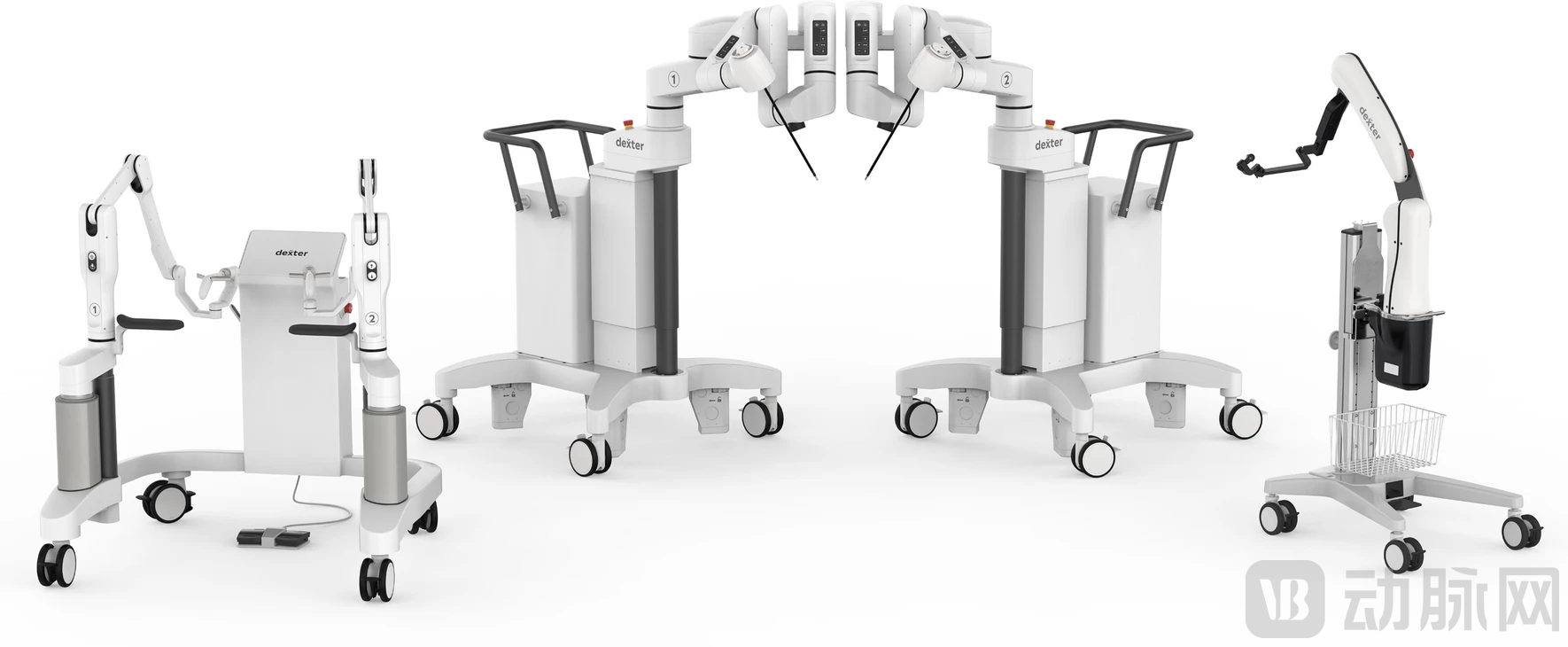
Dexter Surgical Robot System
Dexter adopts a split-cart design that allows for flexible configuration and mobility. Its compact, modular patient-side cart can be easily positioned around the operating table, offering particular advantages in space-constrained operating rooms. The endoscope control arm is compatible with all 5–10 mm endoscopes, including the latest 3D 4K imaging systems, and can be mounted on either the cart or the operating table.
Compared with the integrated design, it offers lower costs and a broader range of surgical applications.The greatest advantage of the modular design is that it allows surgeons to position different carts at various locations beside the operating table according to actual surgical needs, thereby significantly enhancing procedural flexibility and freedom.Furthermore, this design enables surgical robot manufacturers to adopt flexible product bundling strategies, allowing hospitals to procure varying quantities of split-type carts based on their actual needs.
In fact, Distalmotion adopts this very strategy, offering a range of tailored, cost-effective, and flexible procurement solutions to ensure that robotic surgery becomes more affordable. In addition,Dexter is compatible with all operating room equipment, including imaging systems and energy generators, and can be seamlessly integrated into surgeons’ intraoperative workflows. Hospitals do not need to purchase additional instruments or equipment, further reducing usage costs.
Furthermore, as a versatile clinical system, Dexter is well-suited for high-volume and complex surgical procedures, including those in general surgery, gynecology, and urology. It has obtained CE certification and accumulated clinical experience in over 30 types of minimally invasive surgeries.
The Dexter surgical robot places significant emphasis on ease of use and compatibility with existing clinical practices, which is crucial for facilitating the adoption of surgical robots in hospitals.
Although surgical robots have addressed issues such as limited flexibility, hand tremors, and physical fatigue in minimally invasive surgery, they have also altered the surgical workflows and operational habits familiar to surgeons. Most existing robotic systems employ novel port placement strategies and wristed instruments, making it difficult for surgeons to seamlessly transfer their prior experience.
Relevant data show that although China has more than 120,000 physicians performing traditional laparoscopic minimally invasive surgeries, fewer than 1% of them are trained, certified, and actively using the da Vinci Surgical System.
Therefore, how to integrate the use of surgical robots into physicians' clinical practice and prior experience, shorten their learning curve, lower the barrier to entry, and enhance the operational experience are critical considerations in product research and development design.
Dexter features a minimalist design, an intuitive interface, and simple controls, enabling setup and readiness for use within minutes.Furthermore, this surgical robot allows physicians to maintain their existing clinical workflows, preferred operating room equipment, and familiar port configurations, thereby reducing the training burden and shortening the learning curve.
In terms of surgical precision,Dexter’s modular patient cart enables quick and easy switching between different surgical approaches via a single button on the sterile console.This design enables surgeons to flexibly adjust their surgical strategies in accordance with the principle of “optimizing clinical outcomes,” selecting the most appropriate surgical technique. Whether performing fully robotic or partially robotic procedures, Dexter provides comprehensive support.
To enable rapid switching between standard laparoscopic surgery and robot-assisted surgery, surgeons need to wear sterile surgical gowns and work at a sterile console, allowing them to enter and exit the surgical field as needed during the procedure. This rapid-switch capability contrasts with traditional fully robotic platforms. In conventional robotic setups, surgeons must re-scrub, and the robot must be undocked before transitioning. In contrast, each arm of the Dexter robot can fold on command without affecting their docking status.
When the robotic platform is not required, the system can be switched to standard laparoscopic surgical mode, with the robotic arms retracted to provide the surgeon with ample working space.Since the switch from laparoscopic surgery to robotic surgery can be completed within seconds, surgeons can choose at any time whether to use Dexter during various steps of the procedure.This on-demand robot-assisted surgical approach demonstrates more pronounced advantages in colectomy.
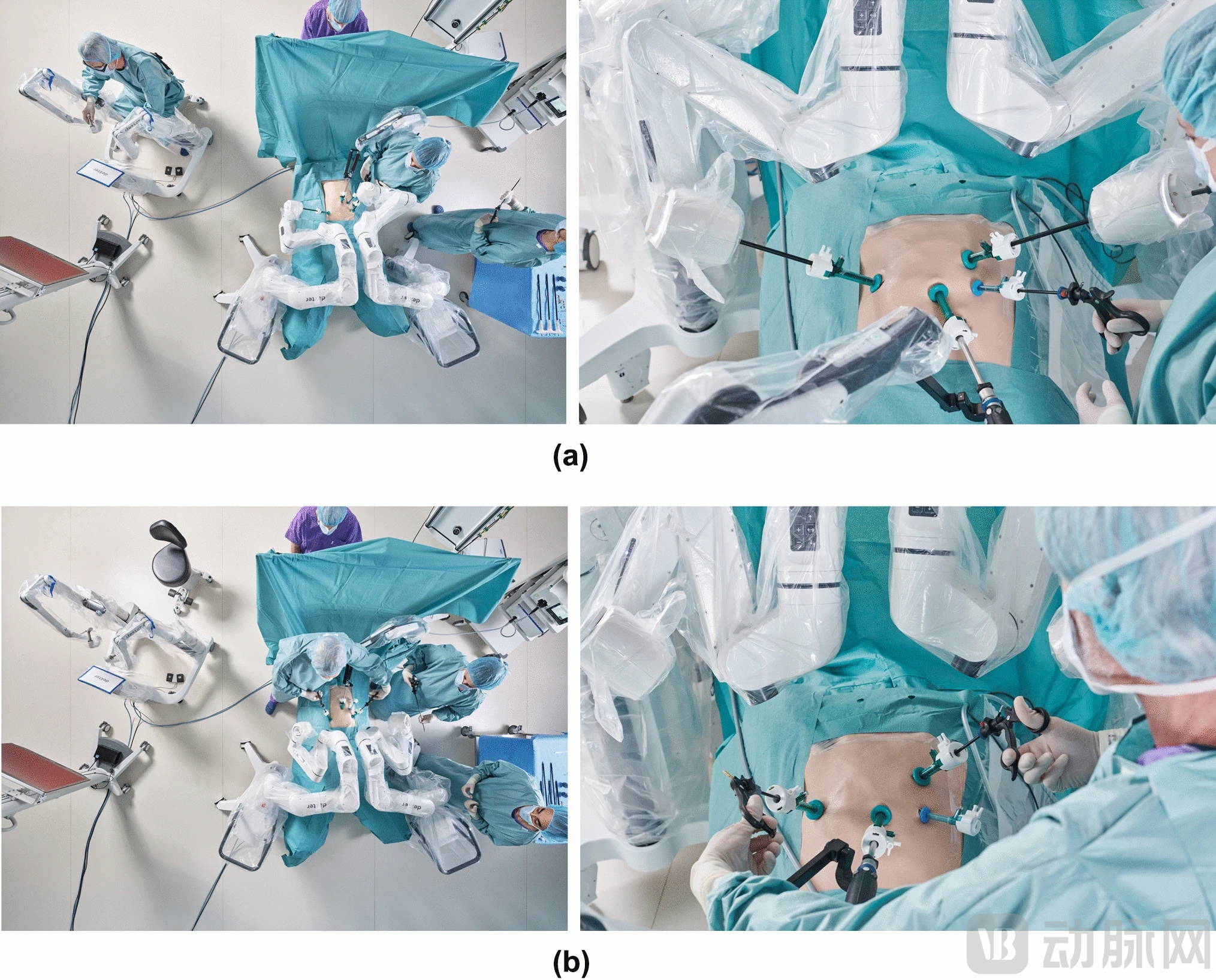
Mode Switching During On-Demand Robotic Operation: (a) Top and front views of a typical Dexter surgical system in robotic mode. (b) Top and front views of a typical Dexter surgical system in laparoscopic mode. Both instrument arms are folded to create sufficient space for standard laparoscopic surgery.
Furthermore, the Dexter surgeon console is ergonomically optimized for maximum comfort, allowing surgeons to choose between sitting or standing positions according to their preference. At the console, surgeons can achieve maximal joint range of motion, precision, and control through hand-position clutches and hand-rotation micro-clutches.Dexter’s natural dexterity and hand control capabilities enable precise rotation even at extreme angles.
To shorten the learning curve for physicians, Distalmotion also offers training programs. Its training institute, Dexter Academy, was established in collaboration with expert teaching centers and clinicians to equip surgical teams with the necessary knowledge and skills. This helps surgical teams improve their proficiency in operating the Dexter surgical robot and rapidly and effectively master its specialized use. Dexter Academy can tailor learning content based on surgeons’ experience, thereby shortening their learning curve.
The training program consists of four modules: basic knowledge training, simulator training, hands-on surgical training for surgeons, and practical training for nurses.
Dexter Academy Fundamentals Training primarily consists of e-learning modules, enabling users to acquire knowledge about the Dexter system, including its components, setup, features, and operational modes. This module is designed to equip surgeons and surgical teams with comprehensive system knowledge, thereby better preparing them for hands-on training courses.
During simulator training, surgeons immerse themselves in a simulated surgical environment with Dexter to practice basic manipulation skills and enhance their familiarity with the system, thereby developing manual dexterity and a deeper understanding of the Dexter surgical robot.
In the surgeon hands-on training course, surgeons will practice their skills through various scenarios and cases during simulated surgeries under the guidance of expert trainers at Dexter Academy.
In the hands-on training course for nurses, participants will acquire the essential knowledge required to properly operate the Dexter system in a hospital setting. This includes understanding how to install and adjust the Dexter system during surgery to ensure appropriate positioning around the patient; how to use the console, control the robotic arms, and adjust the camera; how to properly drape the patient to maintain a clean and sterile surgical field; and how to utilize surgical instruments such as scissors, forceps, and staplers to assist surgeons in completing procedures.
In addition to training courses, Distalmotion provides dedicated clinical experts to offer practical support to the entire surgical team in every case.
Damien Thillou and colleagues reported the world’s first case series of ten robot-assisted radical prostatectomies (RARP) performed using the Dexter robotic system. The study involved ten patients who underwent RARP with or without lymph node dissection at Saintes Hospital in Saintes, France. The surgical team rapidly mastered system positioning and docking, and all procedures were completed successfully without intraoperative major complications, conversion to open surgery, or significant technical failures. The median operative time was 230 minutes (interquartile range [IQR] 226–235), and the median hospital stay was 3 days (IQR 3–4).This case series demonstrates the safety and feasibility of using the Dexter system for RARP, and for the first time reveals how an on-demand robotic platform can assist hospitals in initiating or expanding their robotic surgery programs.
On March 1, 2024, Alkatout I et al. published a paper titled “First Robot-Assisted Hysterectomy Below the Bikini Line Using the Dexter Robotic System.” In this study, a 43-year-old woman with adenomyosis and recurrent uterine prolapse underwent robot-assisted supracervical hysterectomy and sacrocervicopexy below the bikini line using the Dexter robotic system at the Department of Gynecology and Obstetrics, University Hospital of Schleswig-Holstein.
The results showed no intraoperative complications, with an estimated blood loss of 10 mL, a total procedure time of 150 minutes, a console time of 120 minutes, and a total docking time of 6 minutes. The performance of Dexter met expectations, with no device-related issues or robotic arm collisions observed. The patient did not require analgesics and was discharged on the second postoperative day.It is proven that performing RAH below the bikini line using the Dexter robotic system is a feasible and safe surgical procedure.
On April 20, 2023, the company completed a new round of financing led by Revival Healthcare Capital, with a total amount of up to €136.9 million (approximately RMB 1.076 billion). According to disclosures on the Crunchbase website,Having completed seven rounds of financing, Distalmotion has raised a total of $240.4 million (approximately RMB 1.74 billion).
In routine clinical practice across Europe, Dexter has successfully facilitated a large volume of complex surgeries in general surgery, gynecology, urology, and other specialties. This funding will be used to secure FDA approval, further leverage European clinical experience, and accelerate the adoption of Dexter in hospitals worldwide.