

Taiyi Care CEO Xu Jing: Empowering Insurance Growth Through Managed Care
Driven by a combination of factors including China’s demographic structure, healthcare payment systems, and socioeconomic environment, the integrated development of health insurance and health management has become a major trend.
In recent years, domestic insurance companies have actively developed health ecosystems, with several health management service models gaining market recognition. For instance, some insurers provide comprehensive high-end health management services by collaborating with, acquiring or taking controlling stakes in, or independently establishing medical institutions. Others have built online platforms to promote internet-based healthcare, alleviating pressure on offline services and meeting the diagnostic and treatment needs for minor and chronic conditions.
Against the backdrop of rising demand for health management, commercial insurance becoming a vital supplement to public medical insurance, and favorable national policies encouraging the development of health insurance, how should enterprises align with the Healthy China strategy by integrating medical expertise with technological support to safeguard the public’s life and health?
On May 10, 2024, at the Top 100 Summit of the VBEF Future Healthcare Ecosystem Expo hosted by VCBeat, Xu Jing, CEO of Taiyi Guanjia, delivered an insightful presentation themed “New Propositions for Health Management and New Momentum for Insurance Development,” drawing on Taiyi Guanjia’s practical experience in health management services.
Taiyi Steward was established in 2020 as a professional one-stop family physician and managed care service platform in China. Serving as a bridge among healthcare, pharmaceuticals, insurance, and health management, Taiyi Steward aims to empower the insurance industry and benefit the general public through “managed care,” maintaining close alignment with the development of the entire industry.
Taiyi Steward leverages family physicians as its entry point, aggregates high-quality medical resources, penetrates user scenarios across multiple levels, and comprehensively meets users’ health management needs. By adopting a dual-model approach that integrates technology with clinical care, it creates a seamless “online + offline” healthcare experience, continuously leading innovative practices in China’s “family physician + managed care” model.
Over the course of more than three years in delivering medical services, Taiyi Guanjia has deepened its expertise on both the healthcare service and insurance fronts, engaged in in-depth product development, and is now accelerating the construction of an integrated medical health ecosystem that combines health management, insurance products, and medical care services.
“Jia An Xin” marks Taiyi Steward’s inaugural involvement in designing health management services for insurance products covering individuals with pre-existing conditions, fostering deep integration among medical care, pharmaceuticals, and insurance within the supporting ecosystem.
“Lan Yi Bao” is another deeply rooted form of internet insurance. “We believe that internet insurance and internet medical services are, in fact, a highly organic combination. Online insurance and online services have achieved full digitalization across the entire process—from service delivery and sales to policy fulfillment,” said Xu Jing, CEO of Taiyi Guanjia.
In addition, the company has launched the “Health Kiosk” health risk assessment solution, which deploys to frontline institutions to help clients conduct early screening and testing for a better understanding of their early-stage health conditions.
In February 2023, China Pacific Insurance (CPIC) partnered with Taiyi Guanjia to launch “Baisuiju,” a one-stop smart home-based elderly care solution. By integrating medical care management, caregiving services, safety monitoring, and the Lehuo platform, it provides long-term daily care services for elderly individuals living alone at home. Furthermore, the company has strengthened supply chain integration in nursing services. In May 2023, it established a Caregiver Alliance to ensure consistent, high-quality long-term service, addressing multiple pain points in patients’ medical journeys. By consolidating services such as medical accompaniment, professional nursing, recuperative accommodation, and family doctor services, CPIC has built an online-offline closed-loop system, realizing the vision of “accompanied during medical visits, cared for within hospitals, accommodated outside hospitals, and supported by medical professionals during rehabilitation.”
In 2023, Taiyi Guanjia upgraded its Family Doctor 2.0 service, aiming to deliver more refined health management solutions through customer and service tiering. Meanwhile, the company has been continuously advancing its collaborations with insurance providers. In January this year, the disease-specific insurance product “Feikangbao” was launched, breaking through the conventional coverage limits for pulmonary nodules. Taiyi Guanjia provides innovative health management services for pulmonary nodules to the insurance company.
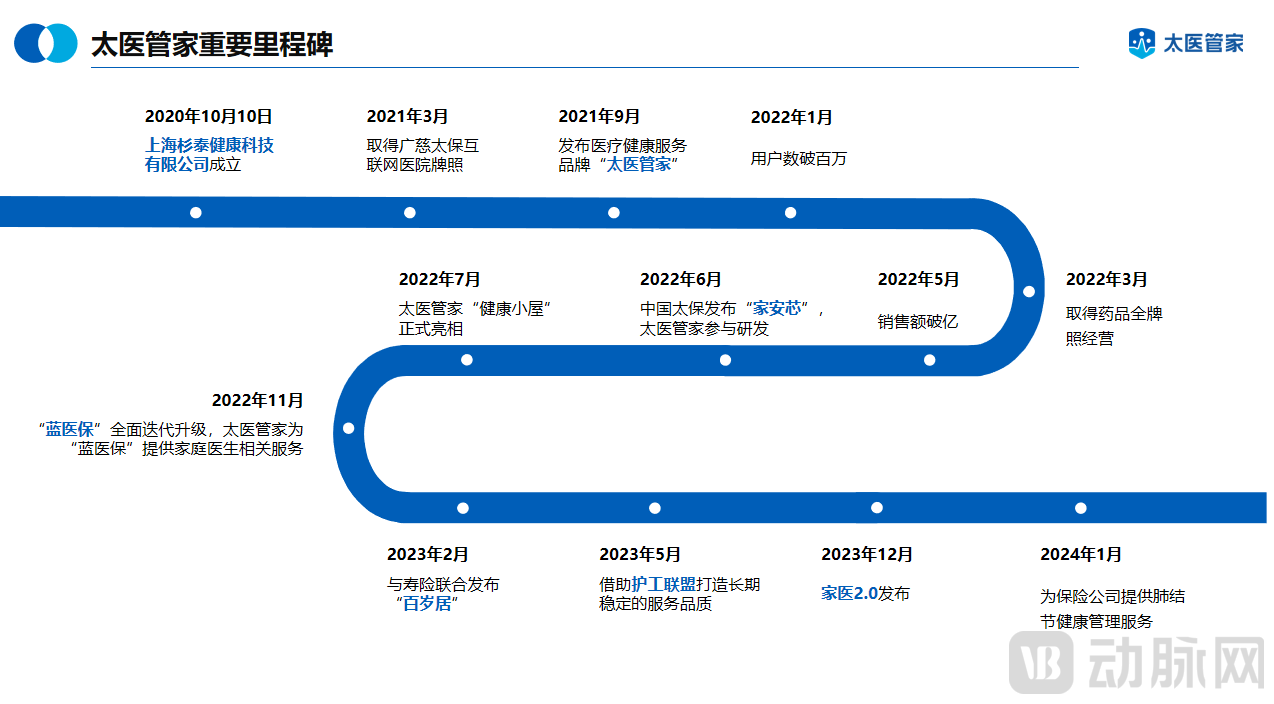
Taiyi Steward: Key Milestones
“Reviewing the major milestones in Taiyi Guanjia’s development, we aim to leverage our professional expertise in the medical field to more closely integrate with the insurance, healthcare, and pharmaceutical sectors in providing specialized, disease-specific services for targeted patient populations,” said Xu Jing, CEO of Taiyi Guanjia.
Data shows that in 2017, chronic diseases accounted for 47%-48% of the leading causes of death among Chinese residents. These include cardiovascular and cerebrovascular diseases, endocrine and metabolic disorders, as well as overlapping conditions characterized by “one high,” “two highs,” “three highs,” or even “four highs.”
“Under the dual pressures of population aging and the trend of chronic diseases affecting younger demographics, health insurance has entered a development stage focused on insuring individuals with pre-existing conditions. However, the growth of such insurance faces multiple challenges, including precisely reaching these insured populations and effectively linking and operating service resources,” introduced Xu Jing.
These issues and challenges indicate that there is still a long way to go in enhancing the role of health insurance in covering medical expenses within the commercial insurance sector. “Taiyi Guanjia aims to support innovation and progress in the insurance industry through the concept of ‘managed care,’” explained Xu Jing. “We hope to accumulate insights by comparing individual data with population-level data through health management, thereby achieving a balance between personalized services and the overall design of insurance products.”
Taiyi Guanjia aims to address current challenges through a managed care approach. On one hand, the company provides users with continuous health management solutions that bridge the gap between general wellness and specific disease conditions, as well as between acute episodes and stable phases. Meanwhile, leveraging its deep integration with insurance companies, Taiyi Guanjia seeks to further advance its service offerings for individuals with pre-existing conditions through product innovation. By effectively managing individual customers on a continuous basis and identifying risks at the individual level, the company enhances its ability to stratify the entire insured population into high-, medium-, and low-risk groups.
In this process, Taiyi Guanjia first launched digital health records to digitally archive users’ physical conditions. This encompasses both the digitization and structuring of medical data and the comparison of individual health trends. Over time, these digital health records track changes in vital sign indicators and, by comparing personal lifestyle habits with various familial abnormalities, construct a predictive model for individual health risks.
Taiyi Steward aims to identify critical threshold data during the graphical representation of health trends, thereby pinpointing earlier intervention points between the pre-threshold phase and disease onset. By comparing multi-year data, it adjusts family members’ health metrics, linking individual and family health. The archiving of disease and preventive care data enables comprehensive documentation of the user’s entire treatment journey. Thus, Taiyi Steward seeks to make health management visualized and continuous, while achieving personalized, proactive control of disease risks.
In addition, Taiyi Guanjia has developed effective health management strategies tailored for individuals with pre-existing conditions, identifying user pain points throughout the entire diagnosis and treatment journey. Taiyi Guanjia segments the population across the full life cycle and designs personalized services to meet the needs of different groups. In managing the health of specific patient populations, Taiyi Guanjia productizes its specialized disease management services, enabling these services to be integrated into insurance product design. This approach combines the design of insurance products with the capability to digitally manage specific population groups. The company also hopes that through this innovative development of insurance for individuals with pre-existing conditions, its daily health management services will better align with the needs of actual healthcare payers.
Taking the “Lung Health Guard” insurance product for individuals with pre-existing conditions as an example, prior to its launch, insurers and their risk control models primarily covered insured individuals with pulmonary nodules measuring 6 mm. “In standard clinical practice, a nodule size of 8 mm is a key indication for surgical intervention. A considerable number of anxious patients fall within the 6–8 mm range, uncertain about their risk levels and future treatment options. Leveraging our medical expertise, we conducted more refined risk assessments and stratified these individuals into high-, medium-, and low-risk categories. This approach elevated the insurability threshold for this population from 6 mm to 8 mm,” explained Xu Jing. This incidence model, based on individualized assessment and health interventions, has also gained recognition from insurers’ reinsurance models.
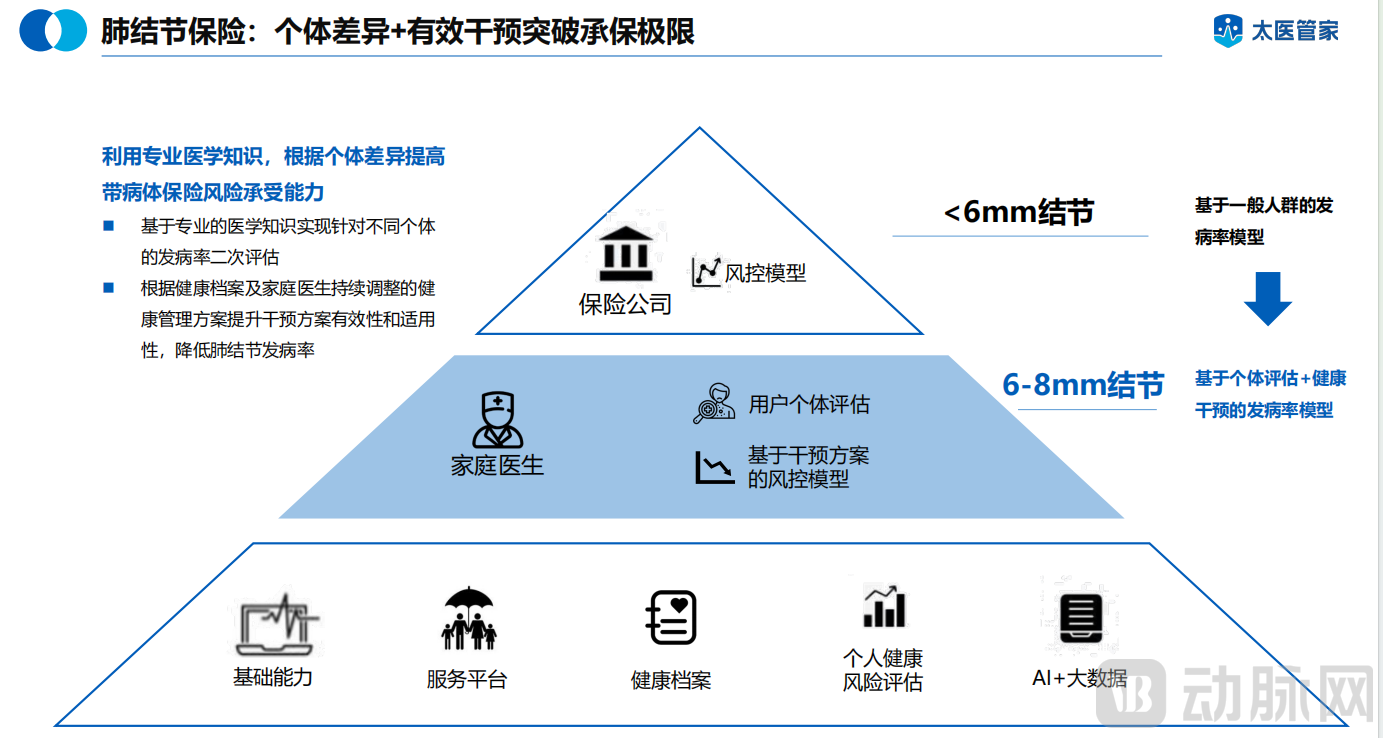
Taiyi Steward Empowers Pulmonary Nodule Insurance
Throughout this process, Taiyi Guanjia’s medical service capabilities, personalized personal health risk assessments, health records, and foundational technologies such as AI and big data have played a crucial supporting role. Taiyi Guanjia also aims to leverage the integration of healthcare and technology to expand the boundaries of insurability for a broader population in commercial insurance coverage.
Following its focus on pulmonary nodules, Taiyi Guanjia will further tailor its services for insurance companies by aligning with the pathways of specific patient populations and leveraging their distinct health characteristics. “We aim to better serve these populations by incorporating more early screening technologies and breakthrough therapeutic approaches. By collaborating with industry partners, we seek to achieve further advancements in the whole-course management of care for these specific patient groups,” said Xu Jing.