

Only One in Ten Pharma Reps to Survive Industry Shakeout: Digital Marketing Emerges as Lifeline Amid Compliance and Cost Pressures
Anti-corruption in the pharmaceutical sector has been a landmark event for the industry over the past year, unprecedented in its depth, breadth, and intensity, and it continues to unfold.
In a document jointly issued by the National Health Commission and eight other departments, requirements were set to focus on key links within the entire chain of pharmaceutical procurement, sales, and medical services that are prone to issues. Pharmaceutical companies’ selling expenses have drawn significant attention. Although these expenses cannot be directly equated with the amount spent on kickback-driven sales or the level of improper benefits transferred to healthcare institutions, high selling expenses or a high proportion of selling expenses will inevitably attract regulatory scrutiny.
The latest round of reshuffling in the pharmaceutical industry continues to compel pharmaceutical companies to ensure marketing compliance, while also driving their transformation and efficiency improvements in marketing practices.In particular, the assertion made several years ago that “only one-sixth, or even one-tenth, of pharmaceutical sales representatives will remain in the industry” is gradually becoming a reality. Consequently, the pharmaceutical industry has witnessed another wave of digital marketing. On one hand, digital marketing can significantly reduce offline and labor costs, while providing full traceability and auditable data trails to meet pharmaceutical companies’ compliance requirements. On the other hand, the accumulation and consolidation of compliant physician-patient data facilitate strategic analysis, market research, and marketing analytics, thereby addressing pharmaceutical companies’ need for effective marketing.
What Changes Have Occurred in Digital Pharmaceutical Marketing Over the Past Year?
Under Intense Cost-Control Pressure, Pharmaceutical Companies Face Urgent Digitalization Needs
According to data from Tonghuashun, the revenue growth of A-share listed pharmaceutical companies slowed significantly in 2023, with year-on-year increases of 9.74% in 2022 and 0.89% in 2023. Sales expenses followed a similar trend, with year-on-year growth rates of 4.44% in 2022 and 1.11% in 2023, among which 223 pharmaceutical companies saw a decline in their sales expense ratios.
In 2022, there were 39 listed pharmaceutical companies with a sales expense ratio exceeding 50%. This number decreased to 34 in 2023. After excluding two companies that newly disclosed their financials in 2023, the number of companies with a sales expense ratio above 50% stood at 32.
The high-pressure anti-corruption campaign in the healthcare sector, coupled with the continuous expansion of centralized volume-based procurement (VBP), has significantly contributed to the reduction of pharmaceutical sales expenses for drug manufacturers.
The decline in sales expense ratios is attributable to two factors: on the one hand, some biopharma or biotech companies have seen their revenues gradually increase and even turn profitable; on the other hand, pharmaceutical companies have implemented cost-cutting and expense-control measures, leading to significant reductions in sales expenses. Traditional pharmaceutical companies that have substantially reduced their sales expenses include Wantai Biological, Yuheng Pharmaceutical, Daan Gene, Yiling Pharmaceutical, BGI Genomics, and Joincare Pharmaceutical.
However, in 2023, the median selling expense ratio for companies with selling expenses exceeding RMB 1 billion remained relatively high at 31.55%. In contrast, the ratio of selling and administrative expenses to revenue for multinational corporations (MNCs) was approximately 20%. According to Aminocaijing, this ratio was only 17.4% for Merck & Co., while even Bristol Myers Squibb, which faces significant growth pressure, had a ratio of just 37%. Therefore, there remains substantial room for domestic pharmaceutical companies to reduce their selling expense ratios in the future.
Meanwhile, efforts to regulate drug prices are ongoing. By comparing prices of drugs with the same generic name, the National Healthcare Security Administration has identified a batch of drugs for price rectification, targeting those with significantly high sales expense ratios and questionable allocations of substantial sales expenses.
Using the average sales expense ratio of 22.8% for A-share listed pharmaceutical companies in 2022 as a benchmark, a sales expense ratio below 25% is considered the safety threshold, 30–35% the tolerance threshold, 40–45% the risk threshold, and 50% or above may trigger key audit scrutiny. Pharmaceuticals involved in such issues face price reductions, delisting from procurement platforms, inclusion in corporate credit ratings, and even disqualification from platform listing, signaling the advent of a more stringent, detailed, and rigorous era of normalized centralized procurement.
China’s pharmaceutical industry has officially entered a period of regulatory compliance, during which cost control and compliance are inextricably linked to digital transformation. Last year, the industry experienced a temporary downturn: in 2023, the value-added of industrial output for pharmaceutical enterprises above designated size decreased by 5.2% year-on-year; operating revenue for these enterprises declined by 4% year-on-year; and profits amounted to RMB 412.72 billion, representing a 16.2% year-on-year decrease.
Niu Zhengqian, Executive Vice President of the China Pharmaceutical Enterprise Management Association, stated at the Pharmaceutical Company Digital Marketing Forum during the 8th Future Healthcare Ecosystem Exhibition: “This is certainly influenced by policy and environmental factors, but I personally believe it is also closely related to the relatively slow transformation of the pharmaceutical industry. There may be a perception that the pharmaceutical industry, particularly pharmaceutical manufacturers, is very conservative and traditional. Although innovation is discussed daily, in reality, innovation within pharmaceutical companies’ own operational management and other areas lags behind.”
“Compliance, efficiency, and low cost—these areDigital Marketing's“The core keyword, and the purpose of using digital tools, is that if the entire pharmaceutical industry can achieve digital transformation relatively quickly, I believe the situation this year will be better than in 2023.”
Driven by the urgent need for cost control and transformation among pharmaceutical companies, the market size of digital medical marketing in China is expected to grow further, reaching RMB 111.0 billion in 2025 and RMB 356.8 billion in 2030, with a compound annual growth rate (CAGR) of 33.9% from 2025 to 2030.
From the perspective of the capital market, despite the currently stringent overall financing environment for the pharmaceutical sector and the challenges in revenue growth from drugs coupled with reduced marketing budgets due to policy impacts, the value of digital marketing in the pharmaceutical industry continues to be recognized by the market.
According to investment and financing data from VCBeat Research Institute, China’s pharmaceutical digital marketing sector has been highly favored by the market over the past year. MedSci Health and Yaoshibang, two companies engaged in pharmaceutical digital marketing, have successively completed initial public offerings (IPOs). In January 2024, Hillhouse Capital acquired Zhengdu Health, a leading physician-focused multi-channel network (MCN) company in the industry, becoming its controlling shareholder and integrating it into its subsidiary Gaoji Health. Listed companies represented by JD Health and Medlive demonstrated strong performance in their digital marketing businesses during fiscal year 2023, achieving growth in both revenue and profit. In the primary market, Shanghai Cloud Health secured RMB 500 million in financing, with investors including Shanghai Comprehensive Reform Fund, ICBC Investment, and Shanghai Biomedical Industry Fund.
From 3 Million to 500,000 Pharmaceutical Sales Representatives
As anti-corruption efforts in the healthcare sector become increasingly granular, pharmaceutical sales representatives are facing stricter regulatory oversight. Since the beginning of this year, multiple regions, including Jiangxi, Fujian, Anhui, Hubei, Hunan, and Liaoning, have strengthened the management of pharmaceutical sales representatives.
Promotional activities by pharmaceutical sales representatives will be subject to more detailed regulations. For instance, the Health Commission of Fujian Province has explicitly required medical institutions to establish reception management systems and implement an appointment-based reception policy in accordance with the “Three Fixed, Two Available” principle (fixed reception time, fixed reception location, and designated reception personnel; available reception procedures and reception records).
Medical representatives are not merely sales promoters, but partners of healthcare professionals, and many pharmaceutical representatives have a strong sense of professional identity.
Chinese physicians handle extremely high volumes of surgeries and outpatient visits, leaving them with insufficient time for continued learning. This often leads to skepticism regarding the application and efficacy of many new therapeutic areas and novel drugs. Pharmaceutical sales representatives address this by curating data aligned with international standards to deliver the most cutting-edge and scientifically robust drug information to clinicians. Meanwhile, it is commonplace for representatives of medical devices and consumables to provide in-theater support during surgical procedures.
What becomes evident is that an increasing number of companies are placing high demands on return on investment (ROI), seeking to achieve more effective physician engagement with lower costs. On one hand, restricted access for medical representatives to hospitals necessitates physician platforms to accommodate orders driven by corporate transformation. On the other hand, policies such as initial diagnosis at primary care facilities and tiered diagnosis and treatment have led to an increase in patient volume and prescriptions in the primary care market, making broad coverage an essential requirement.
At the Pharmaceutical Company Digital Marketing Forum of the 8th Future Healthcare Ecosystem Exhibition, Zhang Xinyan, Founder and CEO of Huimei Shuke, stated: “Currently, there are 3 million sales representatives in China. However, due to cost-cutting measures by pharmaceutical companies, data indicates that the number of sales representatives within China’s prescription drug sector will be reduced to approximately 500,000. How these representatives can achieve broader coverage of the Chinese market is the focus of Huimei Shuke’s digital approach. Leveraging our exclusive Mayo Clinic medical resources, along with a robust platform and operational capabilities, we provide digital and intelligent solutions to help pharmaceutical companies rapidly penetrate the market, accelerate the clinical adoption and practical application of their products, and achieve low-cost, high-efficiency, and extensive market coverage, thereby assisting enterprises in building or enhancing their commercialization capabilities.”
Digital marketing methods maintain a complete audit trail with traceable data, meeting the compliance requirements of pharmaceutical companies. By leveraging new technologies and business models such as AI, data analytics, and SaaS cloud services, digital marketing provides end-to-end marketing solutions. It captures behavioral data, compliance evidence chains, and user data, ensuring that all user information is fully logged throughout the process. This guarantees transparency and traceability in marketing activities, thereby satisfying the regulatory compliance needs of pharmaceutical enterprises.
By leveraging digital marketing strategies—such as hosting online academic conferences and facilitating case-sharing among physicians in professional communities—in conjunction with offline medical representatives, pharmaceutical companies can continuously cultivate physicians’ prescribing concepts, strengthen collaborative relationships, and expand coverage of the target physician population. The hybrid model of virtual representatives combined with field sales teams enables rapid penetration into hospitals in third-tier cities and extensive grassroots medical institutions, thereby achieving broad market coverage and driving swift sales growth.
Japan’s path toward digital pharmaceutical marketing also serves as a reference. The Japanese pharmaceutical industry likewise operates under a centralized procurement system and implements a biennial price-reduction mechanism, resulting in intense competition. Although the number of medical representatives in Japan peaked at 65,752 in 2013 and has since declined continuously—dropping to just 49,682 by 2022—the country’s pharmaceutical industrial scale, pharmaceutical sales revenue, and pharmaceutical marketing expenditures have continued to rise. This trend indicates that digital marketing is increasingly replacing traditional marketing approaches.
Digital engagement with physicians is critical. According to the explanatory materials accompanying M3, Inc.’s 2022 financial report—one of the world’s largest providers of healthcare information services—professional physician platforms increase the number of physicians reached per sales representative by approximately fivefold, monthly average visits by about sixteenfold, and daily interactions with physicians by roughly fourfold. CITIC Securities estimates that in 2021, Japan’s digital pharmaceutical marketing market accounted for 9.9% of the country’s total pharmaceutical marketing expenditures, with digital marketing via professional physician platforms comprising 55% of this segment. By 2030, Japan’s digital pharmaceutical marketing market is projected to account for 20% of total pharmaceutical marketing spending, with professional physician platforms representing 64% of this share.
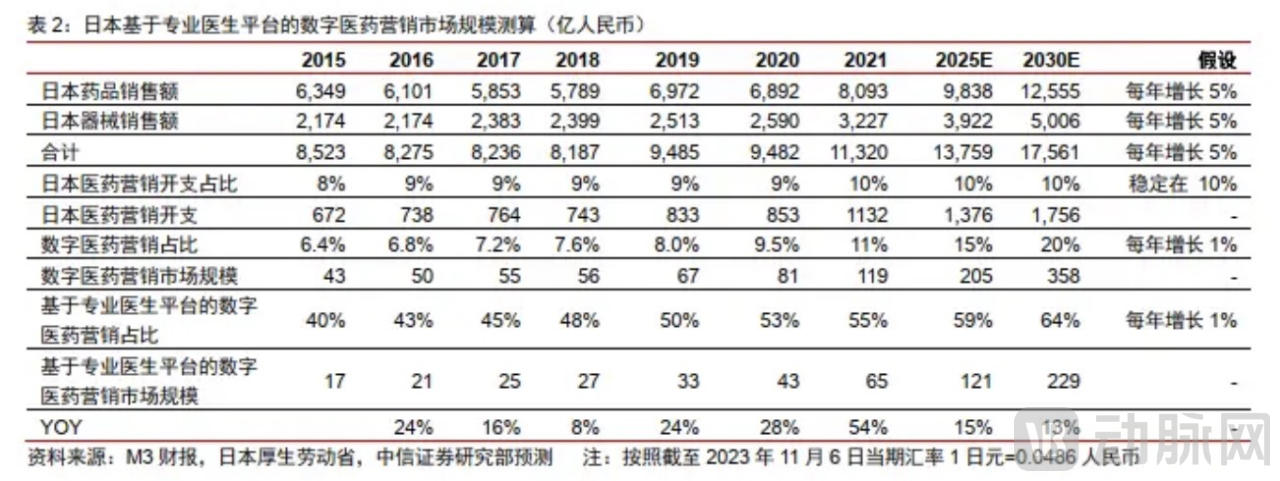
Source: CITIC Securities
The rapid decline in the number of medical representatives in China is inevitable. Moving forward, enhancing the productivity of medical representatives through digital marketing will be crucial to align with the industry’s shift from extensive growth to refined management.
Digital Marketing Bolsters Competition in the Out-of-Hospital Market
As healthcare cost containment and medical reforms are implemented in tandem, pharmaceutical companies are increasingly compelled to identify new growth markets, with the out-of-hospital market emerging as a key focus for many firms.
Fan Jing, Head of the Digital Marketing Department of JD Health’s Pharmaceutical Division, stated at the Pharmaceutical Company Digital Marketing Forum during the 8th Future Medical Ecosystem Exhibition: “The out-of-hospital market has become a critical battleground and may serve as a new source of sales growth for pharmaceutical companies. We have observed that pharmaceutical sales terminals across China are undergoing continuous change, with an increasing share accounted for by the retail market, alongside a growing proportion attributed to pharmaceutical e-commerce.”
Some growth drivers in the out-of-hospital market include not only the phased peak in sales volume of four categories of medications (cough suppressants, antivirals, antibiotics, and antipyretics) following the relaxation of pandemic control measures, but primarily the shift of chronic disease medications (for hypertension, hyperlipidemia, diabetes, asthma, etc.) to online channels, along with rapid growth in tonics and nutritional supplements, as well as topical dermatological products.
Fundamentally, this reflects a shift among the Chinese public from a reactive “seek treatment only when ill” mindset to the pursuit of healthier lifestyles. In the United States, which boasts the most advanced medical technology, over 70% of annual healthcare expenditures are devoted to chronic diseases such as diabetes and hypertension. Given China’s even larger population affected by chronic conditions, leveraging digital marketing to improve diagnostic and treatment efficiency among patient populations—and thereby preventing the progression of chronic diseases to severe stages that incur excessive healthcare costs—is of significant importance.
For example, Zhongmei Huadong launched a Chronic Disease Business School in Hubei Province targeting senior executives of pharmacy chains, store managers, and staff.Leverage digital solutions to help pharmacies enhance the quality of chronic disease management services and strengthen customer retention, accelerate pharmaceutical distribution, and ultimately benefit pharmaceutical companies themselves.
At the Pharmaceutical Company Digital Marketing Forum of the 8th Future Medical Ecology Expo, Dong Qing, Vice President of the Drug Marketing Department at Hua Medicine, mentioned that sales data for Huatangning, the world’s first-in-class innovative drug, showed that “Over the past year, we have reaped the benefits of digital marketing, with in-hospital and out-of-hospital sales of Huatangning each accounting for approximately 50%, driven by our proactive exploration and collaboration with selected digital channel platforms.“, Huatangning, as a business in the self-pay drug phase, has demonstrated strong performance and laid a solid foundation for expanding product accessibility after the implementation of medical insurance policies, thereby benefiting more patients.”
Huatangning was launched in 2022 as the world’s first approved glucokinase activator, and it is also the first global innovative new drug for type 2 diabetes introduced in China. Last December, Huatangning was included in the national medical insurance reimbursement list; prior to this, it had been available only as an out-of-pocket medication.
Amid DRG-based payment reforms and healthcare cost containment, the out-of-hospital channel now accounts for more than half of sales for many pharmaceutical companies. The traditional market landscape and commercial value chain are being progressively disrupted, making the out-of-hospital market a critical battleground for pharmaceutical firms. Given its extensive reach, numerous touchpoints, and high fragmentation, the out-of-hospital market increasingly requires the support of digital marketing.An increasing number of pharmaceutical companies and other upstream or downstream enterprises are leveraging internet hospital platforms or third-party platforms for patient management, aiming to achieve direct-to-consumer (C-end) reach and establish a closed-loop business model.
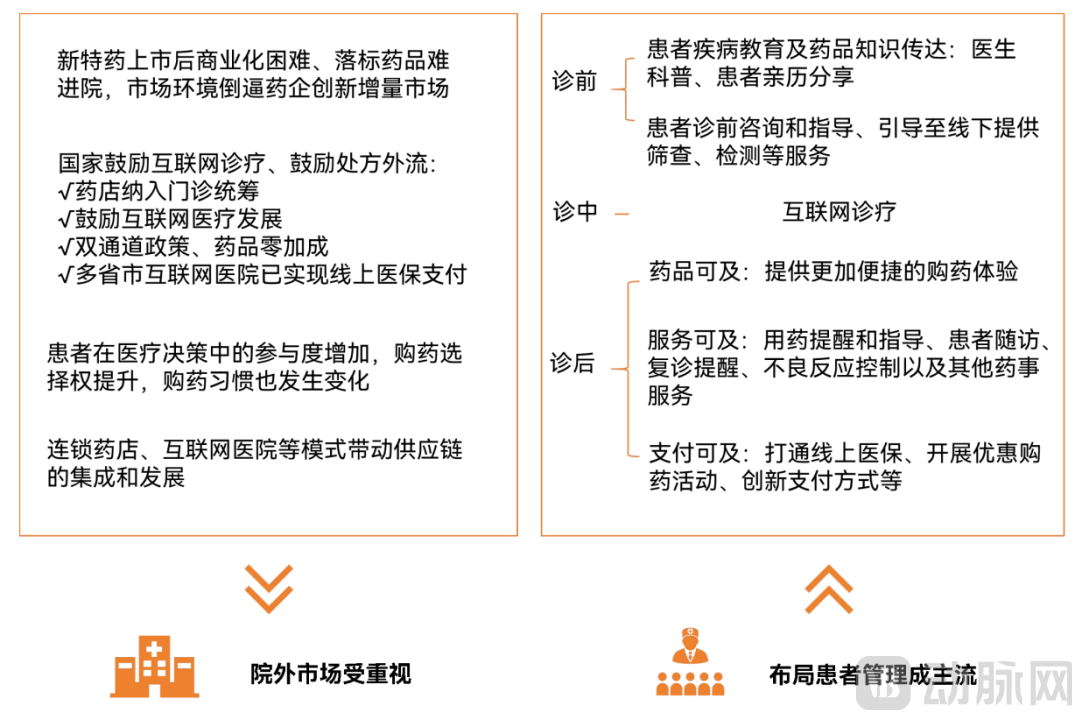
Out-of-Hospital Market Gains Prominence: Patient Management Strategies Become the Mainstream Trend, Source: VCBeat
No matter how the entire chain of screening, diagnosis, treatment, and management outside hospitals is extended and refined, the ultimate goal of digital marketing must be sales.Integrating digital marketing into the out-of-hospital market is a complex yet necessary endeavor for pharmaceutical companies, involving numerous pain points that must be addressed. These include integrating traditional marketing with digital strategies, continuously adapting to market changes, and establishing a scientifically robust digital marketing system. Meanwhile, it is essential to avoid data silos among platforms, physicians, and pharmaceutical companies, and instead implement patient-centric strategies that deliver effective ROI feedback.
The pharmaceutical industry is characterized by intertwined interests and extensive, complex stakeholder involvement. Stricter governance of pharmaceutical marketing, coupled with the evolving marketing strategies of pharmaceutical companies, marks the maturation of China’s pharmaceutical sector.Various digital marketing approaches in the pharmaceutical industry, including online academic promotion, physician communication platforms, patient education platforms, pharmaceutical e-commerce, and internet hospital platforms, are deeply shaping the pharmaceutical marketing value chain. All pharmaceutical companies have now reached a critical juncture where they must prioritize digital transformation.