

Yilian Bio Secures $25 Million Upfront in Strategic ADC Platform Deal with BioNTech
MediLink
Antibody-Drug Conjugates Developer

BioNTech
Developer of Novel Biologics
On May 27, Suzhou MediLink Biopharmaceutical Co., Ltd. (“MediLink”), a clinical-stage biotechnology company, announced a new strategic collaboration with BioNTech SE (Nasdaq: BNTX, “BioNTech”), a pioneering next-generation immunotherapy company dedicated to developing treatments for cancer and other serious diseases.
Under this collaboration, BioNTech will obtain a license to utilize MediLink’s TMALIN®The ADC technology platform development targets exclusive option rights and corresponding global exclusive licenses for ADC products against a limited number of cutting-edge innovative targets.
Under the terms of the new agreement, MediLink will receive an upfront payment of $25 million (approximately RMB 180 million) and will be eligible for up to $1.8 billion in development, regulatory, and commercialization milestone payments, as well as tiered royalties based on future global annual net sales. As part of the agreement, MediLink will have the right of first refusal to collaborate should BioNTech seek to out-license or transfer the rights to these ADC products in any one or more markets within the Greater China region (Mainland China, Hong Kong, Macau, and Taiwan).
TMALIN®Platform Addresses the Limitations of Existing ADC Technologies
Tumor Microenvironment-Activatable Toxin Linker (TMALIN)®) The Antibody-Drug Conjugate (ADC) platform technology is a novel ADC platform independently developed and owned by MediLink, featuring dual cleavage mechanisms via the extracellular tumor microenvironment and intracellular lysosomes. It combines high water solubility, high homogeneity of the drug-to-antibody ratio (DAR), high plasma stability, and enhanced accumulation in tumor tissues.
MediLink’s TMALIN technology platform addresses the limitations of existing ADC technologies. First, its unique enzymatic cleavage property enables extracellular release within the tumor microenvironment. Regardless of whether the antibody possesses internalization capability, the resulting ADCs maintain high anti-tumor activity, thereby significantly broadening the range of selectable antibodies.
Secondly, its unique structure enables ADCs to enrich the tumor microenvironment, increase the proportion of payload within the tumor and its concentration in the blood, thereby achieving a high therapeutic index.
Leveraging enzyme digestion characteristics and tumor-enrichment properties, the payload is significantly accumulated in tumor tissues, generating a potent bystander effect and yielding robust antitumor efficacy even in tumors with low or absent antigen expression.
Furthermore, ADCs developed using the TMALIN technology offer numerous advantages. First, they exhibit exceptionally high systemic circulation stability, which minimizes payload detachment in non-target tissues and thereby reduces "off-target" toxicity caused by such release. Second, they demonstrate excellent solubility and chemical stability, avoiding the reversible Michael addition reactions associated with maleimide linkers in conventional ADCs. This enables the production of highly homogeneous ADCs (DAR = 8.0) and achieves site-specific, quantitative conjugation. Third, the conjugation efficiency is high (≥90%).
Multiple ADC pipelines are currently under development based on this platform
In summary, TMALIN®The design stems from a breakthrough in the current limitations of ADC technology. The linker-payload is engineered to be specifically cleaved by enzymes within the tumor microenvironment, thereby broadening the range of selectable targets. Furthermore, it enhances accumulation in tumor tissue while maintaining high stability in circulation to prevent premature payload release, thus improving efficacy and safety simultaneously.
Based on TMALIN®Leveraging its technology platform, MediLink currently has multiple ADC products based on this platform in clinical trials, with YL201 and YL202 having advanced to Phase II clinical trials.
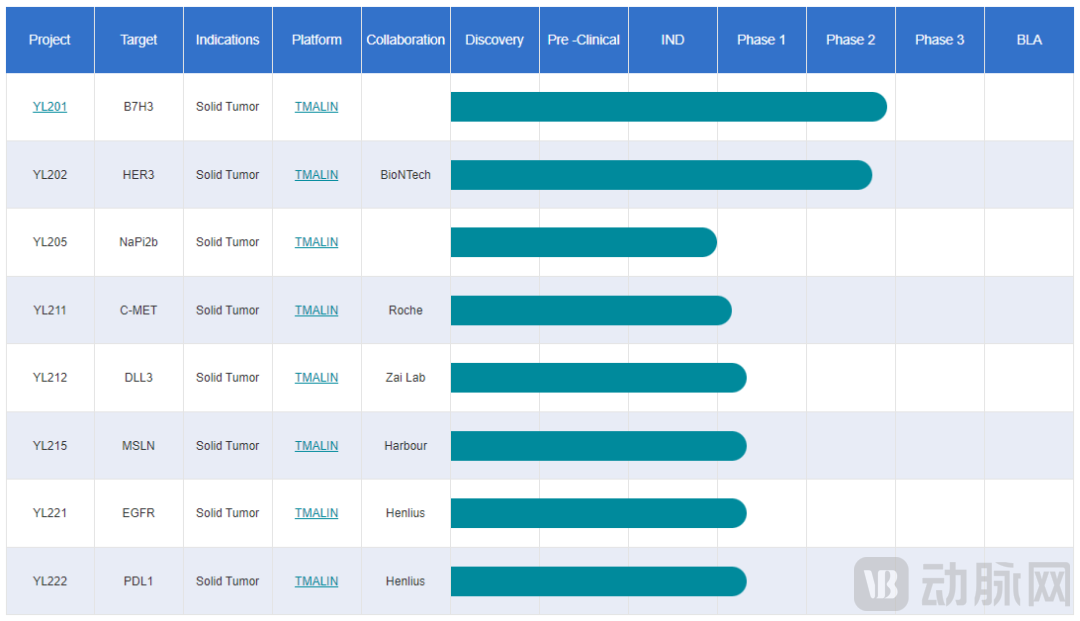
YL201 (B7H3 ADC) is a B7H3-targeting antibody-drug conjugate (ADC) that utilizes MediLink’s proprietary TMALIN platform.®Technology platform, obtained by conjugating monoclonal antibodies with novel camptothecin derivatives via cleavable linkers. This target is highly expressed in esophageal cancer and binds to MediLink’s TMALIN®Leveraging its technological platform that targets the tumor microenvironment and employs a dual extracellular and intracellular lysosomal cleavage mechanism, the agent effectively kills esophageal cancer cells, as validated by both preclinical and clinical data. The YL201 project possesses fully independent intellectual property rights, featuring an innovative toxin-linker structure. Preclinical data demonstrate its efficacy in inhibiting the growth of various tumors with good tolerability. Clinically, it is intended for the treatment of solid tumors, with exploratory studies planned for indications including non-small cell lung cancer, prostate cancer, and esophageal squamous cell carcinoma.
YL202 (HER3 ADC) is based on MediLink's TMALIN®The second product developed by the technology platform is expected to benefit TMALIN®The completion of clinical proof-of-concept for the technology platform provides new evidence, offering safer and more effective treatment options for cancer patients worldwide. In October 2023, MediLink and BioNTech entered into a strategic collaboration and global license agreement for the YL202/BNT326 project. The two parties decided to further expand the scope of their cooperation and reached this platform collaboration license agreement. The establishment of this collaboration marks a further consolidation of the strategic partnership between MediLink and BioNTech, laying a new foundation for their R&D cooperation in the field of antibody-drug conjugates (ADCs).
Attracting Over 100 Billion in Capital, ADC Deals Are in Full Swing
According to incomplete statistics, global ADC transactions have been booming since 2023, with more than 20 deals involving mergers and acquisitions as well as licensing collaborations. The highest total transaction value reached $43 billion, while the aggregate value of all transactions exceeded $100 billion.
As an ADC biotech company founded in 2020, MediLink has won the favor of many MNCs with its technology platform and pipeline potential.
On December 13, 2022, MediLink entered into a collaboration and licensing agreement with Shanghai Henlius Biotech. Under the agreement, Henlius will obtain exclusive, sublicensable rights to MediLink’s proprietary ADC platform technology for two specified targets, enabling Henlius to discover, research, develop, manufacture, use, and commercialize the candidate ADC products within the licensed territory (i.e., worldwide). MediLink will receive an upfront payment, development, regulatory, and sales milestone payments, tiered royalties, and shares of third-party sublicense revenues based on development stages.
On April 27, 2023, a strategic collaboration and global exclusive license agreement with Zai Lab was announced. Through this partnership, MediLink exclusively granted Zai Lab and its subsidiaries the global development and commercialization rights to the YL212 program. YL212 is based on MediLink’s TMALIN®ADC products targeting DLL3 developed by the platform. DLL3 is an inhibitory Notch pathway ligand overexpressed in small cell lung cancer and neuroendocrine tumors. By utilizing MediLink's TAMLIN®Technologically, YL212 has demonstrated encouraging preclinical data, and the two teams will collaborate to advance the YL212 project into the clinical research phase.
On October 12, 2023, MediLink partnered with BioNTech to co-develop a HER3-targeting antibody-drug conjugate (ADC). Under the terms of the agreement, MediLink will grant BioNTech exclusive global rights (excluding mainland China, Hong Kong, and Macau) to develop, manufacture, and commercialize one of its ADC candidates. BioNTech will pay MediLink an upfront payment of $70 million, along with additional milestone payments tied to development, regulatory approvals, and commercialization, with potential total value exceeding $1 billion.
On January 2, 2024, Roche licensed MediLink’s c-MET ADC for $1.05 billion. The two parties will collaborate to develop the next-generation antibody-drug conjugate (ADC) candidate YL211 (“c-MET ADC”), which targets mesenchymal-epithelial transition factor (c-MET), for the treatment of solid tumors. Under the terms of the agreement, Roche will obtain exclusive global rights to develop, manufacture, and commercialize MediLink’s YL211 program. MediLink will collaborate with Roche’s China Innovation Center (CICoR) to advance the YL211 program into Phase I clinical trials, after which Roche will be responsible for subsequent global development and commercialization. Roche will pay MediLink an upfront payment and near-term milestone payments totaling $50 million, as well as up to nearly $1 billion in potential development, regulatory, and commercial milestone payments, along with tiered royalties based on future global annual net sales.
Amid the ADC boom, Chinese pharmaceutical companies have reaped the greatest benefits. As an increasing number of deals are closed, the global community has gained visibility into China’s R&D capabilities in innovative drugs. It is believed that domestic ADC developers will soon rise to prominence.
References:
Get to Know an ADC Pharma Company Every Day: MediLink—Conjugating the World