

After Raising Over RMB 10 Billion, This Sector Still Has 30-Fold Growth Potential!
According to incomplete statistics from VCBeat, a total of 38 financing deals occurred in the cardiovascular industry from 2021 to May 2022, the peak period for fundraising, with the total amount reaching tens of billions of yuan.
During this period, niche sectors such as mitral valve, tricuspid valve, electrophysiology, artificial heart, and vascular interventional surgical robots took turns taking center stage, vying to become the hottest sector.
Two years have passed. How has the cardiovascular device sector developed? What changes have occurred in each market segment? Which innovative medical devices have emerged on the market? And what progress have related companies made?
As the former “darling of the moment,”Valve Intervention MarketAfter attracting substantial capital, domestic related companies have intensified their layout across nearly all categories of valve devices—including aortic, pulmonary, mitral, and tricuspid valves—and have transitioned from imitation to original innovation.
In the heart valve market, many companies are seeking innovative breakthroughs in materials.For example, Yixin Medical has independently developed the world’s first polymer valve, Polymer TAVR, and this product has completed the world’s first clinical implantation at Zhongshan Hospital Affiliated to Fudan University in Shanghai.
Compared with mechanical valves made of pyrolytic carbon and bioprosthetic valves made of biological tissues, polymer valves leverage breakthroughs in materials science to combine the dual advantages of both mechanical and biological valves. They not only offer a long service life but also exhibit excellent blood compatibility, eliminating the need for patients to take long-term anticoagulant medication. It is reported that innovative companies such as Xinling Maide and Xinrui Medical are also investing in the research and development of polymeric heart valves.
In addition to breakthroughs in materials, domestic companies are also innovating in the structural design of heart valves.For example, the AltaValve transcatheter mitral valve replacement device, which recently received FDA Breakthrough Device Designation, is a representative example of structural innovation. Developed by 4C Medical, an affiliate of VitaFlow Medical, this product is indicated for the treatment of mitral regurgitation.
It is reported that AltaValve adopts a supra-annular valve design and an atrial fixation mechanism to address the clinical challenge of difficult anchoring. Meanwhile, the device features an innovative recapture system that allows for retrieval even after full deployment, enabling operators to achieve more precise positioning and release during the procedure. Furthermore, AltaValve is available in three different valve sizes to accommodate patients with varying annular diameters.
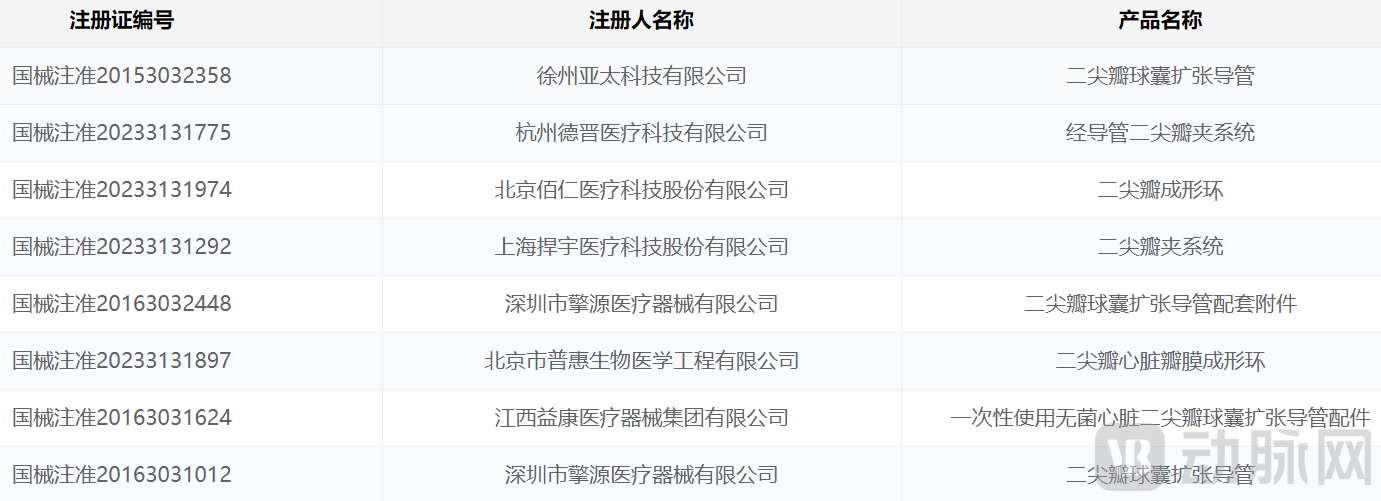
Hanyu Medical and Dejin Medical have also launched transcatheter mitral valve clip systems in the mitral valve market, with both products approved for market release in 2023 as innovative medical devices. Notably, Hanyu Medical’s mitral valve clip system features a closed-ring design that prevents separation between the clip arms, ensuring stable coaptation. Its mitral valve clip offers a broad capture range, facilitating ease of operation. Furthermore, the transapical surgical approach provides a short access route and direct positioning.
Dejin Medical’s transcatheter mitral valve clip system features an expandable central occlusion mesh combined with stepless self-locking clamping arms. This mechanical clipping mechanism ensures stable leaflet capture, reduces leaflet tension and injury, minimizes central residual regurgitation, and lowers the postoperative transvalvular pressure gradient.
Beyond product innovation, domestic valve companies are also accelerating the commercialization of their valve products.As of now, multiple interventional valve products have been approved in China, with two mitral valve interventional products already launched on the market. Meanwhile, relevant companies have initiated the commercialization of their approved products, and firms such as Venus Medtech, HeartTone Medical, Jian Shi Technology, and Jiecheng Medical are all accelerating the overseas deployment of their valve products.
For example, since the beginning of this year, Venus Medtech’s transcatheter pulmonary valve replacement system, VenusP-Valve, has been successively approved for market launch in Canada, Australia, Israel, Singapore, and other countries, accelerating its global strategy. To date, the product has achieved cumulative global sales exceeding 1,000 cases, covering more than 100 overseas centers. Beyond pulmonary valves, Venus Medtech’s other valve products are also being marketed and applied globally, capturing market share from traditional overseas giants.
Furthermore, VitaFlow Liberty, the second-generation TAVR product independently developed by Venus MedTech, has entered nearly 100 core hospitals in Argentina, Colombia, Brazil, Thailand, Russia, Indonesia, and Saudi Arabia. Moreover, the VitaFlow series products have cumulatively completed over 10,000 clinical cases worldwide.
Unfortunately, the commercialization results of domestic valve companies have been less than satisfactory.. According to the 2023 annual reports of various listed companies, Venus Medtech reported revenue of RMB 491 million in 2023, a year-on-year increase of 21%, with a pre-tax loss of RMB 735 million; VitaFlow Medical reported revenue of RMB 336 million in 2023, a year-on-year increase of 33.9%, with a pre-tax loss of RMB 464 million; Peijia Medical reported revenue of RMB 441 million in 2023, a year-on-year increase of 75.9%, with a pre-tax loss of RMB 391 million; Jian Shi Technology reported a net loss attributable to shareholders of RMB 372 million in 2023……Among listed companies only, firms in the valve sector incurred losses of RMB 1.962 billion in 2023, approaching RMB 2 billion.。
Why Are Valve Companies That Have Secured Successive Product Approvals and Increased Commercialization Efforts Still Incurring Losses?On one hand, valve companies continue to invest heavily in research and development. For instance, in 2023, Venus Medtech’s R&D expenses amounted to RMB 524 million, HeartFlow Medical’s R&D costs reached RMB 237 million, Jian Shi Technology’s R&D expenditures totaled RMB 288 million, and Peijia Medical’s valve business segment incurred R&D expenses of RMB 240 million.
On the other hand, the penetration rate of transcatheter valve interventions remains relatively low and requires time to mature. At the Cardiovascular Innovation Forum held during the 8th VBEF Future Medical Ecosystem Exhibition in 2024, Zhong Wei, Chief Scientist at MicroPort HeartFlow, stated, “In 2023, the number of transcatheter aortic valve replacement (TAVR) procedures performed in China was approximately 13,000 to 15,000. The field is expected to continue its rapid growth, with the annual volume projected to reach 100,000 cases or even higher by 2030.”
In fact, industrial development is not a game; rapid application cannot be achieved simply by clicking a mouse. The investment community and the market need to allow valve companies more time. Taking the United States as an example, the world’s first TAVR procedure was successfully performed in 2002, but it was not until 2019 that the volume of TAVR procedures in the U.S. finally surpassed that of surgical aortic valve replacement (SAVR). This evolution took 17 years.
In China, it is believed that the volume of TAVR procedures will surpass that of SAVR in less than 17 years. The first successful TAVR procedure in China was performed in 2010. Following several years of physician training and academic promotion, the number of TAVR procedures reached 1,300 in 2018 and rose to 7,319 in 2021. According to the “2023 Data on Interventional Therapy for Heart Valve Disease in China” released by Professor Pan Wenzhi from Zhongshan Hospital, Fudan University, the number of TAVR procedures performed in the first ten months of 2023 had already reached 11,600.
Behind the sustained surge in surgical volume lies the rapid establishment of Valve Centers and robust support from a wide array of innovative domestically produced valve devices. In 2019, the Interventional Center for Valvular Heart Disease (hereinafter referred to as the “Valve Center”) was initiated under the guidance of the National Clinical Research Center for Radiology and Therapeutics. The Valve Center is committed to promoting the systematic and standardized development of interventional therapy for valvular heart disease. To date, 309 registered institutions across 26 provinces in China have joined the network.
Furthermore, Professor Pan Wenzhi stated, “The iteration of TAVR devices has also driven the growth in the volume of TAVR procedures performed in China.” Valve devices have undergone continuous updates and iterations, evolving from mechanical valves to bioprosthetic valves and then to polymer valves, and from traditional valves to retrievable valves. Meanwhile, at the current stage, domestically developed valve devices with unique clinical advantages have been introduced across disease areas involving the aortic, mitral, tricuspid, and pulmonary valves, providing robust technical support for the advancement of clinical diagnosis and treatment. Promotional efforts by industry enterprises and the expansion of indicated patient populations have both made significant contributions to the increasing penetration rate of valvular interventions.
Although some valve companies continue to incur losses, the fundamental market base and underlying logic of the heart valve sector remain positive. In terms of penetration rate, China has approximately 25 million patients with valvular heart disease, including 1.5 million with severe aortic stenosis. There is still significant room for growth in the penetration rate of TAVR.
At the 8th VBEF Future Medical Ecology Expo in 2024, Jiang Tianjiao, Dean of VCBeat Institute, stated, “Greece’s per capita GDP stands at $20,000, with over 50 TAVR implants per million people. Currently, China has only 9 TAVR implants per million people. By 2035, China aims to reach the income level of moderately developed countries, with a per capita GDP of $23,000–$25,000. Therefore, if China’s TAVR penetration rate were to match Greece’s current level, there would be a fivefold growth potential; if it matched Japan’s current level, there would be a tenfold increase; and if it reached the United States’ current level, there would be a thirtyfold growth opportunity.”
Based on this fundamental logic, we believe the valve intervention market holds promising prospects, and Chinese-made valve companies at the forefront of innovation will secure a place among the future global giants in valve device manufacturing.
It is worth noting that a mutually beneficial relationship is essential for a promising future. While investors provide valve companies with financial support and time for development, these companies must also instill confidence in their investors. Currently, listed companies in the heart valve sector, Venus Medtech and Peijia Medical, have successively announced trading suspensions. Venus Medtech’s suspension was due to internal management issues, specifically involving substantial loans provided to two senior executives without timely information disclosure; Peijia Medical’s suspension was attributed to the company “discussing the valuation of financial assets with its auditors, pending certain information and supporting documents.”
Therefore, in addition to strengthening product innovation, valve companies must also focus on corporate management. In the future, as market penetration increases, domestic valve companies will experience rapid development. However, those who seize the opportunity may be listed companies or innovative enterprises that are currently quietly addressing their weaknesses.
During the peak fundraising period, it was not only transcatheter valve devices that attracted significant capital, but also other niche sectors.
For example, the field of cardiac electrophysiology has attracted a large number of investors by leveraging the emerging pulsed field ablation (PFA) technology, with more than ten companies entering the market having completed financing rounds.
PFA is considered the next-generation ablation technology. Reportedly, PFA features tissue selectivity and non-thermal effects, enabling the destruction of diseased tissue while ensuring no damage to surrounding healthy tissue. Furthermore, PFA systems offer advantages such as high ablation efficiency, ease of operation, and a strong safety profile.
Today, PFA systems from innovative companies such as Jinjiang Electronics and DeNuo Electrophysiology have been approved for market launch. Among them, Jinjiang Electronics’ PFA system, LEAD-PFA, was showcased at the “China Medical Device Innovation Path” Summit Forum in May 2024 and was featured on the “2024 China Medical Device Star-Exploration Innovation List” released by Proxima Ventures.
It is worth mentioning that Ruidi Bio’s steep pulse ablation system (nanosecond pulse ablation system), based on pulsed electric field technology, received the U.S. FDA “Breakthrough Device” designation in February 2024, becoming the first pulsed electric field ablation product in China to receive this designation.
Zhou Hao, a long-term investment partner at Daohe Capital, commented, “As the first domestically produced PFA system to reach the market, Jinjiang Electronics’ LEAD-PFA demonstrates competitiveness in both product and technology. However, it is equally critical to determine how to carry out academic promotion and conduct long-term clinical validation.”
RDN is also a high-profile niche sector attracting significant market attention.. In 2023, Medtronic finally obtained FDA approval for its percutaneous renal denervation (RDN) product after 23 years of arduous effort. Across the ocean, Vesselinova’s Netrod basket-type six-electrode RDN system was granted “Breakthrough Device” designation by the FDA in 2021.
According to reports, the Netrod basket-shaped six-electrode renal denervation (RDN) system, independently developed by Meili Weiye, features a basket-like structure that enhances catheter flexibility and improves vessel wall apposition. Additionally, its six electrodes are arranged in a 360-degree spiral pattern to enable more efficient ablation therapy. Clinical data show that the product achieves a procedural success rate of 60%, with a 25% reduction in office blood pressure and a 12% reduction in ambulatory blood pressure.
Xu Jun, Managing Director and Head of the Strategic Equity Investment Department at Taikang Asset Management, stated, “Meili Weiye’s technology is indeed highly advanced, with clinical data far surpassing that of overseas giants. However, it faces the same challenge for the future: the commercialization of innovative products must be substantiated by data. Meanwhile, the clinical efficacy of the product also requires the company to provide proof through long-term, extensive clinical data.”
Liang Weibin, a partner at the Shanghai Bio-medicine Industry Equity Investment Fund, also stated, “As an innovative therapy, Medtronic’s RDN system faces commercialization challenges. However, since Medtronic’s RDN product has already been approved in China, we believe that Medtronic will be able to jointly promote the application of RDN.”
"In the absence of multinational giants paving the way, domestic enterprises must take the lead in driving innovative products and novel surgical techniques, a task that is significantly more challenging."
In addition to valvular interventions, cardiac electrophysiology, and renal denervation (RDN), sectors such as vascular interventional surgical robots, intravascular imaging, and artificial intelligence are also rife with innovation. For instance, Weimai Medical has addressed pain points in interventional robotics, including variability in individual precision and surgical efficiency, by proposing a synergistic “Eye-Hand-Brain” solution that integrates interventional surgical robots as the “hand,” digital subtraction angiography (DSA) as the “eye,” and an AI decision-making platform as the “brain.”
“The rise of computational medicine can boost the R&D of cardiovascular medical devices. For example, MathWorks collaborates with the University of Auckland to provide complete electrophysiological models that simulate heartbeats through mathematical modeling, thereby helping cardiovascular companies achieve early design verification and evaluation of medical devices. This eliminates the need to wait for animal experiments and clinical trials to conduct costly, time-consuming, and labor-intensive verification and iterative optimization.”
Although industry innovation has been ongoing,However, based on the current market environment, the market and investors are beginning to pay more attention to the commercialization issues of enterprises.。
Some investors have noted that certain innovative medical devices receive outstanding evaluations during academic promotion and demonstrate excellent clinical efficacy, yet struggle to achieve widespread adoption in clinical practice. This is because, after regulatory approval, these products still face formidable hurdles—including pricing approvals, online procurement listing, volume-based procurement, and inclusion in the national reimbursement drug list—with each barrier proving exceptionally difficult to overcome.
Taking medical device pricing as an example, Wang Zewei, Head of Strategic Cooperation and Investment at Guoke Hengtai, stated: “The commercialization of innovative medical devices typically takes about ten years to secure pricing approvals in every province across China. Previously, a founder who developed a globally first-of-its-kind product spent ten years obtaining pricing approvals in only five provinces.”
It is not only innovative startups that face commercialization challenges; multinational medical device giants encounter them as well. For instance, Abbott and Boston Scientific spent over a decade and hundreds of millions of dollars promoting bioresorbable stents, yet their products ultimately exited the market in disappointment.
Zhou Quan, Managing Director at Legend Capital, reminded entrepreneurs: “We hope that all medical device companies will pay early attention to China’s commercialization system and its boundary conditions during the innovation process, as these factors will significantly impact the return on investment and translation cycle of innovative projects.”
Times change, and circumstances evolve; strategies must be adapted to local conditions. At this stage, with no further influx of capital into the market, companies in the cardiovascular innovative device sector need to adjust their development strategies, prioritizing commercialization and ensuring steady growth through healthy cash flow.