

Zhongshan Hospital Unveils Novel Patent for Mitral Regurgitation Modeling Device
Recently, Zhongshan Hospital Affiliated to Fudan University announced the publication of a new patent. ThisPatent for a Modeling Device for Mitral Regurgitation and Its Application
To establish a mouse model of cardiac remodeling due to volume overload, the team performed thoracentesis on small animals using a modified puncture needle under high-frequency ultrasound guidance. According to publicly available information, this patent addresses the limitations of current mitral regurgitation modeling techniques, which are associated with significant tissue injury, high mortality rates, poor reproducibility, and the inability to perform real-time monitoring.It provides an easy-to-operate device for modeling cardiac volume overload, offering a novel animal model that is minimally invasive, highly reproducible, easily scalable, and closely mimics clinical pathology for translational medical research.
Rising Demand Accelerates Deployment of Model Organisms
As a supporting service industry for the biomedical research and development (R&D) sector, the model organism industry has expanded rapidly in tandem with the growing domestic biomedical R&D market. According to data from Huanyang Consulting, China’s model organism market reached RMB 9.321 billion in 2021, with the laboratory mouse market valued at RMB 3.942 billion and the non-human primate (NHP) model market at RMB 4.17 billion.
Accelerating demand growth drives market expansion, while the model animal industry chain is gradually maturing:The upstream sector mainly comprises suppliers of laboratory animals, reagents, and other materials; the midstream consists of model animal enterprises that provide comprehensive model animal-related services; and the downstream primarily includes academic and corporate institutions engaged in life sciences and medical research.
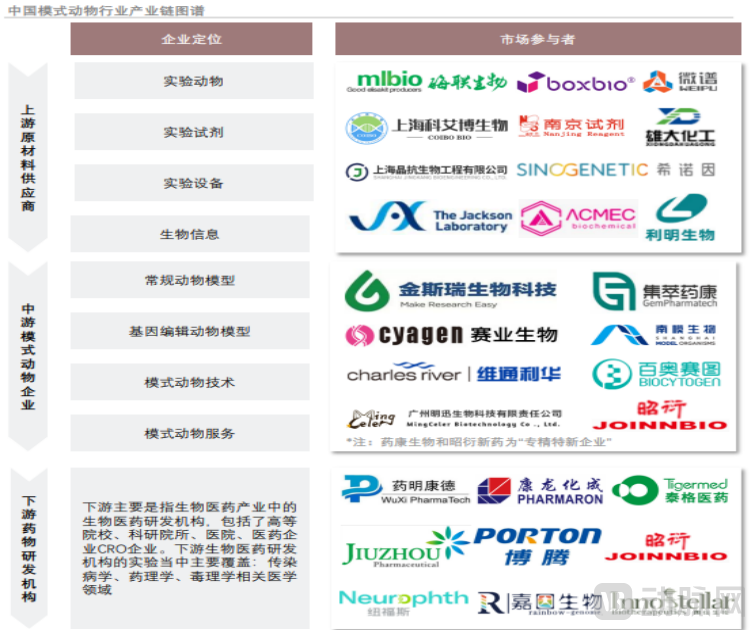 Figure source: "China's Specialized and Innovative Series Research Report: Model Animal Industry — 'Live Reagents' with Resonating Supply and Demand"
Specifically, in the upstream segment of the industry,XinuoyinSeventeen disease models have been successfully developed based on gene-editing technologies, spanning multiple strains including dogs, pigs, cats, rabbits, and mice. Among these, gene-edited dog models for atherosclerosis, autism, GCK diabetes caused by point mutations, and RPE65-associated congenital amaurosis are the first of their kind worldwide. Meanwhile,Shanghai Keaibo BiotechLeveraging ELISA technology, it provides a range of products to the mid- and downstream sectors of the industry, including various biological assay kits, ELISA (Enzyme-Linked Immunosorbent Assay) kits, chemical reagents, and reference standards.
In the midstream of the industry,Cyagen BiosciencesLeveraging animal models and integrating in-depth artificial intelligence exploration, we are at the forefront of the gene-edited animal model industry. We provide comprehensive, intelligent solutions to meet customer needs for animal models in basic research and new drug development, covering services from animal model resource libraries, custom model development, breeding and husbandry, and germ-free mouse technical services to phenotypic functional validation.
Low Cost, High Efficiency & Clear IP: The Advantages Driving the Rise of Chinese Enterprises
However, from the perspective of industry development stages, European and American companies started earlier.The top three global players in model animal sales—Charles River, Jackson Laboratory, and Taconic—were all established in the 1960s.Among them, The Jackson Laboratory is engaged not only in general animal model-related business but also in the supply of genetically engineered animal models, making it one of the largest global suppliers of genetically engineered mouse and rat strains.
In contrast, China’s model animal market is still in its early stages of development.It is worth noting that domestic enterprises possess advantages such as low costs, high efficiency, and clear intellectual property (IP) rights, which may present significant opportunities for them to solidify their hold on the Chinese market.
From the perspective of clear IP ownership, domestic enterprises can independently develop and construct mouse models with well-defined intellectual property rights, facilitating industrial application. In contrast, the Jackson Laboratory, which houses the largest mouse strain repository overseas, sources many of its animal models from various university laboratories and does not own the related IP, thereby facing certain limitations in industrial applications.
From the perspective of high-efficiency production, GemPharmatech currently possesses nearly 20,000 commercialized mouse models and 141 humanized models, with a model count significantly exceeding that of industry peers. Shanghai Model Organisms Center also holds over 6,000 commercialized mouse models and 285 humanized models, holding an advantage in the number of humanized mouse models. Efficient capabilities in constructing mouse models enable domestic enterprises to achieve shorter delivery cycles, thereby enhancing their competitiveness against overseas counterparts.
andWith the continuous advancement of gene-editing technologies (such as CRISPR/Cas9), model animals are increasingly used to expand the spectrum of diseases and enhance the precision of disease models.In 2023, the team led by Zhang Yongqing at the Institute of Genetics and Developmental Biology (IGDB), Chinese Academy of Sciences, successfully constructed the first canine model of autism with gene-edited mutations, effectively recapitulating the core clinical manifestation of autism spectrum disorder—social impairment. This advancement enables researchers to more precisely simulate human disease and conduct in-depth investigations into its pathogenesis and therapeutic strategies.