

Qilu Hospital of Shandong University Unveils Novel Patent for Transcoronary Sinus Mitral Annuloplasty Ring Device
Recently,Qilu Hospital of Shandong UniversityA new patent has been published. This patent is aCoronary Sinus Mitral Annuloplasty Ring Device。
Transcatheter Mitral Valve Annuloplasty via the Coronary Sinus is a common surgical approach for treating mitral regurgitation. This procedure primarily involves implanting a specialized cinching device into the patient’s coronary sinus, leveraging its retractile force to reduce the mitral valve orifice area, thereby mitigating mitral regurgitation. However, currently available cinching devices exhibit limited curvature and suboptimal shaping, which may lead to instability when implanted in the heart, posing threats to patient safety. Furthermore, improper retraction may cause various complications, such as compression of the coronary arteries.
Based on this, the team from Qilu Hospital of Shandong University designed a large-curvature C-shaped stent made of shape-memory metal, equipped with left fibrous trigone anchoring discs on both sides.This device not only maintains a certain degree of stability after installation, but its arched structure in the right fibrous trigone area also prevents compression of the conduction bundle, thereby reducing the incidence of complications.
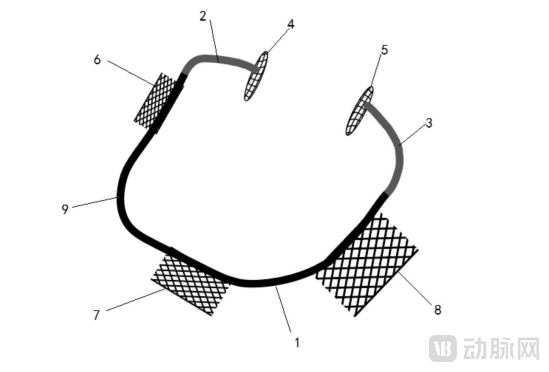 Transcoronary Sinus Mitral Annuloplasty Ring Device (Image source: Patent Specification)
I. Only Direct-Forming Annuloplasty Devices Are Permitted for Clinical Use
Mitral Regurgitation Is a Common Valvular Heart Disease, when the left ventricle fails to close completely during systole, a portion of the blood that has flowed from the left atrium into the left ventricle regurgitates back into the left atrium. This imposes volume overload on both the left atrium and left ventricle, leading to structural and functional abnormalities of the heart; in severe cases, it may result in heart failure, posing a life-threatening risk to the patient.
As the aging population continues to grow, the number of patients with mitral regurgitation in China is also increasing. According to a large-scale study on valvular heart disease in China published by Chinese scholars in JACC Asia in 2022, native, isolated mitral regurgitation accounts for the highest proportion among elderly patients with valvular heart disease.It is estimated that approximately 10 million patients in China require treatment for mitral regurgitation.
Annuloplasty ring devices are indispensable surgical instruments for transcoronary sinus mitral valve annuloplasty. Common annuloplasty ring devices are classified intoDirect Forming RingandIndirect Forming RingTwo types.
Direct annuloplasty reduces mitral regurgitation by implanting a device within the cardiac chamber that causes annular shrinkage or by directly implanting an annuloplasty ring.
In contrast, indirect annuloplasty involves placing a device between the coronary sinus ostium and the distal coronary sinus, then tightening the coronary sinus via a connector to reduce the mitral annulus.However, due to the risk of compressing the circumflex artery and causing coronary obstruction, it was not further promoted in clinical practice after its approval in 2009.
Currently, both types of annuloplasty are used only in patients with functional mitral regurgitation.
II. No Domestically Produced Marketed Products Available at Present
Designing a mitral valve annuloplasty device is no easy task. It requires not only ensuring that the device moves in coordination with the cardiac cycle, but also selecting materials that provide adequate support without damaging the myocardium.Therefore, there are currently few annuloplasty devices on the market, with even fewer domestically produced options.
Currently available direct annuloplasty devices on the market primarily include the Cardioband system, Mitralign system, and Millipede IRIS system from the United States, as well as the Valcare Amend system from Israel. These annuloplasty devices vary in shape and each has its own distinctive operational features.
For Cardioband, once it enters the ventricle, the wire within the annulus can be shortened by rotating the terminal coil, thereby reducing the annular size; Mitralign, on the other hand, targets the posterior leaflet of the mitral valve and directly tightens sutures to reduce the diameter of the mitral annulus, which also leads to differences in their respective patient populations.
Indirect annuloplasty devices currently on the market include the Carillon system from the United States, the MVRx ARTO system, and the Mitral Loop Cerclage system from South Korea; however, none have entered clinical practice and are restricted to investigational use only.
Although no domestically produced products have been approved for market launch yet, researchers continue to strive toward this goal. In 2022,Professor Chen Mao, Department of Cardiology, West China Hospital, Sichuan UniversityLed the multidisciplinary heart team to successfully apply the transcatheter annuloplasty ring system (DragonRing) completed the world's first human implantation surgery.
DragonRing is developed by West China Hospital of Sichuan UniversityProfessor Mao ChenThe team collaborates with HangzhouDejin MedicalTechnology Co., Ltd., and the National Center for Biomedical Materials at Sichuan UniversityProfessor Wang YunbingDeveloped by the team, it isChina's First Simulator for Contemporary Annuloplasty Techniques in Atrioventricular Valve Surgery, a fully self-developed transfemoral venous interventional annuloplasty system.
Although no products have yet been launched in China, it is evident that many research teams are striving in this direction. Some teams have already overcome critical technological bottlenecks, and domestic substitution in this field is certain to be achieved in the future.