

Who Else Is Profiting from the GLP-1 Boom as Billions Flood Into the Sector?
“It’s hard to imagine a drug selling out so completely that it becomes unavailable on the market,” remarked an industry insider. Over the past period, GLP-1 weight-loss medications from Novo Nordisk and Eli Lilly have become increasingly difficult to obtain through various distribution channels. Such a scenario is exceedingly rare in the history of the global pharmaceutical industry.
As a class of products that combine medical and consumer attributes, GLP-1 weight-loss drugs can be described as the crown jewel in the history of the pharmaceutical industry. Obesity has now become a major concern for many people. Many individuals have a long history of struggling with obesity, whether through dieting or using weight-loss medications, yet they often achieve only a 3%–5% reduction in body weight, with effects that are not sustained. Currently, as a country with a significant obesity burden, China has over 100 million people with a body mass index (BMI) greater than 30. Novo Nordisk’s blockbuster weight-loss drug semaglutide and Eli Lilly’s tirzepatide have both undergone rigorous clinical trials, demonstrating potential weight loss exceeding 15%. It is no surprise that these medications have been enthusiastically received since their market launch.
Furthermore, GLP-1 weight-loss drugs inherently exhibit strong user stickiness. Obesity displays clear characteristics of a chronic disease, necessitating long-term pharmacological intervention to sustain weight loss outcomes. Clinical studies from both Novo Nordisk and Eli Lilly have demonstrated that discontinuing treatment after 20 weeks leads to significant weight rebound.
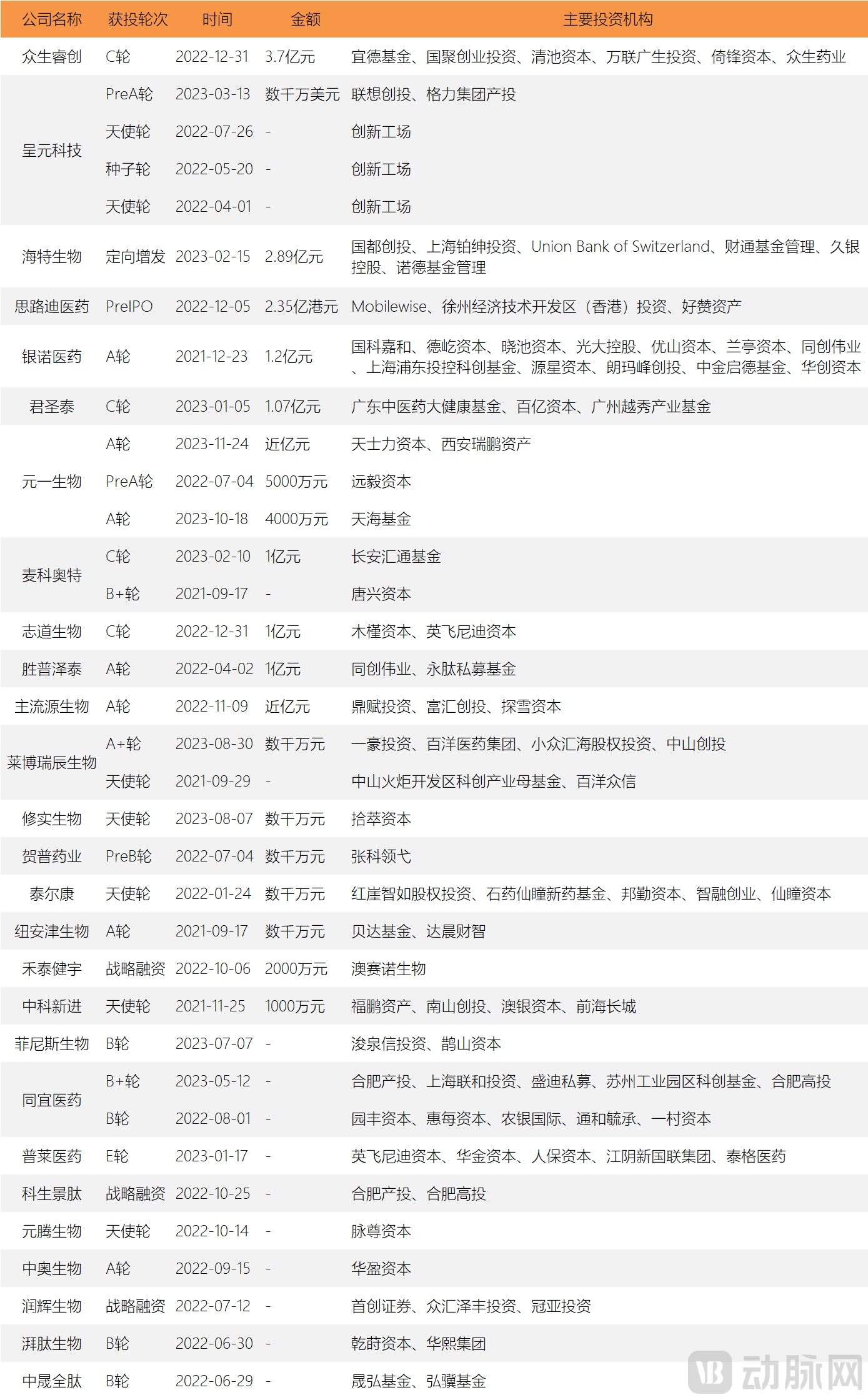
In the pharmaceutical venture capital circle, investment opportunities related to GLP-1 and peptides have instantly become hot targets. According to statistics from the VCBeat Orange Database, since the approval of semaglutide for weight loss indications in 2022, investment enthusiasm for peptide drugs in China’s primary market has surged dramatically. Nearly tens of billions of yuan have flooded into this sector, rapidly intensifying the competition over GLP-1 pipeline development while also igniting the entire industry chain. Market participants are increasingly leveraging cutting-edge technologies—such as drug conjugation, AI-driven drug discovery, and synthetic biology—to overcome technical and industrial bottlenecks in peptide pharmaceuticals, aiming to achieve rapid catch-up growth.
However, despite the high level of enthusiasm on the investment and financing front, the GLP-1 and peptide industries remain somewhat at a loss. While some players have attempted to capture a share of the GLP-1-related drug market, others have explored new indications or even novel targets, yet the results have been less than satisfactory. So, apart from the originator pharmaceutical companies that have propelled GLP-1 drugs to their current prestigious status, who else stands to profit from the GLP-1 boom?
In the Short Term, GLP-1 Is Hard to Surpass
Long before GLP-1 drugs surged in popularity, global innovation in peptide therapeutics had already gained significant momentum. Data show that between 2015 and 2021, driven by the FDA’s continued strengthening of incentives for peptide drug innovation, a total of 18 novel peptide drugs were approved for market launch, with indications spanning high-prevalence conditions such as metabolic disorders, cardiovascular diseases, and cancer.
However, most peptide drugs belong to a niche category with relatively small market size. The attention they have garnered from the general public and professionals outside specialized fields is precisely due to the remarkable performance of GLP-1, a single star target. On one hand, GLP-1 drugs have iterated at an exceptionally rapid pace—from liraglutide to dulaglutide, and then to semaglutide and tirzepatide—quickly achieving upgrades in dosing regimens, drug formulations, and indications, thereby becoming mainstream medications in broader therapeutic areas.
On the other hand, GLP-1 drugs have demonstrated remarkable commercial value. In 2023, Novo Nordisk’s three semaglutide products generated $21.2 billion in sales, accounting for two-thirds of the company’s total revenue, with a growth rate surpassing that of blockbuster PD-1 oncology drugs. In the same year, tirzepatide, newly launched on the market, achieved $5 billion in sales. From the beginning of 2024 to date, tirzepatide has recorded $3 billion in sales, with full-year sales potentially reaching $10 billion, possibly exhibiting an even more impressive growth trajectory than semaglutide.
“However, if the impact of GLP-1 drugs is excluded, the growth rate of global peptide drugs is not rapid.” This was stated by Rong Jing, Managing Director at BlueRun Ventures, at the Peptide Drugs and Industrial Chain Innovation Development Forum held during the 8th Future Medical Ecosystem Exhibition. He pointed out that although he has been engaged in biomedical investment for over a decade, he only began to focus on peptide drugs in recent years. “Approximately two to three years ago, attention to GLP-1 was still relatively low.”
According to Rong Jing, there are currently over 100 companies in China developing GLP-1 drugs, with dozens having advanced their pipelines into clinical trials. However, nearly every company is focusing on optimizing semaglutide-based products—some aiming to enhance efficacy, others exploring added muscle-building benefits, or developing long-acting formulations. “The competition is extremely intense, even more so than in the PD-1 sector,” he noted. This has left him perplexed; while he and his peers remain optimistic about the prospects of peptide therapeutics, they seem unable to identify the next breakthrough area beyond GLP-1.
Typically, with GLP-1 as the core target, pharmaceutical companies adopt two development strategies: one involves developing multi-target combinations, while the other focuses on developing different dosage forms based on single-target GLP-1 agents. In the specific process of compound development, these two strategies often converge. There is little difference in pipeline strategies among different companies. However, Zhang Xujia, Founder and Chairman of ZhiTai Bio, noted that current GLP-1 drug pipelines are intensely focused on weekly formulations. “Yet, whether they are single-, dual-, or triple-target agents, they are all developed as weekly formulations, with weight loss ranging between 18% and 20%. If we look at monthly formulations, we will find that competition is actually minimal.”
However, given the significant challenges associated with peptide synthesis and drug development, it is quite difficult to pursue GLP-1 innovations outside of these two strategies in the short term. Furthermore, some companies are attempting to bypass GLP-1 altogether by exploring new targets and indications for peptide-based therapeutics.
At their core, peptides are biologically active compounds, most of which are toxins and hormones. At present, whether obtained through natural isolation or chemical synthesis, the use of peptide drugs still relies on their inherent functions within the human body. Consequently, peptide drugs are primarily indicated for metabolic diseases and are less effective in treating other types of conditions. For instance, in cancer therapy, peptide drugs mainly play an adjunctive role rather than directly penetrating cell membranes to kill tumor cells. In contrast, both earlier monoclonal and bispecific antibodies, as well as the currently prominent antibody-drug conjugates (ADCs), can directly target tumor tissues, thereby demonstrating significant therapeutic efficacy.
“New blockbuster peptide targets are worth anticipating, but difficult to predict. For now, the priority is differentiation,” pointed out Wu Yinsong, Founder and Chairman of Xiushi Biopharma. He noted that GLP-1 is unlikely to be surpassed in the next 5–10 years. To innovate, peptide drugs need to expand beyond diabetes and weight loss into new indications and novel targets, which requires overcoming a series of technical bottlenecks, such as membrane permeability and synthesis. At present, many companies are attempting to optimize the druggability of peptides using drug conjugation strategies, which represents an important direction. However, developing peptide conjugate drugs is more challenging than anticipated; the field has taken many detours and remains in the exploratory stage.
Peptide Drugs, Overnight Sensations, Face Mounting Challenges
Throughout the nearly century-long history of modern drug development, peptide drugs have been around for a considerable time but have always occupied a rather niche position. After World War II, major pharmaceutical companies devoted substantial resources to the research and development of antibiotics and anti-antibiotic therapies. By the 1960s and 1970s, pharmaceutical giants shifted their strategic focus to oncology, assembling large R&D teams to develop chemotherapeutic agents. To this day, small-molecule chemotherapy drugs remain a critical and unavoidable cornerstone in the pharmaceutical industry.
In 2022, GLP-1 was approved for weight loss indications, marking a turning point in the global development of peptide drugs. Even so, the widespread application of peptide drugs remains constrained. In the global pharmaceutical market, peptide drugs account for only 6%, whereas small-molecule drugs constitute 80%.
The underlying reason is that developing peptides into drugs is not easy.
First, the early-stage screening of peptide drugs presents significant challenges. On one hand, the vast diversity of peptide compounds results in a substantial screening workload. Taking a 14-amino-acid peptide drug as an example, there are 10^18 possible compound combinations. If non-natural amino acids are incorporated, the number of combinations could increase by several orders of magnitude, indicating an immense chemical space. In other words, without addressing the technical challenges associated with drug screening, the development of peptide drugs is indeed extremely difficult.
On the other hand, the development of peptide drugs has not yet established robust discovery pathways and target design methodologies, making screening particularly challenging. In the drug discovery process, large-molecule drugs typically involve generating antibody molecules through antigen expression, while small-molecule drugs rely on screening compound libraries. However, globally, there is still no comprehensive and effective physical library of peptide molecules available for screening. This is especially true for long-chain peptides, where constructing a physical compound library is extremely difficult, thereby hindering targeted screening against specific targets.
Secondly, the synthesis of peptide drugs is challenging. In the past, peptide synthesis was considered straightforward due to its direct synthetic route. However, in reality, peptide synthesis is far more complex than small-molecule synthesis, requiring careful consideration of quality control, cost control, and production capacity. For current peptide synthesis, standalone solid-phase synthesis fails to meet the requirements for production capacity and cost efficiency. The choice of synthetic route is critical; under the fragment-based approach, each fragment can be synthesized via either solid-phase or liquid-phase methods. Numerous detailed issues must be addressed, including how to define the fragments and how to perform their coupling.
Compared with small-molecule drugs, peptide drugs have more complex structures. Throughout the entire manufacturing process, controlling peptide-related impurities presents a significant challenge. Unlike small-molecule drugs, which can achieve purity levels of 98.5% or even above 99%, achieving a purity of 93–94% for peptides is already considered satisfactory. The wide variety of impurities makes the establishment of quality standards highly complex. Typically, in innovative small-molecule drug companies, the ratio of personnel engaged in process development to those in analytical development is 1:1; however, due to the substantial analytical challenges associated with peptides, this ratio needs to be expanded to 1:2 or even 1:3.
Finally, scaling up peptide manufacturing processes is also challenging. There are significant barriers to the development and large-scale production of peptide drugs. While small-molecule drugs can be produced at capacities ranging from thousands to tens of thousands of liters using traditional reaction vessels, peptide drugs are limited to a maximum capacity of 2,000–3,000 liters under conventional manufacturing processes. This limitation has become a bottleneck for the mass production of GLP-1 drugs. Furthermore, the synthesis of peptide drugs requires a wide variety of protecting agents. The selection and use of these agents have become a key focus of environmental organizations. Continuing to rely on traditional solvents will pose substantial challenges, necessitating the exploration of novel protecting agents as alternatives.
Peptide Drugs’ Overnight Surge Grants Industry Practitioners an Extended Investment Horizon.
Thriving Across the Industry Chain
As with all innovative drug narratives, peptides boast the shortest payback period and may also represent the “water sellers” of the industry chain.
“For a drug to achieve large-scale sales in the market, it is not enough for the drug itself to be effective; supporting infrastructure across the industrial chain is also critical,” said an investor. Although the investor has not been tracking peptide drugs for very long and does not yet have a precise grasp of the industry’s next wave of hotspots, they have already made investments in companies along the GLP-1 supply chain.
In China, innovation in the peptide field is just beginning to emerge but has not yet reached its full potential. The global peptide drug market is projected to reach $111.3 billion by 2027, yet China’s share accounts for less than one-fifth of this total. In the domestic market, innovative peptide drugs are predominantly imported; even among generic versions, imports hold a significant presence, while domestically produced original innovative peptide drugs account for only 15.9%, with generics making up just 27.8%. “Recently, China has issued guidelines for the development of peptide drugs. However, overall, the regulatory framework for peptide drugs remains incomplete. Given the unique characteristics of peptide CMC (Chemistry, Manufacturing, and Controls) development, a specialized regulatory system is required,” stated an industry practitioner.
At this stage, the construction of China’s innovative peptide industry chain involves, on one hand, expanding external production capacity and, on the other, establishing early-stage development platforms for innovative peptide drugs.
Regarding external production capacity, specialized upstream raw material manufacturers and mid-to-downstream peptide CDMOs have gradually emerged. “In fact, Chinese companies are highly competitive in upstream GLP-1 sectors such as resins and protected amino acids, holding a significant share of the global market,” said Wan Wei, Assistant to the Chairman and Vice General Manager of Taihe Weiye.
However, overall, peptide pharmaceutical companies and peptide CDMOs still face significant pain points in expanding production capacity at this stage. On one hand, demand for GLP-1 and next-generation GLP-1 products is expected to surge rapidly in the coming years, but building peptide drug manufacturing capacity involves a very long lead time. With a wide variety of end-product categories, it is difficult to scale up production in the short term. On the other hand, manufacturing processes for various peptide formulations remain immature at present, with numerous steps yet to be explored and validated. Furthermore, while some companies are attempting to use synthetic biology approaches to improve peptide production efficiency, the preparation of GLP-1 involves modifications that may introduce impurities, making separation and purification particularly challenging. As such, the synthetic biology route is still under exploration.
In the realm of early-stage development platforms, some companies are attempting to build long-chain molecule libraries to empower innovation in peptide drug development. Leveraging synthetic biology, certain enterprises have improved upon natural enzyme technologies to construct peptide molecule libraries that meet market demands. “Due to molecular weight constraints, it is challenging to create physical libraries of long-chain molecules. However, empowering the drug discovery field through underlying technology development enables screening of long-chain drug molecules or active targets. Work based on these foundational technologies can drive many downstream drug discovery efforts and facilitate more effective drug molecule discovery,” stated an industry practitioner.
Furthermore, some companies are attempting to use AI to construct peptide molecular libraries, employing combinatorial library approaches to enhance library diversity and address challenges in peptide discovery. “There are numerous potential targets for peptide drugs, and AI can accelerate the screening process. However, it is essential to focus on relatively well-validated targets to improve both efficiency and quality,” pointed out Ye Xiangsheng, CSO of Dongtai Pharma.
Indeed, the surge in popularity of GLP-1 has propelled peptide drugs onto the fast track of innovation, allowing “shovel sellers” to profit from the GLP-1 boom. However, the other side of the coin is that this very trend underscores the long road still ahead for peptide therapeutics worldwide.