

Huawei, OPPO, Xiaomi Spark a 'Tsunami' in the Digital Health Market

OPPO
Intelligent Terminal and Mobile Internet Service Provider
The Booming “Silver Economy” Has Already Attracted Consumer Giants!
At its recent summer all-scenario new product launch, Huawei unveiled AI-assisted health and elderly care sensors, marking the first application of millimeter-wave radar technology in its whole-home smart solution to monitor the health status of the elderly. This move signals Huawei’s entry into the emerging smart elderly care sector, which is poised to have a profound impact on the field. In fact, in recent years, it has become a trend for consumer brands to cross over into the big health market.
In January this year, the General Office of the State Council issued the “Opinions of the General Office of the State Council on Developing the Silver Economy and Enhancing the Well-being of the Elderly” (hereinafter referred to as the “Opinions”). This document, bearing the designation “Guo Ban Fa [2024] No. 1,” defines and outlines plans for the “silver economy,” identifying seven high-potential industries, one of which is smart health and elderly care.
Prior to this, China had already introduced multiple policies targeting the elderly population. For instance, the 14th Five-Year Plan for National Aging Development and the Elderly Care Service System explicitly called for “advancing the standardization of elderly care services.” The Opinions on Promoting the Construction of a Basic Elderly Care Service System and the Opinions on Developing the Silver Economy to Enhance the Well-being of Older Adults have further driven the continuous improvement of the institutional framework for elderly care services. Meanwhile, the Urban Home Age-Friendly Renovation Guidance Manual provides systematic, straightforward, and feasible industry solutions and technical pathways for home age-friendly renovations.
Behind the successive policy releases lies the rapidly accelerating “aging” of China’s population. According to the latest data from the National Bureau of Statistics, by the end of 2023, the number of people aged 60 and above in China exceeded 290 million, accounting for 21.1% of the total population.
Given China’s current socioeconomic conditions and cultural traditions,Home-based elderly care will be the realistic choice for the vast majority of older adults. As early as 2005, Shanghai took the lead in proposing the “9073” model for elderly care services, under which 90% of seniors receive home-based care, 7% rely on community-based care, and 3% reside in institutional care facilities.. Since then, most national plans for the development of the elderly care service system have adopted this target framework.
Making home environments more age-friendly and safer is the key to improving the quality of life for seniors aging in place.
Policy support and substantial market demand are undoubtedly significant benefits for industry practitioners. This has also attracted consumer brands like Huawei to enter the smart elderly care sector, with AI-assisted elderly care sensors based on millimeter-wave radar technology marking Huawei’s inaugural venture into this field.
Millimeter-wave radar technology has emerged as a new trend in smart home-based health and elderly care in recent years. It combines certain advantages of both microwave and optoelectronic radars, such as high spatial resolution and strong penetration capability. However, due to limitations in miniaturization technology and cost, it had previously been used primarily for military applications.
In recent years, civilian millimeter-wave radar technology has been continuously refined, with costs gradually decreasing and application scenarios expanding. Particularly in autonomous driving, the large-scale adoption of millimeter-wave radar has further driven down the cost of related products, laying the foundation for its entry into the broader health and wellness sector.
An increasing number of enterprises are exploring application opportunities for millimeter-wave radar in the broader health sector. Major semiconductor manufacturers, such as Texas Instruments and Infineon, have launched millimeter-wave radar products designed for health monitoring, particularly for tracking the health status of the elderly.
In the field of vital signs monitoring, the advantages of millimeter-wave radar technology are evident.On the one hand, compared with contact-based vital signs monitoring devices, millimeter-wave radar technology enables non-contact sensing, which does not interfere with users' daily lives and is suitable for various scenarios such as hospitals and home care; on the other hand, unlike monitoring devices such as smart cameras, millimeter-wave radar does not infringe upon user privacy.
Taking Huawei’s AI health and elderly care sensors as an example, this technology integrates with deep learning algorithms to enable non-contact vital signs monitoring. Without requiring users to wear any devices, it supports eight major detection functions—including intelligent nighttime awakening detection, prolonged absence from bed after nighttime awakening detection, and fall assistance detection—around the clock and across multiple scenarios, thereby eliminating concerns about wearing comfort. When abnormal events such as an elderly person falling are detected, the system issues timely alerts and notifies caregivers via phone calls, text messages, and other means.
It also achieves up to 99% accuracy in detecting micro-movements, sensing millimeter-level chest movements associated with human respiration. By employing algorithms to actively filter out interference from moving objects such as robot vacuums, it enables second-level reporting of human presence without relying on cameras or other surveillance devices. This approach fully respects user privacy by ensuring that data remains processed locally on the device (“data does not leave the endpoint”).
In terms of installation, this solution features a sophisticated design. Its lightweight equipment installation mode is compatible with both suspended ceiling and non-suspended ceiling environments, and offers the choice between pre-installation (pre-wired connection via existing PLC power lines) or post-installation (Wi-Fi connection) solutions, significantly enhancing installation flexibility and convenience.
According to the official website, a single AI health and wellness sensor can cover 25 m at a height of 2.8 m.2With a coverage area and price of just RMB 1,399, calculations show that even accounting for wall-penetration attenuation, most residential units can achieve full coverage with only four to five sensors. This makes it possible to provide a low-cost smart health and elderly care solution for home-based elderly care, which accounts for the largest proportion of the market, indicating significant market potential.
So, to what extent will Huawei’s entry impact the traditional smart health and elderly care sector?
Currently, the primary business focus of traditional smart health and elderly care enterprises remains centered on community-based elderly care or institutional care facilities—corresponding to the “7” and “3” in the “9073” model. These do not directly compete with Huawei’s main target segment, namely home-based elderly care (the “90”), but rather exhibit a complementary relationship. In fact,Huawei’s strong brand effect, combined with its low costs and ease of installation, will significantly boost public confidence in and awareness of smart elderly care, thereby helping to expand the still-nascent market for this sector.。
However, given the vast market potential of home-based elderly care, it has always been one of the target sectors for traditional smart health and elderly care enterprises, even if there are no immediate plans in place.With Huawei’s entry, this potential pathway will face significant challenges in the future. On the other hand, it is not impossible that after achieving phased results in home-based elderly care, Huawei may proactively expand into the community-based elderly care or institutional care markets, or be sought out for partnerships by relevant organizations.。
Frankly speaking, the vast majority of traditional home-based smart elderly care enterprises are unlikely to rival Huawei, which holds the discourse power over core communication technologies. Significant gaps also exist in terms of brand, product design, user experience, and iterative upgrades. Although these companies currently hold a temporary advantage in their understanding of health application scenarios, this relative edge is likely to be quickly reversed once Huawei commits resources to catch up.
It is worth noting that Huawei is not the only consumer brand interested in smart health and elderly care; there are many consumer giants with ambitions in the “silver economy.” Once Huawei achieves breakthroughs in home-based smart health and elderly care, numerous consumer electronics giants currently on the sidelines will inevitably rush in, intensifying competition instantly.
Although there are no immediate survival concerns, and companies can even capitalize on the impending expansion of the market “pie,” the challenge of how to build a robust “moat” through differentiated competition before consumer electronics giants fully enter the fray is likely to become an unavoidable issue for smart health and elderly care enterprises in the future.
In fact, it is not only smart elderly care; in recent years, it has become a widespread trend for consumer giants to cross over into the broader health and wellness sector. This is particularly evident in the wearable device market, where consumer brands have been involved for many years and have made significant progress.
Taking Huawei as an example, its self-developed vital signs monitoring technology integrates innovative technologies from the Huawei Motion Health Science Laboratory and Huawei’s Global Research Institute. After seven years and five generations of technological iterations, it has achieved precise and convenient vital signs detection. In 2020, the Watch GT 2 Pro ECG smartwatch obtained Huawei’s first medical device registration certificate, providing electrocardiogram (ECG) acquisition and vascular health research testing functions.
Subsequently, the Huawei Watch GT 3 Pro smartwatch, equipped with ECG analysis software and supporting risk screening for atrial fibrillation and premature beats, also obtained a medical device registration certificate. Based on this wearable device, Huawei conducted clinical studies in the fields of cardiology and respiration with the Chinese PLA General Hospital (301 Hospital) and Tongji Hospital affiliated to Tongji Medical College of Huazhong University of Science and Technology, respectively.
In December 2021, the Huawei Watch D smartwatch obtained medical device registration certification, becoming the industry’s first hybrid continuous blood pressure monitoring smartwatch that enables continuous blood pressure tracking in a wearable form factor. Additionally, the product comes with complimentary professional health services, including access to private physicians, specialist consultations, and appointment scheduling assistance, thereby driving the industry’s iterative upgrade from conventional fitness and wellness products to medical-grade devices.
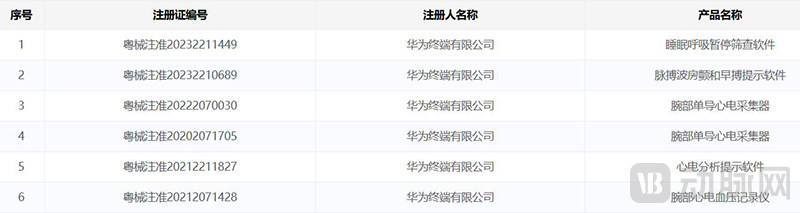
Huawei has currently obtained approval for six Class II medical device registration certificates (screenshot from the NMPA official website)
To date, Huawei has obtained six Class II medical device registration certificates, all of which fall within the category of wearable devices.
In addition to Huawei, OPPO, another giant in the consumer electronics industry, has also been exploring the broader healthcare sector. In fact, as early as September 2020, the OPPO Watch ECG obtained OPPO’s first medical device registration certificate, even one month earlier than Huawei’s certification.
The single-lead ECG continuous monitoring provided by this wearable device can display the user's electrocardiogram waveform and offer paid expert interpretation and free algorithm-based analysis services for users in need. In addition to ECG functionality, the OPPO Watch ECG also features routine health monitoring capabilities such as heart rate monitoring, sleep tracking, menstrual cycle management, sedentary reminders, and breathing exercises for stress relief.
In 2022, the ECG analysis prompt software configured in the OPPO Watch 3 Pro was approved by the NMPA as a Class II medical device, enabling it to indicate adult sinus rhythm and atrial fibrillation within 30 seconds.
These early explorations into wearable devices helped OPPO pinpoint its market positioning and identify its core strengths. Leveraging these advantages in alignment with its strategic planning, OPPO promptly embarked on a more differentiated path in health technology. In late 2022, recognizing that existing devices fell short of meeting the needs of “preventive healthcare,” OPPO launched an innovative concept product—the OHealth H1 Home Smart Health Monitor.
This conceptual product combines the advantages of wearable devices and home medical equipment, creating a solution that is both minimalist in design and powerful in functionality, while meeting medical-grade precision requirements.
Compared to wearable devices such as smartwatches, the H1 boasts robust sensor hardware capabilities, enabling medical-grade precision monitoring of six key health indicators: cardiopulmonary auscultation, electrocardiogram (ECG), heart rate, blood oxygen saturation, body temperature, and sleep. In contrast to various home-use medical devices, it further integrates and manages multi-parameter monitoring data, thereby delivering intelligent and diversified healthcare services.
Taking the H1’s specialized auscultation and measurement of heart and lung sounds as an example, it employs a proprietary electronic stethoscope that uses piezoelectric ceramic sensors as the sound-pickup component. With its wide audio frequency response range, coupled with unique noise reduction and dynamic adjustment algorithms, it is capable of acquiring heart and lung sound signals that meet the requirements for clinical auscultation.
With Huawei and OPPO achieving phased successes, other consumer electronics giants that had been holding a wait-and-see stance have also entered the healthcare sector. In July 2023, Xiaomi received approval for its wearable smart blood pressure watch. Nubia, a sub-brand under ZTE, expanded its business scope earlier this year to include the sales, leasing, and manufacturing of Class II medical devices, paving the way for its next moves.
If the scope is further expanded, home appliance giants such as Haier, Gree, and Midea are also eyeing the big health market with great interest.
The entry of these consumer electronics giants has stirred up the general health market like a “catfish.”Historically, professional medical brands and consumer brands were clearly distinct—the former prioritized regulatory compliance, featured slow iteration cycles, and enjoyed high profit margins, while the latter focused on user experience, rapid iteration, and large-scale industrial operations. Driven by consumer brands’ pursuit of growth and profitability, alongside technological advancements in smart sensing, edge computing, and data transmission, these previously separate domains are gradually converging, with their boundaries becoming increasingly blurred.。
VCBeat believes that, compared with traditional professional medical and health brands,Consumer brands have several distinct advantages. The first is a significant brand effect.Consumer brands have long engaged in high-intensity brand promotion, making their names deeply ingrained in consumers’ minds. By contrast, traditional medical and health brands enjoy far lower awareness in the niche segments where consumer brands are currently active.
Secondly, consumer brands place significant emphasis on user experience in product design and user experience., its products feature designs that are both practical and trendy, with intelligent and user-centric features that have gained user recognition and continue to evolve along this trajectory.
Furthermore, consumer brands possess scale advantages within the industrial ecosystem., which enables the rapid adoption of new technologies and swift cost reductions, thereby facilitating accelerated technological iteration. Taking wearable medical health devices as an example, consumer brands often achieve shipment volumes in the tens of millions. For professional medical brands, competing with rivals of this scale in terms of supply chain capabilities presents a significant challenge.
Due to the vast disparity in scale,There is even less comparability between the two in terms of R&D investment..
Finally, consumer brands have increasingly prioritized the broader health market in recent years and invested more resources in research and development.Its previously perceived weaknesses in healthcare understanding and compliance oversight have also seen significant improvement.。
It was previously believed that professional medical brands fell short of consumer brands in terms of user experience, cost, and aesthetic appeal; conversely, the clinical significance of consumer brands has not yet reached the level of professional medical brands. This is precisely why consumer brands often choose out-of-hospital scenarios when entering the market. However, with recent pilot explorations and substantial resource investments by consumer brands in the healthcare sector, they are rapidly catching up.
Taking Huawei as an example, it currently holds six medical device registration certificates and has established collaborations with multiple hospitals. Most traditional healthcare companies operating in the health sectors where Huawei is active would likely struggle to claim greater expertise than Huawei.
The “catfish effect” brought about by consumer brands crossing over into the health sector has become increasingly pronounced, rapidly securing a top-tier position within the ecosystem chain. It is no exaggeration to say that in out-of-hospital settings, where demands for professional expertise are relatively lower, consumer brands’ competition against traditional professional brands constitutes, to some extent, a dimensional strike.
TheseThe entry of consumer brands has also driven impressive growth in the wearable medical device market in recent years.。
Although data from different research institutions cannot be directly compared, it can still serve as a rough reference to illustrate certain trends. According to the "2023 Overview of China's Wearable Medical Device Industry" by LeadLeo Research Institute, the compound annual growth rate (CAGR) of the domestic wearable medical device market size is estimated to reach 18.1% between 2021 and 2026. In contrast, IDC's "Quarterly Tracker of the Global Wearable Device Market" forecasts that the market size growth for adult smartwatches in China will be only 11% in 2024.
Judging solely by the development of wearable devices in recent years, massive investments have enabled consumer-brand wearables to evolve their health and medical features from optional step-counting functions to blood oxygen monitoring, ECG, and blood pressure measurement, with non-invasive glucose monitoring soon to be launched. In specific domains, their functionality and performance even surpass those of most professional-grade wearable medical devices.
Barring any unforeseen circumstances, this scenario is highly likely to recur in the burgeoning “silver economy.”Undoubtedly, the number of cross-industry brands entering the healthcare sector will only continue to grow. If traditional medical brands fail to adapt, they risk being overwhelmed by the “tsunami” triggered by these new entrants.。
Huawei’s entry into the home-based elderly care market is merely the latest example of an irreversible trend: consumer brands crossing over into the healthcare industry. The boundary between low-risk medical devices and consumer goods will become increasingly blurred, a shift that will drive the development of the medical and health industry and deliver better healthcare and lifestyle solutions to consumers.
With the entry of consumer brands, the landscape of the corresponding sectors will undergo significant changes. Although consumer brands possess substantial advantages, industry experts have stated in communications with VCBeat that,Traditional healthcare brands are not without opportunities. Beyond maintaining their professional attributes, they must avoid complacency in their mindset. They should adopt the branding strategies and rapid iterative evolution approaches of consumer brands to break away from the current status quo of mediocrity. Furthermore, they must be bold in experimenting with emerging trends, such as various new media platforms, and place even greater emphasis on user experience and product design than ever before.。
Only by keeping pace with the tide, staying true to our original mission, paying meticulous attention to critical details, and genuinely addressing user needs can we remain steadfast amidst fierce competition.
References:
IDC: “China’s Wearable Market Grew 7.5% Year-on-Year in Q3, While the Global Market Rose 2.6%, Setting a Two-Year High for Quarterly Shipments”
LeadLeo Research: "Overview of China's Wearable Medical Device Industry in 2023"