

How China's Medical Device Industry Leverages Exhibitions to Expand into Global Markets
As global economic integration accelerates and medical health technologies advance rapidly, the medical device industry stands at a historical crossroads of globalization and innovation. China’s innovative capabilities and international competitiveness in medical devices are becoming increasingly prominent. Currently, China has become the world’s second-largest medical device market, accounting for one-quarter of global output value, while overseas markets are emerging as new frontiers for Chinese medical device enterprises to expand their reach.
However, the path to global expansion is not only about boundless opportunities but also fraught with challenges, requiring diverse pathways and strategies. At the 2024 8th Future Medical Ecosystem Exhibition—Medical Device Globalization Forum and Global Healthcare Innovative Product Sourcing Event, Jiang Huai, Vice President and Secretary-General of the China Convention and Exhibition Society, revealed through his keynote speech the unique role of exhibitions in the internationalization of the medical industry and the new trends in its future development.
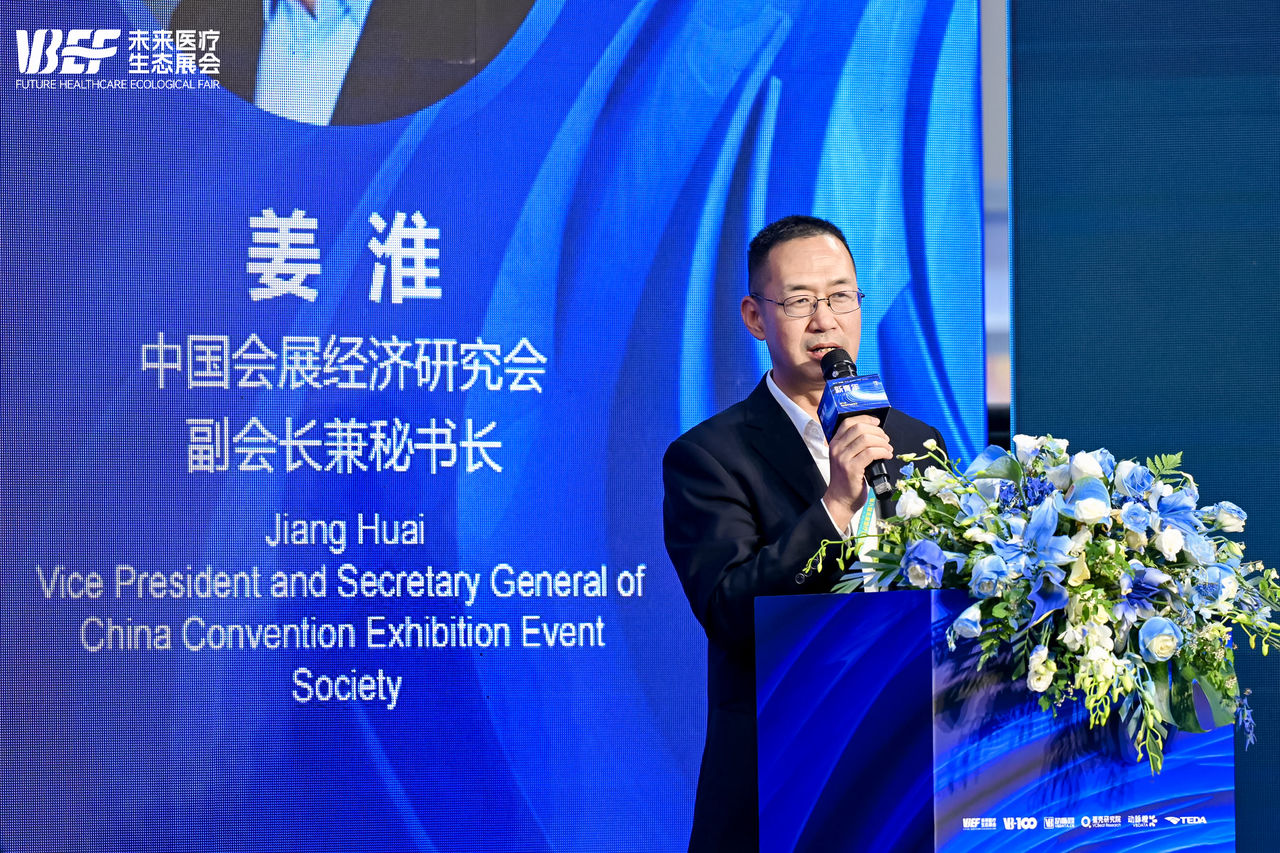
China has become a veritable powerhouse in the exhibition and convention industry, which has evolved from a producer service sector into a strategic leading industry within modern services. It plays a strategic pioneering role in national economic development. Against the new backdrop of digitalization and globalization, the traditional organizational models, exhibitor and investor recruitment methods, and exhibition presentation formats are undergoing significant transformation.
China currently attaches great importance to promoting the development of foreign trade and enhancing the quality of international trade, and has introduced a series of related policies to this end.From the perspective of policy orientation, the state explicitly and actively supports the following points:
First, the state encourages enterprises to actively participate in overseas exhibitions and promote high-quality Chinese products to the international market;
Secondly, governments at all levels have provided substantial financial support, with corresponding fiscal assistance measures in place from the local to the central level.
Currently, policies are increasingly inclined toward encouraging enterprises to independently organize exhibitions overseas, advancing through a “three-step” strategy. In 2021 and 2022, particularly against the backdrop of the pandemic, the state introduced policies to support enterprises that faced difficulties in participating in overseas exhibitions due to the outbreak. As early as 2000, the Ministry of Finance and the Ministry of Foreign Trade and Economic Cooperation jointly launched an incentive policy known as the “SME Market Development Fund” (commonly referred to as “Zhongxiaokai”), aimed at encouraging small and medium-sized enterprises (SMEs) to expand into international markets. Subsequently, foreign trade-provinces and municipalities with developed external trade sectors, including Shenzhen, Guangzhou, Shanghai, and Zhejiang, also established expansion funds targeted at industries related to the Belt and Road Initiative (BRI). At present, funding for enterprises’ participation in overseas exhibitions and their independent organization of such events primarily derives from these special funds dedicated to exploring international markets, evolving from the initial “SME Market Development Fund” to the current “Belt and Road Initiative Market Development Fund.”
Since 2021, the Department of Commerce of Zhejiang Province has taken the lead in directing funds toward online exhibitions to address the challenges Chinese enterprises faced in attending overseas trade fairs due to international travel restrictions during the pandemic. As the global pandemic situation has gradually come under control, Chinese companies have actively resumed their international expansion, particularly in emerging markets as well as in Europe and the United States, with numerous enterprises participating in various trade fairs. Meanwhile, China has also begun to actively organize enterprises to hold exhibitions abroad, aiming to expand their presence in overseas markets.
A careful review of the relevant documents reveals that,Policies are guiding enterprises to actively explore overseas markets.
Notably, the “Opinions of the General Office of the State Council on Promoting the Stabilization of Scale and Optimization of Structure in Foreign Trade,” issued on April 11, 2023, explicitly calls for strengthening trade promotion and market expansion, while continuously increasing support for foreign trade enterprises’ participation in various overseas exhibitions, so as to further cultivate and develop the exhibition business.
According to IMF forecasts, the global economic growth rate is projected at 2.9% this year, while the Government Work Report delivered during the Two Sessions anticipates China’s economic growth to be around 5%. Notably, China’s foreign trade growth reached 5.4% in the first quarter of this year, surpassing the GDP growth rate, which fully demonstrates the strong momentum and stable trend of China’s foreign trade following its comprehensive recovery.
Furthermore, according to a report by the China Council for the Promotion of International Trade (CCPIT), equipment manufacturing and the healthcare industry ranked as the top two categories for products exhibited abroad. This data underscores the significant role of the healthcare industry in international trade. In alignment with the Healthy China strategy, the healthcare sector has been established as one of China’s key pillar industries. Based on actual exhibition participation, the healthcare industry also ranks prominently nationwide, holding the second position.
Against the backdrop of deepening globalization, 2024 undoubtedly presented both opportunities and challenges for numerous Chinese enterprises.
First is the regulatory risk.Laws and regulations vary across countries; enterprises must thoroughly understand and comply with local laws and regulations before participating in exhibitions to avoid risks arising from ignorance or neglect of such rules.
Secondly, market risk.We are currently in a golden era for Chinese enterprises expanding overseas, with a large number of companies expected to enter the international market in the coming years. However, this also means that market competition will become more intense. In addition to competing with domestic peers, these enterprises must also face competition from local exhibition companies in their host countries. To establish a foothold in this environment, companies need to develop business models that align with local economic and social development.
Third is cultural risk.According to statistical reports from the International Association of Exhibitions and Events (IAEE), the Middle East, particularly Saudi Arabia, has emerged as one of the global hotspots for exhibitions. Chinese enterprises, especially those in the sports equipment and sports event sectors, are increasingly establishing branches in Saudi Arabia, preparing to host multiple related events over the next one to two years. However, cultural differences may pose a significant obstacle to these companies’ market expansion efforts; therefore, understanding and adapting to the local culture is crucial.
Fourth is resource risk.Due to the differing resource endowments for exhibition organization across various regions, differentiated approaches are required in areas such as policy, culture, and diplomacy.
Finally, the service team.The service team plays a pivotal role in business operations. The construction of such a team should be centered on local personnel, who possess inherent advantages in cultural understanding and policy insights, thereby ensuring smooth and efficient service delivery. As companies expanding overseas, it is essential to establish robust top-level design and planning while engaging in more extensive and deeper collaboration with local teams to mitigate potential risks and jointly deliver an exceptional service experience to customers.
How to Respond? Jiang Huai Points to Three Directions:
First, conduct in-depth market research.Prior to organizing an exhibition, it is essential to conduct comprehensive and in-depth market research on local market demand, the competitive landscape, and the dynamics of competition among domestic and international peers. Only by fully understanding the market conditions can the theme and strategy of the exhibition be positioned with greater precision;
Second, seek diversified collaborations.It is crucial to establish extensive collaborations with industry associations, embassies and consulates, professional exhibition companies, and even travel agencies with advantageous tourism resources. Diversified cooperation models can provide Chinese manufacturers with richer resources and support;
Third, strengthen policy support and resource integration.It is crucial to be well-versed in and fully grasp China’s policy support measures for participating in overseas trade shows. A thorough analysis of these policy details, coupled with precise alignment and effective integration with resources in the target markets, will lay a solid foundation for the smooth advancement and successful implementation of projects.
In 2023, China’s exhibition industry boldly “went global,” pioneering a new development paradigm. Top-tier domestic exhibitions, such as the China International Import Expo in Shanghai and the Canton Fair in Guangzhou, have jointly established key platforms for China’s opening-up to the outside world. The “Several Opinions on the Integrated Development of Domestic and Foreign Trade” further elevated the status of the exhibition industry, upgrading it from a production-oriented service sector to a leader in modern services.
Nowadays, the exhibition industry is playing an increasingly important role in strengthening international trade cooperation and facilitating product imports and exports. What makes this new landscape unique?
At the conference, Jiang Huai analyzed data from the Annual Statistical Report issued by the China Convention and Exhibition Economy Research Society, pointing out that, in terms of geographic distribution, 109 out of 190 self-organized exhibitions were held in countries along the Belt and Road Initiative (BRI), accounting for a significant 57%. Russia, Brazil, Indonesia, and South Africa—members of the BRICS nations—have also become important destinations for Chinese exhibitions held overseas. Meanwhile, the number of exhibitions hosted in RCEP member countries reached 71, representing 37.37% of the total, with this proportion continuing to rise.
Looking back at 2023, the number of hotspot countries for Chinese overseas exhibitions reached 17, including Vietnam, Indonesia, and Japan in Southeast Asia, with European and American countries also gradually gaining favor. Looking ahead, China plans to establish multiple core exhibition hubs globally—as a key pillar of its global expansion strategy—in locations such as Jakarta, Dubai, Saudi Arabia, Japan, South Korea, and Brazil.
Overall, the industry is accelerating its internationalization, evolving from actively encouraging independent exhibition organization abroad to fully promoting Chinese exhibitions on the global stage. China’s exhibition industry is gradually emerging as a prominent player in the international arena, becoming a strategic leading sector in modern services and in expanding international trade and cooperation.