

Xu Anding, Vice President of the Chinese Stroke Association: Innovation in Neuroprotective Drug Development and Therapeutic Strategies
Stroke is the leading cause of death and disability among adults in China, characterized by high incidence, high disability, and high mortality rates. According to the Report on Cardiovascular Health and Diseases in China 2022, the mortality rate from cardiovascular diseases in China continues to rise, with no inflection point yet in sight. The prevention and control of cardiovascular diseases undoubtedly remain urgent and arduous tasks.
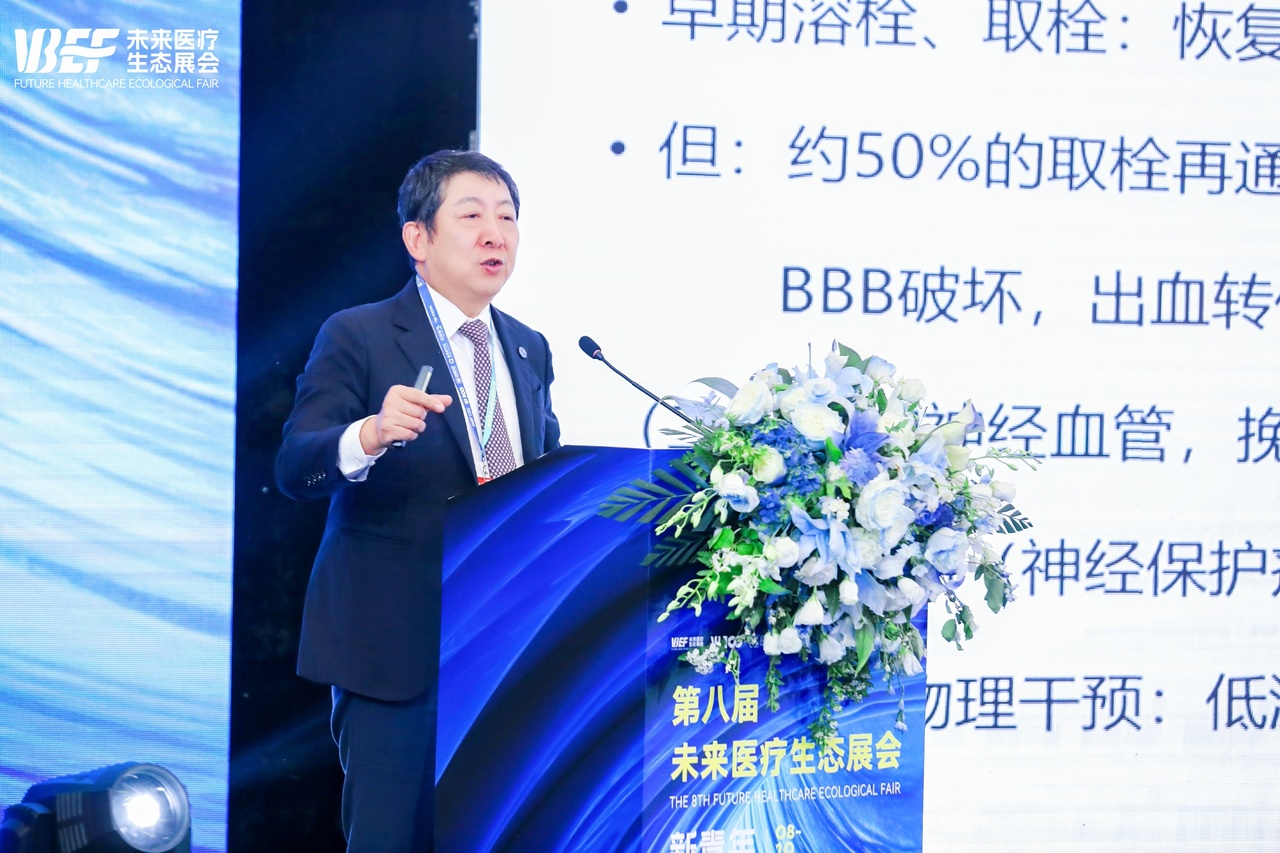
At the 2024 8th Future Medical Ecosystem Expo – Forum on Innovative Development in Brain ScienceAt the forum, Professor Xu Anding, Vice President of the Chinese Stroke Association and former President of the First Affiliated Hospital of Jinan University, pointed out in his presentation that ischemic stroke imposes a particularly heavy burden in China. Although vascular recanalization techniques have, to some extent, reduced disability among stroke patients,morbidity and mortality rates, a significant number of patients still face severe neurological impairment.
Drug innovation is a key driver for further enhancing the prevention and treatment capabilities for cardiovascular and cerebrovascular diseases. However, the journey of drug development has not been smooth. Over the past few decades, despite substantial resources and efforts invested in China, many clinical trials of neuroprotective drugs have ended in failure. This is primarily due to a significant gap between basic research and clinical application, including issues such as inadequate rigor in trial design and differences between animal models and human diseases.
How to Narrow the Scope of Basic ResearchBridging the Gap with Clinical Applications to Improve the Translation Rate of Neuroprotective Drugs?
Xu Anding pointed out,In research on neuroprotective therapy for ischemic stroke, the selection and implementation of experimental methods are crucial.From drug development to clinical application, the process requires rigorous preclinical evaluation and clinical trials. This is not merely a technical challenge but also a severe test of the scientific literacy and ethical standards of medical researchers.
In the Early Stages of Drug Development,The primary task is to clarify the drug’s main efficacy and development objectives.—Is it to reduce disease recurrence, alleviate the degree of disability, or improve patients' affective disorders? All of the above must be determined based on the drug's design philosophy and the objectives of clinical trials.
Meanwhile, to ensure the reliability of experimental results, strict inclusion and exclusion criteria must be established. For instance, in the "cerebral ischemia model" using animal models, standardized procedures are required to make the experimentally induced "infarction" more closely resemble real-world stroke.
In animal experiments, the use of rodents (such as mice) is common practice. However, due to individual variations and differences in experimental procedures, using a small number of animals often makes it difficult to obtain reliable results. Therefore, adopting methods such as blinding and independent multi-center operations can significantly improve the accuracy and reproducibility of experimental results.
Significant discrepancies remain between animal models and real-world clinical scenarios. The etiology of stroke is complex and multifactorial, encompassing atherosclerosis, hypertension, heart disease, and other factors. These diverse etiologies are difficult to fully replicate in animal models, resulting in a substantial gap between basic research and clinical application.
To bridge this gap, researchers have proposed the use of composite models, such as constructing animal models based on conditions like diabetes, atherosclerosis, and hyperlipidemia, to better reflect clinical reality.
Regarding the selection of animal species, although large animals (such as monkeys) may more closely resemble humans, their high costs and operational complexities render this approach impractical. Therefore, researchers need to obtain sufficiently reliable evidence from small animal models, such as mice and rats, before gradually transitioning to experiments involving large animals.
Additionally, factors such as animal circadian rhythms and the timing of disease onset may also influence experimental outcomes. For instance, strokes in humans predominantly occur at night, whereas animal experiments are typically conducted during the day. This discrepancy may lead to deviations between experimental results and real-world clinical scenarios.
Despite the adoption of various methods by researchers to enhance the accuracy and reliability of experimental results, numerous challenges persist in practical implementation. For instance, even under stringent operational protocols, discrepancies may still arise among findings from different experimental centers. These variations may be attributed to subtle differences in experimental methodologies, individual animal variability, and laboratory environmental conditions. Nevertheless, such disparities are inherent and unavoidable in scientific research.
In response, scholars both domestically and internationally have conducted extensive exploration and research. A typical example is the Stroke Preclinical Assessment Network (SPAN) established in the United States.
This project is by the U.S. National Institutes of HealthA multi-laboratory preclinical network funded by the National Institutes of Health (NIH)/National Institute of Neurological Disorders and Stroke (NINDS). SPAN tests promising neuroprotective interventions through standardized animal experimental designs and multi-center collaboration, validating them in preclinical models to maximize the likelihood of successful human studies.The establishment of SPAN has enhanced the rigor, reliability, and reproducibility of preclinical research, reduced capital investment risks, and provided a new platform for the development of neuroprotective drugs.。
In China, experts in the field of stroke are also actively promoting research on neuroprotective therapies. For instance, Professor Wang Yongjun’s team at Beijing Tiantan Hospital has made significant progress in the study of edaravone and dexborneol, a drug that improves prognosis in stroke patients through dual antioxidant and anti-inflammatory mechanisms. This represents the first global multi-target, double-blind randomized controlled trial (RCT) to yield positive results. Furthermore, the study led by Professor Miao Zhongrong from Beijing Tiantan Hospital on the efficacy of butylphthalide was awarded the Whitaker Award at the Stroke Conference held in the United States.
Moreover, the role of traditional Chinese medicine (TCM) and natural products in neuroprotective therapy has gradually garnered attention. Although high-quality randomized controlled trial (RCT) evidence remains limited, recent relatively high-quality RCTs on ginkgolides conducted by Professor Dong Qiang from Huashan Hospital and Professor Lou Min from Zhejiang University suggest that their potential therapeutic value should not be overlooked.
In addition to pharmacological therapy, non-pharmacological interventions are also being explored. For instance, limb remote ischemic preconditioning has been shown to confer protective effects, offering new possibilities for the treatment of ischemic stroke.
Notably, the Chinese Stroke Association has successfully established the Academic Roundtable on Neuroprotection, which received formal accreditation last year. This roundtable not only focuses on research into cerebral infarction but also broadly covers related topics such as small vessel disease and hemorrhage, aiming to lead and advance research in these fields to the international forefront. Initiated by the Chinese Stroke Association, this project has attracted active participation from numerous international experts.
After nearly ten months of meticulous revision, the Scientific Statement on Neuroprotection in Ischemic Stroke is now nearing completion and will be officially released in the near future. Oriented toward the future, this statement is dedicated to exploring effective ways to bridge the gap between clinical research and real-world clinical practice, with a particular focus on clinical studies of multi-target drugs and novel-target agents. Furthermore, the statement actively advocates for in-depth discussions on new therapeutic targets and combinations of diverse strategies, aiming to drive sustained progress in the field.
Over the past few years, Professor Xu Anding’s research team has achieved several significant academic accomplishments. The team successfully identified a non-coding RNA, specifically circular RNA (circRNA), that demonstrates the capacity to predict the size of the ischemic penumbra—that is, the extent of tissue areas at risk of infarction but not yet necrotic or irreversibly ischemic. Furthermore, this circRNA exhibits a protective effect on the blood-brain barrier, and interventions targeting it have shown efficacy. These findings have been published in two articles, with additional research materials currently undergoing second-round review at *Advanced Science*.
Furthermore, the team has engaged in in-depth collaboration with Professor Ye Yongcai, former Vice President of Jinan University and Director of a State Key Laboratory. By employing the SPAN method, they successfully identified a natural drug candidate named MBC1. Preliminary research results indicate that this drug demonstrates excellent efficacy. These findings hold significant research value and implications for discussion within the field of cerebrovascular research, warranting further attention and exploration.
Overall, protecting and treating the neurovascular unit in ischemic stroke is a highly challenging and complex task. However, with the continuous deepening of medical research and the emergence of new technologies, we have reason to believe that China will be able to bring hope for recovery to more stroke patients in the future.