

Breakthrough in High-End Optical Microscope Objective Technology by CAS Researcher Gong Yan Drives Effective Domestic Substitution of Scientific Instruments
For a long time, China’s laboratory instruments and equipment industry, due to its late start, has lagged behind international giants in R&D technology, quality, and scale, with a particularly high reliance on imports in the field of high-end analytical instruments. In recent years, however, driven by national policy support and incentives, domestic manufacturers of laboratory instruments and equipment are seizing unprecedented development opportunities, and the industry is experiencing rapid growth.
Optical microscopy, an indispensable tool in scientific research, has undergone a long evolution from simple magnification to today’s ultra-high-resolution imaging. Breakthroughs in high-end optical microscope objective technology have undoubtedly injected new vitality into this field. These advances not only enable the observation of finer details but also play a crucial role in life sciences, materials science, and other disciplines, propelling the development of experimental instruments into a new phase and opening entirely new avenues for scientific exploration.
On May 10, 2024, at the Laboratory Instruments and Equipment Sub-forum of the VBEF Future Healthcare Ecosystem Expo hosted by VCBeat, Mr. Gong Yan, Distinguished Research Fellow at the Chinese Academy of Sciences, shared his insights on “Breakthroughs in High-End Optical Microscope Objective Lens Technology and R&D of Optical Microscopy Experimental Instruments.” The following is a summary of his presentation.
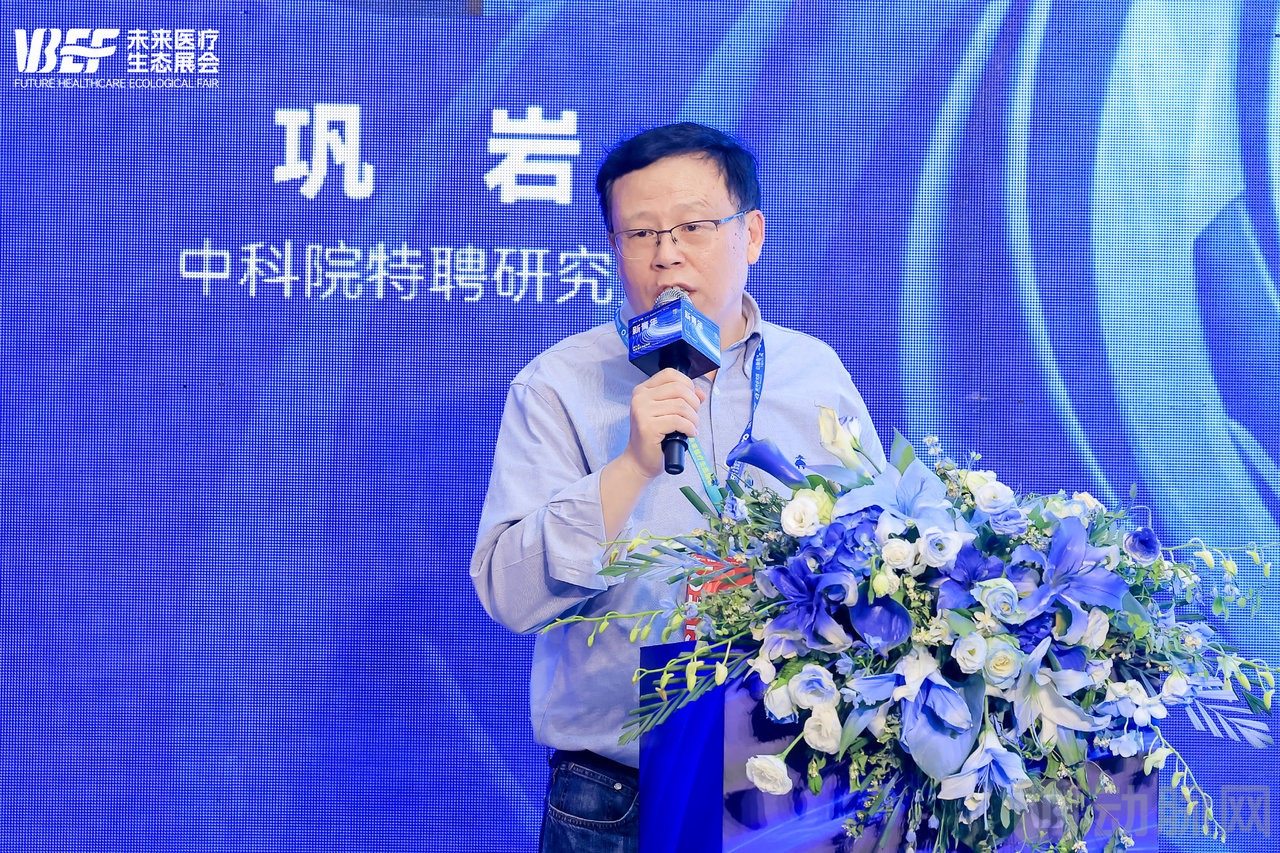
Gong Yan, Distinguished Researcher at the Chinese Academy of Sciences
Independent Innovation + Open Collaboration: Promoting Effective Substitution with Domestically Produced Instruments
The horn of a new round of technological revolution has been sounded; whoever masters scientific and technological instruments holds the key to development.
However, over 90% of China’s high-end instrument market is currently monopolized by foreign companies, with annual imports of instruments and equipment reaching hundreds of billions of dollars. None of the top 20 global scientific instrument companies are Chinese enterprises. This is particularly evident in the field of advanced microscopy, where China’s scientific research faces severe constraints. A single small “hidden champion” abroad withholding supplies can bring Chinese scientific research to a standstill and paralyze industries worth trillions of yuan.
Currently, China’s research on high-end scientific instruments still largely relies on the secondary development of existing technologies. These instruments are not only expensive and difficult to maintain, but their related scientific research parameters are also not accessible to China.
Furthermore, the domestic microscopy market is limited in size, leading many enterprises to prioritize research with greater commercial potential, such as modules or automotive lenses. This has resulted in insufficient investment in microscopic research capabilities in China, a shortage of high-end research teams, and severe underinvestment in processes and technologies.
The Path to Breakthroughs in High-End Microscopy Technology in China Lies in Mastering Key Technologies and Achieving Independent R&D of Core Components, Thereby Promoting the Effective Replacement with Domestically Produced Instruments.
In recent years, China has witnessed rapid advancements in the field of ultra-high-resolution microscopy systems, which have spurred numerous new application demands. This is particularly evident in biological research, where such systems are utilized for cell observation, gene sequencing, cancer diagnosis, and brain science studies. Furthermore, the semiconductor metrology sector requires more advanced microscopy systems featuring higher resolution, superior contrast, faster imaging speeds, and greater observation depth, along with specialized system parameters such as operating wavelength band, working distance, distortion, chromatic aberration, and field of view.
Microscopic objectives are the core of super-resolution microscopy systems. Currently, the domestic high-end microscopic objective market is monopolized by five major companies. Insufficient early-stage investment in China’s microscopy sector has led to technological bottlenecks.
Improving resolution is a major challenge in optical engineering, particularly in the field of optical microscopy. According to the fundamental formula for microscopy systems, R = k * (λ/NA), resolution can be enhanced by reducing the wavelength (λ) and increasing the numerical aperture (NA). Therefore, essential requirements for microscopy systems include numerical aperture, magnification, field of view size, and chromatic aberration correction. Increasing the numerical aperture of core components represents a critical approach to improving resolution.
Breaking the Monopoly on High-End Microscopy Systems: Establishment of the “Advanced Microscopic Optical Engineering Center”
To break the monopoly on high-end microscopy technology, we established the “Advanced Microscopy Optical Engineering Center” with support from a national project, creating a research and development platform for microscope objectives that leads in technological capability within China.
The Center boasts a domestically leading R&D platform for ultra-precision objective lenses, having established a fully digitalized R&D process and workflow for microscopic optical objectives. This encompasses optical design, opto-mechanical design, optical fabrication, precision machining, assembly and integration, image quality inspection, and objective lens packaging. The platform possesses the capability to develop system-level ultra-precision optical objectives and intelligent optoelectronic instruments, along with the infrastructure and conditions for ultra-precision manufacturing across the entire process chain. Furthermore, it has cultivated a team of engineers with extensive experience in optical objective lens manufacturing.
In the field of microscope objective lens development, we have overcome multiple key technologies and processes, including multi-parameter collaborative design, manufacturing of specialized micro-optical components, and high-precision assembly. We have successfully developed four series of microscope objectives: high numerical aperture (NA), broadband, large field-of-view, and extreme environment series. The technical specifications of our independently developed objectives have reached international first-class standards, achieving domestic substitution for imported products. Furthermore, we have supported the successful implementation of several national major instrument projects.
Applications of microscope objectives include two-photon STED microscopy, structured illumination microscopy, large-field-of-view optical tomography microscopy, and mesoscopic two-photon microscopy. These instruments have played a significant role in live-cell imaging, targeted drug imaging for liver cancer, and mesoscopic imaging of HE-stained mouse brain sections.
The independently developed two-photon microscope, equipped with the NA 0.72 broadband long-working-distance two-photon objective lens developed in this project, has been exported to leading countries in microscopy technology, including Germany, Japan, and the United States.
During the development of microscope objectives, we independently developed two critical high-precision optical assembly and testing instruments: an integrated decentering and spacing tester, and a non-contact lens center thickness gauge. These devices were previously manufactured exclusively by German companies and were prohibitively expensive.
In the future, the development of microscopy systems will integrate novel principles and technologies with new devices, focusing on core components of microscopic optics. Domestically produced microscopes will evolve toward serialization, customization, and high-end positioning to achieve world-class scientific research outcomes. Artificial intelligence and algorithms will also play a significant role in scientific instruments.
As a global leader in science and technology, quality, and manufacturing, we must possess our own advanced optical microscopy instruments to support technological innovation and industrial applications. The state should provide policy support to promote the development of domestically produced scientific research instruments and achieve integration among industry, academia, research, and application. We are confident that the goal of bringing Chinese-made scientific research instruments to the global market will be realized in the near future.