

Thirteen Chinese Cities Offer Up to ¥5 Billion in Incentives to Attract Innovative Drug Projects
It was foreseeable from the moment innovative drugs were included in the Government Work Report for the first time at the national Two Sessions a few months ago that 2024 would be no ordinary year.
Since 2024, provinces and municipalities including Shandong, Hainan, Jiangsu, and Beijing, as well as cities such as Guangzhou, Zhuhai, Haikou, and Wenzhou, have successively introduced policies to support innovative drugs. According to incomplete statistics, these initiatives have spanned 13 regions across China, characterized by extensive coverage, substantial support, and rapid implementation.
For example, Beijing, Guangzhou, and Zhuhai all released new policies on the same day, becoming a hot topic of discussion within the industry. Notably, on April 7, while soliciting public comments on the “Several Measures to Support the High-Quality Development of Innovative Pharmaceuticals in Beijing (2024),” Beijing authorities stated that due to time constraints, the public comment period was shortened to three working days; ten days later, the document was officially issued.
The successive new policies have become the industry bellwether for 2024 and the years ahead.
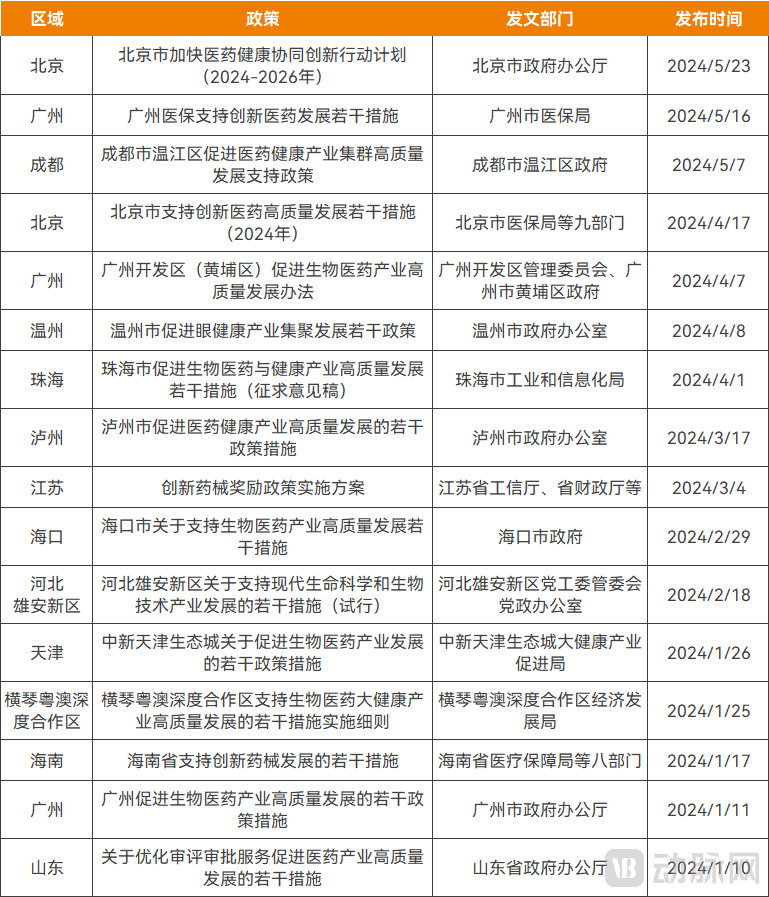
Selected Policies Supporting Innovative Drugs Implemented Nationwide Since 2024, Source: Official Websites of Local Governments
The 2024 Government Work Report pointed out that it is necessary to actively cultivate emerging industries and future industries, including accelerating the development of cutting-edge emerging industries such as hydrogen energy, new materials, and innovative drugs, and actively creating new growth engines such as biomanufacturing, commercial aerospace, and the low-altitude economy; innovative drugs have also been included in the category of "new quality productive forces," which signifies a leap in productivity.
Top-level design must be implemented through concrete measures.Among the measures to encourage the development of the biopharmaceutical industry, the most direct ones are financial support, rewards, or subsidies. In 2024, many regions formulated policies to support and reward innovative projects or enterprises in the pharmaceutical and medical device sectors, with amounts ranging from hundreds of thousands to billions of yuan.
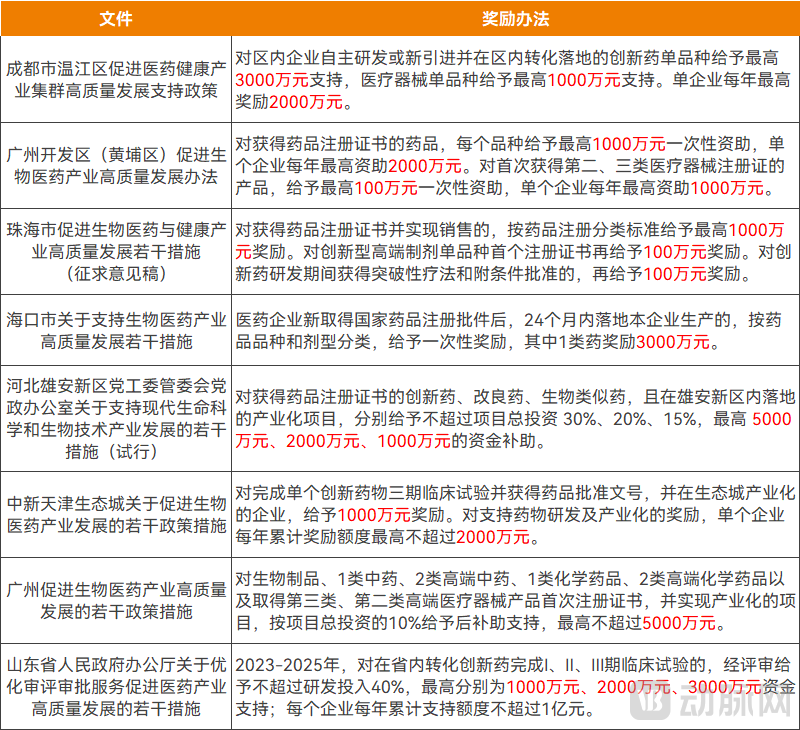
Partial Reward Measures for the Formulation of New Policies on Innovative Drugs in Various Regions, Source: Official Websites of Local Governments
In the R&D phase, various regions provide support for the conversion of innovative achievements and clinical trials through measures such as financial rewards, equity investments, and interest-subsidized loans.
Guangzhou will provide up to RMB 5 billion in support, on a case-by-case basis, for several top-tier biopharmaceutical projects led by globally influential masters and strategic scientists, which feature disruptive technological innovations and clear, broad application prospects. This support covers the stages of scientific research and development, achievement transformation, and industrialization.
From 2023 to 2025, Shandong Province will provide financial support of up to 40% of R&D investment, capped at RMB 10 million, RMB 20 million, and RMB 30 million respectively for Class 1 innovative drugs that have completed Phase I, II, and III clinical trials and achieved transformation within the province, subject to review. The cumulative annual funding cap per enterprise is RMB 100 million.
In terms of innovative achievements, local governments typically provide rewards for products that have obtained registration certificates for innovative drugs and innovative medical devices. Among these, Class 1 new drugs and Class III medical devices that have passed the special review procedure are eligible for more substantial rewards, with a single product category receiving up to tens of millions of yuan.
The pharmaceutical industry is a vital component of the industrial system, holding significant value for local tax revenue, employment, and the enhancement of industrial chains. Therefore, in the manufacturing sector, local governments are vigorously supporting the development of CDMO/CMO enterprises and encouraging innovative drug and medical device companies to establish local production.
The Xiong’an New Area in Hebei Province provides subsidies covering 20% of the total project investment, as assessed and approved, for public service platforms such as CROs, CDMOs/CMOs, and CSOs, with a maximum cap of RMB 50 million. Haikou offers one-time rewards to pharmaceutical enterprises that commence local production within 24 months after obtaining new national drug registration approvals; these rewards are categorized by drug type and dosage form, with Class 1 new drugs receiving RMB 30 million.
Introducing non-local products for local production is also a key strategy. For example, Haikou encourages pharmaceutical companies to purchase, transfer, and introduce drug production approval documents from regions outside the city and manufacture the drugs in-house. Xiamen supports enterprises in acquiring and commercializing scientific and technological achievements from both domestic and international sources; enterprises that purchase major biomedical scientific and technological achievements and achieve their industrialization within the city are eligible for subsidies of up to 30% of the actual technology transaction amount paid.
Optimizing the review and approval processes for incentive or support programs was also a major highlight among the many policies introduced in 2024.
Despite the active provision of substantial financial support for the innovative drug industry across various regions, in most cases, enterprises are required to submit applications in accordance with policy requirements and undergo multi-tiered approval processes before eligible entities can receive the corresponding funds.
In 2024, Jiangsu Province pioneered the “no-application-required” model for provincial fiscal funds, whereby eligible innovative drug companies receive direct rewards without undergoing the traditional processes of application submission, expert review, and public selection announcements. This initiative covered 20 enterprises and supported 26 innovative drugs and medical devices, including 8 innovative drugs, 9 improved drugs, and 9 innovative medical devices, with a total reward fund of RMB 166 million. This measure has greatly facilitated business operations and enhanced enterprises’ enthusiasm for innovation.
Overall, the innovative drug encouragement policies across various regions generally follow this trajectory: attracting innovative R&D projects, vigorously promoting the local transformation of innovative achievements, and introducing external projects for local production, with these main lines proceeding simultaneously.
Yu Jianlin, Deputy General Manager of GTJA Investment, stated that driven by favorable policies, capital market development, talent acquisition, and domestic demand, China’s biopharmaceutical industry has experienced rapid growth over the past decade. It has become the world’s second-largest pharmaceutical market, with the number of new drugs under clinical development also ranking second globally.
“In the global innovation market, China’s biopharmaceutical industry has gradually evolved from a follower to a peer, and in certain areas, it has even taken the lead; in some emerging sectors, such as genetic testing, innovative vaccines, novel antibodies, and cell therapy, we have established comparative advantages,” said Yu Jianlin. “However, it is undeniable that the industry does face certain challenges, such as deficiencies in fundamental theories and key underlying technologies, insufficient accumulation of bioinformatics resources, and weak original innovation capabilities.”
An analysis of new policies introduced since 2024 reveals that original innovation and the foundational research underpinning it are receiving increasing attention. In popular fields where various regions are actively making strategic investments—such as cell and gene therapy, synthetic biology, brain science, and foods for special medical purposes (FSMP)—there is no uniform “involution” within the same hot tracks despite the widespread competition for high-quality projects. Instead, these regions are leveraging their existing industrial foundations and advantageous resources to provide targeted encouragement to key or distinctive niche segments.
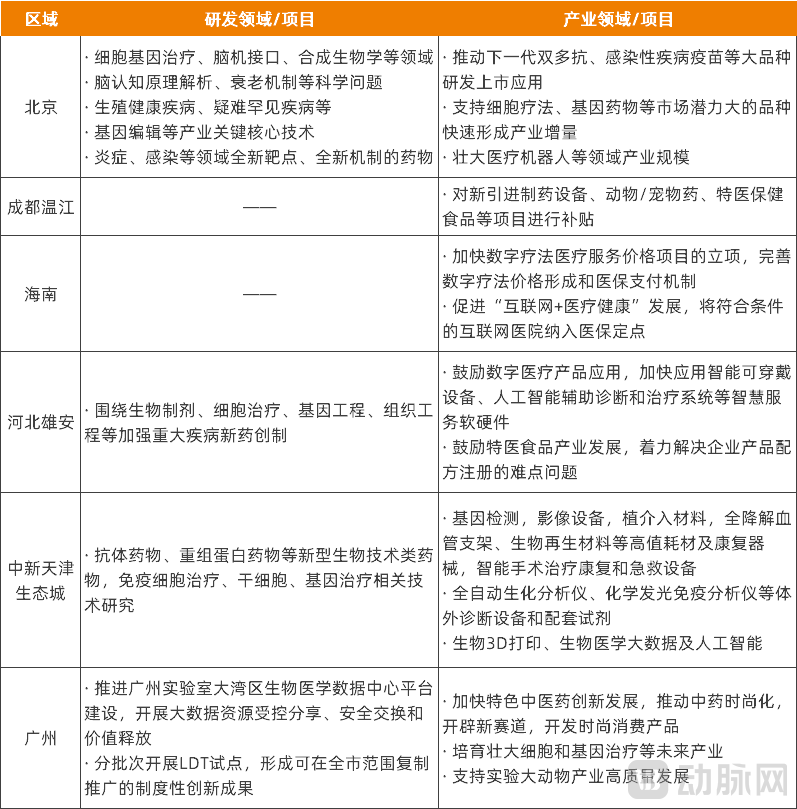
Selected Sub-sectors Prioritized for Development in R&D and Industry Across Various Regions, Source: Official Websites of Local Governments
Beijing is home to a concentration of top-tier universities and research institutions, as well as a large community of scientists, and has already achieved numerous innovations in frontier technological fields. Building on this foundation, Beijing will focus on key disease areas and technological domains in the future, striving for further breakthroughs in both basic and applied research.
In accordance with the "Beijing Action Plan for Accelerating Collaborative Innovation in Medicine and Health (2024–2026)," Beijing will achieve research breakthroughs on major scientific challenges and key technologies in fields such as degenerative diseases; foster disruptive and pioneering scientific discoveries and technological breakthroughs in frontier areas including cell and gene therapy, brain-computer interfaces, and synthetic biology; and support basic research on forward-looking major scientific issues such as the elucidation of principles of brain cognition and mechanisms of aging.
Medical laboratory testing is one of Guangzhou’s key industries. Benefiting from early market entry, policy support, and a virtuous cycle of corporate innovation, Guangzhou has cultivated leading companies in the medical laboratory testing sector, such as KingMed Diagnostics and Daan Gene. It has also formed industrial clusters like Guangzhou International Bio Island and Guangzhou Science City. The industry chain, centered on medical laboratory testing services, comprehensively covers upstream and downstream segments, including the research, development, and manufacturing of in vitro diagnostic reagents and equipment, pathological diagnosis, data services, and cold-chain logistics.
In recent years, under the trend of precision medicine, Laboratory Developed Tests (LDTs) will become an important component of medical testing. LDTs in China are still in a very early stage.
As early as 2022, Guangzhou had already proposed plans to explore the Laboratory Developed Tests (LDT) model. In 2024, the "Several Policy Measures for Promoting High-Quality Development of the Biopharmaceutical Industry in Guangzhou" further clarified that pilot programs for LDT in vitro diagnostic (IVD) reagents would be rolled out in batches. Medical institutions with appropriate capabilities are encouraged to collaborate with key enterprises in the LDT sector to conduct LDT pilots for IVD reagents that have no comparable products currently marketed in China, yet address significant clinical needs, feature mature technologies, and pose controllable risks. The aim is to develop institutional innovations that can be replicated and promoted across the entire city in the future.
By boldly embracing Laboratory Developed Tests (LDTs), Guangzhou will further expand the scale of its medical testing industry and its upstream and downstream sectors.
Following the establishment of the Boao Lecheng International Medical Tourism Pilot Zone, digital therapeutics has emerged as a key area of focus in Hainan. Over the past two years, Hainan has taken significant steps in clinical trials, regulatory review and approval, product promotion and application, and industry exchanges related to digital therapeutics, achieving substantial results.
In 2024, the "Several Measures of Hainan Province to Support the Development of Innovative Drugs and Medical Devices" stated that the approval process for pricing items related to digital therapeutics services will be accelerated, the price formation and medical insurance payment mechanisms for digital therapeutics will be improved, and the integration of digital therapeutics with DRG/DIP medical insurance payment reforms will be promoted to leverage their role in controlling healthcare costs and accelerating their application in health management.
Similar to its support for other innovative pharmaceutical and medical device products, Hainan has adopted more specific measures for digital therapeutics. For instance, the "Several Measures of Haikou City on Supporting the High-Quality Development of the Biopharmaceutical Industry" encourages medical institutions to use digital therapeutic products, offering a one-time reward of RMB 100,000 to those that establish digital therapy diagnosis and treatment centers. Medical institutions that use digital therapeutic products manufactured by local enterprises for diagnosis and treatment shall receive rewards based on the number of approval documents obtained for initial adoption; each approval document qualifies for a reward of RMB 200,000, with the total annual reward for any single medical institution capped at RMB 1 million.
At a time when digital therapeutics worldwide are still validating their clinical value and commercialization pathways, Hainan’s robust support for the sector demonstrates its determination to lead global innovation.
Of course, the cities and niche sectors listed here are merely the tip of the iceberg. It is certain that while the focal points of each city’s niche sectors share a common lineage, they also strive to continuously break new ground and identify new growth drivers.
Since the pharmaceutical review and approval reforms, nearly a decade of development has brought China’s innovative drugs into a harvest period. From 2020 to 2023, 47, 21, and 40 innovative drugs were approved annually in China. With the intensive approval of products, commercialization challenges have emerged.
“Currently, hospitals face significant challenges in introducing innovative products due to assessment constraints such as the drug-to-revenue ratio and the retention of surplus funds, as well as pressure from DRG/DIP payment reforms.” Yu Jianlin believes that in the payment sector, China’s payment system is predominantly reliant on basic medical insurance, with commercial insurance yet to fully develop and patient acceptance still needing improvement. Under the overarching principles of basic coverage and cost containment within medical insurance, the prices of innovative drugs and devices have not yet been fully aligned with their value.
Under the new policies introduced in 2024, regions such as Beijing, Hainan, and Guangzhou saw participation from healthcare security authorities, which collaborated with health commissions, drug regulatory agencies, and financial regulatory bodies to propose supportive measures for innovative products in areas including pricing, hospital admission, medical insurance reimbursement, and the supply of commercial health insurance.
Among these initiatives, Hainan will establish a mechanism for determining the initial launch prices of newly approved innovative drugs and medical devices: adhering to the principle of enterprise-led pricing to stimulate innovation, guiding companies toward reasonable pricing, and improving full-cycle price management and oversight. Beijing, meanwhile, has proposed prioritizing the initiation of unified pricing evaluation procedures for innovative technology projects, while concurrently studying their inclusion in medical insurance reimbursement.
Another high-level document has also indicated one of the directions for the future pricing mechanism of innovative drugs. In January 2024, the General Office of the Communist Party of China Central Committee and the General Office of the State Council issued the “Implementation Plan for the Comprehensive Reform Pilot in Pudong New Area (2023–2027),” which proposes that, in accordance with relevant regulations, new biopharmaceutical products be allowed to reference international prices for comparable drugs, thereby supporting the development of the innovative drug and medical device industries.
During the hospital admission process, many regions have adopted key measures such as establishing “green channels” for innovative products to facilitate rapid online listing; separately settling the costs of drugs or therapies associated with innovative products, excluding them from DRG/DIP payment systems; and exempting the use of innovative drugs and medical devices from relevant performance assessments. These policies provide healthcare institutions with stronger incentives to prioritize clinical needs in the adoption of innovative products.
In the payment sector, the National Healthcare Security Administration has vigorously promoted the timely inclusion of new drugs in the national reimbursement drug list in recent years. While localities are further facilitating the implementation of medical insurance payment policies, they are prioritizing commercial health insurance as a key channel for expansion.
In cities such as Beijing and Guangzhou, where there is a large number of enterprises, local healthcare security administrations encourage companies to establish supplementary medical insurance. Leveraging preferential policies that allow supplementary medical insurance premiums to be expensed as costs, they support the purchase of supplementary medical insurance products covering innovative drugs and medical devices.
To address the scarcity of medical and health insurance data resources essential for developing commercial health insurance products, Beijing and Hainan are encouraging exploration of information-sharing mechanisms between healthcare data and commercial health insurers. This initiative aims to facilitate data sharing between basic medical insurance platforms and commercial insurance companies, thereby promoting the compliant application of such data in the development of commercial insurance products and claims processing.
In fact, as early as 2023, the Shanghai Municipal Healthcare Security Administration, in collaboration with local health and financial regulatory authorities, formulated the “Several Measures for Further Improving the Multi-Payer Mechanism to Support the Development of Innovative Drugs and Medical Devices in Shanghai,” aiming to break through a series of bottlenecks on the commercialization path for innovative products.
In March 2024, Shanghai publicly disclosed the progress of the aforementioned policies: the effective implementation of the new policies has significantly boosted the biopharmaceutical industry, with its scale reaching RMB 933.732 billion in 2023, a year-on-year increase of 4.9%. High-end manufacturing segments such as therapeutic biological products, implantable and interventional devices, and medical imaging equipment have experienced relatively rapid growth.
Furthermore, in 2023, Shanghai’s medical institutions spent RMB 10.8 billion on procuring innovative drugs included in the National Reimbursement Drug List (NRDL) through price negotiations, representing a year-on-year increase of 73.1%. Taking a Shanghai-based biopharmaceutical company specializing in the R&D of targeted innovative drugs as an example, two Class 1 new drugs independently developed by the company were successfully renewed for inclusion in the NRDL and added to Shanghai’s “New and Superior Drugs and Medical Devices” catalog. Following the implementation of the new policy, these two products have been adopted by multiple municipal-level medical institutions, with their sales revenues in the Shanghai market increasing by 36% and 105%, respectively, in the second half of 2023 compared to the same period of the previous year.
The pace of commercialization directly determines whether innovative enterprises can recoup their R&D costs and secure funding for further product development. Shanghai’s current initiatives to support the commercialization of innovative drugs and medical devices have already yielded tangible results. It remains to be seen whether other new policies will achieve similarly immediate effects—a prospect worth anticipating.
With solutions to challenges across the entire product lifecycle in place, innovative drugs still face another major hurdle: funding shortages. The current landscape is characterized by difficulties in primary market financing, a narrowing IPO pipeline, and challenges for investors in exiting their positions. These factors are intertwined and mutually reinforcing, resulting in a capital winter.
As mentioned earlier,Various regions are making substantial investments and offering rewards to foster innovation. However, relying solely on subsidies is far from sufficient for innovation; it must depend on market-driven capital.
The incentive policies issued by various regions in 2024 also included support for the capital market of innovative drugs.
Guangzhou encourages and supports government-guided funds in the biopharmaceutical sector to “invest early, invest in small enterprises, and invest in innovation.” It encourages various government-funded science and technology innovation fund-of-funds, private equity funds of municipal state-owned enterprises, and venture capital funds to increase their investment ratios in early-stage biopharmaceutical projects, with a focus on seed-stage and start-up stage technological innovation enterprises or projects.
Beijing is also channeling more capital into early-stage and small-scale investments, leveraging the Beijing Pharmaceutical and Health Industry Investment Fund to mobilize social investment; it is strengthening its pipeline of companies preparing for initial public offerings (IPOs), with a focus in 2024 on providing IPO readiness support and services to 10 key enterprises, and aims to add 20 newly listed companies between 2024 and 2026.
“Biopharmaceuticals is characterized by high risks, substantial capital requirements, and long development cycles. Financing permeates the entire process of corporate growth and expansion. Even after a company goes public, it continues to engage in pipeline in-licensing and industrial M&A, necessitating ongoing refinancing. A multi-tiered capital market plays a pivotal role in the development of the industry,” stated Yu Jianlin.
In the secondary market, in 2024, the China Securities Regulatory Commission (CSRC) not only reiterated relevant provisions regarding the listing of pre-profit companies on the STAR Market but also amended the Guidelines for Evaluating Sci-Tech Innovation Attributes (Trial), raising the requirements for proposed issuers in terms of R&D investment, number of invention patents, and compound annual growth rate of operating revenue.
The new policy places greater emphasis on screening for genuinely innovative enterprises. In the short term, this has resulted in a narrowing of IPO channels; however, in the long run, it will facilitate listing and capital raising for truly outstanding companies, enabling their further development through subsequent financing rounds.
Therefore, despite the encouragement and support from various innovative drug policies across different regions, many enterprises and investment institutions still have to endure the growing pains brought about by changes in the listing environment. Against this backdrop, enterprises need to establish diversified sources of funding, while investment institutions need to explore diversified exit channels.
In March 2024, a draft document titled “Implementation Plan for Full-Chain Support of Innovative Drug Development (Draft for Comments),” reportedly drafted by departments under the State Council, circulated online. The document immediately stirred significant discussion within the industry, as it was regarded as the most substantial policy initiative by the state to support innovative drugs since the pharmaceutical regulatory reforms. To date, although the document has not been officially released,Based on the preceding analysis of innovative drug policies across China, measures to support innovative drugs throughout the entire value chain have begun to take shape and have even been implemented in certain regions.
Currently, China’s policy framework for innovative drugs has stabilized and matured. Looking ahead, “innovation” will remain a key focus over the long term.
In Yu Jianlin’s view, previous innovation efforts in China favored follow-on innovations characterized by relatively short R&D cycles, lower risks, and modest investment. In 2024, with the successive introduction and implementation of new policies, comprehensive support has been extended across the entire innovative drug value chain, signaling that the era of source innovation may be dawning.