

Dr. Yan Wei of Peking University School of Stomatology Proposes Novel 'Ion Conduction' Mechanism for Dental Pain and Advances Clinical Translation through Medical-Engineering Integration
With the new round of higher education institutional reforms in the 1980s, numerous previously independent medical colleges and universities chose to merge with comprehensive or polytechnic universities. This move rapidly promoted the widespread adoption and application of the “medical-engineering integration” concept within research institutions. After forty years of continuous exploration and development, “medical-engineering integration” has become an indispensable component of today’s medical innovation landscape.
At the 8th Future Medical Ecology Expo—China Conference on Integration of Medicine and Engineering in 2024, Professor Wei Yan, Chief Physician at Peking University School of Stomatology, emphasized the pivotal role of interdisciplinary research between medicine and engineering in addressing practical clinical challenges during his keynote address. He delved into the novel mechanism of “ionic conduction” in dental pain and elaborated in detail on the advances in the application of biomimetic materials in dental restorations and implants. Drawing upon extensive experience in dental clinical research, he provided new insights and directions for the future development of dental medical technologies.
Due to the nature of their work, dentists maintain a close integration with medical engineering. Rather than relying primarily on surgical incisions or pharmacological prescriptions, dentists leverage manual dexterity in conjunction with advanced medical devices and high-quality materials to restore dental defects, thereby reinstating normal morphology and function to achieve therapeutic outcomes.
However, dentists also face numerous challenges. First, superficial tooth defects can cause excruciating pain, and currently available analgesic methods are suboptimal in efficacy. Second, larger tooth defects require restorative fillings, but the durability of current filling materials needs improvement, as they frequently dislodge after placement. Finally, in cases of complete tooth loss, patients require dental implants; however, the lifespan of implants is relatively short and cannot compare with that of natural teeth.
Therefore, conducting research centered on clinical bottlenecks is crucial for achieving further breakthroughs in the field of oral healthcare.
For toothache relief, the prevailing method currently on the market primarily involves occluding dentinal tubules with mineral salts to isolate external stimuli.
The theoretical basis for this treatment is the "hydrodynamic theory of dentinal pain," which posits that external stimuli induce fluid movement within the dentinal tubules, thereby generating mechanical forces that trigger nerve impulses and result in tooth pain. However, the analgesic effect of this approach is often short-lived and fails to provide long-term pain relief.
Drawing on clinical practice, a team led by Dr. Wei Yan, Chief Physician at Peking University School of Stomatology, embarked on an in-depth investigation into the mechanisms of dental pain. During this exploration, they unexpectedly discovered previously overlooked tubular structures within the teeth. These specialized conical channels, located between the walls of the dentinal tubules and the odontoblasts, exhibit three distinct characteristics: an asymmetric conical structure, nanoscale pore diameters, and a high density of negative charges. These features bear striking resemblance to the ways in which cellular transmembrane ion channels perceive and respond to external stimuli.
It is precisely for this reason that the team developed a new concept: the tooth functions as a single large cell, with dentinal tubules acting analogous to transmembrane ion channels within a cell, responsible for sensing and transmitting external stimuli.
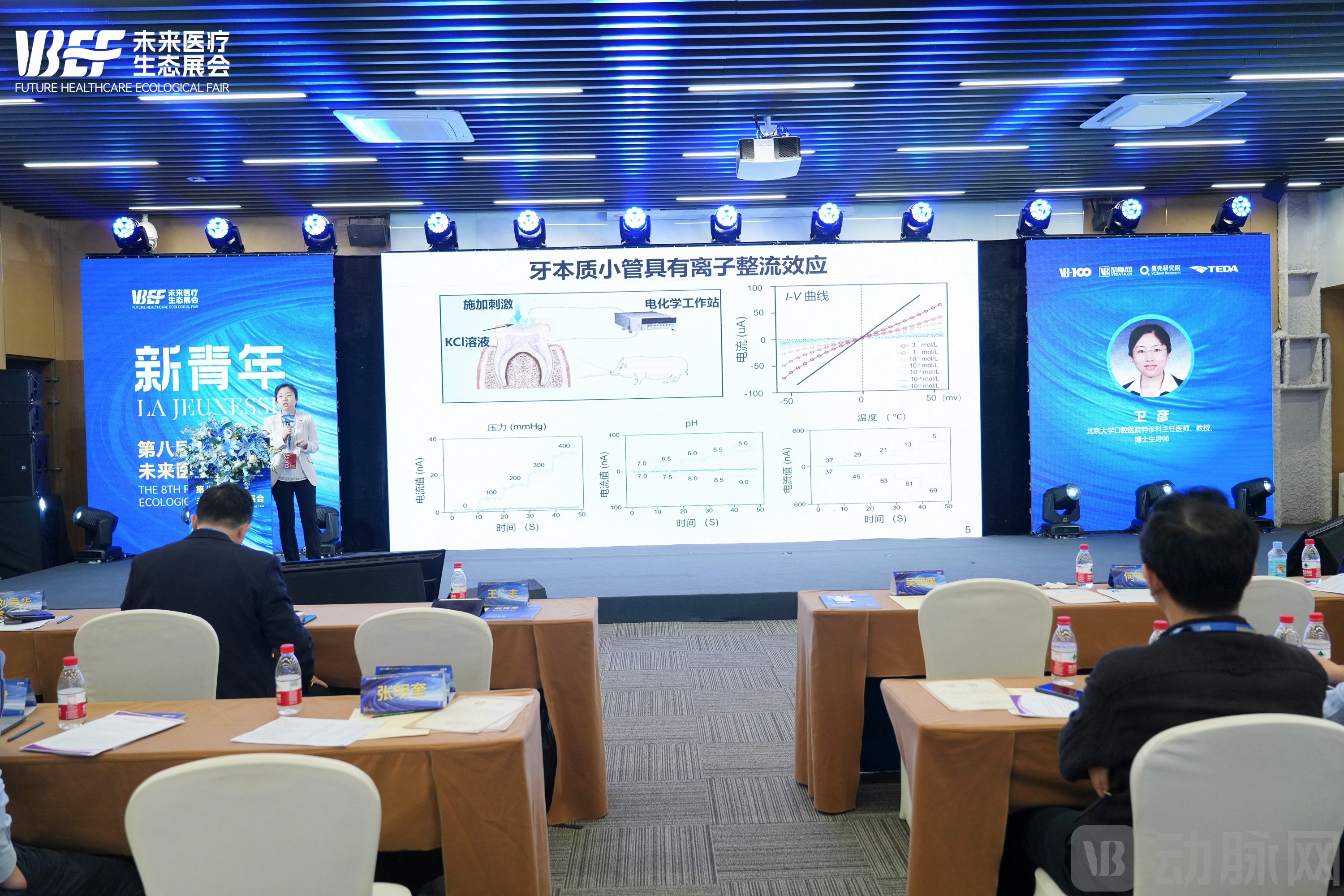
To validate this hypothesis, the team established an animal model of dentin hypersensitivity in pigs and conducted a series of studies analogous to those on transmembrane ion channels using an electrochemical workstation. The experimental results strikingly confirmed the hypothesis: when pressure, acidic or alkaline, or thermal stimuli were applied to the tooth surface, an electric current was generated between the inner and outer aspects of the tooth. This finding indicates that external stimuli are effectively encoded by the tooth into electrical signals, which then stimulate nerves, thereby triggering tooth pain.
More excitingly, the team constructed a digital model of dentinal tubules based on theoretical simulations. After applying various stimuli to the model, they found that the velocity of ionic currents in dentin is more than 30,000 times faster than the fluid flow rates posited by traditional theories. This high-velocity ionic current can rapidly traverse the dentinal tubules, enabling instantaneous sensory transduction.
This discovery has fundamentally reshaped the understanding of the mediators involved in transmitting dental pain stimuli, offering new perspectives for the treatment of toothache.
Based on these findings, Professor Wei Yan’s team proposed the “ionic conduction” mechanism of tooth pain, overturning the “classical theory of tooth pain.”
“The Classic Theory of Dental Pain” posits that dental pain is caused by fluid flow induced by external stimuli, whereas the “Ion Conduction” mechanism of dental pain suggests that pain is triggered by ion flows initiated by external stimuli, which are then converted into electrical signals to stimulate nerves.
Furthermore, this theory can adequately explain specific symptoms of tooth sensitivity.
For example, people often experience tooth sensitivity when eating pineapples, meaning that teeth respond more intensely to acidic stimuli and relatively weakly to alkaline stimuli. This phenomenon is difficult to explain reasonably within the framework of traditional theory, because according to liquid-sensing-based theories, both acidic and alkaline stimuli drive fluid flow through concentration gradients; thus, equal amounts of acid and base should generate equal mechanical forces.
However, the mechanism of “ion conduction” in tooth pain can provide a reasonable explanation for this. Specifically, an equivalent amount of acid generates twice the cation flux within dentinal tubules compared to alkali, resulting in a significantly increased ionic current and causing more intense pain when acidic foods are consumed.
At the conference, Wei Yan pointed out that as a clinician, basic research should always revolve around the actual needs of patients.
Based on the theory of "ionic conduction," Professor Wei Yan’s team designed a cationic hydrogel to occlude dentinal tubules, thereby controlling the transmission of ionic signals. This hydrogel inhibits ionic signaling through the principle of electrostatic repulsion, while its porous structure prevents extrusion by hydraulic pressure, effectively blocking external stimuli and significantly reducing neuronal action potentials, thus preventing the onset of pain. Currently, this product has completed clinical validation and is undergoing second-round review.
For extensive tooth defects, traditional restorative materials often exhibit low strength and poor toughness, resulting in compromised mechanical properties of the restored teeth and a high rate of restoration failure. The fundamental cause lies in an insufficient understanding of the structural and functional basics of teeth, leading to a lack of theoretical foundation in the development of dental restorative materials.
To address this issue, Professor Wei Yan conducted an in-depth analysis of tooth structure and discovered that teeth are composed not only of ordered crystals but also contain amorphous components. These amorphous components can scatter and dissipate stress during mastication, complementing the crystalline phase to jointly enhance the mechanical properties of teeth. Based on this finding, and in collaboration with materials scientists, a biomimetic assembly technology was developed to create aNovel Biomimetic Restorative Materials, achieving robust and rigid biomimetic restoration. The material is highly compatible with natural teeth in terms of mechanical properties and has been successfully applied to the new clinical pathway of "digital dental fillings."
For completely missing teeth, dental implants are a common restorative option. However, the significant disparity in mechanical properties between traditional implants and bone tissue can easily generate interfacial stress, leading to bone resorption and implant loosening. To address this issue, Professor Wei Yan has also proposedFunctional Periodontal Ligamentdesign philosophy, through theoretical simulation to optimize the bidirectional component design of amorphous metals and flexible polymers. This design can buffer stress, activate osteogenic signaling pathways, while achieving both stress buffering and osseointegration, thereby mimicking the function of the natural periodontal ligament. Currently, this product has obtained relevant registration certificates.
In summary, to address the bottleneck issues faced in clinical dentistry, it is still necessary toFrom a clinical perspective, integrating theoretical research to deeply investigate the mechanisms of disease pathogenesis, and developing innovative biomimetic repair technologies and clinical strategies,Overcoming clinical bottlenecks in dental fillings, restorations, and implants by ultimately providing technical and product support, thereby effectively breaking through the limitations of existing clinical practices.