

Development and Clinical Translation of Degradable Metallic Stents for Head and Neck Vasculature by Dr. Aihua Liu, Director of Neurosurgery at Beijing Tiantan Hospital
Currently, cerebrovascular disease has become the leading cause of disability and death worldwide. Statistics show that the number of patients with cerebrovascular disease in China has reached 14 million, with 3 million new cases added annually. In the field of treatment, stent technology has become one of the primary therapeutic approaches, playing a significant role in improving patients' quality of life and reducing mortality rates.
It is worth noting that although 80% of cardiac stents are domestically manufactured, imported products still account for 70%-80% of the market share. This phenomenon not only reveals the significant potential of China’s cerebrovascular stent market but also highlights that domestic cerebrovascular stent products still have room for improvement in terms of technology and quality. Therefore, strengthening technological research and development and innovation in the field of cerebrovascular stents, and enhancing the competitiveness of domestic products, will be an important direction for future development.
The integration of medicine and engineering, as a critical pathway for medical innovation, is undoubtedly key. Only by organically combining new materials, new technologies, advanced computing, and novel applications with clinical needs can we better develop innovative medical devices that address clinical challenges.
At the 8th Future Medical Ecosystem Expo—China Conference on the Integration of Medicine and Engineering in 2024, Liu Aihua, Director of the Department of Neurosurgery at Beijing Tiantan Hospital, delivered a presentation titled “Research and Development and Clinical Translation of Biodegradable Metal Stents for Head and Neck Vessels.” Drawing on clinical practice, he elaborated in detail on how the integration of medicine and engineering drives advancements in medical science.
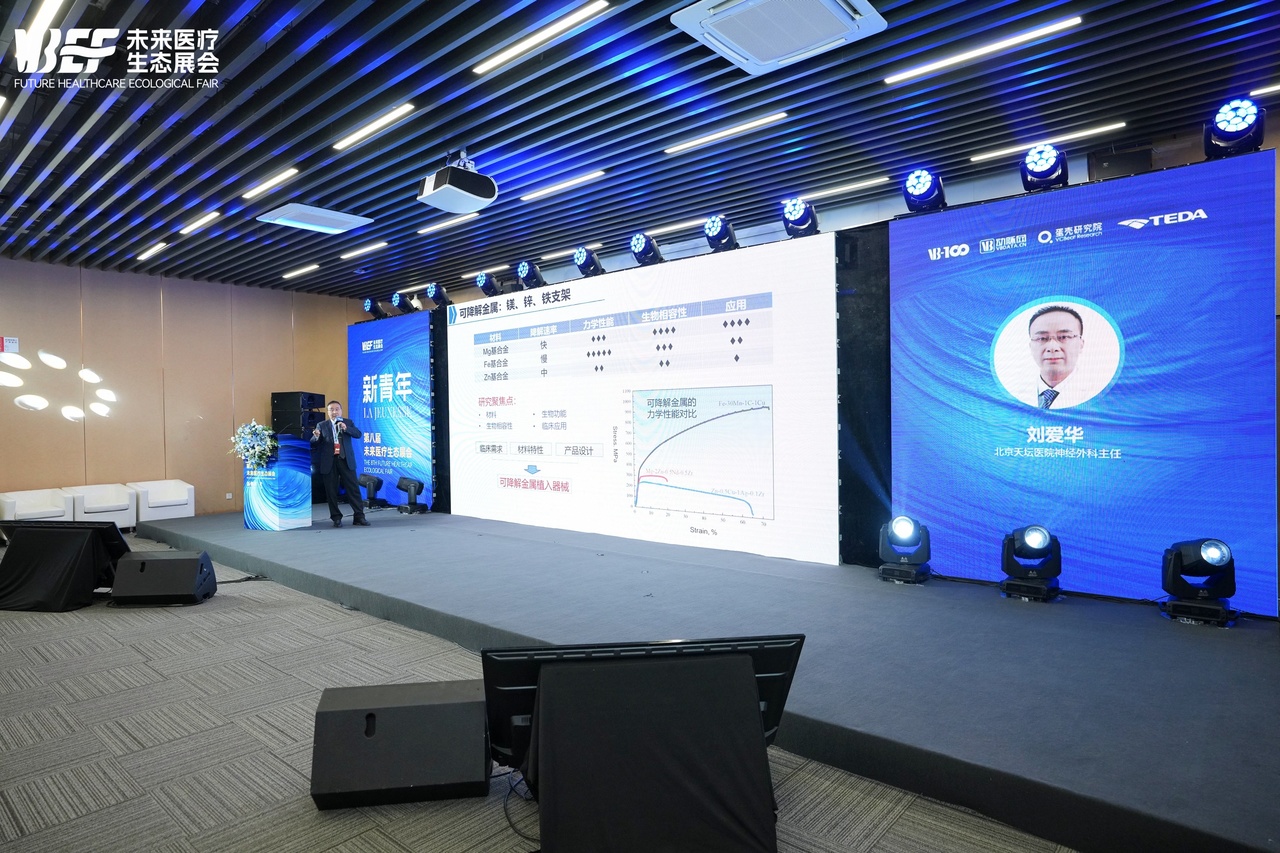
Cerebrovascular diseases demonstrate significant market potential and growth opportunities. However, current stent technologies still face three core challenges that urgently need to be addressed: first, the stent must remain permanently implanted in the body; second, there is a risk of post-procedural thrombosis and restenosis; and third, patients are required to take medications long-term. This undoubtedly increases the burden and risks for patients.
To address the aforementioned challenges, Liu Aihua’s team has been dedicated to developing fourth-generation biodegradable stents, with a particular focus on metallic stents. In selecting metallic materials, they have experimented with various options, including magnesium, zinc, and iron. These materials not only exhibit excellent elasticity and processability but also provide sufficient radial support. More importantly, they are biocompatible and pose no harm to the human body.
Currently, there is an urgent need for such technological innovations in the field of cardiovascular and cerebrovascular diseases to drive progress in the healthcare industry. The research conducted by Liu Aihua’s team on metallic materials, including magnesium, zinc, and iron, has successfully transitioned from animal studies to clinical trials.
Among these metals, magnesium is widely used due to its degradation rate, favorable mechanical properties, and biocompatibility.
Among these, magnesium has been particularly widely used in dentistry and orthopedics. For instance, nails used in orthopedic surgeries do not require removal due to their excellent strength and slow degradation rate, representing a significant breakthrough in the medical field. However, magnesium has a notable drawback in cerebrovascular applications: its degradation rate is too rapid. For example, magnesium stents implanted in blood vessels may completely degrade and collapse within as little as three months.
Zinc-based materials are novel materials developed in collaboration with the University of Science and Technology Beijing. Although they are just preparing to enter the clinical trial phase and face numerous challenges, they represent a zero-to-one innovative endeavor.
For instance, regarding the mechanical properties of biomaterials, there is often initial concern about the insufficient mechanical strength of biodegradable stents. However, zinc-iron alloys have the potential to exhibit superior mechanical properties compared to other metallic materials, enabling the fabrication of thinner and lighter biodegradable stents. A series of experiments conducted at Zhongshan Hospital yielded highly favorable results. Within two years, the material degraded by 80%, and within three years, degradation approached 90%. Notably, the vascular wall became wider after degradation, which holds promise for opening new possibilities in future vascular therapies.
Meanwhile, this stent features a metallic scaffold structure coated with polylactic acid and sirolimus. Its unique design allows patients to undergo magnetic resonance imaging (MRI) after stent implantation. Furthermore, the stent has a thickness of only 50 micrometers, significantly lower than the 60–80 micrometer thickness of conventional coronary stents, while maintaining robust radial support. This innovative design not only enhances patient comfort but also improves long-term safety.
During the development of iron stents, Liu Aihua’s team investigated their compatibility with magnetic resonance imaging (MRI). Experimental results demonstrated that iron stents do not interfere with MRI scans after implantation and even outperform traditional non-degradable stents in certain aspects. Specifically, the iron stents exhibit negligible degradation during the first six months post-implantation, while any metallic interference completely disappears within the subsequent two years, thereby providing superior diagnostic and therapeutic outcomes. The research goal for the next generation of stents is to achieve complete non-magnetism.
Guided by clinical needs and the integration of medicine and engineering in product development, the team’s innovative device received approval in 2014. It was subsequently applied in pediatric pulmonary arteries and has since been successfully used in over 1,000 coronary artery procedures, with no complications reported. The procedural success rate reached 100%. Endothelialization-associated degradation was 34% at six months, 82% at two years, and 95% at three years.
At the conference, Liu Aihua further shared insights based on her own experience: “When our research began to explore head and neck applications on a global scale, we encountered some skepticism. Investment firms were primarily concerned with two issues: first, the magnetic properties of the stent; and second, the issue of vascular wall support after the stent degrades. To address these concerns, we collaborated with Beihang University to strive for reduced magnetism in the stent. Although my background as a medical researcher provides limited insight into engineering principles, our partners indicated that the structure of iron can be modified, and we are actively working in this direction. We selected zinc-iron as the material based on evidence from literature and international biological studies, which confirm that zinc-iron acts as a protective factor, whereas cadmium, copper, and other elements are considered risk factors.”
Finally, Liu Aihua pointed out that compliance and wall apposition are the most critical considerations in stent design. Although endovascular treatment for aneurysms has been supported by evidence-based medicine to date, stenting for intracranial stenosis has not yet gained widespread acceptance. Therefore, the team is also striving to develop new stent scaffolds that can both dilate blood vessels and naturally degrade over time, thereby avoiding complications associated with long-term stent implantation.