

Top-Tier VCs Return: Is the Health Management Sector Making a Breakthrough?
The healthcare sector, which once attracted nearly RMB 7 billion in a single year, had long gone quiet in the primary market. It has only recently returned to the industry spotlight following another round of investments by top-tier institutions.
Recently, Taiyi Guanjia announced the completion of a substantial RMB 920 million financing round, with investors including star institutions such as Shanghai International Asset Management, Mitsui Sumitomo Insurance, China Pacific Insurance, and Sequoia China. Additionally, VCBeat has learned that several venture capital firms are currently engaging with innovative health management companies. This has sparked renewed interest in the health management sector within China’s medical venture capital and private equity industry.
“In recent years, setbacks faced by leading enterprises, the industry-wide challenge of achieving profitability, and the need to improve user awareness have all made the narrative around health management less appealing. As insiders, we have also clearly observed a decline in investor interest in health management,” Wang Qi, a practitioner in the health management industry, told VCBeat.The emergence of this new round of large-scale financing has helped to boost confidence in the industry.”
It is worth noting that health management was once one of the most prominent medical sectors in the spotlight. According to data from the VCBeat Orange Database,From 2018 to 2023, the primary market in the health management sector witnessed over 220 financing and investment events, with total capital inflows exceeding RMB 20 billion.In 2018, the sector witnessed a record high of 74 financing and investment events, with total capital raised nearing RMB 7 billion.(Note: In a broad sense, health management refers to helping people approach a state of complete physical and mental well-being through non-medical means. In a narrow sense, it refers to the direct provision of managed health services using various methods to promote and maintain users’ health, with corporate business models primarily built around delivering these managed health services directly to consumers.)
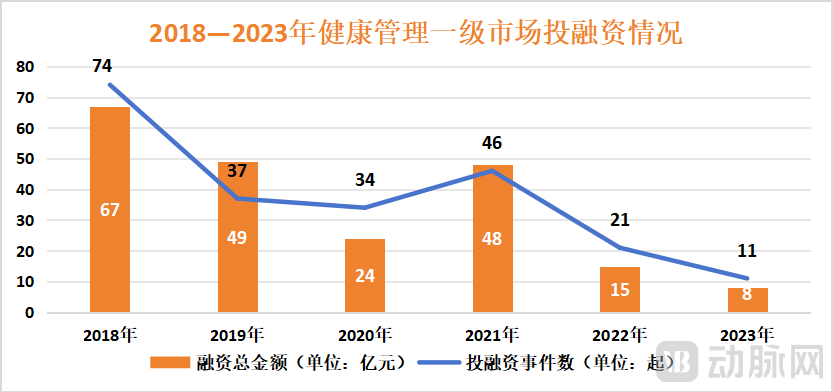 (Data source: Artery Orange Database; Chart by VCBeat)
At that time, the health management sector was white-hot. IDG and SoftBank were actively investing, while firms such as Northern Light Venture Capital, Hillhouse Capital, Sequoia Capital, Matrix Partners China, and CICC frequently appeared in financing news. Flush with capital, numerous innovative companies raced to capture market share. The subsequent developments are well known: some companies went public, others remained stagnant, and still others faded into obscurity alongside their once-prominent financing headlines. During this process, investors recognized the real-world challenges facing the health management industry and scaled back their investments, causing the sector to cool down rapidly.
Once again, the venture capital industry is focusing on health management. Has the sector unveiled a new narrative?
Why Did the Health Management Industry Previously Experience a Rapid Cooling?
In the view of Wang Qi, a practitioner in the health management industry,The business model of health management is difficult to implement or form a so-called closed loop.“A leading listed company in our industry serves as a benchmark; an examination of its financial reports reveals that the vast majority of its revenue comes from product sales (specialty drugs), while revenue derived from providing health management services to users is minimal. This is not an issue faced by a single enterprise, but rather a challenge confronting the entire industry.”
The reasons are threefold: first, a lack of innovative payment models; second, users’ awareness and perceived value of health management services remain to be improved; and third, health management companies fail to offer more services that deliver tangible benefits. These factors ultimately result in a weak alignment between market supply and demand.
Industry insiders once told VCBeat that, under pressure to monetize, many health management companies claim to help users manage their health, butUltimately, many have evolved into profit models focused on helping insurance companies sell more policies or pharmaceutical companies sell more drugs.
From this perspective, the industry is currently seeking solutions by innovating payment models and deepening health management services to ensure users derive tangible benefits.
Payment Innovation and Deepened Services: Both Are Indispensable; Only Through Synergy Can Effective Results Be Achieved
In terms of payment innovation, the integrated development model of “health insurance + health management” has become an industry consensus and achieved certain successes in recent years.
However, in practice,Commercial health insurance mostly serves only a payment function, lacking effective integration with health management., significantly undermining the user experience of health insurance in areas such as risk prevention and medical assistance. For instance, in the pre-diagnosis phase, insurers are unable to intervene promptly in users’ health risks, leading to a continuous rise in disease incidence among insured individuals and a corresponding increase in claim ratios for insurers.
Therefore, designing products that integrate “health insurance + health management” has become critically important.
“More and more people are purchasing insurance today, with a particular focus on whether they can receive timely assistance in the event of illness after buying coverage.On one hand, it provides financial assistance; on the other hand, it offers support in the treatment process.“At the 2024 VBEF Health Management and Health Insurance Innovation Development Forum,” stated Xing Jing, Founder and CEO of Shangyong Technology.
First, Shangyong Technology addresses users' financial difficulties by providing advance payment services. Specifically, after a user submits an application online, Shangyong Technology evaluates the results of basic pre-admission examinations to determine eligibility for insurance claims. Based on this assessment, it advances funds to cover the hospitalization deposit against future medical expenses, and subsequently settles with the insurance company, thereby alleviating the urgent financial burden that prevents patients from being hospitalized due to lack of funds.
To address users’ treatment needs following illness, Shangyong Technology launched in late 2023Specialized Disease Management Services: The First Condition to Undergo In-Depth Management Is Hematologic Malignancies, Which Are Characterized by Long Treatment Cycles and High Costs. The treatment course for this disease lasts 18–24 months, and it is prone to misdiagnosis with suboptimal adherence to standardized treatment protocols. Proactive management can effectively extend patient survival. In response to these challenges, Shangyong Technology deconstructs the entire treatment process into multiple dimensions, including preliminary diagnosis, misdiagnosis, overtreatment, treatment regimens, adverse reaction identification, and compliance management. Based on data analysis, the disease course is further divided into several key nodes, enabling targeted intervention and correction throughout the treatment process.
Meanwhile, Shangyong Technology has independently developed a blood drug concentration early warning model product to help patients achieve appropriate dosage levels, reduce adverse reactions, and improve treatment outcomes.
Xing Jing, CEO of Shangyong Technology, further stated that while helping users achieve better diagnostic and treatment outcomes, it is also essential to focus on the sustainability of commercial health insurance. By reducing insurers’ additional payout pressures caused by over-treatment, commercial health insurance can continue to provide better services to more patients. The purpose of implementing whole-process disease-specific management and promoting rational drug use is to ensure that every dollar paid by commercial health insurers delivers value to patients. Through proactive management, medical costs are kept within a reasonable, necessary, and clinically meaningful range, thereby fostering a virtuous cycle in the commercial health insurance sector.
What other attempts and innovative solutions exist to foster synergy between payment innovation and the deepening of services? Insurance for individuals with pre-existing conditions may be one of the answers.
Xu Jing, CEO of Taiyi Guanjia, stated at the 2024 VBEF Top 100 Summit that, under the dual pressures of population aging and the trend of chronic diseases affecting younger demographics, health insurance has entered a development stage focused on coverage for individuals with pre-existing conditions. However,The development of insurance for individuals with pre-existing conditions faces multiple challenges, including precise outreach to this population and the linkage and operation of service resources.
Centered on this direction, Taiyi Steward has established a service team of over 1,000 professionals, comprising “health stewards, in-house physicians, and external experts,” with the family doctor system as its cornerstone. Meanwhile, it leverages digitalization and intelligence to build a comprehensive product matrix.Providing customized health management services for individuals with pre-existing conditions, thereby empowering insurance products such as “Jia An Xin” and “Fei Kang Bao.”
Taking the “Jia An Xin” product as an example, its advantage lies in extending insurance coverage to non-standard (pre-existing condition) individuals, including the middle-aged and elderly population, for whom chronic disease management is a primary concern. In response, Taiyi Guanjia provides professional specialized disease management services to this demographic through regular follow-ups by specialized disease centers, health assessments, risk evaluations, and lifestyle and wellness guidance, thereby helping users control their conditions and prevent disease progression.
“Pulmonary Nodule Insurance Products” integrate the pulmonary nodule health management services provided by Taiyi Guanjia to insurance customers, including establishing exclusive digital health records for pulmonary nodules, assisting users with lung health training, providing year-round proactive management and follow-up for pulmonary nodules, lung cancer risk assessment, lung cancer prevention plans, and 24/7 health consultations.
From the results, it is evident that innovative insurance products for individuals with pre-existing conditions not only fill a market gap but also enhance users’ perceived value. VCBeat has observed that the industry is currently undertaking further innovations and trials in this area, with an increasing number of companies joining the effort.
The above cases indicate that,The key to building stronger customer stickiness in health management lies in combining payment innovation with deepened services to create products or holistic solutions that deliver a tangible sense of value.
AI Empowerment: Industry Transformation Driven by Technology and Three Major Opportunities
Technological innovation has always been a key driver of industrial transformation. Since ChatGPT took the internet by storm last year, AI-driven personalized health management has seen increased opportunities.
“AI has five major applications in the fields of health management and healthcare."First, health data monitoring and analysis; second, intelligent assisted diagnosis; third, personalized health guidance; fourth, chronic disease management; and fifth, resource allocation and optimization," stated Xu Bingyu, Founder and CEO of Huamei Haolian, at the 2024 VBEF Forum on Health Management and Innovative Development of Health Insurance.
She believes that,In the sector promoting the integration of health management with health insurance, AI presents three major opportunities., as follows:
First, AI can enhance the accuracy and efficiency of integrating health management with health insurance;
Second, expand the breadth of the population covered by health management and health insurance services;
Third, promote product innovation.
From these three perspectives, the industry has already seen some new breakthroughs.For instance, in advancing the integration of health management with health insurance, intelligent underwriting serves as an ideal use case—AI can enable more automated and intelligent processes, while also making the automated claims settlement process more efficient and rapid., or through AI-driven personalized analysis, more precise customer profiles can be constructed to enable targeted marketing.
Taking Huamei Haolian’s AI Doctor Assistant as an example, it efficiently enables real-time recognition and documentation of doctor-patient consultations, while providing services such as consultation prompts, patient education recommendations, and medication safety alerts. By facilitating precise medical care, it serves as a highly efficient auxiliary tool that significantly enhances the service efficiency of general practitioners.
In expanding the breadth of health management and health insurance services, AI technology can more accurately predict individual health risks., thereby helping insurance companies provide more targeted health insurance solutions to their customers, which not only cover traditional medical risks but also offer specialized services for specific diseases or chronic conditions.
In driving product innovation,Integrating AI into health management solutions has become a key direction for innovative companies to actively expand.For instance, Taiyi Guanjia has launched digital health records leveraging artificial intelligence and big data. This system professionally archives users’ personal health metrics, including relevant laboratory test results, imaging findings, and physical examination indicators, thereby standardizing the data and ensuring traceability. Furthermore, “Xiao Taiyi,” an AI consultation tool powered by Taiyi Guanjia’s self-trained large language model specialized in the medical consultation domain, engages users in health consultations based on conversational context. It also assists physicians in drafting electronic medical records and facilitates prescription issuance by licensed professionals, enhancing platform efficiency while enriching the user experience.
Furthermore, AI is gradually expanding from a purely software-based layer to new initiatives that integrate both hardware and software. In early May, Meinian Onehealth launched the trial operation of “Health Xiaomei,” an AI-powered digital health manager robot. This intelligent health management robot is built upon large language model (LLM) technology, extensive medical knowledge, and high-quality big health data. Its core capabilities include establishing lifelong digital health records, creating three-dimensional digital human twins, enabling LLM-driven intelligent interactions, real-time aggregation and analysis of health risks, providing health recommendations based on a health management LLM, formulating personalized health plans, and facilitating the implementation of AI-assisted health management.
As can be seen from the above,Health management embodies integrated medical technologies; its development has been empowered by advanced technologies, particularly AI, and is also the result of collaborative efforts across multiple industries.
“AI is essentially a tool designed to serve health management; the core issue remains whether the service delivers a positive user experience,” said Wang Qi, a practitioner in the health management industry.
Moving forward, by leveraging AI and strengthening the integrated application of more technologies, health management will see further breakthroughs in service precision and personalization.
Over the past decade, the health management industry has experienced significant fluctuations. Capital investment surged initially, then gradually cooled off. Now, as innovators achieve further breakthroughs, investor enthusiasm is being reignited, potentially ushering in a new wave of growth for the entire sector.
“As far as I know, VC/PE firms have indeed increased their attention and strategic investments in health management, but it is nearly impossible to return to the level of enthusiasm seen in 2018.” At the 2024 VBEF event, a healthcare investor from a U.S. dollar fund told VCBeat, “An indisputable fact is that without health management, China will face immense pressure on its healthcare and elderly care systems in the future. Health management will play an extremely valuable role in the entire healthcare industry going forward.”
For instance, on May 16, the National Health Commission proposed providing health management services to 127 million elderly people aged 65 and above. This underscores the unequivocally promising prospects for the development of the health management industry.
Just from the perspective of the bottlenecks currently facing the industry,The health management industry has long lacked unified standards, with many companies’ businesses and models still in a stage of exploration and trial., which has prevented the emergence of fully mature brands and enterprises in the industry.
From a technological perspective, the health management industry has historically lacked effective and targeted interventions, and practices in this field await new breakthroughs. For instance, one-on-one precision health management solutions tailored to individuals require continuous tracking, analysis, and feedback to customize personalized strategies for achieving health promotion goals. Meanwhile, these approaches also need validation of their effectiveness based on evidence-based medicine. The processes involved are complex, with numerous stakeholders participating.
The aforementioned issues have led to persistent criticism of the health management industry regarding the implementation of its business models. However, in communications with industry professionals by VCBeat, most experts believe thatFirstConducting user value validation is more important than seeking short-term commercial value.
For instance, although health management faces challenges such as unclear payers and weak willingness to pay, this necessitates that stakeholders develop and implement robust solutions—governments, insurance institutions, and users will all pay for truly effective health management solutions.
It is important to note that health management is an industry that requires dedication and diligent effort.The funding boom of recent years led many enterprises to prioritize securing investment and scaling up, while neglecting the long-term nature of health management., leading to a significant blow to the industry after the primary market cooled down.
Fortunately, after a period of stagnation, the industry has continued to make progress in delivering substantive and in-depth services. The integration of health insurance with health management has gained momentum, and new advancements have been made in technologies such as AI. These developments will undoubtedly drive the in-depth growth of the health management sector, although it will still take some time before the next inflection point of explosive growth is reached.
In fact, a review of global industrial history reveals that enterprises which have consistently created value for users all underwent extended periods of accumulation before gradually achieving commensurate commercial value and ultimately ushering in rapid growth.
As the health management industry embarks on a new journey, it is poised to usher in a bright new future through years of sustained user value creation.