

R&D Progress of the Tsinghua High Flux Reactor (THFR) and Its Prospects in Nuclear Medicine
Nuclear medicine, as a vital branch of the medical field, plays a pivotal role in the diagnosis and treatment of various diseases by leveraging radioactive isotopes and their labeled compounds. Its non-invasive or minimally invasive diagnostic techniques enable early disease detection, demonstrating exceptional efficacy particularly in oncology, cardiology, and neurological disorders. Furthermore, nuclear medicine holds significant importance in targeted therapy, new drug development, basic medical research, customization of personalized medical plans, medical education and professional training, fostering the growth of the healthcare industry, and addressing global public health challenges. These contributions will help collectively tackle global healthcare issues, improve patients’ quality of life, and drive continuous innovation and advancement in the medical field.
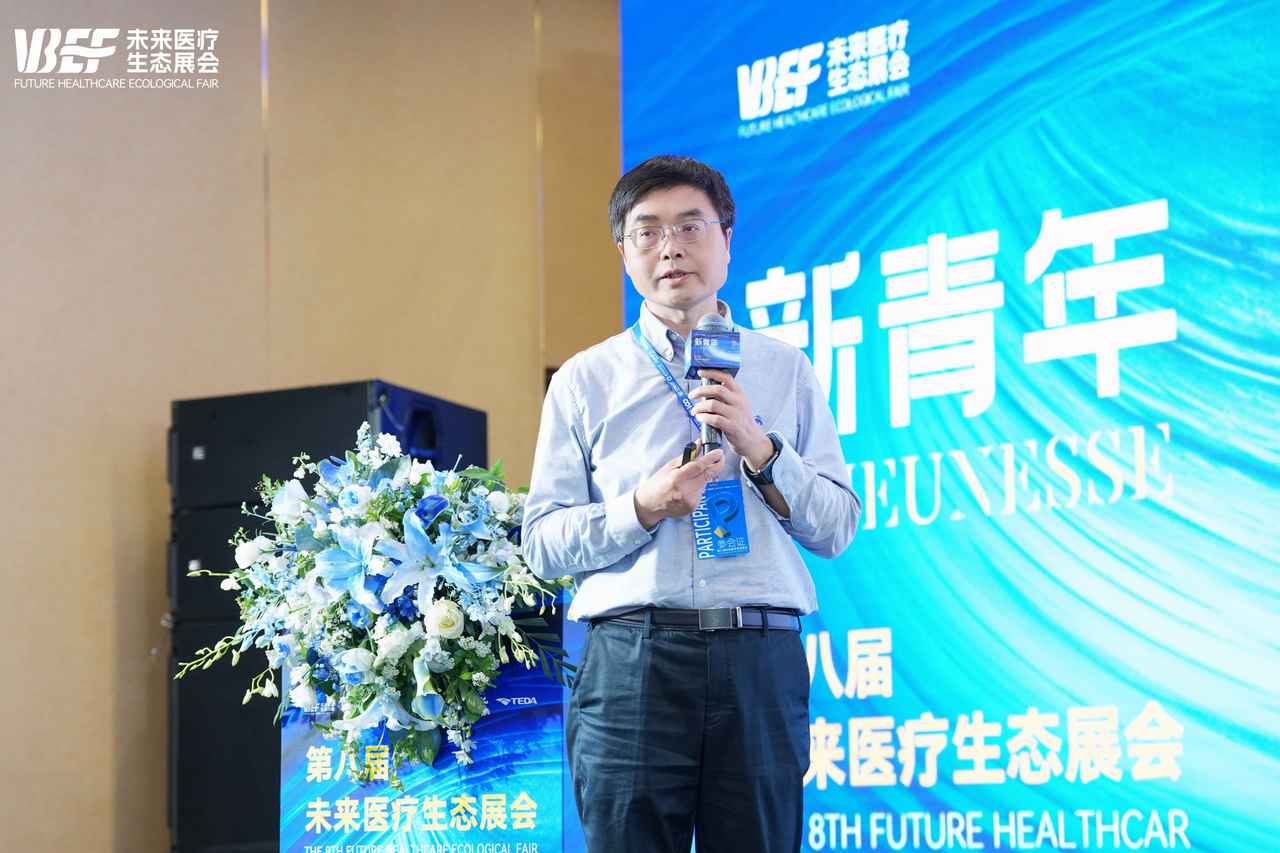
In the field of nuclear medicine, the integration of engineering and medicine is reflected in multiple key aspects, jointly driving the development of this field. In this context,Recently, at the Top 100 Summit of the VBEF Future Medical Ecology Exhibition hosted by VCBeat, Professor Shi Lei, Deputy Dean of the Institute of Nuclear and New Energy Technology at Tsinghua University, delivered a speech titled “Progress in the Development of the Wide-Spectrum Ultra-High Flux Test Reactor and Prospects for Its Applications in Nuclear Medicine.”The following is a transcript of the speech.
Research reactors differ from conventional thermal-energy reactors in that they are primarily used for scientific experiments and research, utilizing neutrons for experimentation. They are nuclear reactors that employ radiation beams generated by controlled chain fission reactions as a means of research. Research reactors can be classified according to neutron flux levels into low-flux, medium-flux, and high-flux research reactors.
High-flux reactors are critical infrastructure in the nuclear science and technology industry, characterized by an extremely high neutron flux of approximately 10¹⁴ n/(cm²·s). This intense neutron flux significantly accelerates irradiation testing processes. Integrating scientific research, industrial manufacturing, and materials processing, high-flux reactors serve as a benchmark of a nation’s technological prowess. They are primarily employed in areas such as nuclear fuel development, material irradiation testing, radioisotope production, and neutron scattering/imaging.
At the conference, Professor Shi focused on the applications of isotopes in medicine. Isotope production is primarily achieved through three pathways: nuclear reactors, accelerators, and extraction from spent nuclear fuel. Among these, nuclear reactors represent the predominant production method, characterized by high yield, high efficiency, and favorable cost-effectiveness. They enable low-cost, large-scale production of a diverse range of isotopes, accounting for over 80% of the market share and playing a central role in isotope production.
Although China has made certain progress in the construction and application of high-flux reactors, a gap remains compared with other internationally advanced countries. In terms of technological advancement, supporting infrastructure, and resource utilization, the development of high-flux reactors in China still faces numerous challenges. At present, there is an urgent need for China to develop high-performance, multi-purpose, and highly safe high-flux reactors to promote advancements in nuclear energy and nuclear medicine, and to contribute to the nation’s scientific and technological progress.
To address these challenges, Professor Shi introduced the “Thorium Molten Salt Reactor” (THFR) project currently being designed and constructed at Tsinghua University. The project has been included in the national list of major science and technology infrastructure projects under China’s 14th Five-Year Plan, aiming to build a high-flux reactor that reaches international advanced levels and promote the development of nuclear energy and nuclear technology in China.
THFR adopts advanced design concepts, including fuel optimization, a low self-shielding core design, rotating control drums, and fast/thermal neutron separation. It features numerous irradiation channels, enabling the core to flexibly conduct multiple irradiation tests simultaneously and demonstrating robust irradiation capabilities. THFR provides a multi-purpose, high-level platform for fuel material irradiation, capable of supporting a wide range of neutron science research and nuclear technology development.
THFR holds significant application prospects in the field of nuclear medicine: First, THFR features high neutron flux and strong irradiation capability, providing robust support for isotope production in nuclear medicine; Second, leveraging Tsinghua University’s multidisciplinary talent advantages, THFR has established extensive collaborative relationships with domestic and international institutions; Third, the THFR project plan includes comprehensive supporting facilities to ensure the smooth operation of the reactor and related scientific research activities; Fourth, a production park is being planned near the reactor site, which, upon completion, will meet the demand for isotope products in northern China.
The isotopes planned for production by the THFR project include rare nuclides, medical isotopes, and industrial isotopes. In the future, the project will also power the downstream preparation and purification processes of radiopharmaceuticals, fostering collaboration between the nuclear energy and medical communities and helping to address the current situation where over 90% of isotopes used in nuclear medicine are imported.
Currently, the market for medical isotopes and radiopharmaceuticals boasts broad prospects and substantial demand, with high-flux reactors serving as a critical pathway for the large-scale production of medical isotopes. Designed to address major national needs, the Wide-Energy Spectrum High-Flux Test Reactor (THFR) offers advantages such as high neutron flux, strong irradiation capability, and flexible core configuration. It plays a significant role in nuclear fuel and material irradiation testing, the production of scarce and medical isotopes, and neutron science, thereby helping to resolve critical bottlenecks hindering the development of nuclear energy and technology. With its high neutron flux and robust irradiation capabilities, the THFR will be equipped with advanced facilities for medical isotope production. Leveraging the open-sharing platform of this major scientific infrastructure and its strategic locational advantages, the THFR will demonstrate significant strengths in medical isotope production, thereby supporting the "Healthy China" strategy.