

Hisense Healthcare Enters the Billion-Dollar Ultrasound Market with Self-Developed HD80 Intelligent Whole-Body Ultrasound System Amid Supportive National and Regional Policies

Hisense Medical
Developer of Medical Dedicated Equipment
Medical ultrasound, as a mature yet rapidly evolving medical imaging technology, is increasingly highlighting its significance in clinical practice. According to projections by VCBeat’s “White Paper on the Smart Ultrasound Industry,” China’s ultrasound medical equipment market is expected to maintain continuous growth at a compound annual growth rate (CAGR) of 8% over the next five years,The market size is projected to reach RMB 17.91 billion in 2027.

Market Size of China's Ultrasound Medical Equipment Industry
Image source: VCBeat
This optimistic growth outlook is primarily reflected in two aspects. First, the Action Plan for Promoting Large-Scale Equipment Renewal and Trade-Ins of Consumer Goods, issued by the State Council in March 2024, indicates that the overall standard of domestic medical equipment has entered a new phase of enhancement. This will drive public hospitals, which are already fully equipped with ultrasound devices, to procure high-end equipment featuring new functions and technologies, thereby improving medical standards and service quality.
Secondly, to enhance the level of primary healthcare services and establish a tiered diagnosis and treatment system, multiple provinces and municipalities, including Sichuan Province, Guizhou Province, and Hebei Province, have successively introduced long-term plans for the construction of new county-level sub-centers for medical and health services.The expansion of primary healthcare institutions is also expected to become the main driver of incremental growth in the future ultrasound market.
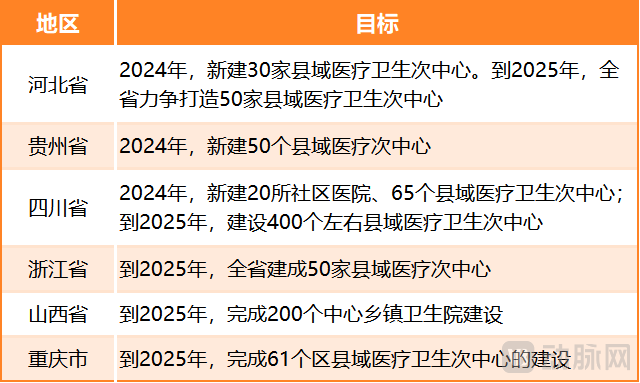
Planning for the Construction of New County-Level Sub-Centers of Medical and Health Services in Various Regions (Incomplete Statistics)
Against the backdrop of rapid digital technology integration, medical ultrasound is accelerating its evolution toward precision and intelligence, bringing significant benefits to the improvement of primary healthcare services.Hisense Medical, established in 2014, is committed to becoming a world-class provider of medical imaging equipment and smart healthcare solutions, with a sustained focus on ultrasound diagnostics and minimally invasive surgery.
In March 2024, Hisense Medical officially released its latest independently developed product in the field of ultrasound diagnosis and treatment—the HD80 Color Doppler Ultrasound Diagnostic System. The HD80 integrates artificial intelligence technology across five dimensions: detection prompts, quantitative observation, operational guidance, human-computer interaction, and image optimization, driving domestically produced ultrasound systems toward comprehensive intelligence.
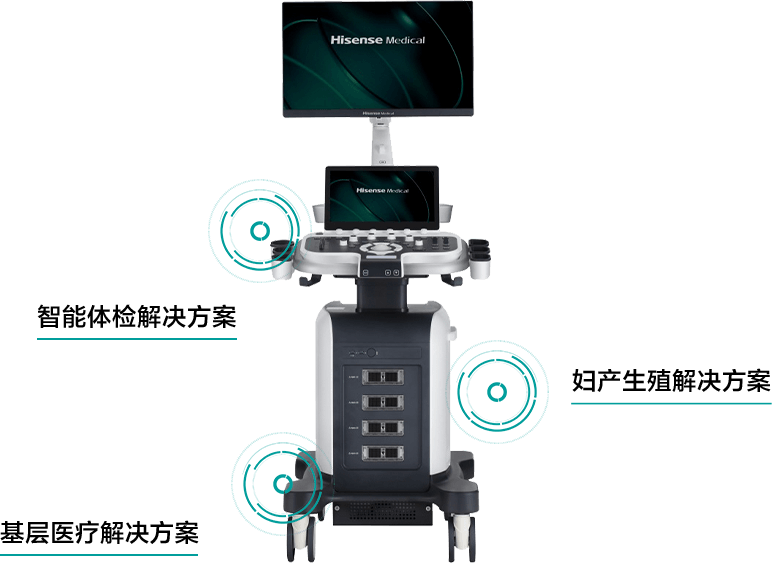
Hisense Medical Color Doppler Ultrasound Diagnostic System HD80
According to data from the National Bureau of Statistics, there were 1.071 million medical and health institutions in China at the end of 2023, including 39,000 hospitals and 1.016 million primary healthcare institutions. These 1.016 million primary healthcare institutions served a patient population of nearly 900 million.
In contrast to the urgent needs of 900 million patients, primary care facilities face pressing challenges such as talent shortages and insufficient physician skills. Furthermore, as patient expectations continue to rise, the public has placed higher and more comprehensive demands on the quality of services provided by primary healthcare institutions.These realities have severely constrained the accessibility, accuracy, and efficacy of ultrasound diagnosis and treatment.
As an essential diagnostic tool mandated for community health service centers, ultrasound covers a wide range of areas, including health examinations, disease diagnosis, prevention and control of chronic diseases, and screening for breast and cervical cancers. With the rapid advancement of digital technologies, smarter, more convenient, and more efficient solutions have brought new breakthroughs to ultrasound medicine.
As a practitioner of smart ultrasound, Hisense Medical was the first in the industry to proposeIntelligent “5I” Concept (More than Intelligence): Intelligent Indication, Intelligent Inspection, Intelligent Instruction, Intelligent Interaction, and Intelligent Improvement.
Wang Wenkai, Head of AI Development at Hisense Medical’s Ultrasound Division, explained:“Precision and intelligence have become the primary technological drivers of development in the ultrasound industry. Hisense’s intelligent ‘5I’ concept aims to clarify the competitive landscape for the industry’s future growth and establish a cognitive framework.”
Specifically,Intelligent Detection Prompts and Intelligent Quantitative Observations as Part One, primarily manifested in the advancement from automatic measurement and evaluation of static images to the dynamic, real-time, latency-free acquisition of standard planes, as well as automatic lesion detection. The HD80’s automatic measurement and intelligent analysis capabilities can be applied to more than 20 intelligent measurement and diagnostic items across five major smart clinical scenarios—physical examination, obstetrics and gynecology, musculoskeletal, reproductive, and breast imaging—thereby meeting the needs for whole-body patient examinations.
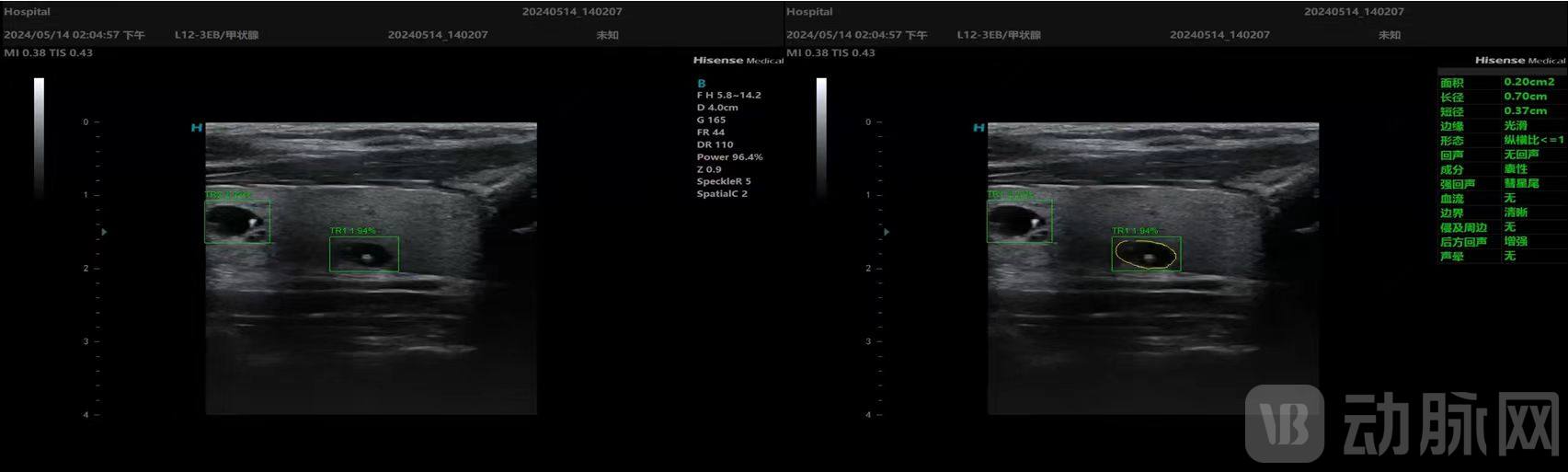
Intelligent Thyroid Detection and Analysis
The HD80 ultrasound system achieves over 90% accuracy in measurements, lesion detection, and grading, supported by a cumulative training and validation database of 500,000 cases. In addition to improving the work efficiency of sonographers and assisting less experienced primary-care and young physicians in enhancing diagnostic accuracy, the system further promotes standardized diagnosis and treatment in primary healthcare institutions through the automatic generation of structured, normalized reports.
Intelligent operation guidance and intelligent human-computer interaction constitute the second component of intelligent ultrasound.How to cultivate ultrasound physicians at the primary care level is likewise a fundamental obstacle constraining the improvement of diagnostic and therapeutic capabilities in primary healthcare institutions. On one hand, Hisense Medical provides operational guidance to primary care or junior physicians during scanning through its “Intelligent Operation Guidance” system, assisting them in rapidly and accurately performing relatively complex procedures, such as color Doppler echocardiography.
On the other hand, the HD80 will also integrate intelligent voice and other human-computer interaction technologies, enabling physicians to perform complete examinations at the bedside through voice commands. This design accommodates the diverse operational environments encountered by sonographers, particularly enhancing workflow efficiency and saving critical time during the resuscitation and emergency care of critically ill patients.
Part III: Intelligent Image Optimization Primarily Focuses on Leveraging Smart Digital Technologies to Enhance the Overall Image Quality of Ultrasound.For instance, leveraging deep learning to optimize ultrasound image processing, enhancing resolution and contrast, and improving diagnostic clarity, thereby boosting the efficiency of ultrasound diagnosis and treatment.
While intelligent ultrasound products can largely address the shortage of ultrasound physicians and their limited experience at the primary care level, more specific and comprehensive solutions from ultrasound manufacturers are still required for complex cases that exceed the diagnostic capabilities of primary care physicians.
In response, Hisense Medical has not only launched its latest HD80 intelligent whole-body ultrasound system but also developed and introduced products such as the HD60 ultrasound, HD20 ultrasound, and portable ultrasound devices, along with remote ultrasound solutions, thereby comprehensively establishing its presence in the domestically produced intelligent ultrasound market.Among them, Hisense Medical'sXinlian Remote Consultation SystemIt was developed to further strengthen the collaboration between tertiary hospitals and primary care institutions, enabling primary care physicians to obtain diagnostic opinions through remote consultations with specialists from tertiary hospitals when dealing with complex cases, thereby preventing arbitrary diagnoses and reducing misdiagnosis rates.
Li Ping, a solutions development expert in the Ultrasound Division of Hisense Medical, stated, “The Xinlian Remote Ultrasound Platform enables remote acquisition, transmission, processing, storage, and querying of ultrasound diagnostic information. It supports one-to-one, one-to-many, and many-to-one telemedicine activities among medical institutions, facilitating real-time remote ultrasound diagnosis, remote teaching, online quality control, and academic discussions, thereby further enhancing the diagnostic and treatment capabilities of primary healthcare institutions.”
“Specifically, the platform supports remote high-definition consultations and the high-speed transmission and sharing of medical imaging data. By leveraging deep learning-based 3A audio algorithms, it enhances voice signals while eliminating echo, thereby facilitating remote consultations in noisy clinical environments.”Li Ping continued.
It is reported that Hisense Medical’s full range of ultrasound products has rapidly penetrated primary healthcare institutions in multiple regions, including Shandong, Guangdong, and Gansu, enabling medical facilities at all levels to fulfill their designated roles and continuously expanding access to high-quality medical resources.Meanwhile, Hisense Medical is also promoting the widespread adoption of intelligent and remote ultrasound products by participating in the development of industry standards and regulations.
As a domestic innovator deeply rooted in the field of intelligent ultrasound, Hisense Medical has participated in establishing an ultrasound capability enhancement training base for primary healthcare institutions, led by the Qingdao Municipal Health Commission. Additionally, it spearheaded the development of the industry’s first group standard for remote ultrasound, titled “Technical Specifications for Remote Ultrasound Diagnostic Information Systems.” Furthermore, Hisense Medical contributed to the formulation of national standards for remote consultations, which are scheduled for release within this year.
The release of this national standard is expected to further fill industry gaps, promote the standardized development of remote consultations at a higher level, and enhance Hisense’s influence and competitiveness in the field of remote ultrasound.
Another major application scenario of the Xinlian Remote Ultrasound Platform lies in chronic disease management.By leveraging a remote monitoring platform, hospital-side terminal monitoring platforms, and patient-side data collection devices, a closed-loop chronic disease management system is established to provide timely, effective, and long-term monitoring and intervention for patients with chronic conditions, while also helping primary healthcare institutions with limited medical resources improve their management efficiency.
Primary healthcare institutions form the foundation of chronic disease management. Hisense Medical’s remote ultrasound platform enables specialists and public health physicians from tertiary hospitals to jointly participate in chronic disease management at the primary care level. It provides patients with chronic conditions with services such as appointment scheduling, screening, health record establishment, follow-up visits, and health education, thereby effectively advancing the implementation of national policies on the integration of medical treatment and prevention for chronic diseases in primary healthcare.
Artificial intelligence is defining the Fourth Industrial Revolution, providing new ideas and tools for various industries, including healthcare. Although China is still in the catch-up phase in both artificial intelligence and medical devices, it is undeniable that innovative Chinese medical device companies are experiencing rapid growth.
Driven by factors such as continuous technological iteration, policy support, and market demand in China, the gap between domestically produced ultrasound systems and imported products has been narrowing significantly across multiple dimensions, including product quality, performance, and applications. Competition in the ultrasound market has now evolved into a contest of high quality and advanced technology.
In 2020, Hisense Medical incubated its first ultrasound product, the HD60, from scratch, thereby introducing a new Chinese force with core technologies and complete independent intellectual property rights to the global ultrasound arena. Over the following four years, Hisense Medical launched the HD80, conceptualized as an intelligent whole-body ultrasound system.
“Since its inception, Hisense Medical has adhered to a path of independent R&D and a positioning strategy focused on the high-end market. The first-generation HD60 already adopted an architecture based on GPU-accelerated parallel processing, a feature typically reserved for premium ultrasound platforms. Today, the HD80 has been upgraded to a heterogeneous multi-processor parallel processing architecture, with entirely new designs implemented across its hardware system, core data pathways, and logic system.”
“Upgrades to the underlying technology have primarily enhanced two key performance aspects of the HD80. First, it has transformed traditional hardware-based beamforming into software-driven adaptive beamforming, significantly improving spatial resolution and field uniformity. This assists physicians in more accurately assessing the morphology and structure of the examined areas, thereby enhancing diagnostic accuracy. Second, computational power has been increased, with parallel processing capability quadrupled. This not only facilitates functional expansion but also meets the demands for large-scale image processing and computation required by intelligent features.”Zhang Wenhua, Product Director of the Ultrasound Division at Hisense Medical, provided this introduction.
Under the guidance of the “5I” philosophy, Hisense Medical is also continuously striving to develop smarter, more convenient, more efficient, and more precise intelligent ultrasound solutions.
China is currently transitioning from a phase of rapid aging to one of deep aging, leading to increasingly severe pressure on the prevention and control of chronic diseases. In response, HD80’s intelligent development is expanding into the field of chronic disease management. Building on its existing capabilities in intelligent detection and analysis for thyroid and breast conditions, it has been developed to provide support for high-prevalence focal lesions, including carotid artery atherosclerotic plaques, stenosis, cysts, and nodules.Intelligent Carotid Artery Detection and Analysis, Intelligent Abdominal Detection and Analysis Functions. As primary care settings constitute a critical frontline in the prevention and control of major diseases, enhancing their capacity for chronic disease management can effectively support the implementation of China’s strategy for early prevention, early control, and early treatment of chronic diseases.
It can be said that the HD80 is a microcosm of the development of domestically produced ultrasound equipment. Numerous enterprises are continuously enhancing the intelligence, precision, and user-friendliness of their products through the integration of cutting-edge technologies, among which Hisense Medical and the HD80 demonstrate strong innovative DNA and development potential.
Amid the favorable conditions of the “policy-intensive period,” Hisense Medical will continue to focus on the weak links in domestic substitution and the most urgent healthcare needs of the general public. By intensifying innovation and sustaining R&D efforts, the company aims to achieve a breakthrough from catching up to taking the lead, deploying intelligent ultrasound and remote consultation systems in more primary healthcare institutions. This will support China’s tiered diagnosis and treatment model while promoting the high-quality development of high-end medical equipment in China.