

4th Conference on Clinical Medical Research and Medical Animal Experiments Opens Registration: Exploring Full Lifecycle Services for Medical Device Innovation Translation
Technological innovation in medical devices is a crucial component of the national science and technology innovation system, as well as a significant driving force and support for advancing the Healthy China initiative. In recent years, relevant Chinese authorities have issued a series of regulations to standardize all aspects of medical device supervision and administration, providing robust support in terms of policy, funding, talent, and technology, thereby creating a favorable policy environment for the healthy and steady development of the medical device industry.
After years of development, China’s medical device industry has established a large-scale, well-structured, and technologically advanced industrial system. According to data from iiMedia Research and the Blue Book of Medical Devices, China has become the world’s second-largest medical device market, with an annual growth rate of approximately 10%. However, behind the immense growth potential of China’s medical device industry, there are numerous challenges facing the entire lifecycle of medical device research outcomes.
To implement the "Opinions of the State Council on Supporting the High-Quality Development of Beijing’s Sub-Center" and the "Three-Year Action Plan for the Development of the Pharmaceutical and Health Industry in Beijing’s Sub-Center (2023–2025)," and to further promote the high-quality development of Beijing’s pharmaceutical and health industry, the 2024 "4th Clinical Medical Research and Medical Animal Experiment Conference" of the Expert Committee on Medical Animal Experiments of the Chinese Association of Research Hospitals, together with the "Academic Conference on Full-Life-Cycle Services for the Transformation of Scientific and Technological Achievements in Medical Devices," jointly organized by the Expert Committee on Medical Animal Experiments of the Chinese Association of Research Hospitals, the Professional Committee on Med-Engineering Translation and Health Industry Integration of the Chinese Association of Research Hospitals, and Beijing Luhe Hospital Affiliated to Capital Medical University, will be held in Tongzhou District, Beijing, on July 20, 2024.
Themed “New Thinking, New Models, Strengthening Foundations, and Emphasizing Translation,” this conference focuses on the transfer and commercialization of scientific and technological achievements in medical devices. It provides one-stop services covering patent protection for achievements, early-stage concept validation, preclinical animal studies, clinical trials and regulatory submissions, achievement commercialization, capital operations, and equity structure design. The event invites leaders from the China National Intellectual Property Administration and the Center for Medical Device Evaluation of the National Medical Products Administration, as well as industry experts, scholars, and representatives from medical device companies, to attend and deliver forum presentations, with the aim of creating an interactive platform that encompasses the full lifecycle, all key elements, and the entire value chain.
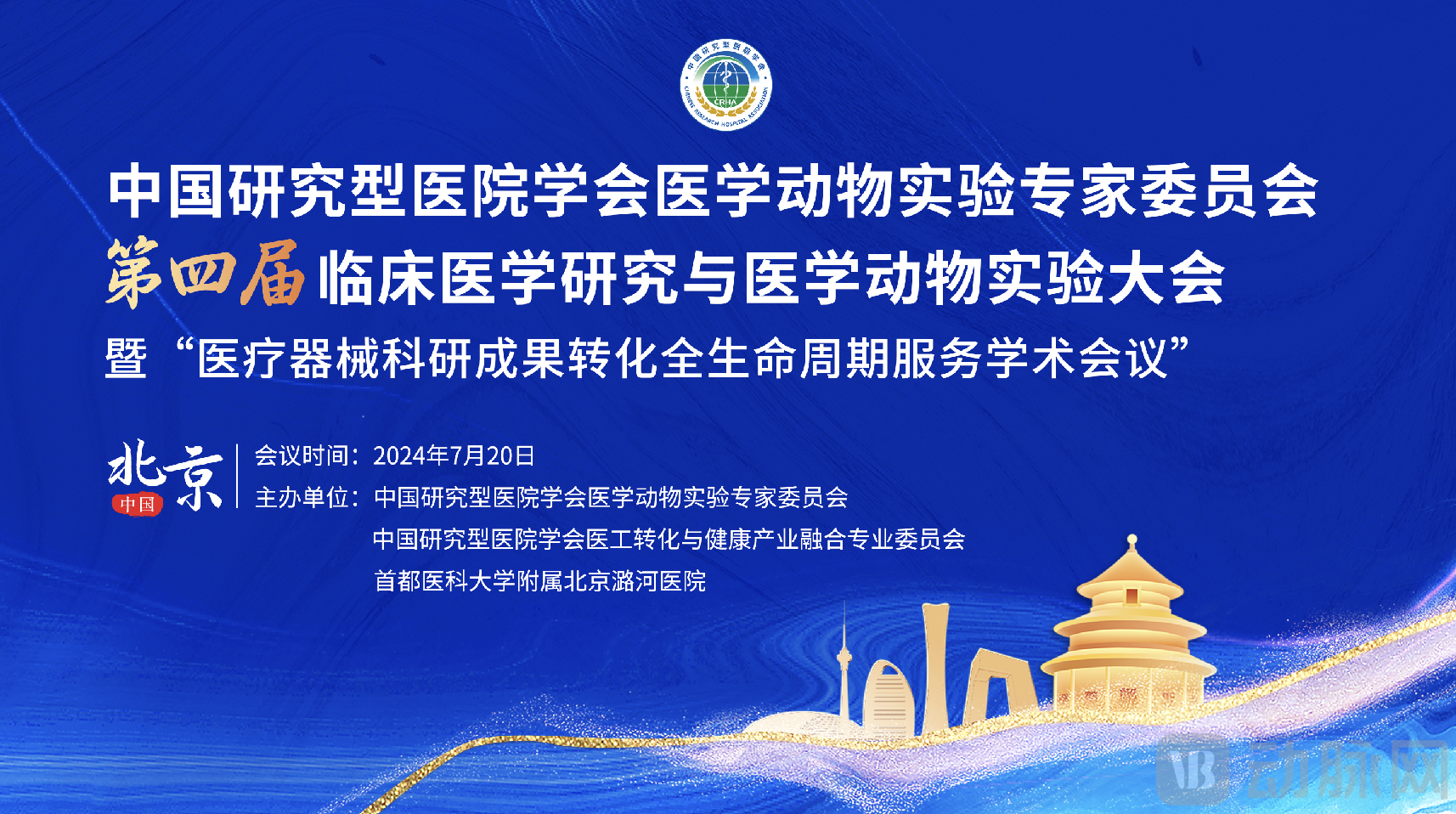
This marks the fourth edition of the Conference on Clinical Medical Research and Medical Animal Experimentation. Continuing to focus on the theme of “New Thinking, New Models, Strong Foundations, and Emphasis on Translation,” the event serves as an academic and industrial conference addressing the challenges and responses across the entire lifecycle of the translation of medical device research achievements.
“Main Forum + Three Sub-Forums”: Bridging the Full Lifecycle of Medical Device Research Achievement Commercialization
The translation of medical device research achievements is a crucial component of innovative development in the healthcare sector. This process involves incubating technological innovations from medical institutions, research organizations, enterprises, or individuals; conducting verification, testing, and regulatory submissions; and ultimately bringing these products to market for use by healthcare providers and patients. For a long time, the commercialization rate of scientific research outcomes at Chinese universities has hovered between 4% and 5%. Transitioning from laboratory research to market application requires medical device innovations to undergo a series of complex processes.
To facilitate the entire lifecycle of translating medical device research achievements into practical applications and to connect multiple key stages in this process, the conference features one main forum and three sub-forums. Incorporating thematic reports, academic discussions, experience sharing, and interactive exchanges, the event adopts a hybrid online-offline format to comprehensively explore experts’ insights and experiences regarding the full lifecycle of medical device research translation.
At the end of 2023, the Ministry of Industry and Information Technology (MIIT) and the National Health Commission (NHC) convened a working group meeting in Beijing to advance the development and application of medical equipment. The meeting emphasized the need to continuously strengthen top-level design, improve regulatory standards for medical devices, enhance inter-departmental policy coordination, and establish robust institutional mechanisms. It also called for intensified efforts to overcome key core technological challenges, focusing on frontier-leading technologies and addressing weaknesses, while innovating organizational implementation methods to drive breakthroughs across the entire product lifecycle. In this context, the main forum of the conference was themed “From Top-Level Design to Practical Exploration of Achievement Transformation,” and featured distinguished guests including Li Yingjun, Chairman of the Committee on Medical Animal Experiment Experts under the Chinese Research Hospital Association and General Manager of Tonghe Litai; Huang Gang, Chairman of the Special Committee on Medical-Engineering Translation under the Chinese Research Hospital Association; Zhang Suhua, Vice Chairman of the same committee; Wu Yingfeng, Deputy Secretary of the Party Committee and President of Beijing Luhe Hospital Affiliated to Capital Medical University; as well as leaders from Tongzhou District, Beijing, academicians, and other relevant scientific research experts.
Furthermore, the conference’s three sub-forums, structured around the full lifecycle of medical devices, focused on three key themes: proof of concept, preclinical/clinical CRO services, and clinical innovation practices in hospitals.
The first step in medical device product development is to conduct preliminary proof-of-concept validation for scientific research achievements. A gap often exists between early-stage research outcomes and product prototypes, which must be bridged through services such as technical and commercial feasibility assessments provided by professional teams, thereby enabling the development of products with market value. Therefore, the establishment of Proof-of-Concept Centers is crucial. A Proof-of-Concept Center is an innovation organization operated collaboratively by universities and various institutions, dedicated to validating the commercialization feasibility of early-stage research achievements, such as laboratory inventions. Currently, many universities and organizations in China have established Proof-of-Concept Centers to help improve the success rate of translating scientific research achievements into practical applications.
In China’s medical device industry, preclinical and clinical contract research organizations (CROs) play an irreplaceable role. Leveraging their focused professional expertise, cutting-edge technology and experience, and comprehensive organizational service capabilities, CROs help research institutions and hospitals ensure the compliance, reliability, and success rate of studies. By collaborating with CROs, medical device companies can better address the challenges of clinical research, thereby more effectively bringing safe and advanced medical devices to market. Tonghe Litai, a comprehensive large-animal platform engaged in preclinical testing of medical devices, has submitted for review and issued more than 400 preclinical evaluation reports for medical devices.
Healthcare institutions possess extensive clinical experience, technical reserves, patient needs, and market realities, which harbor and generate a wealth of convertible innovative ideas and scientific achievements. Although healthcare institutions face numerous challenges in translating scientific research outcomes—such as funding, equipment development, commercial operations, and marketing—physicians serve not only as users of medical device products but also as drivers of innovation and even developers of technology. Currently, many hospitals in China are leveraging relevant platform organizations to promote the translation of scientific research outcomes. Under the guidance of the Tongzhou District Science and Technology Commission, the Tongzhou District Health Commission, the Management Committee of Zhongguancun Science Park Tongzhou Park, and the Tongzhou District Bureau of Economy and Information Technology, Beijing Luhe Hospital Affiliated to Capital Medical University has leveraged its own advantages and actively collaborated with pharmaceutical and health enterprises to establish the “Beijing City Sub-center Medical-Industrial Collaborative Innovation Center,” characterized by medical-industrial synergy.
Bringing Together Multi-Sector Resources from Government, Industry, Academia, Research, and Healthcare: A Vivid Practice in the Scientific Research Translation of Medical Devices
In addition to covering the entire lifecycle of scientific research and translation in the medical device industry, a major highlight of this conference is the gathering of distinguished guests from multiple sectors, including government, industry, academia, research, and clinical practice. These attendees include government leaders and heads of relevant departments, scholars and professors, clinical experts, as well as representatives from related enterprises and intellectual property specialists. The conference leverages multi-layered platform resources across the medical device research and translation ecosystem, with insights shared from various perspectives, including policy frameworks, technological innovation, clinical practice, and experience in translating scientific achievements into practical applications.
At that time, the conference will also invite numerous industry-leading enterprises, industry associations, clinical experts, and scholars to participate in high-level dialogues and share their innovative practices in translating scientific research achievements into practical applications.
The Expert Committee on Medical Animal Experiments of the Chinese Research Hospital Association is about to convene the “4th Conference on Clinical Medical Research and Medical Animal Experiments” and the “Academic Conference on Full-Lifecycle Services for the Translation of Medical Device Research Achievements.” As a high-level, multidimensional conference in China focused on clinical medical research and medical animal experiments, it will build a broad platform for exchange and cooperation, promote interconnectivity among government, industry, academia, research institutions, and healthcare providers, gather strengths from all sectors of the industry, and empower the high-quality development of the medical device industry.
This conference will serve as a vital window, illuminating the path forward for the translation of medical device research achievements into practical applications. On July 20 in Tongzhou, Beijing, more exciting highlights await—don’t miss it!
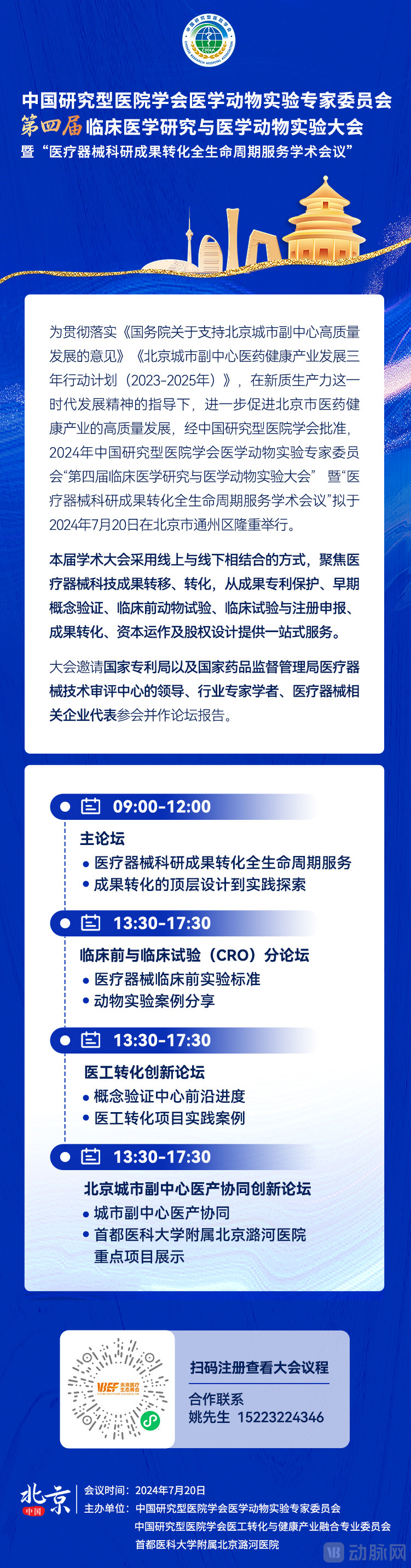
Conference Registration QR Code