

Kelun-Biotech's Proprietary ADC Platform Secures $615.5M Global Partnership with ArriVent

Alphamab Oncology
Developer of Antibody and Protein Macromolecule Drugs
ArriVent
Biopharmaceutical Product Developer

Alphamab
Clinical Trial Service Provider for Novel Biologics
On June 6, 2024, Alphamab Oncology (Stock Code: 9966.HK) announced that its wholly-owned subsidiary, Jiangsu Alphamab Biopharmaceuticals Co., Ltd. (hereinafter referred to as “Alphamab” or the “Company”), has entered into a research and development and commercialization collaboration agreement with ArriVent BioPharma, Inc. (hereinafter referred to as “ArriVent,” NASDAQ Stock Code: AVBP). The two parties will collaborate to discover and develop novel antibody-drug conjugates (ADCs) utilizing Alphamab’s proprietary linker-payload platform (Alphatecan) and glycosite-specific conjugation platform.
During the collaboration period, Alphamab Oncology will retain the rights to develop and commercialize the relevant ADC products covered under the agreement in Mainland China, the Hong Kong Special Administrative Region, the Macao Special Administrative Region, and Taiwan (collectively referred to as "Greater China"). In countries and regions outside Greater China, ArriVent will hold exclusive rights to develop and commercialize the relevant ADC products in the field of oncology, and will be responsible for bearing the corresponding development costs of the ADC products.
Under the terms of the agreement, Alphamab Oncology is entitled to receive a one-time, non-refundable upfront payment, as well as potential milestone payments, including those related to product registration, development, and sales milestones, totaling up to $615.5 million. In addition, Alphamab Oncology is entitled to receive tiered sales royalties from ArriVent for each ADC product.
Focus on Bispecific Antibody ADCs: “Combination” R&D Achieves Significant Results
Ideal antibody-drug conjugate (ADC) therapeutics must remain stable in systemic circulation, precisely reach the therapeutic target, bind specifically to the target, and release the cytotoxic payload. Therefore, key factors enabling ADCs to selectively kill tumor cells include a specific target, high affinity for tumor binding, an optimized conjugation strategy, and enhanced stability in systemic circulation.
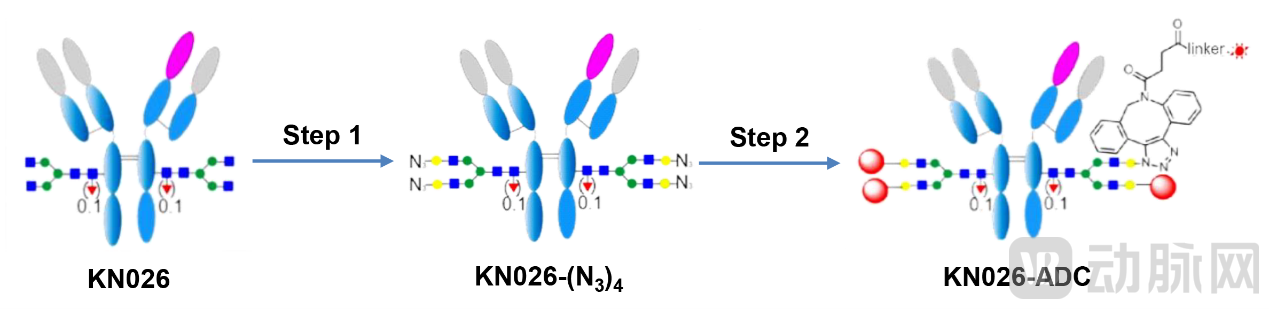
Alphamab Oncology’s One-Enzyme, Two-Step Method for JSKN003, from the Alphamab Oncology Official Website
Based on this, Alphamab Oncology has developed an antibody-drug conjugate (ADC) development platform with independent intellectual property rights. This platform utilizes site-specific conjugation technology targeting the glycan chains in the antibody CH2 domain, employing a one-enzyme, two-step method that offers a simpler process and lower costs. Leveraging this platform, ADCs with highly homogeneous drug-to-antibody ratios (DAR) can be produced, exhibiting superior serum stability and significantly reduced side effects.
Among them, JSKN003 is a novel HER2-targeted bispecific epitope ADC developed by Alphamab Oncology using its glycan site-specific conjugation platform. Studies have shown that JSKN003 offers superior serum stability, a stronger bystander killing effect, and equivalent tumor-killing activity compared to similar drugs, thereby effectively widening the therapeutic window.
On June 3, 2024, in Suzhou, China, Alphamab Oncology announced for the first time at the 2024 American Society of Clinical Oncology (ASCO) Annual Meeting the Phase I clinical study data from China on JSKN003, a HER2 bispecific antibody-drug conjugate (ADC), for the treatment of HER2-expressing solid tumors. The data demonstrated that JSKN003 exhibited good tolerability and manageable safety in patients with advanced/metastatic solid tumors who had previously received multiple lines of systemic therapy: no dose-limiting toxicity (DLT) events occurred, and the maximum tolerated dose (MTD) was not reached. The incidence of hematologic toxicity and interstitial lung disease (ILD) was low (only two patients experienced Grade 2 ILD). Encouraging anti-tumor activity was observed during the dose-escalation phase: among all efficacy-evaluable patients with HER2-positive and HER2-low expression tumors, the objective response rate (ORR) was 51.1%; the ORR reached 57.1% in patients who had previously received anti-HER2 therapy. In breast cancer patients, the ORR was 73.3% among 15 HER2-positive patients and 33.3% among nine HER2-low expression patients.
Notably, financial report data for 2023 shows that Alphamab Oncology’s total revenue increased by 31.12% year-on-year, while product revenue rose by 32.54% year-on-year. Meanwhile, its R&D expenditure decreased by 12.97% year-on-year, and the net loss narrowed by 35.35% year-on-year. Behind these impressive results lies Alphamab Oncology’s long-term strategic layout, which focuses on product commercialization and pursues a differentiated path amidst cyclical fluctuations. Furthermore, these achievements sufficiently validate the differentiated advantages of its ADC platform.
Alphamab Oncology has been one of the most watched innovative pharmaceutical companies in the past three years. It gained early recognition for its strong emphasis on technology and R&D, earning high acclaim within the industry. The substantial R&D investments made in its early stages are now beginning to yield returns. To mitigate various uncertainties and risks, Alphamab Oncology focuses on several highly innovative bispecific antibody and ADC products, advancing its pipeline through a “combination” strategy. Meanwhile, it engages in business development (BD) collaborations for certain in-house developed products to jointly accelerate their market launch. This approach aims to diversify risks while enhancing product development efficiency.
Taking JSKN003 as an example. In October 2022, JSKN003 was approved in Australia to conduct clinical studies; one year later, the Phase III clinical trial of this product for the indication of HER2-low breast cancer was officially launched; in 2024, based on more data from the Phase I clinical study in Australia and the Phase I/II clinical studies in China, Alphamab Oncology will also add two registrational clinical studies targeting solid tumors.
Based on existing pipeline information, Alphamab Oncology is currently expanding indications and combination therapies centered on KN046, KN026, and JSKN003. From 2025 to 2027, the company is expected to enter its next major R&D phase. In addition to focusing on KN046 and JSKN003, it will further explore new products with innovative mechanisms and molecular structures that address clear clinical needs, including JSKN033, JSKN016, and JSKN022.
ArriVent: Backed by Hillhouse and Eli Lilly, Successfully IPOs Three Years After Founding
ArriVent, which has entered into a collaboration with Alphamab Oncology, listed on the Nasdaq on January 26, 2024. According to documents filed by ArriVent with the U.S. Securities and Exchange Commission, the initial public offering (IPO) involved the issuance of approximately 8.3 million shares at a price of $18 per share, valuing the company at $550 million. In fact, ArriVent raised approximately $175 million in its IPO, exceeding prior expectations. On its first day of trading, ArriVent opened at $24 per share and rose as high as $25.95 during intraday trading.
The founding of ArriVent dates back to 2018, when AstraZeneca divested its business.
In February 2018, AstraZeneca spun off six early-stage inflammation and autoimmune projects from its global biologics R&D division, MedImmune, to establish Viela Bio (hereinafter referred to as “Viela”). Viela is dedicated to the development of autoimmune disease therapeutics. Dr. Zhengbin Yao, who previously served as Senior Vice President at MedImmune, overseeing the Respiratory, Inflammation, and Autoimmunity Innovative Medicines unit, was naturally appointed as CEO of Viela.
Just one year later, Viela went public at $19 per share. In 2021, Viela was acquired by Horizon Therapeutics for $53 per share, totaling approximately $3.1 billion. Notably, during Dr. Zhengbin Yao’s tenure as CEO, Viela secured around $283 million in investments from prominent venture capital firms, including Boyu Capital, Tonghe Yucheng, and Hillhouse Capital.
It was also in 2021, following Viela Bio’s successful exit, that Dr. Zhengbin Yao and his team co-founded ArriVent. In June, ArriVent closed a $150 million Series A financing round, with participation from prominent investment firms including Hillhouse, Lilly Asia Ventures, and OrbiMed. Dr. Yao’s longstanding relationships with existing investors continue to thrive.
In March 2023, ArriVent completed a $155 million Series B financing round. The proceeds from this round will be primarily used to support pivotal Phase 3 clinical trials and indication expansion for the company’s core product, furmonertinib, as well as to expand its product pipeline. This means that during the two-year pre-IPO development period, ArriVent completed multiple rounds of financing totaling $305 million.
Following the successful IPO, Hillhouse holds a 12.8% equity stake in ArriVent, OrbiMed holds 8.4%, Sirona Capital Partners Ltd. holds 4.2%, Dr. Zhengbin Yao holds 2.7%, and Robin LaChapelle holds 1.6%.
Currently, ArriVent has two pipelines, one of which is furmonertinib, the company’s lead candidate. Furmonertinib is a novel epidermal growth factor receptor (EGFR) mutation-selective tyrosine kinase inhibitor (TKI) under investigation for EGFR-mutated (EGFRm) non-small cell lung cancer (NSCLC), covering a broader spectrum of mutations than currently approved EGFR TKIs. Furmonertinib is being evaluated in multiple clinical trials, including a pivotal Phase 3 trial in first-line patients with locally advanced or metastatic EGFRm NSCLC harboring exon 20 insertion mutations. ArriVent expects to report top-line data from this key trial in 2025.
This pipeline originates from Allist, an innovative Chinese pharmaceutical company. Notably, Allist holds a 4.2% stake in ArriVent.
Another pipeline is an ADC program co-developed with Aarvik Therapeutics (hereinafter referred to as “Aarvik”).
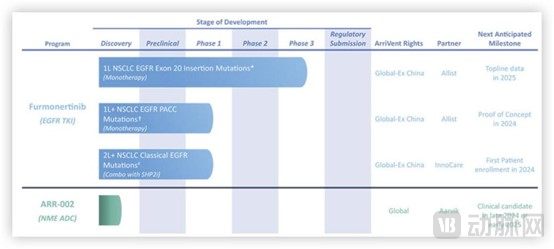
Pipeline sourced from ArriVent's prospectus
In late 2023, Aarvik’s team submitted a manuscript titled “Exploration of the antibody-drug conjugate clinical landscape” to the journal mAbs, which elaborated on the prospects and future development of antibody-drug conjugates (ADCs) and summarized the current status of the field. The article noted that, to date, more than 260 ADCs have entered clinical trials; among these, 11 ADC drugs have received FDA approval, approximately 164 are undergoing clinical trials but remain unapproved, and 92 ADC candidates were discontinued after clinical evaluation. Drawing lessons from the reasons for clinical discontinuation of those abandoned ADC pipelines may hold profound implications for the ADC sector, helping to eliminate unpromising approaches and guide future development.
It is evident that ArriVent focuses its R&D efforts on oncology, dedicated to accelerating the global development of innovative drugs. The company seeks first-in-class candidate drugs at various stages of development in China and other regions with active biotechnology innovation. Through strategic collaborations with innovative drug developers, ArriVent provides high-quality therapeutics from around the world to address unmet clinical needs across a range of diseases.
The integration of Alphamab Oncology’s ADC development platform is expected to accelerate the R&D of its ADC pipeline. Dr. Zhengbin Yao, Chairman and CEO of ArriVent, also stated that this collaboration will strengthen and enrich ArriVent’s product pipeline, with the potential to add multiple innovative ADC products, aligning with ArriVent’s strategic model of discovering and developing first-in-class (FIC) and best-in-class (BIC) drugs globally.