

Jin Yan, Founder of the Tissue Engineering R&D Center at Air Force Medical University, Unveils Prospectus Highlighting Broad Applications of Cell-Based Regenerative Medicine Products
Originating in the early 20th century, bio-regenerative materials have become a frontier and priority area of development in materials science, biotechnology, and clinical medicine, as well as the foundation of biomedical engineering, emerging as one of the most dynamic sectors within the economic system, driven by growing cross-disciplinary demand and continuous technological advancements.
Leveraging cutting-edge technologies such as 3D printing, biosensing, and neuro-optoelectronics, bio-regenerative materials are not only undergoing continuous transformation and upgrades but also expanding the boundaries of their clinical applications. This forum will examine the bio-regenerative materials industry chain from a holistic perspective, tracing the journey from upstream scientific innovation to downstream development across various specialized sectors. Centered on scientists, executives of technology-driven enterprises, and professionals from industrial service and consulting firms, the forum aims to explore new pathways for the comprehensive advancement and vibrant growth of the bio-regenerative materials industry.
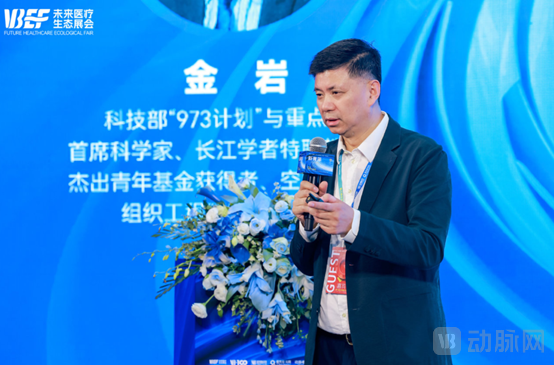
On May 10, 2024, at the Biomaterials for Regenerative Medicine Forum held during the VBEF Future Healthcare Ecosystem Exhibition organized by VCBeat, Professor Jin Yan—Chief Scientist of the Ministry of Science and Technology’s “973 Program” and Key Projects, Changjiang Scholar Distinguished Professor, recipient of the National Science Fund for Distinguished Young Scholars, and founder of the Tissue Engineering Research and Development Center at Air Force Medical University—delivered an insightful presentation on “Development Strategies and Translational Applications of Cell-Based Regenerative Medicine Products,” drawing upon his team’s work and research advancements in this field.
Bioregenerative materials represent a niche sector within regenerative medicine that has seen early initiation and rapid development. Modifying biomaterials to confer specific cell-binding capabilities, thereby addressing the reconstruction of in vitro or in vivo microenvironments, is a core aspect of regenerative medicine. The ultimate goal of bioregenerative materials is to be implanted into the human body to repair tissue defects or serve other therapeutic functions; therefore, the interaction between tissues and the host should be prioritized during material development.
Jin Yan noted that the concept of regenerative medicine is continuously evolving, primarily comprising two aspects. First, regenerative medicine requires a fundamental understanding of tissues, organs, and the human body. Second, based on this understanding and the laws governing biological changes, effective solutions must be identified. Currently, there are two particularly significant approaches: one is tissue engineering technology, which enables the development of materials akin to Class III medical devices; the other is stem cell-based therapeutics. Both approaches hold substantial potential for clinical application.
“Regenerative medicine involves understanding the nature of diseases and addressing them; what lies at its core? Cells. Therefore, cell-based approaches are indispensable to its product development.” Jin Yan then introduced some of the work his team has undertaken in the field of regenerative medicine.
Commercialization of Regenerative Medicine Cell-Based Products
Jin Yan subsequently introduced the first product from the Tissue Engineering R&D Center of the Air Force Medical University, describing it as a milestone achievement. This product is a functional tissue-engineered skin; however, it is not artificial skin in the conventional sense, but rather a product possessing genuine skin cellular architecture and viable cells. The manufacturing process involves several stages, including tissue sourcing and acquisition, cell culture and bank establishment, and large-scale cell expansion. It also requires steps such as biomaterial integration and 3D tissue construction. Finally, it is essential to ensure that the regenerated skin replicates the structure and function of native skin. Therefore, each of the aforementioned stages represents a core technological component of tissue engineering.
The large-scale cell culture mentioned herein involves harvesting skin cells and expanding them on a massive scale, theoretically enabling the production of skin tissue covering an area equivalent to a football field. It is also a challenging endeavor to guide these cells through three-dimensional reconstruction and facilitate their successful development into skin tissue within laboratory or industrial settings. Leveraging the principles of cellular interactions during skin development, Professor Jin Yan’s team successfully engineered skin tissue with keratinization function.
Furthermore, a considerable amount of time is required to bridge the gap between successful laboratory R&D and commercial product development. Jin Yan recalled that, due to the public’s lack of awareness regarding tissue engineering products at the time, it was necessary for clinical expert teams to engage in repeated discussions and communications, regardless of the cost.
In 2007, China approved the market launch of its first and the world’s second tissue-engineered product, which remains to date the only such product containing living cells. This milestone event in China’s regenerative biomaterials sector has attracted widespread attention.
Tissue-functional skin products can be applied in the treatment of burns and skin injuries, but their application scenarios are not limited to these areas. Taking organoids and organ-on-a-chip technologies as examples, the most mature applications lie in the evaluation of cosmetic ingredients and product efficacy.
Skin constructs engineered using tissue engineering technology demand higher technical standards, as the final products must not only support the detection of cellular changes but also monitor protein expression to generate more comprehensive data. Furthermore, mandatory eye irritation tests for skincare products can be conducted using functional skin tissue models, which offer superior sensitivity and precision. Jin Yan also introduced EpiOriis®, China’s first successfully developed 3D oral mucosal model, which is used to assess the presence and severity of oral mucosal irritation caused by oral care product formulations or ingredients, thereby facilitating the development and optimization of mild formulations and pediatric care products. Driven by these industrial technological advancements, China has gradually implemented alternative testing methods to replace animal experiments.
In addition to cell and tissue engineering products, organoid 3D models, and related assays, regenerative medicine cell-based products also encompass the development of stem cell therapeutics. The development process for stem cell therapeutics involves highly complex technologies, even more so than that for antibody drugs. It is essential to first elucidate their mechanisms of action. Jin Yan’s team initiated research in this area at an early stage. To investigate the relationships between stem cells, disease, and aging, Jin Yan, as the chief scientist, secured funding from the National Basic Research Program of China (973 Program). The project focused on osteoporosis, a condition that is relatively easy to evaluate clinically. Jin Yan’s team established numerous models to observe changes in stem cells. The team observed that in all models, the differentiation capacity of aged mesenchymal stem cells was diminished, with significant fatty degeneration evident in aged bone marrow.
Through pathway analysis, Jin Yan’s team demonstrated that genetic pathways significantly influence stem cells during the aging process. Meanwhile, the team is also investigating the preventive and therapeutic effects of normal stem cells on skeletal aging. Experiments have shown that osteoporosis affecting the entire vertebral body can be treated through stem cell injection. The cells treat osteoporosis by releasing vesicles and engulfing host cells, thereby rejuvenating senescent cells. Jin Yan’s team published their findings in *Cell Metabolism*, highlighting the critical role of vesicles in stem cell therapy. Jin Yan further illustrated that, in the human body, the liver is a site for vesicle metabolism, and vesicles are closely linked to hepatic rejuvenation and healthy metabolic function. Moreover, vesicles can promote liver regeneration even after liver injury or partial hepatectomy.
When explaining why vesicles fail to function in patients, Jin Yan pointed out that the issue lies in insufficient local concentration. To increase the concentration, vesicles can be captured and released locally to achieve therapeutic effects. Jin Yan’s team experimentally demonstrated that this approach can treat myocardial infarction, with the related research published in Nature Biomedical Engineering.
The Role of Stem Cells in Local Tissue Regeneration
When discussing the role of stem cells in local tissue regeneration, Jin Yan cited tooth regeneration as an example and noted that his team has been engaged in extensive research in this field for a considerable period.
In tooth regeneration, pulp regeneration is particularly challenging. The root canal therapy familiar to the public involves removing the dental pulp and filling the space with materials, as the pulp cannot regenerate on its own. How to induce angiogenesis after implanting stem cells into the dental pulp chamber remains a global challenge. Addressing these critical issues, Jin Yan’s team has formulated the following strategies:

1. Implanted cells survive for extended periods in an avascular environment;
2. Rapidly induce vascular ingrowth into the pulp chamber;
3. Regeneration and Integration of Pulp Tissue with Implanted Cells.
This work represents the first experimental study worldwide to conduct clinical observation and research on whole-tooth regeneration. In 2023, Jin Yan’s team summarized their theoretical and technical frameworks in an article published in *Physiological Reviews*, followed by another publication in *Aggregate* in 2024, with support from the Ministry of Science and Technology of China, the National Natural Science Foundation of China, and other relevant agencies.
Jin Yan emphasized that when using cell-based products to study biomaterials, it is essential to consider their application scenarios, technological translation pathways, and the mechanisms by which they exert regenerative effects after implantation. The R&D team should conduct multidimensional research to optimize the outcomes of regenerative therapy following product implantation.
Baiao Regeneration: Driving China’s Breakthrough from Zero in In Vitro Alternative Testing Tools
Finally, the core R&D team of Bai’ao Regenerative Medicine, led by Professor Jin Yan, has achieved multiple breakthroughs after more than a decade of dedicated research. In the field of jawbone repair, they developed China’s first moldable oral bone graft material compounded with the biomacromolecule hyaluronic acid—Aosu® Bone Filling Material—which was approved in 2022. In the realm of technological skincare, they introduced the DTSS Skin-Targeted Supramolecular Smart Assembly Technology, encompassing five major technology platforms, to achieve efficient skin penetration and intelligent targeting, thereby enabling truly precise skincare. In the area of organoid testing, they developed EpiKutis®, the world’s first 3D skin model specifically for Chinese populations, marking a zero-to-one breakthrough for China’s in vitro alternative testing tools.