

SHANMU Biotech Secures Tens of Millions in Pre-A Funding to Advance AIGC-Powered At-Home Medical Devices

SHANMU
Developer of Home Medical Robots
Recently,SHANMU (Shenzhen) Biotechnology Co., Ltd., abbreviated as "SHANMU"SHANMU」, completing tens of millions of yuan inPre -Around of financing. This round was led by the listed company “Songlin Technology” (SH 603992) led by major shareholder Songlin Investment, with follow-on investments from Gengxin Capital and Wanwuwei Capital. Gengxin Capital served as the exclusive long-term financial advisor. The proceeds from this financing round will be primarily used for“Perception Series”Product mass production, overseas team building, and market promotion.
Over the past six months,SHANMUHaving successively secured tens of millions in Angel+ round financing from Qifu Capital and Haofang Venture Capital, as well as a strategic investment of tens of millions from the unicorn enterprise “Narwal Intelligence,” the company has recently completed its third Pre-A round of financing.
SHANMU is an AI healthcare company founded in London, UK, in 2021 by its founder, Lin Hequan, and the core team.The founding team members all graduated from prestigious domestic and international universities such as UCLA, Johns Hopkins University (JHU), Fudan University, and the University of Manchester. Some R&D team members come from Google’s U.S. headquarters, Columbia University Vagelos College of Physicians and Surgeons, and Fudan University’s Department of Environmental Science and Engineering. It is a young team with highly complementary skill sets.
It is reported that SHANMU will officially launch its medical-grade “Sensing Series” products this year. The company has completed clinical controlled trials at multiple hospitals and obtained the NMPA Class II medical device testing report. The registration certificate is expected to be granted in August, while applications for US FDA clearance and EU CE certification are being submitted concurrently.
The “Sensing Series” products can arguably claim to be the most miniaturized, high-precision, fully automated medical-grade bioanalyzers globally, indicating that they can directly benchmark against hospital-grade large-scale clinical chemistry analyzers costing millions in terms of consistency, sensitivity, and specificity.

Compared to traditional hospitals, users’ intuitive perception of health is often limited to the “manifestations” of disease. In reality, most diseases have a latent period during which users experience no symptoms. However, once the condition accumulates to a critical threshold, symptoms emerge, prompting users to visit hospitals and seek specialized care. Therefore, the traditional model of deciding whether to seek medical attention based on symptomatic manifestations is no longer suitable for meeting user health management needs in the era of Artificial General Intelligence (AGI). Take diabetes as an example. According to data from the 10th edition of the IDF Diabetes Atlas, the awareness rate of diabetes in China is currently 36.7% (i.e., the proportion of individuals with diabetes who are aware of their condition prior to testing). This means that two-thirds of people are unaware that they have diabetes.
Diabetes is fundamentally characterized by impaired pancreatic islet function. However, this does not occur overnight; rather, it is a slowly progressing process during which no symptomatic manifestations are present. By the time diabetes develops, pancreatic islet function has deteriorated to an irreversible stage, necessitating long-term intervention with medications and medical devices. This pattern also applies to various other chronic conditions, such as hyperuricemia, chronic nephritis, and cardiovascular diseases.
In the “Sensing Series” scenario by SHANMU, users engage in normal toileting routines. The temperature of the urine activates a mouse-sized “Sensing Series” device embedded within the toilet. Microliter volumes of urine are uniformly mixed with reagents, enabling fully automated, non-intrusive, continuous, and non-quantitative detection and analysis of over ten types of small molecules and several proteins within five minutes. Leveraging SHANMU’s deep learning-based vertical pathology model, the system analyzes the interactions between metabolic indicators and diseases. Users can view real-time data and pathological analysis results via a mobile app. An AIGC large language model interprets these extensive personal health datasets, allowing users to pose questions directly to the model. As the volume of data accumulates, SHANMU’s vertical pathology model gains an increasingly nuanced understanding of the user’s health status, thereby delivering more professional and personalized health feedback.

SHANMU’s “PerceptionSeries"The product is focused on two user personas."
1. Patients with chronic diseases (diabetes, hyperuricemia, chronic nephritis).
For these three chronic disease populations, there are approximately 350 million diagnosed patients and 500 million at-risk individuals in China, while globally, the number of diagnosed patients exceeds 1.5 billion, with approximately 2 billion people in a sub-health status. All diagnosed patients have rigid demands for medical device testing and pharmaceutical intervention.
SHANMU’s “Perception Series” products focus on fully automated quantitative analysis for three types of chronic diseases. For instance, the combination of urinary C-peptide and urine glucose can assess the early stage of diabetes; the combination of total urinary protein and creatinine meets the needs for 24-hour monitoring and medication response evaluation in patients with chronic nephritis; and the combination of uric acid and ions can analyze users’ risks of kidney stones and gout. Coupled with SHANMU’s deep learning-based vertical pathology models, these products can to some extent predict users’ health status. Beyond diabetes and chronic nephritis, the “Perception Series” also provides high-precision quantitative analysis and predictive capabilities for conditions such as hyperuricemia, urinary tract infections, and cystitis.
The second is household users.
Traditional medical device manufacturers’ products, such as blood glucose meters, uric acid meters, and continuous glucose monitoring (CGM) systems, are standalone devices that provide qualitative measurements of single indicators and are invasive. In other words, these types of products are more suitable for routine testing by patients. However, for families with growing health anxieties, there is an urgent need for an AI-driven healthcare solution that offers “unobtrusive,” “continuous,” and “non-invasive” monitoring for every family member.At the beginning of the year, SHANMU conducted in-depth interviews with members of 200 domestic and international families and 15 market institutions. Over 85% of the family members expressed full acceptance, indicating that they prioritize the health of their family members far above their own, akin to the mindset behind purchasing family insurance.Female users demonstrate a stronger willingness to try compared to male users, while overseas family members, primarily from the United States and the United Kingdom, exhibit greater enthusiasm.
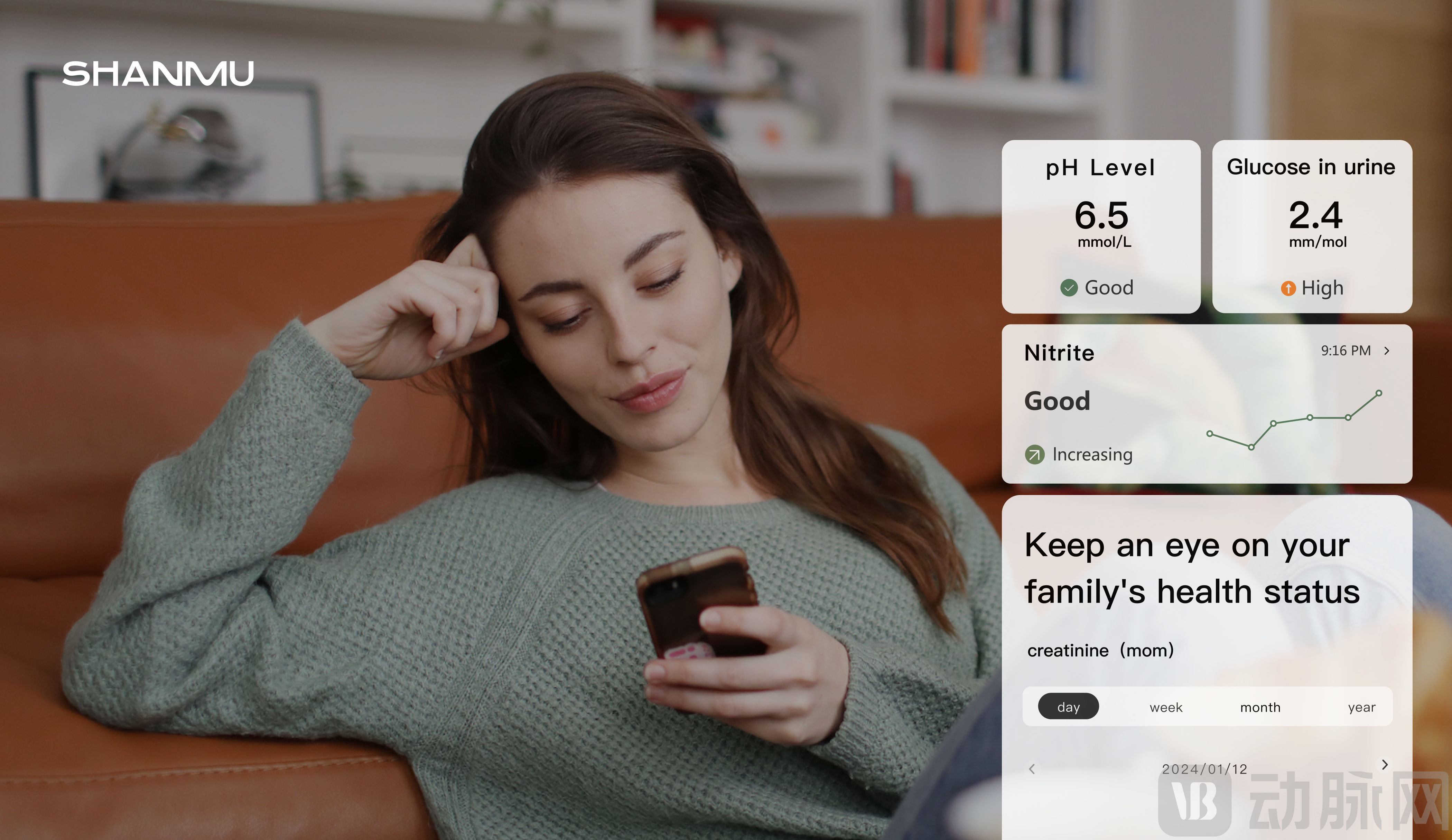
SHANMU is committed to becomingThe World’s First AI Family Doctor Robot Company in the AIGC Era,“Perception Series” and “Agility Series” Medical-Grade Products, focusing on providing digital healthcare system solutions for individuals, families, and medical institutions. By continuously simulating the characteristics and patterns of metabolism, marking the correlation between disease and health, and setting different disease management cycles, it can effectively help each individual better manage their health.
In the future, we will no longer need to worry about the "hidden" health issues affecting ourselves and our families, as proactive medical visits will evolve into "passive interventions." AI will establish a entirely new healthcare sensing ecosystem. By collecting and analyzing real-time multi-biomarker data, it will integrate various personal data dimensions—such as dietary habits, sleep patterns, genetic diseases, and DNA expression—into a personalized health database. This system will provide insights for disease intervention, diagnosis, and drug treatment feedback that surpass those of human medical experts. Much like today’s intelligent vehicles, where AI-driven autonomous driving systems are truly trained through the massive collection of road condition data from cameras and millimeter-wave radars, combined with human drivers’ obstacle avoidance capabilities, this AI healthcare model relies on comprehensive data integration to achieve superior performance.
AI godfather Hinton has publicly stated, “Healthcare is clearly a vast application area for AI and one of its best use cases. There is virtually no upper limit to the medical resources that society can accommodate. For users, they need multiple doctors who know them exceptionally well, providing care around the clock…”
For this round of financing,Executive General Manager, Strategic Investment Department, Songlin TechnologyHan ZongyuIt appears that humanity has entered the first year of a new technological revolution, with large AIGC models fundamentally reshaping various industries. SHANMU possesses significant advantages in product structure innovation, biochemical reagent R&D, and vertical AI models. By combining vertical large models with medical-grade consumer hardware, SHANMU can provide continuous, high-precision metabolic data in a seamless and cost-effective manner. Through in-depth exploration based on its vertical large model, SHANMU has the opportunity to create unprecedented value in health management for users. In fact, it has gradually become an industry consensus that AI+ is driving innovation and development in the broader healthcare sector. We look forward to SHANMU’s disruptive technological innovations and first-mover business model being deeply integrated with Songlin Technology’s industrial strengths to create new value for global users.
Partner at Gengxin CapitalWu PengMotto: Technology transforms lives, and AI empowers hardware. The SHANMU team has developed innovative hardware with high barriers to entry by miniaturizing medical-grade devices, innovating their structures, making them affordably priced for consumers, and ensuring a seamless, unobtrusive user experience. Leveraging this hardware as an entry point, SHANMU accumulates vast amounts of continuous, long-term, and real-world user health data. In the era of Artificial General Intelligence (AGI), the combination of the SHANMU health database and large language models is poised to enable SHANMU’s widespread adoption in households globally, elevating human health management to unprecedented heights.