

German Radiopharmaceutical Leader ITM Secures €188 Million in 2024’s Largest Nuclear Medicine Financing Round
ITM Isotope Technologies Munich
Developer of Radiopharmaceuticals and Radioisotopes

Temasek
Investment Company
Carbyne
Emergency Medical Communication Platform

Athos
Fitness Apparel Manufacturer

Qatar Investment Authority
National Wealth Fund

BlackRock
Financial Investment Company
On June 6, 2024, the renowned German radiopharmaceutical company ITM Isotope Technologies Munich (hereinafter referred to as “ITM”) announced the completion of its latest funding round, raising €188 million (approximately RMB 1.48 billion). In addition to Temasek Holdings, BlackRock, and the Qatar Investment Authority, Athos and Carbyne also participated in this round. Nextech, which had participated in the investment in June 2023, was listed among the designated investors.
According to VBInsight, this is the largest financing round in the nuclear medicine sector in 2024.
The company has advanced a radiopharmaceutical for the treatment of gastrointestinal cancers into two Phase 3 studies, which are expected to be completed in 2024 and 2027, respectively. Notably, ITM is also a supplier of radioisotopes, including the commonly used lutetium-177 and gallium-68, an imaging radioisotope. Reportedly, the majority of the newly raised funds will be allocated to ITM’s R&D pipeline, with its lead asset being ITM-11, a drug for gastrointestinal cancers. Other therapeutic candidates are still in early-stage testing but cover various tumor types and radioisotopes.
A Pioneer in Radiopharmaceuticals, Originating in Germany with Nearly 20 Years of Deep Expertise
ITM, founded in Germany in 2004, is a company dedicated to the research and development, production, and global supply of medical radioisotopes and radiopharmaceuticals for targeted diagnosis and therapy of various tumors. As one of the world’s largest producers of medical radioisotopes, ITM is among the few global radiopharmaceutical biotechnology companies with integrated capabilities in R&D, manufacturing, and supply.
In 2007, ITM’s subsidiary, ITM Medical Isotopes GmbH, was established and began the research and development of radiopharmaceuticals for diagnostic and therapeutic applications. In 2009, ITM developed carrier-added-free Lutetium-177 (Lu-177) for medical use, which received marketing authorization in 2016.
Headquartered at the Technical University of Munich, ITM operates GMP-compliant laboratories dedicated to the manufacturing of next-generation radiopharmaceuticals. These facilities feature cleanrooms and specialized hot cells for GMP radiolabeling, with classifications up to Grade A. Furthermore, leveraging its proximity to the FRM-II neutron source and Munich International Airport, ITM enjoys superior logistical capabilities, enabling delivery within 24–48 hours across Europe and within 72 hours overseas. ITM and its subsidiaries have established GMP manufacturing capabilities and a robust global supply network, including innovative, state-of-the-art medical radioisotope and generator platforms for next-generation targeted cancer diagnosis and therapy.
In June 2023, ITM completed a new round of financing amounting to €255 million, with investments from institutions including Temasek, BlackRock, QIA (Qatar Investment Authority), Nextech, ATHOS (a single-family office), Carbyne Europe, and Petrichor (converting a €90 million loan into equity). To date, the company has completed six rounds of financing, accumulating nearly €450 million, demonstrating particularly strong performance.
Leading ITM are two executive directors with low-key management styles.
The Executive Board of ITM consists of Steffen Schuster and Klaus Maleck.
Schuster graduated from Saarland University with a Master’s degree in Economics. He has served as the Chief Executive Officer of ITM since December 2011, bringing nearly 30 years of executive experience. Previously, Schuster was a partner at TVM Capital and served as the Chief Financial Officer of the publicly listed company cycos AG. Early in his career, Steffen worked in the Networks Division of Siemens, where he held various leadership roles, including those related to international mergers and acquisitions, and co-founded Mustang Ventures, a fund headquartered in Silicon Valley.
During his tenure at ITM, he significantly expanded the international development and production of medical radioisotopes and radiopharmaceuticals, successfully leading ITM’s transformation from a pure radioisotope manufacturer into a global biotechnology and radiopharmaceutical company. Furthermore, he established key strategic partnerships, secured relevant equity and debt financing—including loans from the European Investment Bank—and opened new ITM growth sites in Germany and the United States.
Dr. Klaus Maleck holds an MBA and a Master’s degree in Biotechnology from the École Supérieure de Biotechnologie Strasbourg (ESBS), as well as a Ph.D. in Biochemistry from the Max Planck Institute in Cologne, Germany; he joined ITM in June 2021 as Chief Financial Officer.
Prior to joining ITM, Dr. Maleck had over 25 years of executive experience in the biopharmaceutical industry, serving as CEO of TETEC AG. TETEC AG was a fully integrated developer and manufacturer of regenerative medicine products within the Aesculap/B. Braun Group. Under Dr. Maleck’s leadership, the company grew from 30 employees to become one of the largest manufacturers in the field. Previously, he also served as Chief Financial Officer (CFO) and Chief Business Officer (CBO) at Evotec AG, where he witnessed the company’s listing on the NASDAQ stock exchange.
Pioneering Carrier-Free Lutetium-177: China’s National Team in Nuclear Medicine Ramps Up Investment
ITM’s product portfolio spans pharmaceuticals, equipment, and services, corresponding to radiopharmaceuticals and medical radioisotopes, radiolabeling and quality control equipment, and GMP radiolabeling services.
EndolucinBeta is the trademark name for ITM’s carrier-free Lutetium-177, and it is the first carrier-free Lutetium-177 pharmaceutical product to apply for marketing authorization in the European Union. The product received authorization in the European Union in 2015.
Lutetium-177 is currently the most promising and market-dynamic theranostic radionuclide for targeted radiotherapy. It can be used to prepare radiopharmaceuticals with tumor-targeting capabilities for both diagnostic and therapeutic purposes. In recent years, it has been widely applied in research and clinical applications of targeted radionuclide therapy in developed countries in Europe and the United States, achieving favorable outcomes.
Lutetium-177 can be produced via two methods, yielding carrier-added lutetium-177 and no-carrier-added lutetium-177, respectively. Compared with carrier-added lutetium-177, no-carrier-added lutetium-177 products contain extremely low levels of the long-half-life impurity 177mLu and exhibit a specific activity exceeding 3,000 GBq/mg. These characteristics offer advantages such as reduced consumption of labeling precursors, extended shelf life of radiolabeled pharmaceuticals, and easier management of radioactive waste. Consequently, no-carrier-added lutetium-177 holds broader prospects for clinical application.
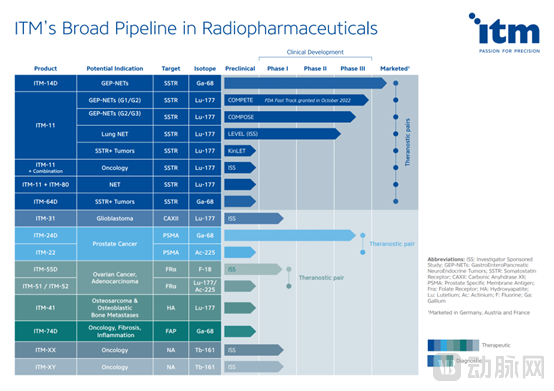
ITM Pipeline, image source: ITM official website
The pipeline ITM-11, which uses carrier-free lutetium-177 as the radionuclide, has naturally become a focal product of interest for many parties.
ITM-11 is a radiopharmaceutical drug conjugate (RDC) based on radionuclide conjugation technology for the targeted radiotherapy of gastroenteropancreatic neuroendocrine tumors (GEP-NETs). This product couples carrier-free lutetium-177 with a somatostatin analog, achieving targeted killing of tumor cells by binding to somatostatin receptors (SSTRs) that are highly expressed on the surface of GEP-NETs. Compared with currently commonly used carrier-added lutetium-177 products, carrier-free lutetium-177 offers higher specific activity and purity, generates fewer long-half-life impurities during production, and results in less radioactive contamination. The product has been granted orphan drug designation by both the FDA and the EMA.
In April 2019, ITM Isotope Technologies Munich SE and United Imaging Healthcare signed a strategic cooperation agreement to collaborate in areas such as marketing, sales, imaging, and related products. Also in 2019, a cooperation agreement was signed with ITM for the large-scale production of GMP-grade Germanium-68/Gallium-68 generators and carrier-free Lutetium-177. As the partnership deepened, the two parties formally signed a joint venture agreement in 2021, marking the establishment of the first Sino-German joint venture in China dedicated to supplying domestically produced next-generation theranostic medical isotopes.
Notably, in early 2022, Grand Pharma (00512.HK) announced that the group would subscribe to new shares of Germany’s ITM Isotope Technologies Munich SE for €25 million (approximately RMB 179 million), representing 1.31% of its enlarged share capital.
Previously, Grand Pharma had secured the exclusive rights for the development, manufacturing, and commercialization in the Greater China region of three globally innovative radiopharmaceutical drug candidates (RDCs) developed by ITM, including: 1) TOCscan®, used for the diagnosis of gastroenteropancreatic neuroendocrine tumors; 2) ITM-11, used for the treatment of gastroenteropancreatic neuroendocrine tumors; and 3) ITM-41, used for the treatment of bone metastases from malignant tumors. This equity acquisition will further deepen the collaboration between Grand Pharma and ITM.
The Board of Directors of Grand Pharma stated that this strategic alliance between two industry leaders will further strengthen the company’s global capabilities in the research and development, manufacturing, and supply of radiopharmaceuticals. It will support Grand Pharma in building an internationally leading theranostic platform for radionuclide drugs, thereby solidifying its position as a global leader in the nuclear medicine sector. Additionally, this partnership is set to become a successful case study of deep collaboration among upstream and downstream enterprises in the domestic and international radiopharmaceutical industries.
Challenging Novartis
ITM-11 is directly benchmarked against Novartis’s Lutathera, as both utilize the same isotope: lutetium-177. However, according to Schuster, there are differences in dosing intervals and certain therapeutic components between the two. “Our goal is not merely to capture market share from Novartis,” Schuster declared boldly. “We aim to create a larger market. There are many patients who could have received this treatment but ultimately did not.”
ITM’s challenge is not without merit; it squarely targets the supply issues of radiopharmaceuticals.
In March 2022, Pluvicto received FDA approval for the treatment of PSMA-positive metastatic castration-resistant prostate cancer (mCRPC), becoming the world’s first PSMA-targeted radioligand therapy (RLT). Although it achieved impressive sales of $980 million in its first full year on the market, supply constraints prevented Pluvicto from reaching its full potential.
Due to immense demand, Pluvicto’s production capacity was once insufficient, leading Novartis to suspend enrollment of new patients. Previously, Alfredo Najá Domingos, a prostate cancer patient, stated that when all chemotherapy options were deemed futile, hope rested solely on Pluvicto; yet he still faced a wait of several months to access the drug.
In addition to insufficient production capacity caused by isotope supply shortages, which has resulted in a significant gap in clinical demand, the fact that Pluvicto has a shelf life of only a few days and therefore cannot be stockpiled in advance is another major reason limiting its widespread adoption. In contrast, ITM Isotope Technologies Munich achieves self-sufficiency through its own business layout and leverages resources accumulated over years of commercial partnerships, thereby minimizing concerns about supply chain disruptions.
In January 2024, ITM also announced that its new production facility in Germany was ready for operation. A few months earlier, the company had established a joint venture with Canadian Nuclear Laboratories to produce actinium-225, another radioactive isotope used by pharmaceutical manufacturers and often referred to as “the rarest drug on Earth.” Just days prior, Bristol Myers Squibb (BMS) publicly stated that it had to suspend enrollment of new patients in the Phase 3 trial of its radiopharmaceutical RYZ101 due to a shortage of actinium-225.
On May 28 of the same year, ITM, Bruce Power, the Saugeen Ojibway Nation (SON), and Isogen entered into a cross-border partnership to jointly celebrate the construction of a second production line. This initiative will double the production capacity of the Isotope Production System (IPS) at Bruce Power’s Unit 7, further expanding isotope output. The move has received support from Ontario’s Minister of Energy, who stated that Ontario continues to strengthen its global leadership in isotope production.