

Zhongshan Hospital Unveils New Intraoperative Stent System Patent for Type A Aortic Dissection
Recently,Zhongshan Hospital, Fudan UniversityA New Patent Publication, Which IsAn Intraoperative Stent System for Type A Aortic Dissection。
Aortic dissection is a severe cardiovascular disease. It is often fatal when blood penetrates the outer wall of the aorta. Type A dissection, which involves a tear in the portion of the aorta as it exits the heart, is more common and dangerous than other types.
Aortic Arch Replacement Combined with Descending Aorta Stent ImplantationAlthough it is currently an effective surgical approach for treating Type A aortic dissection, its adoption has not been widely disseminated due to the complexity of the procedure and the relatively high rates of complications and mortality; consequently, the majority of these surgeries are performed at experienced medical centers.
The intraoperative stent system developed by the team at Sun Yat-sen University comprises multiple components, including a synthetic vascular graft segment, a single-branch segment, a bare-metal stent segment, and a covered stent segment. The distal covered stent segment can cover and support the descending aortic dissection during deep hypothermic circulatory arrest; the single-branch segment prevents stent migration; and the synthetic vascular graft segment can be directly anastomosed to the prosthetic graft used for ascending aorta replacement.
The intraoperative stent system can enhance existing surgical strategies and methods for treating type A aortic dissection.Significantly shorten the duration of deep hypothermia and circulatory arrest surgery, reducing surgical complexity, thereby improving patient survival rates.
I. Complex Classification of Vascular Interventional Products
Vascular interventional therapy is an emerging minimally invasive treatment for vascular diseases in recent years, which has advantages over open surgical procedures.Minimal trauma, rapid recovery, and few complicationsadvantages and features. Vascular interventional products also vary depending on the location of the lesion.
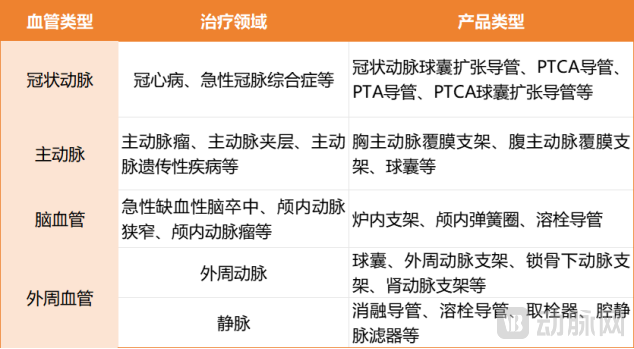 Types of Vascular Interventional Products
In China’s field of endovascular intervention, coronary intervention has developed relatively maturely, while interventional treatment solutions and medical devices for the aorta and peripheral vessels entered the Chinese market later than those for coronary intervention. Therefore, regarding related products,The product categories for aortic and peripheral vascular interventions are also fewer than those for coronary intervention devices.
As population aging intensifies, the number of patients with chronic diseases such as hypertension is increasing year by year. Taking Type A aortic dissection as an example, the incidence rate has reached 77.73 per 100,000 people, with a compound annual growth rate (CAGR) of 3.18%. The number of patients is projected to grow to 1.589 million by 2030. In addition, according to Frost & Sullivan data, the total volume of aortic endovascular procedures is expected to increase from 57,300 in 2022 to 180,400 in 2030.
The growing patient population demands safer and more effective surgical strategies, while market demand for aortic interventional devices continues to expand.
II. Domestic Substitution Has Become a Trend
As aortic endovascular interventions are still in the developmental stage, independent research and development in this field started relatively late.Domestic medical devices remain in the initial stage of import substitution.。
The major participants in this sector currently include Lombard Medical Corporation, Braile Biomedica, Getinge Group, and Johnson & Johnson. Domestic companies such as CenterPulse Medical and Lifetech Scientific hold significant market shares.
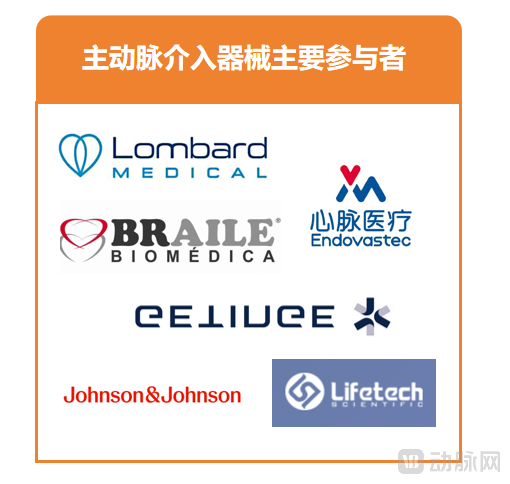
Key Players in the Aortic Endovascular Device Industry
In 2018, Medtronic held the leading market share in China’s thoracic endovascular aortic repair (TEVAR) stent and abdominal endovascular aortic repair (EVAR) stent markets, at 38% and 37%, respectively. Despite the rise of domestic substitution this year,Medtronic continues to maintain a high market share.。
MicroPort Endovastec is a leading domestic brand with a significant market share. In 2018, it ranked second in the Chinese market for aortic endovascular interventional medical devices, trailing only Medtronic. As of 2022, MicroPort Endovastec had 12 marketed products covering multiple application scenarios, including the aortic arch, descending aorta, and abdominal aorta, thereby establishing a comprehensive product portfolio.
According to public information, in April 2024, multiple covered stents and delivery systems from MicroPort Endovascular were clinically implanted in overseas markets such as Uzbekistan and Belarus, marking the entry of Chinese-made innovative aortic products into international markets.
In recent years, with the rise of improved surgical techniques in China and advancements in medical standards, the number of aortic endovascular interventions has been gradually increasing. Looking ahead, domestically produced stents for aortic procedures are also poised for new growth.