

Hospitals Issue $300 Million IT Infrastructure Procurement Orders Amid Surge in Healthcare Digital Innovation
As spring transitions into summer, rising alongside temperatures are confidence and sentiment in the healthcare IT industry.
In 2024, the initiative to adopt indigenous IT innovations in the healthcare sector gained significant momentum. On the demand side from hospitals, not only were hundreds of thousands of procurement orders released intensively, but there also emerged numerous large-scale contracts worth tens of millions, or even over one hundred million yuan.
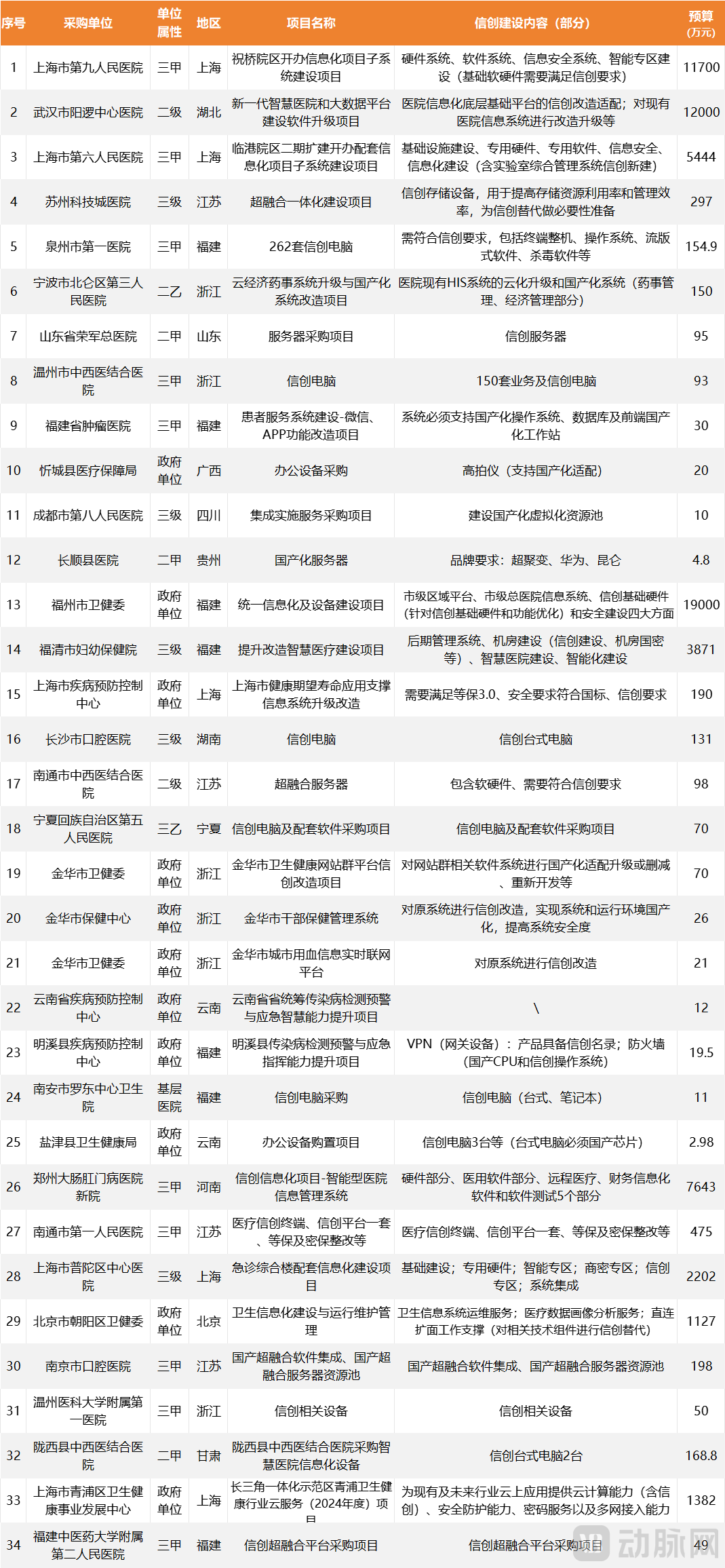
On April 18, medical institutions in Fuzhou released an IT and equipment construction project related to information technology application innovation (Xinchuang), with a total amount of RMB 190 million, setting a new historical high. In May, two more Xinchuang projects each worth over RMB 100 million were announced by Wuhan Yangluo Central Hospital and Shanghai Ninth People’s Hospital, respectively. According to incomplete statistics from VCBeat, the total publicly disclosed procurement demand for Xinchuang and informatization in healthcare systems across various regions approached RMB 700 million in the first five months of 2024 alone.
Significant changes have also emerged on the technology supply side. As the most influential and leading industry events in the Health Information Technology (HIT) sector, CHINC and CHIMA often set the tone for industry development through their chosen themes. In 2024, both conferences introduced “Information Technology Application Innovation (Xinchuang)” special sessions for the first time and dedicated exhibition areas to showcase Xinchuang solutions. Hospital administrators from across China were invited to share practical experiences in implementing medical Xinchuang initiatives and to demonstrate related products. Elements of “Xinchuang” were ubiquitous throughout the events.
Amidst these changes, healthcare informatization may usher in new growth opportunities. By analyzing bidding and tendering information and interviewing multiple healthcare IT companies that have taken the lead in implementing healthcare-specific information technology application innovation (Xinchuang), VCBeat has outlined the current Xinchuang demands on the hospital side and shared practical exploration outcomes from the industry.
The fundamental objective of launching information technology application innovation (Xinchuang) is to “address supply chain security issues” by achieving full-industry-chain substitution centered on foundational hardware and software. After 2020, as the Xinchuang ecosystem for party and government agencies gradually matured, Xinchuang initiatives began expanding into eight key livelihood sectors, including finance, electric power, telecommunications, healthcare, and education.
According to data from EO Intelligence, the market size of medical IT application innovation is expected to experience exponential growth over the next 3–5 years, entering a phase of comprehensive explosive growth after 2025. The industry widely regards 2023 as the inaugural year of medical IT application innovation, for three reasons:
First, since 2023, local health commissions, centers for disease control and prevention, and other authorities have successively issued guidance policies on medical information technology application innovation., with some regions also specifying implementation timelines. For instance, Shanghai requires municipal-level hospitals to complete comprehensive IT application innovation upgrades by June 2025, while the first batch of pilot hospitals must achieve over 50% completion of such upgrades by June 2024.
Second, it has transcended the retrofitting of non-core business systems and achieved “genuine replacement and genuine adoption” in core clinical care business systems.In December 2023, Xiamen University Affiliated Chenggong Hospital, the Chinese PLA General Hospital (301 Hospital), and Peking University First Hospital successively completed IT application innovation (Xinchuang) replacement of their core systems at various stages, setting a demonstrative example for healthcare institutions nationwide. Taking the 301 Hospital as an example, supported by Kingbase database and UnionTech OS, the cloud-based Hospital Information System (HIS) of the Chinese PLA General Hospital was launched on a fully domestic hardware and software platform, becoming a benchmark case for IT application innovation practices among ultra-large tertiary Grade A hospitals in China.
Third, a surge in bidding and tendering data in 2023.Following the surge in medical IT innovation tender values to RMB 3.191 billion in 2022, many industry experts noted that both the transaction amount and volume of medical IT innovation tenders achieved historic exponential growth in 2023, with several large-value orders secured. For instance, in November 2023, China Unicom Digital Tech won the bid for the new campus IT innovation project at Zhengzhou Colorectal and Anal Disease Hospital, valued at RMB 110 million.
In 2024, major contracts for IT application innovation in the healthcare sector reached new highs. VCBeat has compiled publicly available tender data for healthcare IT application innovation in 2024 from multiple channels, aiming to extract valuable insights from it.
In accordance with the requirements set forth in the "Guidelines for Information Technology Application Innovation in Health Information" (hereinafter referred to as the "Guidelines") issued by the National Health Commission, the implementation of information technology application innovation in the healthcare sector shall proceed on a stable foundation, starting with areas of low business criticality. The implementation sequence shall comprehensively consider factors such as urgency, complexity, and the maturity of domestic IT products.
Moreover, given the unique nature of medical scenarios and the complexity of healthcare systems, requirements for IT application innovation (Xinchuang) transformation vary across different medical systems. Specifically, hardware such as personal computers and basic peripherals undergo comprehensive replacement, while information systems are localized to varying degrees based on their relevance to clinical care operations.
First, information systems unrelated to clinical diagnosis and treatment services, such as administrative office systems and website-based systems, mustFull Completion of Xinchuang Transformation;
Second, core business support systems that do not provide diagnostic and treatment services, such as clinical data centers, operational data centers, and research data centers, shall achieve localization with information technology application innovation (Xinchuang) products, except for those systems using non-Xinchuang technologies that are retained after demonstration.Replace as Much as Possible;
Finally, the core business systems that provide diagnostic and treatment services to patients, such as HIS/LIS/RIS/PACS, thenReplace whenever possible.。
Class III products exhibit a high degree of reliance on foreign products. In particular, large-scale, high-end medical devices are predominantly imported and comply with international standards. Their accompanying software products demonstrate low compatibility with domestically produced infrastructure and basic software platforms. Since clinical, technical, and pharmaceutical departments all rely on these software systems for daily diagnostic and therapeutic operations, replacement poses significant challenges. If an assessment determines that adaptation to Information Technology Application Innovation (Xinchuang) standards is not feasible, these systems must undergo modifications to integrate domestic cryptographic algorithms and implement data classification and grading measures.
Based on the construction scope of the tendered projects, current information technology application innovation (Xinchuang) initiatives in medical institutions exhibit weak relevance to clinical diagnosis and treatment operations., with a preference for procuring IT infrastructure such as Xinchuang (Information Technology Application Innovation) computers and Xinchuang clouds, as well as application systems and equipment including office automation systems, management systems, peripheral business platforms, and core business platforms. The adaptation and migration work for medical Xinchuang is still in the initial stage of development.
It should be noted that many tender announcements specify: IT application innovation (Xinchuang) technical operation and maintenance support services must also be provided., such as providing on-site technical support services including system installation, configuration optimization, and troubleshooting, to ensure the stable operation of the IT application innovation infrastructure resource environment, and facilitating collaboration among upstream and downstream vendors in the industry chain.
Deputy Director of the Smart Traditional Chinese and Western Medicine Research Center, Peking University Chongqing Big Data Institute; CEO of Zhiyi CunneiHuang XintingIn the field of healthcare informatization, extensive practical experience has demonstrated that the successful deployment of any new technology or product relies on the synergy between application and maintenance. Users identify issues, propose optimizations, and articulate new business requirements during actual use, while technology providers respond promptly with updates and iterative improvements.
“Given the unique nature of healthcare scenarios, hospitals favor comprehensive solutions that provide end-to-end services, ranging from the adaptation of independently developed hardware and software products to the migration, adaptation, R&D, and testing of application software,” stated Huang Xinting from Zhiyi Cunnei. “For instance, our self-developed Intelligent Auxiliary Diagnosis and Treatment System for TCM Syndrome Differentiation and the Integrated Traditional Chinese and Western Medicine Knowledge Base System have successively obtained adaptation certification certificates from Dameng Database and Kylin Software. This signifies that both systems meet compatibility, performance, and reliability requirements, thereby fulfilling users’ critical application needs.”
Senior Director, Meichuang TechnologyDing Feialso expressed the same idea. Targeting users’ current database construction and application architecture, combined with their business conditions and specific requirements for localization transformation, Meichuang Technology provides a comprehensive solution for domestic IT innovation transformation of databases. This solution covers guidance on selecting domestic databases, assists users in formulating migration plans, implements the migration, and provides ongoing operation and maintenance services for domestic databases.
Next, consider the location of the procuring entity., based solely on the publicly available tender information collected in this article, Fujian Province had the highest procurement volume with 7 cases; the Jiangsu-Zhejiang-Shanghai region followed closely with a total of 15 cases. It should be noted that the Xinchuang (Information Technology Application Innovation) tender information presented herein was obtained only from selected public channels, and the limited data volume may lead to biased conclusions. Industry practitioners are welcome to engage in discussions and exchanges.
Fujian Province has made rapid progress in its healthcare information technology innovation initiatives,Case Study of Domestic Substitution at Chenggong Hospital Affiliated to Xiamen University,It has not only set a pioneering example for the industry but also instilled confidence in information technology application innovation (Xinchuang) among more healthcare institutions that were previously on the sidelines.
VCBeat previously analyzed winning bid samples from nationwide medical informatization tender procurements. Fujian Province ranked among the top three in China in both the volume and value of procurement in the field of medical informatization, with its construction pace consistently leading the nation. In April, Fujian Province also announced the list of key digital economy projects for 2024, stating that it would invest RMB 131 billion in digital economy projects in 2024 to further promote innovative development of the digital economy.
On the other hand, healthcare IT innovation localization is a systematic project that requires high-level attention from the government, proactive deployment of work, and continuous improvement of the policy framework. For instance, Shanghai has introduced highly targeted and actionable policies on IT innovation localization, requiring municipal-level hospitals in Shanghai to complete comprehensive upgrades by June 2025, and the first batch of pilot hospitals to achieve over 50% completion of their IT innovation localization upgrades by June 2024. The policy also explicitly mandates the classification of hospital application software, providing clear direction for hospitals’ IT innovation localization efforts.
General Manager, Healthcare Division, KingbaseHe Rongstated that, leveraging regional economic strength, talent support, and technological innovation capabilities,Currently, the East and South China regions are advancing relatively quickly in their domestic upgrade and transformation efforts, such as in Zhejiang, Shanghai, Jiangsu, Fujian, and Guangdong provinces. The North China region (Beijing, Tianjin) and Central China (Henan) are also steadily promoting these initiatives.
Then, check the purchasing unit., in addition to hospitals at all levels, entities such as the National Health Commission and the Centers for Disease Control and Prevention have intensified their efforts in medical IT application innovation, driven by the pandemic. These initiatives aim to advance the construction of public health informatization platforms, substantially enhance the capacity and capability to respond to major sudden public health emergencies, and continuously improve healthcare security standards, ensuring the rational, secure, and controllable use of medical insurance funds. The horizontal expansion of medical IT application innovation coverage also reflects the healthcare industry’s heightened emphasis on this strategic initiative.
Although efforts to promote information technology application innovation (ITAI) in the healthcare sector have been underway for many years, progress has remained limited. This is due to the unique characteristics of the healthcare industry and the fact that ITAI itself is a complex systemic engineering endeavor. Advancing ITAI in healthcare requires concerted efforts from all stakeholders, including policymakers, hospitals, and enterprises.
“Medical information technology innovation efforts must be policy-led, with strong policy guidance and coordinated planning to establish key milestones, thereby enhancing the efficiency and enthusiasm of implementation.“Policy is the top priority among the many factors driving the development of healthcare informatization and smart healthcare in China,” stated Ding Fei from Meichuang Technology. Requirements such as the “three pillars” of smart hospital construction, interoperability, and Level 3 Classified Protection of Cybersecurity are all mandatory challenges that medical institutions must address. Currently, healthcare IT application innovation represents one of the key innovative challenges facing healthcare informatization.
Furthermore,Address funding issues and encourage medical institutions to undergo IT innovation transformation.Public hospitals are currently operating under tight budget constraints, facing significant financial pressure regarding medical information technology application innovation (Xinchuang) initiatives. As previously mentioned, the funding for such procurement projects is largely self-raised by the hospitals. In response, some local governments have introduced subsidy policies. For instance, in April 2024, the Beijing Municipal Bureau of Economy and Information Technology and the Beijing Municipal Finance Bureau issued the "Notice on Organizing the Application for the 2024 Beijing High-Precision and Advanced Industry Development Fund," which explicitly supports Beijing-based enterprises in jointly developing Xinchuang solutions with users in the healthcare sector. Applicants meeting the specified criteria will be granted a reward equal to 10% of the amount allocated to Xinchuang products and services (excluding application software) in the procurement contract, with a maximum cap of RMB 30 million for the lead entity.
Medical IT innovation vendors must continue to enhance the cost-effectiveness of their products to bolster the confidence of hospital information departments.
Given the unique nature of the healthcare industry compared to other sectors, particularly the extremely high stability requirements for core systems, it is essential to ensure 24/7 uninterrupted operation. As a leading domestic database enterprise, Kingbase offers relatively comprehensive and mature localization solutions, such as primary-standby high availability, zero-downtime migration, and dual-track parallel operations, providing robust support for hospitals’ digital transformation initiatives. Furthermore, Kingbase places significant emphasis on ecosystem development within the healthcare sector. To better facilitate the localization upgrade of medical systems, Kingbase actively promotes ecological adaptation with leading vendors in the healthcare industry. It has already achieved deep product compatibility with over 200 healthcare ecosystem vendors, including providers of core systems such as Hospital Information Systems (HIS), Laboratory Information Systems (LIS), and Electronic Medical Records (EMR).
After gaining a deep understanding of the unique needs of the healthcare industry, Kingbase has also launched a one-stop digital healthcare solution. Centered on the Kingbase Cloud Database Appliance KXData-M, this solution integrates high-performance database, storage, and computing resources, enabling rapid deployment and efficient operation of healthcare business systems. According to reports, the KXData-M cloud database appliance not only eliminates the cumbersome processes of product selection and adaptation but also enhances overall performance by more than 20% through in-depth optimization.
The localization and innovation initiative in the healthcare industry is still in its early stages, and the effectiveness of IT application innovation upgrades and adaptations by mainstream medical software vendors remains to be verified. Without the bold attempts of pioneering hospitals, it would be difficult to implement IT application innovation in the healthcare sector.“Hospitals are currently in a state of stable operation. To undertake risky IT innovation initiatives, successful case studies are needed. However, there are currently too few such cases; leading large hospitals are needed to set an example and establish industry best practices.”.” said Ding Fei of Meichuang Technology.
It is important to note that in the context of healthcare IT innovation, emphasis should not only be placed on the localization of IT systems but also on the domestic production of high-end medical devices.
Currently, the localization of IT innovation in healthcare has become an inevitable trend. For healthcare IT companies, this presents opportunities; for healthcare system administrators, it offers a chance to upgrade hospital information infrastructure. As an industry observer, VCBeat will continue to monitor developments in healthcare IT localization and welcomes insights and discussions from industry practitioners.