

Waystar Raises Nearly $1 Billion in 2024’s Largest Digital Health IPO

Waystar
Healthcare Payment Software Developer
On June 8, local time,U.S. healthcare IT company Waystar lists on Nasdaq, raising up to $967.5 million. This marks the second IPO in the U.S. digital health sector within a short period (Tempus AI’s listing in late May ended the drought of digital health IPOs in the U.S. market since 2023), and it is the largest digital health IPO since 2022, likely also the largest in the sector for 2024.。
What Impressive Assets Enable This Company to Pursue Such a Large-Scale IPO? Can the Once “Frozen” Digital Health Sector Be Revitalized? VCBeat Has Compiled Relevant Information for Readers’ Reference.
Waystar is a healthcare information technology company that primarily provides SaaS-based Revenue Cycle Management (RCM) services to healthcare providers, streamlining medical insurance payments for healthcare institutions.
Anyone with even a basic understanding of U.S. healthcare reimbursement knows that its payment system is highly complex. Revenue cycle management (RCM) refers to the financial processes used by healthcare organizations. This process encompasses everything from initial patient scheduling and registration, through the translation of provided care into billable codes and submission of claims to insurers, to posting payments, managing accounts receivable, and finally issuing any necessary patient bills. The entire workflow involves “appointment/pre-registration – benefit verification – visit – charge capture and coding – third-party follow-up – payment or denial management.”
Since the primary revenue of healthcare institutions comes from insurance reimbursements, revenue cycle management is critically important to them and is regarded as the lifeline of healthcare organizations. However, this process is highly complex, involving dozens of interdependent steps from the moment a patient enters a healthcare facility to receive services until the post-service payment and reimbursement are completed. Within these multi-step workflows, the process of determining the amount of insurance reimbursement payable to a healthcare institution involves millions of variables. In addition to tens of thousands of constantly evolving diagnosis codes, there are unique insurance payment contracts, each with its own distinct rules, procedures, and reimbursement requirements.
In the past, healthcare organizations could only barely cope by relying on patchwork manual processes and systems. As the entire payment system has become increasingly complex, manual processing has turned into a nightmare. Tracking and managing all these variables is extremely difficult for healthcare organizations, and coupled with ever-changing regulatory requirements, this inevitably leads to delays in reimbursement and payment workflows, as well as slower payment times. Minor errors can even result in incorrect reimbursement amounts being submitted or claims being denied, leading to revenue loss. According to KFF research, approximately 17% of medical reimbursement submissions were initially denied in the United States in 2021. Once such errors occur, they can only be resolved through litigation, which is time-consuming, labor-intensive, and costly.
According to a survey by the Healthcare Financial Management Association (HFMA), healthcare organizations face numerous challenges that hinder the optimization of their revenue cycle management (RCM). First, billing processes are overly complex, with processing times often extending over several months. During this period, claims frequently bounce back and forth between payers and providers before issues are resolved, while most patients are unable to prepay for medical services. Second, a lack of information makes it difficult for healthcare organizations to address reimbursement-related issues. Finally, due to inadequate systems, healthcare organizations are unable to determine which procedures require prior authorization from patients’ health plans.
The goal of RCM is to create a process that enables healthcare organizations to collect service-related fees in the shortest possible time. With technological advancements, automated payment platforms leveraging big data, AI, and information technology are gradually becoming effective solutions for RCM.
For this reason, Revenue Cycle Management (RCM) has garnered increasing attention in recent years, presenting a significant market opportunity. According to a report by Fortune Market Insights,At the end of 2022, the global market size for medical revenue cycle management software was approximately $64.13 billion, with a projected compound annual growth rate (CAGR) of 10.7% from 2023 to 2030. Waystar’s prospectus also cited a report from the Journal of the American Medical Association, stating that administrative costs account for up to $350 billion annually in U.S. healthcare expenditures, which includes waste associated with medical payments.。
This sector is highly competitive, with Change Healthcare—acquired by Optum, a subsidiary of UnitedHealth Group—being the most prominent player. Founded in 2006, the company went public in 2019. Its prospectus at the time revealed that since 2016, Change Healthcare had been saving insurance clients over $4 billion annually, not only improving payment accuracy but also enhancing provider satisfaction.
Given such impressive “results,” it is no surprise that Change Healthcare was acquired by UnitedHealth for a record $13.5 billion in 2021.
In addition to Change Healthcare, major healthcare IT giants such as Epic and Cerner are also key players in this space. This is because revenue cycle management (RCM) is often closely integrated with electronic health records (EHR), so it is natural for these IT leaders to seize this opportunity.
Waystar was founded in 2017 through the merger of revenue cycle management companies Navicure and ZirMed. Its software platform helps healthcare organizations manage pre-visit (such as eligibility verification and prior authorization approval), during-visit, and post-visit workflows (such as copayment collection, claim submission and monitoring, and insurance payments).
A key feature of its solution is the use of AI to automate payment-related workflow tasks and drive continuous improvement, thereby enhancing the accuracy of claims and billing, enriching data integrity, and reducing providers’ labor costs. In short, these solutions help healthcare organizations secure payments faster, more accurately, and more efficiently, while ensuring patients receive a modern, transparent, and user-friendly financial experience.
Like many publicly listed companies, acquisitions have also been a means for Waystar to rapidly expand.Since 2018, Waystar has completed nine acquisitions, two of which were finalized in the second half of 2023.. Among these acquisitions, the 2020 purchase of eSolutions is particularly noteworthy. Through this acquisition, Waystar gained Medicare-focused solutions, enabling it to address both commercial insurance and government-sponsored healthcare programs on its SaaS platform.
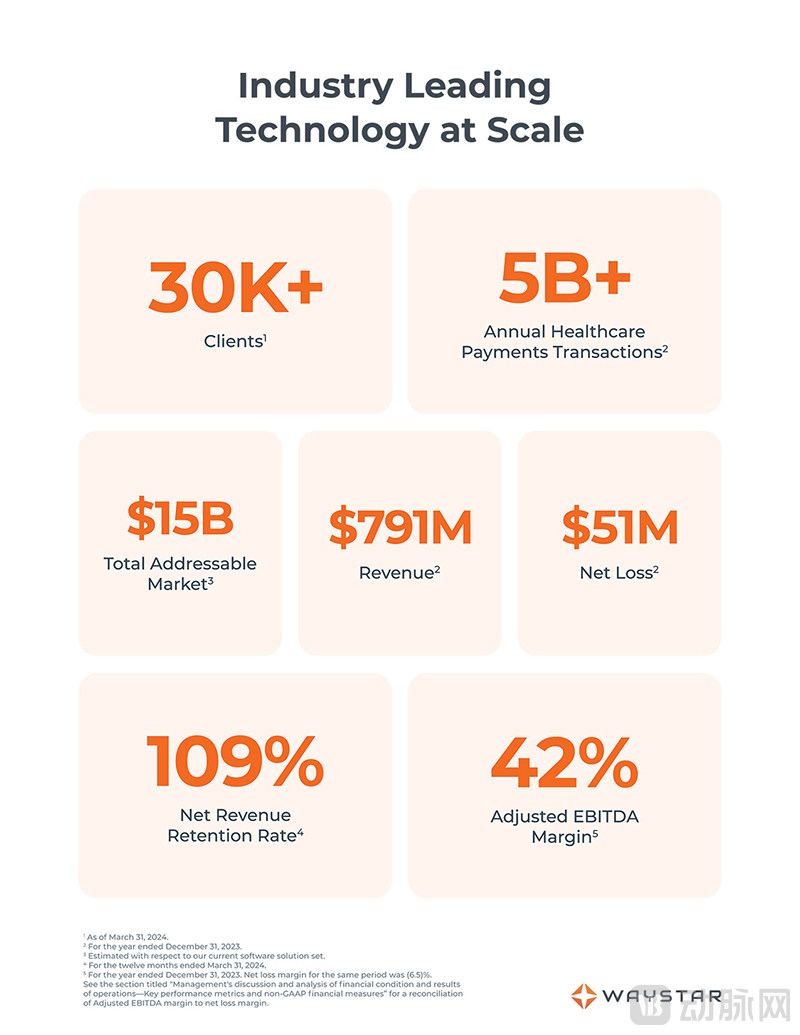
Key Highlights Listed in Waystar’s Prospectus (Screenshot from Waystar’s Prospectus)
After years of effort, Waystar finally went public in 2024, setting a fundraising record in the digital health sector in recent years. Its IPO price was $21.5 per share, with a market capitalization of approximately $3.5 billion, or about $5 billion including debt. The IPO involved the issuance of 45 million shares, raising a total of $967.5 million. Neuberger Berman and the Qatar Investment Authority will purchase shares worth a combined $225 million. Waystar’s stock opened at $21, slightly below the IPO price, which is considered acceptable given the current market environment.
According to the prospectus, Waystar’s comprehensive solutions address the pain points of healthcare providers, patients, and payers in the following areas.
First, financial clearance. Waystar’s platform can automate the insurance verification process and validate patients’ insurance eligibility through prior authorization workflows, thereby helping to eliminate claim denials. A survey conducted by Waystar found that 81% of patients stated they would be more proactive in seeking medical care if they knew the costs in advance. Financial clearance solutions provide greater price transparency for patients, enabling them to have a clearer understanding of their expected out-of-pocket costs.
Second, patient financial support. The Waystar platform facilitates interaction between patients and healthcare providers by offering electronic statements and processing patient payments through its one-stop patient portal. Patients can choose from multiple payment methods for flexible transactions, thereby enjoying an improved payment experience. Meanwhile, this enables healthcare institutions to achieve faster collections and higher collection rates.
Third, claims and reimbursement payment management. Waystar’s platform significantly streamlines the process for healthcare providers to submit reimbursement claims and receive payment information. This solution ensures that healthcare providers submit appropriate documentation and claims in accordance with payer contracts, while automating workflows to reduce and prevent claim denials. Furthermore, its solution features AI-powered claims auditing capabilities to detect errors and verify accuracy.
Fourth, Prevention and Recovery of Claim Denials. Waystar’s platform leverages AI-powered predictive analytics to identify claims at risk of denial and prioritizes denied claims based on the likelihood of a successful appeal. This solution reduces manual workflows and shortens the turnaround time for post-denial appeals. Furthermore, the solution features robust data analytics capabilities that help healthcare organizations identify root causes, thereby reducing the likelihood of future claim denials.
Fifth, Revenue Capture. Waystar’s platform leverages AI to identify and resolve missed charges and errors in reimbursement submissions, reducing manual audits while improving clients’ reimbursement accuracy and cash flow.
Sixth, analytics and reporting. Waystar’s platform can collect and organize vast amounts of healthcare data, presenting it in a unified, one-stop dashboard. These data can be standardized or customized to meet client needs. The solution also provides data visualization and business intelligence analytics, enabling healthcare organizations to manage payment and denial trends across their entire operations. Compared with traditional manual spreadsheets used for assessing business trends, the solution significantly improves workflow efficiency and optimizes performance through real-time evaluation of key performance indicators.
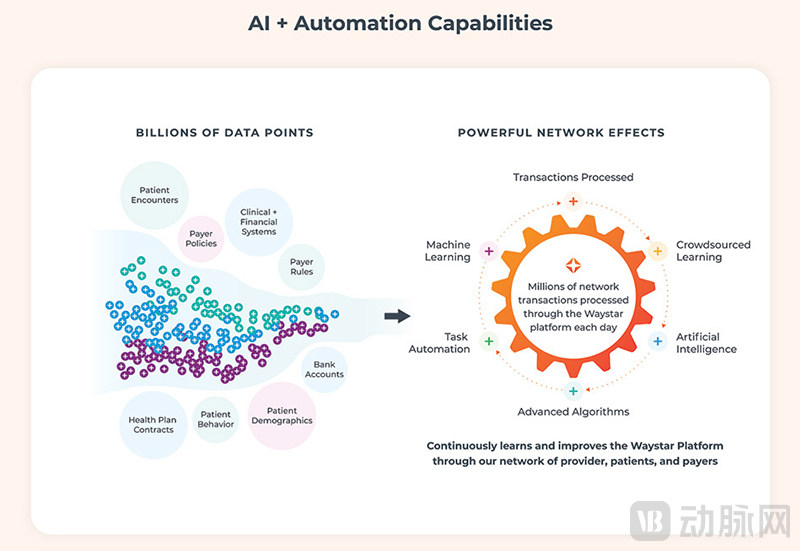
Waystar Places Special Emphasis on AI’s Empowering Role in Revenue Cycle Management (Screenshot from Waystar’s Prospectus)
Notably, this past May, Waystar announced a partnership with Google Cloud to leverage generative AI for revenue cycle management functions. According to the announcement, Waystar and Google Cloud have automated the extraction of prior authorization requirements from complex payer datasets. In a proof-of-concept study conducted by the two companies, the application reduced the time required to generate procedural prior authorization reports by 99.93%, while improving accuracy by 13%.
After several years of growth, Waystar has emerged as a significant force in the U.S. revenue cycle management (RCM) sector. According to its prospectus, its solutions are used daily by healthcare organizations of all types and sizes, ranging from clinics to large hospitals and health systems. Waystar directly serves approximately 30,000 clients, supporting around one million healthcare providers—from individual practices to large hospitals—in their clinical operations. Notably, 18 of the top 22 hospitals ranked as the best in the United States by U.S. News & World Report utilize Waystar’s solutions.
AtThroughout 2023, Waystar facilitated over 5 billion healthcare payments, including more than $1.2 trillion in total reimbursements, covering approximately 50% of patients nationwide.. Its scale is still quite considerable.
According to the prospectus, over 99% of Waystar’s revenue is derived from recurring subscriptions or highly predictable volume-based arrangements. Customer contracts typically include both a subscription fee component and a volume-based component, although some contracts contain only one of these elements. Generally, Waystar’s customer contracts have a term of two to three years, with automatic one-year renewal provisions, tiered discounts, and monthly billing.
Subscription fees provide a stable, recurring revenue stream, while the volume-based component enables it to benefit from customer growth. Given its contract structure, proprietary data assets, predictive analytics capabilities, and deep understanding of the healthcare market, Waystar believes it is well-positioned to understand and forecast its revenue.
It is worth noting that Waystar has a highly diversified customer base. As of 2023, its top ten customers accounted for only 11.3% of its total revenue. Meanwhile, Waystar’s business model is characterized by long-term engagement; as the healthcare institutions it serves expand in scale, reimbursement volumes and transaction counts will further increase, along with the adoption of additional Waystar solutions, thereby driving its business growth.
In terms of customer satisfaction, Waystar’s services and solutions have also proven to be highly competitive. According to the prospectus,Waystar’s net revenue retention rate reached 108.8% in the 12 months ended March 31, 2024.. This also reflects customer satisfaction, as evidenced by the growing adoption of Waystar solutions and referrals to other healthcare institutions. Furthermore,During fiscal years 2021–2023, Waystar achieved an 82% win rate against competitors in deals where customers ultimately chose to switch vendors or purchase new solutions.。
With the help of Waystar’s solutions, its clients have also experienced rapid revenue growth.The number of its customers with annual revenues exceeding $100,000 has grown in recent years from 920 (as of March 2022) to 1,007 (as of March 2023), and further to 1,080 (as of March 2024).。
Interestingly, Waystar also “benefited” from the recent cyberattack on Change Healthcare. According to its prospectus, Waystar helped more than 30,000 healthcare providers, including large health systems and clinics, transition to and adopt its solutions during the crisis, with migration taking as little as 48 hours.
This presents Waystar with an opportunity to establish direct connections with large national health plans. Previously, these nationwide health plans often maintained exclusive integrations with giants such as Change Healthcare. As part of its strategy, Waystar aims to achieve a breakthrough in this sector, thereby facilitating the acquisition of new customers.
According to the prospectus, Waystar generated $791 million in revenue in 2023, with a net loss of $51.3 million, compared to $705 million in revenue and a net loss of $51.5 million in 2022. On a quarterly basis, its revenue and net loss for the first quarter of 2024 were $225 million and $15.93 million, respectively, versus $191 million and $10.62 million, respectively, in the same period of the previous year.
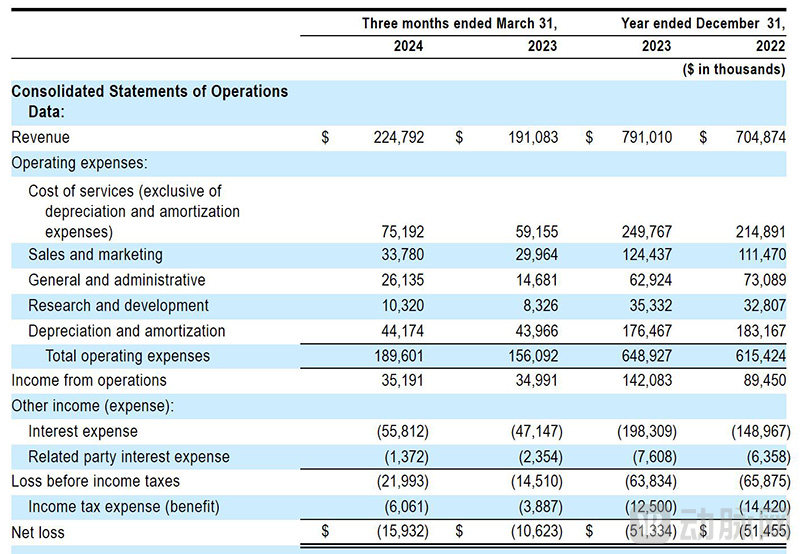
Waystar’s Revenue Performance (Screenshot from Waystar’s Prospectus)
Obviously, it is quite challenging to achieve such results under the current macroeconomic backdrop.
Over the past year or more, digital health has clearly endured a challenging period. Taking U.S.-listed stocks as an example, there were no initial public offerings (IPOs) related to digital health throughout the entire year of 2023. In contrast, the sector saw approximately 20 IPOs during its boom in 2021.
Waystar’s high-profile IPO, valued at nearly $1 billion, has set a new record in recent years. This marks the second IPO in the U.S. digital health sector within a short period, following Tempus AI’s listing application on May 20, which aimed to raise up to $100 million. This development also seems to signal that the prolonged winter for the digital health industry is finally gradually coming to an end.
Nevertheless, in the wake of the recent “bubble,” demonstrating a proven ability to generate sustainable revenue has become more critical than ever. After all, no matter how cutting-edge the technology or how flashy the product, nothing is more tangible than being genuinely “useful.” Moreover, companies like Waystar deliver quantifiable, financial impact, making their record-breaking performance a natural outcome.
We also sincerely hope that the record set by Waystar will soon be broken by successors, and that the winter of digital health will eventually pass.