

Fuwai Hospital Announces New Artificial Heart Patent: Dual-Balloon Ventricular Assist System
Recently,Shenzhen Hospital of Fuwai Hospital, Chinese Academy of Medical Sciences(Shenzhen Sun Yat-sen Cardiovascular Hospital) adds one new itemDual-Balloon Pump Ventricular Assist SystemPatent Disclosure.
Ventricular Assist Devices (VADs) are primarily used in the treatment of cardiac weakness or heart failure, as these devices help pump blood from the lower chambers of the heart to other parts of the body. VADs vary in design depending on different clinical needs.
This team-designed ventricular assist device is primarily intended for heart failure with reduced ejection fraction. The product uses a catheter to position two balloons in the left ventricle and the descending aorta, respectively. By periodically inflating and deflating these balloons, the device augments the pumping capacity of the left ventricle, thereby alleviating symptoms associated with myocardial ischemia and heart failure. Additionally, the device can be synchronized with an electrocardiogram (ECG) to precisely control balloon inflation and deflation, achieving optimal therapeutic outcomes.
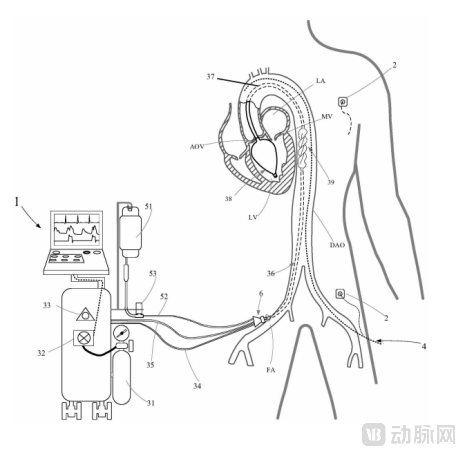
Product Schematic (Source: Patent Specification)
I. Artificial Hearts May Alleviate the Dilemma of Cardiac Implantation
Heart failure is a common cardiovascular disease. According to statistics, as of 2023, the number of heart failure patients in China had reached 12.1 million, with the incidence rate increasing year by year.It has become one of the most severe cardiovascular diseases in China.
According to the "2024 Chinese Guidelines for the Diagnosis and Treatment of Heart Failure," there have been numerous breakthrough advances in pharmacological therapy for heart failure in recent years; however, drug treatment may be suboptimal for patients with severe heart failure or those with specific phenotypes.Ventricular Assist Devices Have Become the Most Effective Treatment for Heart Failure Besides Heart Transplantation.
Based on the site of action, ventricular assist devices currently available on the market can be classified intoLeft Ventricular Assist Devices, Right Ventricular Assist Devices, and Biventricular Assist DevicesThree categories. Among them, left ventricular assist devices are the most common.
Additionally, from the perspective of intervention methods, ventricular assist devices can be classified intoImplantable, Interventional, and Extracorporeal Circulation-BasedThree types. Selection varies according to clinical needs.
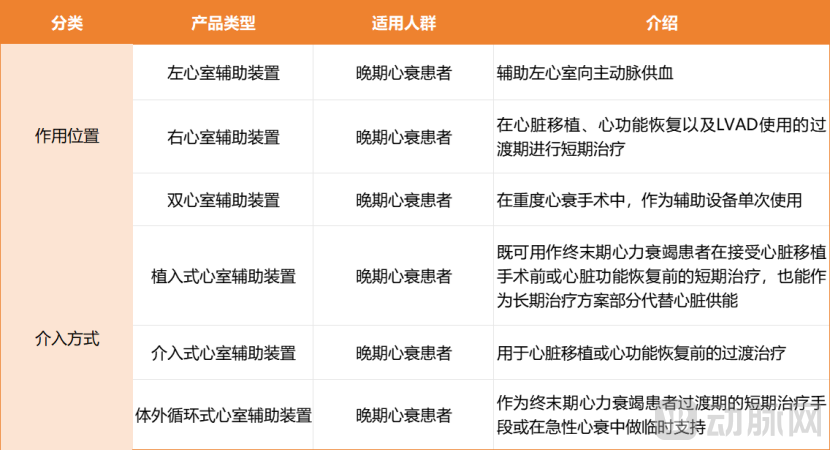 Introduction to Various Ventricular Assist Devices
II. Late Start in China, but Rapid Development
Ventricular assist devices (VADs) present high technical barriers, requiring not only biocompatibility but also precise control of hemolysis and thrombosis parameters, posing significant challenges to both medicine and engineering.
Currently, foreign products onlyHeartmate ⅢHas obtained long-term assistive device licensing but has not yet entered the Chinese market; whereas domestically, only those that have received approval for long-term assistive useEternal HeartMedical products, additionallySuzhou Tongxin, Hangtian Taixin, and Shenzhen HexinAll approved for short-term adjunctive use.
HeartMate ⅢIt is a ventricular assist device approved for market launch by Abbott in 2017. The pump’s impeller employs levitation with multi-degree-of-freedom control to achieve high-speed rotation and generate mechanical suction. As it utilizes contactless bearings, mechanical friction is eliminated, thereby extending the pump’s operational lifespan and improving biocompatibility. Clinical trial data indicate that the two-year survival rate for patients with end-stage heart failure treated with this device reaches 79%, comparable to that of heart transplantation.
In 2024, the domestic brand Yongrenxin Medical ProductsEVA-Pulsar™Listed, this is the only artificial heart product approved in China for long-term implantation. According to reports, the product has a small volume but still maintains high flow and pulse characteristics, enabling minimally invasive implantation while reducing the risk of postoperative right heart failure and aortic regurgitation.
Ventricular assist devices (VADs) have been in use overseas for over 40 years. Although China started later, it has developed rapidly. Currently, more than 20 hospitals in China are capable of implementing clinical VAD technology. Among them,Fuwai Hospital is one of the most technically mature institutions.As of 2022, the team had completed 70 cases of ventricular assist device (VAD) implantation, with a two-year postoperative survival rate of 90%.
Clinical experience has also inspired the team’s scientific research and innovation. In April 2024, Academician Hu Shengshou’s team at Fuwai Hospital announced to the world for the first time that Tongxin Medical had independently developedCifu®️VADLong-term follow-up results show that Cifu®️VAD has reached an internationally leading level.