2024 China Women's Gynecological Inflammation Blue Book: Unveiling Four Key Trends in Female Health and Addressing Real Needs
The women's health sector is being heavily favored by a large number of medical practitioners.
According to Acumen Research & Consulting, the global market size for women's health reached $25.3 billion in 2021 and is projected to expand to $97.3 billion by 2030, with a compound annual growth rate (CAGR) exceeding 16% from 2022 to 2030, indicating a significant growth trend.
Behind the rapid expansion of the industry lies a market demand of 688 million visits, accompanied by the emergence of rich and diverse product and service capabilities.The vast population base ensures sufficient market space for the majority of niche segments in women’s health. Uncovering latent needs and providing product and service systems that support lifecycle management have increasingly become the driving force behind continuous innovation and development for healthcare enterprises.
Therefore, Guangxi Huahong Pharmaceutical Group (hereinafter referred to as “Huahong Pharmaceutical”), in collaboration with the Gynecological Schools Branch of the China Association for the Promotion of Traditional Chinese Medicine and China Women’s Magazine, jointly released the Blue Book on Inflammatory Gynecological Diseases among Chinese Women 2024 (hereinafter referred to as the “Blue Book”). Leveraging Huahong Pharmaceutical’s over 50 years of expertise and accumulated insights in the field of women’s health, the Blue Book aims to gain a profound understanding of the common needs and clinical pain points in current gynecological inflammation and women’s health through extensive survey samples, establish accurate concepts of women’s health in China, and explore development trends in the women’s health industry.
Gynecological inflammation has long become a significant disease affecting women's health, with a vast potential patient market. According to relevant data from the World Health Organization (WHO), 40% of Chinese women suffer from gynecological conditions such as reproductive tract infections to varying degrees, with the prevalence rate among married women reaching as high as 70%. Based on these figures, it is estimated that approximately 300 million women in China are affected. Furthermore, the China Health Statistics Yearbook (2020) reports that annual outpatient visits to obstetrics and gynecology departments in China have exceeded 400 million.
Behind the vast patient population lie deep-seated issues. For a long time, primary-level gynecology has faced challenges such as insufficient patient volume, delayed medical consultations, and low follow-up rates. These problems essentially stem from the public’s inadequate awareness of the harms associated with gynecological inflammatory diseases, strong stigma, misconceptions about privacy protection, and an overall lack of health consciousness.
To better trace issues, this “Blue Book” leverages China’s booming internet-based healthcare applications,Collected public behavioral footprints and interaction content of female patients with gynecological conditions on high-traffic platforms, acquiring millions of data points covering doctor-patient consultations, online searches, health education, and peer support discussions.. Meanwhile, by leveraging technologies such as natural language processing, non-sensitive data collection and cleaning are performed on these public, anonymized datasets to comprehensively analyze the cognition, needs, and pain points of female patients with diseases from the perspectives of patient profiling, behavioral cognition, and treatment medication. In combination with science popularization content provided by professional physicians, recommendations for key stages in disease diagnosis and treatment are offered.
On one hand, with the rapid development of the internet healthcare ecosystem, gynecological inflammation—a condition that affects women throughout their life cycle yet is often overlooked—is being brought to light. More patient-centered perspectives and feedback expressed in patients’ own language are becoming visible through data channels.
On the other hand, by leveraging the internet-based medical and health ecosystem, we can shed light on the “hidden corners” of gynecological diseases among women. By integrating patient voices with expert insights and science-based health education, we have developed a comprehensive and reliable open knowledge graph of inflammatory gynecological conditions in contemporary China.
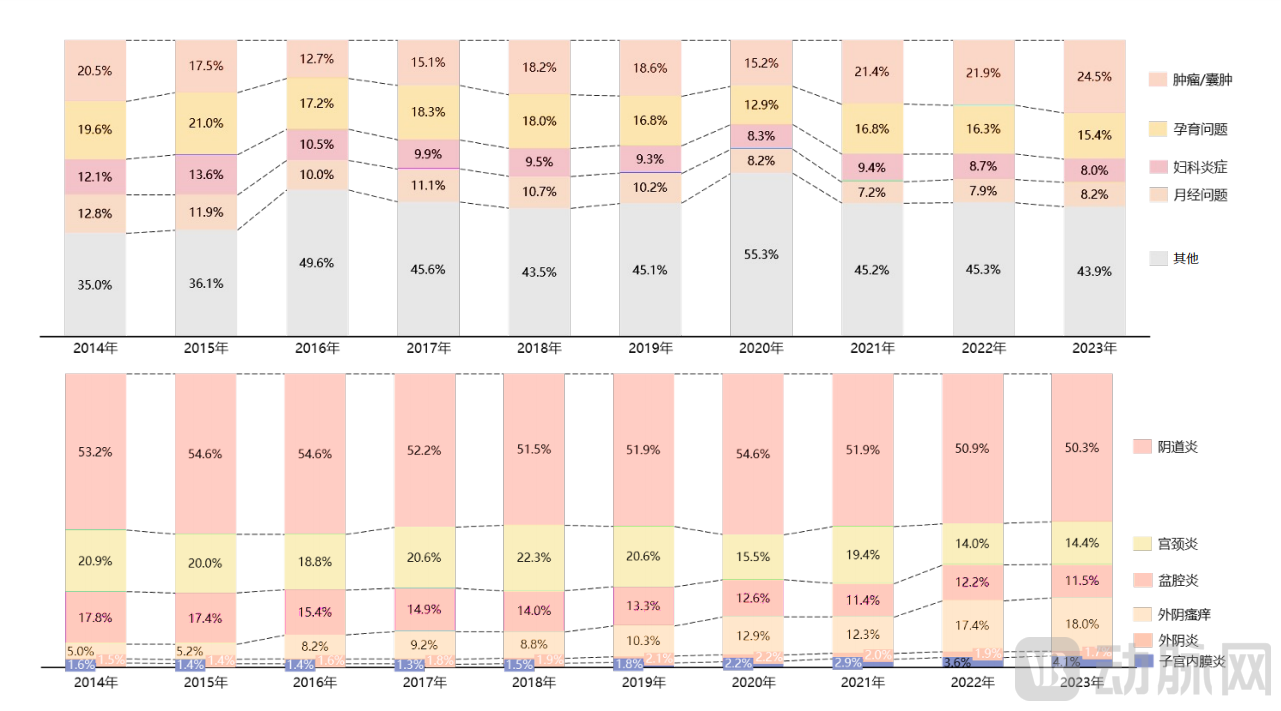 (Overview of the Development of Female Gynecological Inflammatory Diseases Over the Years)
According to the "Blue Book," gynecological inflammations include vulvitis, vaginitis, cervicitis, and pelvic inflammatory disease (PID). PID primarily encompasses endometritis, salpingitis, tubo-ovarian abscess, and pelvic peritonitis. These conditions may be caused by bacteria, fungi, viruses, or parasites.
Meanwhile, the Blue Book provides a detailed profile of patients. Clinical feedback indicates a strong demand for services addressing female health conditions. However, gynecological inflammation remains a major threat to women’s physical and mental well-being due to complex etiologies, susceptibility to misdiagnosis and treatment delays, reluctance to seek medical care, and non-standardized products and services. Demand for management of conditions such as vulvar pruritus and endometritis continues to rise.
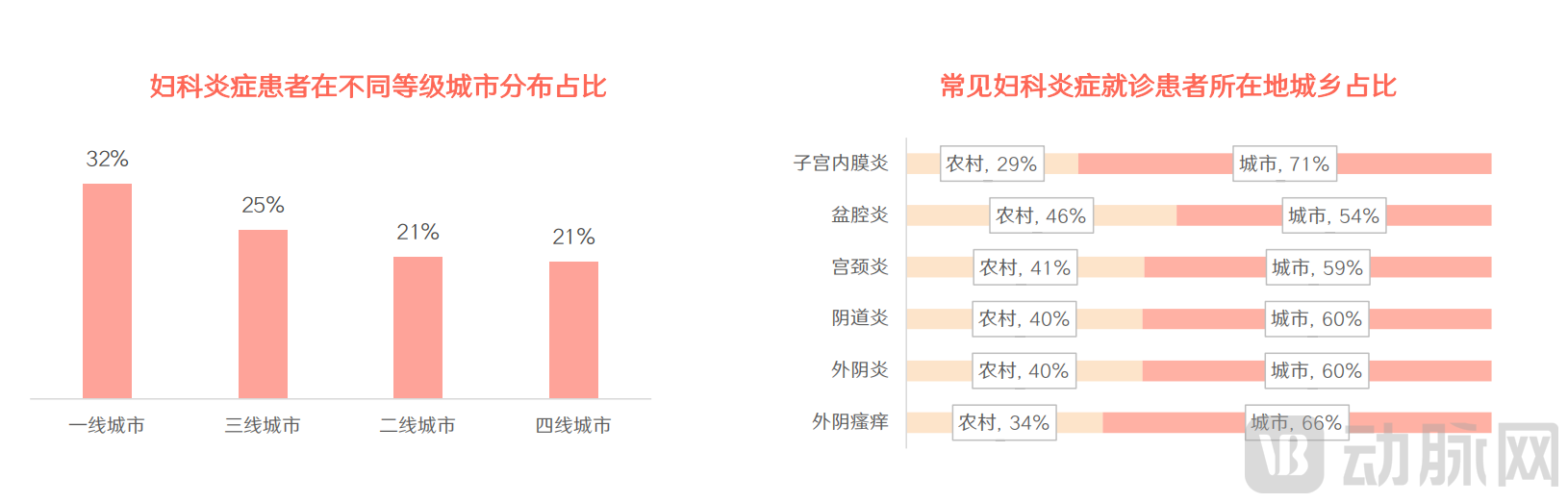 (Geographic Distribution and Urban-Rural Proportion of Patients with Gynecological Inflammation)
In terms of the geographical distribution of diseases, patient demand in first-tier cities accounts for over 30%, while demand in second-, third-, and fourth-tier cities each exceeds 20%. This indicates that first-tier cities have a significantly larger patient volume and greater demand. Although the proportion of patient demand in second-tier cities is slightly lower than that in third-tier cities, their larger population base results in a higher absolute patient volume and demand compared to third- and fourth-tier cities. Furthermore, surveys show that urban women not only have a lower incidence rate than their rural counterparts but also a significantly higher consultation rate. This disparity reflects the close correlation with regional economic conditions, healthcare standards, transportation infrastructure, and patients’ disease awareness.
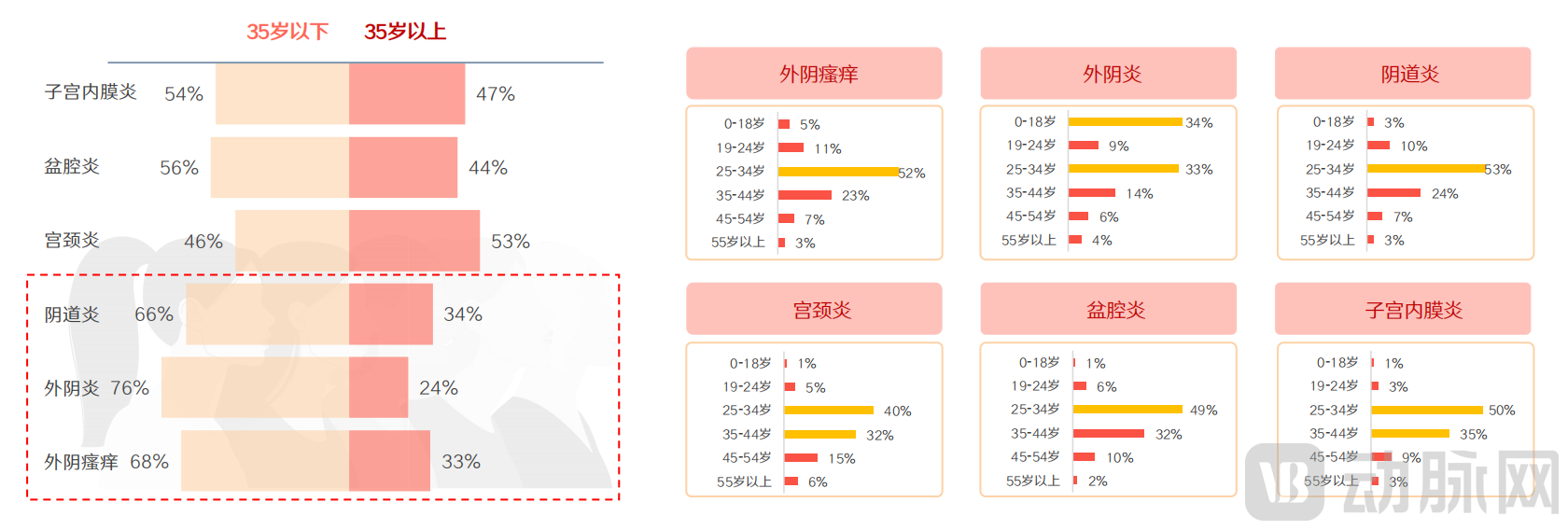 (Age and Type Distribution of Patients with Gynecological Inflammation)
As indicated by the aforementioned trends in the progression of female diseases, vaginitis is the most prevalent among common gynecological inflammations, followed by cervicitis and pelvic inflammatory disease. In this survey, the *Blue Book* analyzes the relationship between female diseases and age groups, using 35 years as the cutoff. Upper genital tract infections are predominantly chronic, characterized by longer disease duration and a higher average patient age. In contrast, patients with lower genital tract infections are, on average, younger, with cases concentrated among those aged 25 to 34, a pattern closely associated with reproductive behaviors.
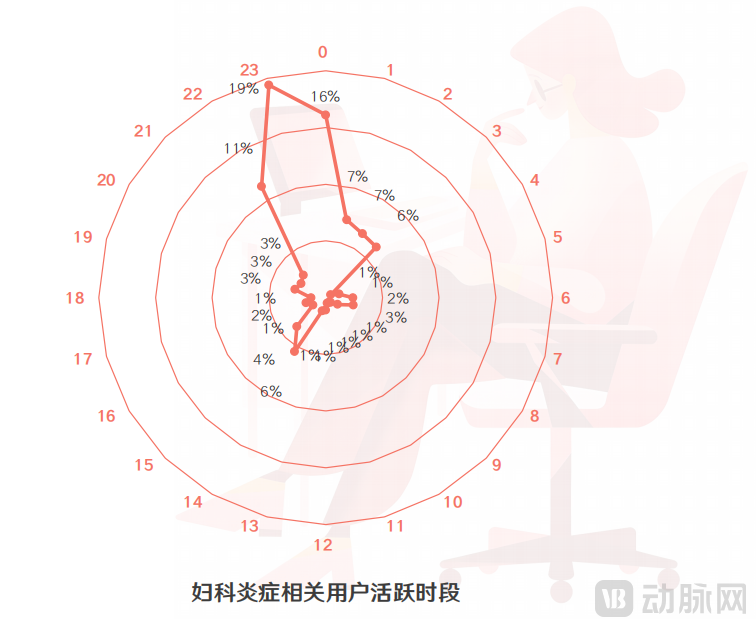 (Peak User Engagement Periods for Gynecological Inflammation-Related Topics)
Since symptoms of gynecological inflammation are more pronounced at night, research has found that patient-related learning and discussions on social media typically occur late at night. For gynecological inflammatory conditions, traditionally considered highly private, patients have become accustomed to communicating about their conditions and sharing treatment experiences on social media. This indicates that, in the internet era, more convenient and privacy-preserving methods of accessing information have emerged.
Nevertheless, a significant gap remains between the information patients obtain via the internet and authoritative knowledge or professional medical opinions. This discrepancy may lead to specific issues such as delayed healthcare-seeking behavior, unguided self-diagnosis and arbitrary medication use, and excessive hygiene practices. The root cause lies in the lack of a well-established collaborative system between patient needs and professional channels, including online consultation platforms, pharmaceutical companies, and pharmacies.Therefore, in-depth and sustained health education, awareness of safe medication use, and complementary medication guidance are all key to helping women correctly understand gynecological health issues.
In the Blue Book, Huahong Pharmaceutical dedicates 80% of its content to in-depth public education on gynecological inflammation, addressing the questions most concerning to patients and most critical in clinical practice. It begins with high-frequency clinical manifestations—specifically itching and pain; proceeds to the management of clinical symptoms, such as whether it is permissible to scratch vulvar pruritus and how to manage excoriated skin, as well as how to determine the type of vaginitis; and further provides systematic knowledge dissemination, including the characteristics of common gynecological inflammatory conditions and expert treatment recommendations.
Based on the collation of primary patient data and needs analysis, Huahong Pharmaceutical identified a vast array of unanswered disease-related questions through its Blue Book. By gaining a profound understanding of the gaps in women’s health management, the company established a precise, educational, and supportive product-service system, giving rise to four major trends.
Trend 1: Fully meet patients’ immediate needs for product services and professional clarification of their concerns
Research indicates that the target demographic for products related to gynecological inflammation is becoming increasingly younger. Young women’s information acquisition and product engagement exhibit strong internet-centric characteristics—discussions on gynecological inflammation via social media can directly generate organic traffic for related products in terms of reach and click-throughs. Meanwhile, young women’s expectations for products and services related to gynecological inflammation are continuously rising, with a demand for rapid response and efficient feedback across product offerings, diagnostic and treatment services, and health consultations.
In the Internet ecosystem,Digital tools have become the mainstream channel for young women to access products and services. Product-service models represented by O2O (Online-to-Offline) are poised for explosive growth. Meanwhile, pharmacies, practitioners, and channel operators are actively embracing digitalization. Once pharmacy staff are equipped with comprehensive professional expertise, patients’ immediate needs will be fully met.
Trend 2: As the demand for disease treatment evolves, medication management plans will become more specialized and precise
As channels for disease education expand, patient-physician interactions become more frequent, and topic discussions grow increasingly diverse, patients’ treatment needs are continuously evolving. Patients with gynecological inflammation are no longer satisfied with single-item diagnoses, vague treatment plans, or generic hygiene and care products.For enterprises, it is not only necessary to provide products targeting different anatomical sites and indications, but also to supplement them with professional disease education and customized medication care plans, so as to meet patients’ needs for precision diagnosis and treatment.
In an interview with VCBeat, Li Yingren, Vice President of Huahong Pharmaceutical Group, stated, “The scope of women’s health is extensive, spanning from physical and mental well-being to social recognition and identity. We aim not only to establish a Traditional Chinese Medicine (TCM) system for long-term conditioning and systematic management through our products and services, but also to promote a multidimensional and in-depth Eastern philosophy of women’s health in terms of public awareness.”
It is understood that Huahong Pharmaceutical has established a multi-dimensional health management system centered on women’s health, integrating Traditional Chinese Medicine (TCM) principles with modern science. To address the diverse therapeutic needs of gynecological inflammation, Huahong Pharmaceutical has developed a comprehensive product portfolio, including topical washes, cervical suppositories, and oral proprietary Chinese medicines. These products are designed to eliminate inflammation through gentle, systemic regulation, with strict control over studies such as reproductive toxicity assessments to avoid damage to the reproductive system and overall health. In terms of channel development, Huahong Pharmaceutical has implemented a full-chain product accessibility strategy, covering offline traditional pharmacies, B2C pharmaceutical e-commerce, and O2O pharmaceutical platforms, thereby meeting patients’ needs for timely access and professional medication services.
Trend 3: A clear shift from “treating disease” to “preventive care,” necessitating full-cycle product solutions
Health management has been elevated to a national strategy, and women are undoubtedly paying closer attention to their own health. As understanding of “comprehensive health” deepens, it is believed that many women will engage in self-examination and self-testing even in the absence of obvious symptoms. Female patients are demonstrating a trend toward proactive action, progressing from a state of observation to online consultations, and further to actively seeking solutions.This reflects that women’s health needs are expanding from mere diagnosis and treatment of diseases to disease prevention, shifting from “treating illness” to “preventing illness,” and evolving from a singular treatment-oriented mindset to comprehensive health management and lifestyle improvement.In response to this shift, relevant enterprises must not only provide therapeutic products but also strategically develop care and preventive offerings, thereby delivering comprehensive, full-lifecycle women’s health solutions.
Trend 4: Users Assert Sovereignty, Urgently Seeking Direct Access to Authoritative, Effective, and Personalized Health Information
It is undeniable that the internet ecosystem has reshaped how people access health science popularization and health management resources, empowering users to take control of information retrieval and product screening through online platforms. As the market shifts from a seller’s to a buyer’s market, individuals with limited health literacy are increasingly eager to obtain authoritative, effective, and personally relevant health information directly to aid in product selection. This product screening mechanism is also evident at the purchase stage, where users pay closer attention to product ingredients, favoring key attributes such as being all-natural, additive-free, and having clearly defined mechanisms of action.
To address women’s uncertainties regarding health awareness and product selection, Huahong Pharmaceutical has custom-developed the “Huahong Women’s Health” mini-program, which officially launched on June 10, 2024. This initiative aims to help women better understand their health status and facilitate quicker self-screening for gynecological inflammation as well as more informed product choices.“We aim to disseminate authoritative information in an accessible manner through our mini-program, serving as a translator among clinicians, products, and patients to help them gain professional health insights directly,” emphasized Li Yingren. “The mini-program’s inquiry system integrates the therapeutic logics of both traditional Chinese and Western medicine, covering multi-dimensional parameters such as lifestyle, emotional state, and physical condition. By leveraging AI capabilities to consolidate a question-and-answer knowledge graph, it provides patients with user-friendly, systematic health recommendations.”
Starting with the “Blue Book,” and integrating real-time patient feedback with the demands for precision diagnosis and treatment, while adapting to the trend of “preventive treatment of disease” and mechanisms for individualized product selection, Huahong Pharmaceutical has notedOffline retail channels, represented by pharmacies, suffer from critical gaps—grassroots pharmacies vary widely in staff training, professional knowledge acquisition, and updates on health concepts, making it difficult for them to comprehensively address the needs and concerns of today’s consumer base.
Li Yingren stated that current retail pharmacies must not only dispense medications but also assume the role of suppliers addressing the health needs of potential patients, thereby enhancing their social function in the distribution of medical resources and product supply. For instance, by combining informatization tools with traditional education and training, pharmacies can improve staff’s professional knowledge in women’s health and the quality of pharmaceutical care services, enhance their understanding and identification of patients’ health status, and provide more precise product recommendations based on patient needs.
In response, Huahong Pharmaceutical has proposed a co-development initiative with pharmacies to enhance the professionalism of frontline practitioners, widely deploy personnel with specialized gynecological knowledge across pharmacy outlets, strengthen in-depth reach at offline terminals, and optimize the consumer experience.
Huahong Pharmaceutical has long been committed to promoting awareness of women’s health. In collaboration with local Women’s Federations and primary healthcare centers, it has advanced initiatives such as screening for cervical and breast cancers, public education on sexual and reproductive health, girls’ education, domestic violence prevention, and employment support for women. Leveraging the release of the Blue Book, along with its keen grasp of internet value and deep market insights, Huahong Pharmaceutical is introducing innovative solutions:The launch of the “Huahong Women’s Health” mini-program and its Xiaohongshu account, which has reached 200 million female users, along with the promotion of a co-construction initiative for offline pharmacies, represents a continuous inheritance of the strategy to better serve women in the contemporary era.Uncovering the true state of women’s health and addressing their tangible needs will pave the way for a win-win scenario that combines market education with social responsibility.