

Synthetic Biology 2024: Growth Amid Fragmentation
Since the concept of “new quality productive forces” was proposed, the enthusiasm for synthetic biology has remained unabated.
In the past month alone, multiple regional policy documents have emphasized the development of synthetic biology. The National Development and Reform Commission’s 14th Five-Year Plan for Bioeconomy Development identifies biomanufacturing as a key focus area for the growth of the bioeconomy. Across the Pacific, the United States has also elevated biomanufacturing to the level of national strategy.
According to McKinsey, by the end of this century, synthetic biology will be widely applied in manufacturing sectors accounting for more than one-third of global output, creating $30 trillion in value. At a time when the global economy lacks new growth curves, the significance of synthetic biology and biomanufacturing goes without saying.
Zhang Ying, Founding Managing Partner of Matrix Partners China, remarked in 2022: “The current state of synthetic biology bears some resemblance to the early stages of the electric vehicle industry; it may represent the next opportunity for latecomers to leapfrog ahead. However, the key lies in overcoming bottlenecks in large-scale manufacturing and selecting products with substantial mass-market demand and high added value. This is a universal challenge in transitioning from technology to commercialization, and from the laboratory to the production line.”
However, it is currently evident that the realization of value in synthetic biology is proceeding more slowly than that in the electric vehicle sector. Not long ago, Ginkgo Bioworks, a platform-based company and global leader in synthetic biology, received a delisting warning. In the first quarter of 2024, Ginkgo’s total revenue amounted to $38 million, representing a 53% year-on-year decline. Although its operating losses have improved, investors have expressed dissatisfaction and skepticism regarding its performance and Ginkgo’s business model as a synthetic biology platform.
As for this year’s synthetic biology conferences or exhibitions, feedback from some attendees was: “It wasn’t as hot as the previous two years; in fact, the hype has cooled down.”
Synthetic biology has experienced several waves of hype and development, yet to this day, a “disconnect” persists between capital and industry, between policy and enterprises, and between production scale and technological advancement.
Schism One: “Authentic” vs. “Fake” Synthetic Biology
Looking back at the surge in the secondary market for synthetic biology in early May, nearly 20 companies whose stock prices rose—represented by Chuanning Biotechnology and Bluepha Microbiology—were mostly engaged in traditional biosynthesis as their core business. For instance, Chuanning Biotechnology started with antibiotics, while Huaheng Biotechnology’s products mainly consist of amino acids, vitamins, and other related compounds.
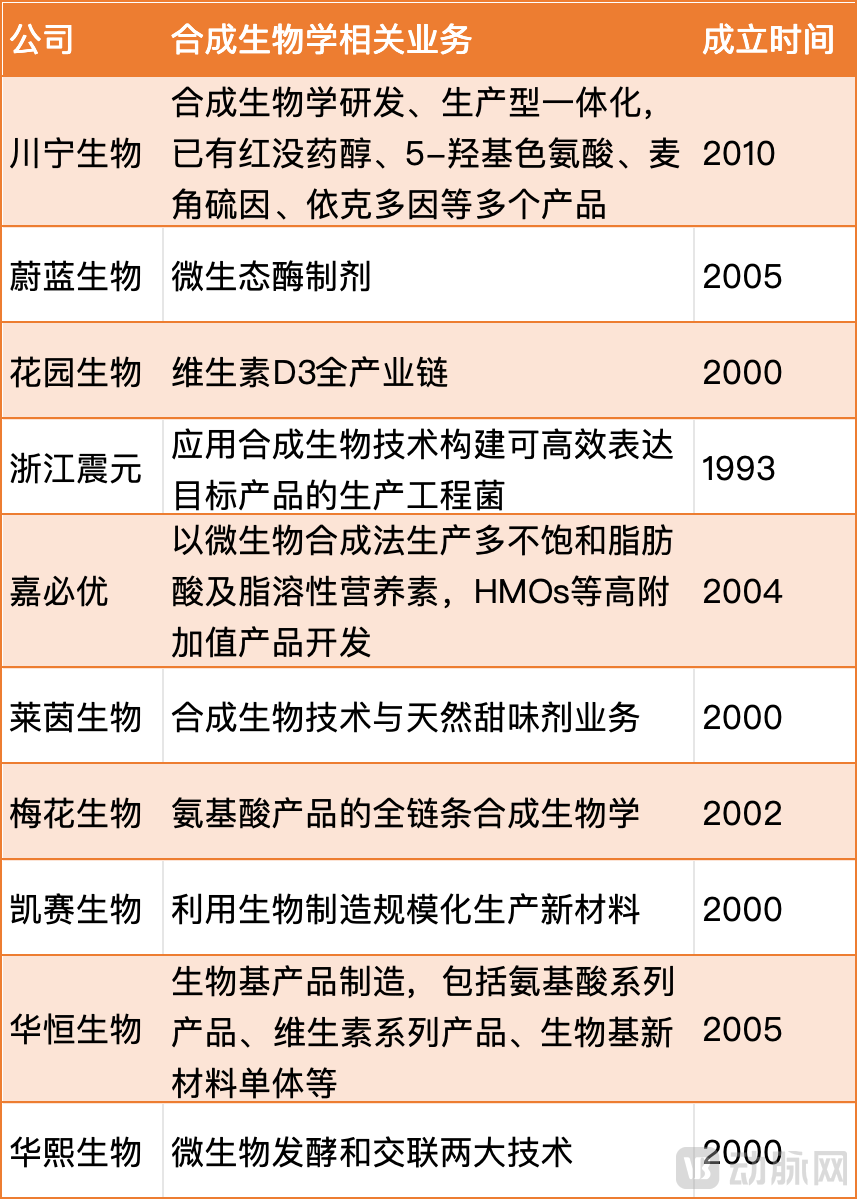
Selected “Synthetic Biology Concept” Companies and Related Businesses, Compiled by VCBeat
With the rise of synthetic biology technologies, traditional companies have begun to establish synthetic biology R&D platforms and attempt to integrate them with their existing businesses, although these efforts do not yet constitute their core operations. Even Chuaning Bio, which already offers multiple products such as bisabolol, 5-hydroxytryptophan, ergothioneine, and ectoine, explicitly stated in a recent response to investors that while its synthetic biology projects have generated some revenue for the company, the proportion of total revenue remains relatively small.
More companies, such as Bluepha, have established synthetic biology innovation laboratories to conduct R&D; however, they have a limited pipeline of reserve projects, and there remains a significant gap between early-stage strain development in the laboratory and scalable manufacturing, meaning that commercial realization is still quite far off.
This is also why the stock prices of multiple synthetic biology concept companies plunged after a surge in May.
Generally speaking, “orthodox” synthetic biology refers to the screening and discovery of natural organisms capable of efficiently producing specific materials, followed by the design and construction of biological systems using engineering principles. This approach maximizes bacterial efficiency through genetic modification, a process known as reconstructing “metabolic pathways.” The fundamental criterion for distinguishing “true” synthetic biology lies in whether novel biological systems with new functions are constructed at the genetic level, involving targeted design and modification of genes.
Thus, it is evident that Ginkgo Bioworks, a leader in synthetic biology, continues to ramp up its investments in gene technology despite pressures from declining revenue and workforce reductions: in February, it announced the acquisition of Patch Biosciences, a machine learning-driven gene drug design company, and in March, it acquired Proof Diagnostics, a CRISPR-based molecular diagnostics company.
In contrast to the popularity of traditional biomanufacturing companies in the secondary market, innovative synthetic biology companies have experienced relatively weak fundraising momentum over the past two years. Throughout last year, there were more than 50 financing and capital-raising events in China’s synthetic biology sector, with total funding amounting to approximately RMB 15 billion. As of June 10 this year, only 13 financing deals had been recorded in China’s synthetic biology field, predominantly concentrated in angel to Series A rounds, with funding amounts generally at the level of tens of millions of RMB.
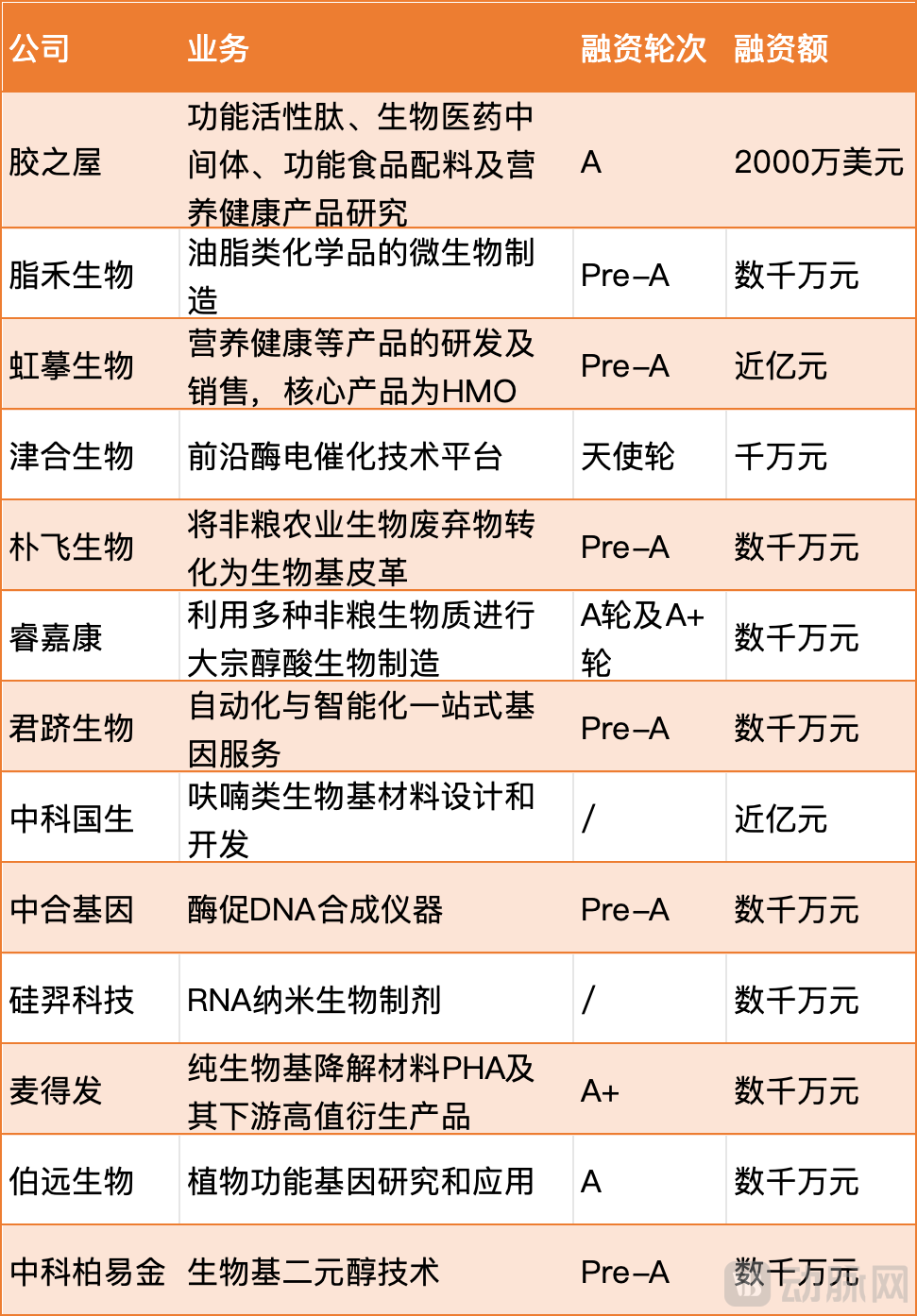
Synthetic Biology Companies That Completed Financing in 2024, as of June 10; Source: Public Information
However, the boundary between traditional biomanufacturing companies and emerging synthetic biology companies is becoming increasingly blurred.Emerging companies can be viewed as innovators within the traditional biomanufacturing sector, while established firms also have the potential to become new leaders in synthetic biology. Amidst this current industry boom, it is no longer necessary to dwell on distinguishing “genuine” from “fake” synthetic biology.
An investor spoke candidly to VCBeat: “Whether the label is ‘synthetic biology’ or not is less important; what matters is whether the final product is sufficiently competitive. In other words, does a new variety reduce costs, improve quality, and offer good value for money? If a company can develop and successfully market its products, it is a good company.”
Disconnect II: Technical Success vs. Commercial Success
Ginkgo is no stranger to trouble. Since its stock price peaked, the company has lost more than 90% of its market capitalization, and its business model for its synthetic biology platform has frequently come under scrutiny. Ginkgo integrates design, build, test, and optimize capabilities into a single workflow, providing strain engineering services to downstream customers while sharing in product sales revenue or patent licensing fees. Institutions that previously shorted Ginkgo have argued that this leading synthetic biology company lacks proprietary technology. Some critics contend that Ginkgo resembles a contract research organization (CRO) more than a true synthetic biology enterprise, noting that the key to success for such companies lies in producing “blockbuster” products.
But the market is equally intolerant of companies that follow a product-driven logic.Amyris, a synthetic biology company that pursued a product-centric strategy, produced a vitamin E precursor using farnesene, and its squalene output once accounted for one-third of the global market. However, subsequent production capacity constraints and an aggressive expansion strategy led the company into bankruptcy restructuring.
The field of synthetic biology faces the classic problem that “technical success does not equate to commercial success.”In certain cases, the unit economic benefits of biosynthetic products have become comparable to those of existing methods. A senior investor in the field of synthetic biology stated, “Chemical synthesis typically yields a 50:50 mixture of levorotatory and dextrorotatory enantiomers, making it difficult to achieve 100% stereoselectivity. In contrast, biosynthesis leverages the high selectivity of enzymes to directionally synthesize products with a single configuration, thereby doubling utilization efficiency. This advantage of biosynthesis has already been demonstrated in many product categories.”
However, the prerequisite for synthetic biology to gain market recognition is the company's ability to operate at scale.John Cumbers, founder of SynBioBeta, has proposed the “scale-cost paradox” facing synthetic biology startups. Emerging synthetic biology companies often lack economies of scale, making it difficult to secure funding for large-scale production. Constrained by limited capital, they are forced to produce on a small scale. As a result, costs remain high, which in turn makes it challenging to demonstrate robust market demand for their synthetic biology products.
In short, rather than pursuing disruptive innovation, synthetic biology companies need to demonstrate their industrialization capabilities. One investor stated directly, “We evaluate synthetic biology projects through the lens of manufacturing with technological barriers.”
Zhao Jingya, an investor at Jiacheng Capital, stated, “Even when high-yield strains are obtained in a laboratory setting, the pilot-scale stage still requires a lengthy period to explore and optimize process conditions, which differs significantly from upstream synthetic biology experiments. Whether synthetic biology can drive explosive performance growth also depends on downstream customer demand. Regardless of whether they are upstream raw materials or intermediates, the market performance of synthetic biology companies’ final products is ultimately determined by downstream factors.”
The Pursuit of Scalable Production Poses Challenges for Synthetic Biology Companies. John Cumbers pointed out that the financing landscape for synthetic biology remains bleak in the second half of this year, advising companies to prepare for a major industry shakeout in 2024.
In the early stages, such as upstream synthetic biology and bioprocess development, capital is readily invested; when large-scale production becomes feasible and products achieve blockbuster sales, market response will inevitably be enthusiastic. Companies that can successfully cross the “valley of death” in industrial manufacturing in between will emerge as standouts in the synthetic biology sector.
At the 8th Future Medical Ecosystem Expo, Liao Jieying, Managing Director of China Renaissance and Head of its Synthetic Biology Team, stated, “Synthetic biology has now evolved into a second wave driven by commercialization. This means that companies in this sector will face significant fundraising challenges this year if they lack revenue, impressive order books, or strong strategic partners. For beneficiaries of this second wave, fundamental strength is essential. We believe this second wave will be more prolonged, stable, and diversified.”
“From 2022 to March 31, 2024, there were a total of seven initial public offering (IPO) events in China’s biomanufacturing industry, including Jinbo Bio, the first synthetic biology company listed on the Beijing Stock Exchange. Companies continue to seek public listings under the concepts of synthetic biology or the broader bioindustry, as these are platform-level concepts rather than belonging to any specific niche sector, thereby offering greater flexibility in selecting listing boards and facilitating smoother IPO pathways. Currently, the secondary market favors product-oriented enterprises, focusing on revenue, flagship products, and scale.”
Disconnection III: Industrial Scale vs. Underlying Technology
If synthetic biology is brought back to the logic of manufacturing, China’s advantages in developing this field are obvious.
“China’s competitive edge lies in its abundant capacity and cost-effectiveness. First, domestic fermentation production capacity is certainly in surplus, and costs are undoubtedly lower than those abroad. Additionally, utilities such as water and electricity, as well as labor, offer greater cost-efficiency in China,” said Zhao Jingya.
Wang Ruiyan, Director of Biological Activity and Biopharmaceutical R&D Management at Bloomage Biotech, also stated at the 8th Future Medical Ecosystem Exhibition: “China boasts a robust supply chain system, along with advanced downstream separation and purification capabilities, giving it a distinct advantage in fermentation and scale-up processes. The vast downstream consumer markets for food, healthcare, and other sectors further constitute China’s inherent advantages.”
Although China’s fermentation industry ranks first globally in scale, it holds only 2–4% of the core microbial strain patents. Moreover, over 80% of key synthetic biology inputs—such as enzyme preparations and lactic acid bacterial agents—are reliant on imports. The limited supply capacity for core technologies has become a bottleneck constraining the development of China’s biomanufacturing industry.
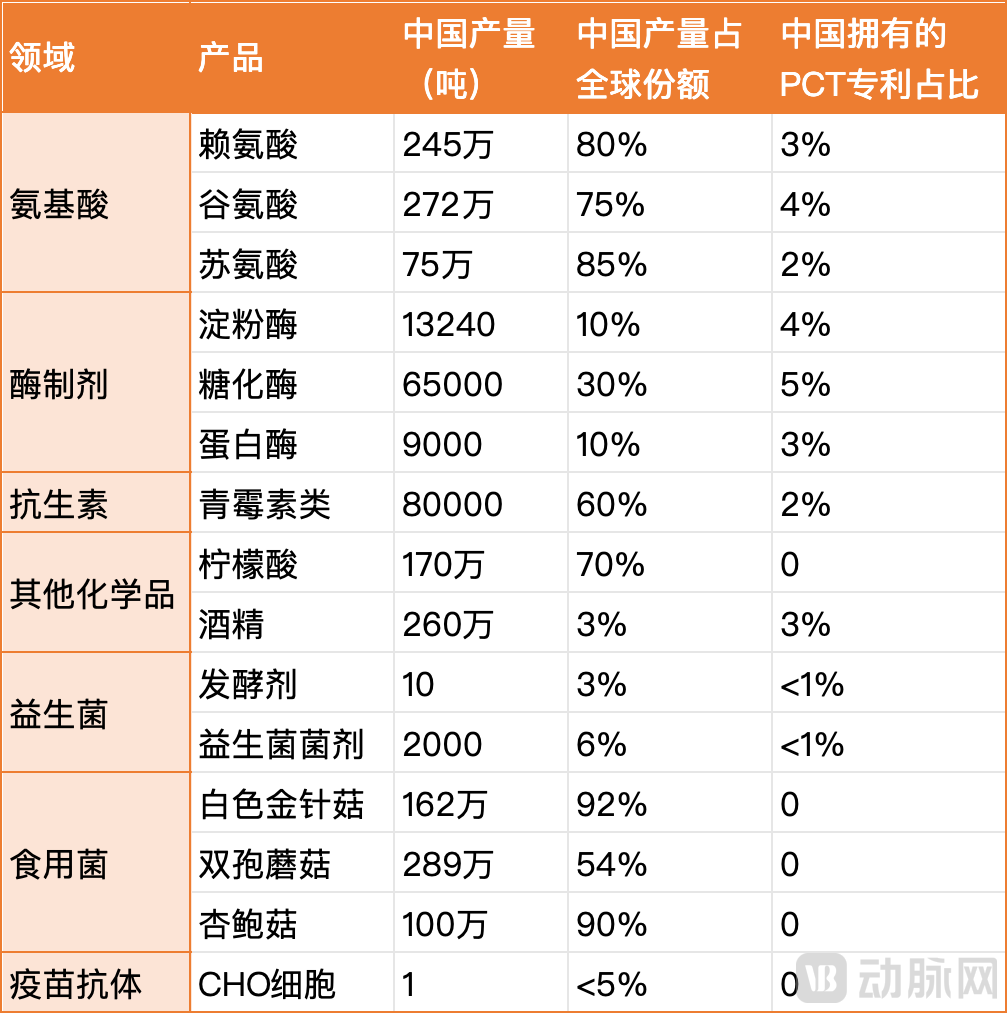
Source: Hefei Bio-Manufacturing Industry Development Conference
Delving deeper, the underlying issue is weak R&D capabilities in foundational technologies, characterized by extensive follow-on research but limited original innovation.
“Our product portfolio capabilities remain limited, and our product structure is not yet optimized. Some large enterprises still lack a significant voice on the international stage, necessitating greater efforts in this regard. Foundational technologies and scientific support constitute critical success factors for the synthetic biology industry and warrant increased attention,” noted an industry expert commenting on the development of China’s synthetic biology sector.
When comparing China and the United States, there is a significant gap between the two in areas such as gene editing, DNA synthesis, cellular immunotherapy, and strain engineering. This disparity is largely attributable to the United States’ long-term strategic planning and substantial financial investment, which have established its leading advantage in synthetic biology.
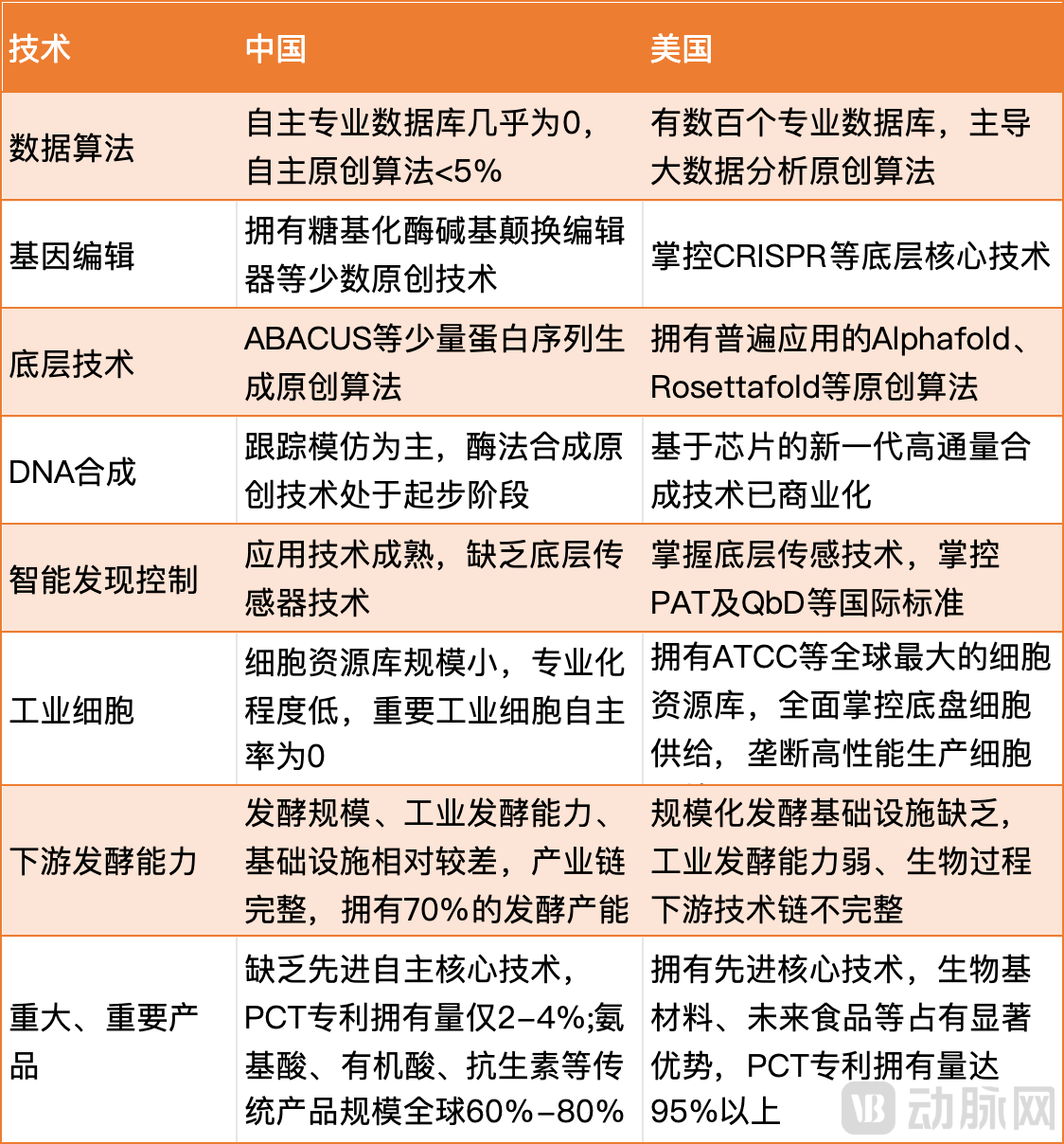
Source: Hefei Bio-Manufacturing Industry Development Conference
However, the pace of industry-academia-research collaboration in synthetic biology within China has accelerated significantly. For instance, two national innovation centers represented by the Tianjin Institute of Industrial Biotechnology and the Shenzhen Institute of Synthetic Biology—one focused on foundational innovations in synthetic biology and the other on industrial innovations—are empowering the sector by providing upstream core underlying technologies and midstream general-purpose technology platforms. On the production side, leveraging China’s manufacturing advantages, multiple industrial clusters have already taken shape in the Beijing-Tianjin-Hebei region, Shanxi, Shandong, Henan, the Pearl River Delta, and the Yangtze River Delta, with various localities developing their bio-manufacturing industries through coordinated efforts.
Furthermore, industry giants have entered the fray. Large petroleum and traditional chemical companies, such as Wanhua, are investing heavily in enterprises across the upstream and downstream chains of biomanufacturing as part of their strategic transformation. Moutai has also established a dedicated biotechnology fund, investing in representative amino acid producer Taihe Weiye, single-cell analysis and sorting startup Xingsai Bio, and nutritional health synthetic biology company Hongmo Bio.
However, regulatory approval remains another hurdle for synthetic biology. Existing regulations may fail to keep pace with the rapid advancement of synthetic biology technologies, resulting in regulatory lag and legal risks. This situation not only poses potential safety concerns but also hinders the ability of synthetic biology products to compete effectively in the market.
“Accelerated approval cycles and clear supportive policies will affect the industrial implementation of synthetic biology. In contrast, chemical synthesis pathways are more mature, with lower costs at scale. Taking peptide intermediates as an example, although biosynthesis theoretically offers greater advantages and lower costs, many companies in China have opted for total chemical synthesis to expedite the approval process. Current policies have, to some extent, influenced corporate decision-making regarding production methods,” pointed out Zhao Jingya.
Synthetic biology is broad and complex; perhaps we should move beyond the “concept” of synthetic biology itself and return to the value of products delivered by modern biomanufacturing.
Returning to the initial comparison with the new energy vehicle (NEV) industry, an investor summarized: “The NEV sector also went through various phases of policy support and subsidies in its early stages, and naturally, a large number of companies ‘perished’ along the way. The current state of synthetic biology is similar. Previously, there were many unrealistic expectations for the field; now those expectations are fading. Nevertheless, I believe that synthetic biology will ultimately become a competitive advantage industry for China.”
“The difference is that synthetic biology has broader application scenarios and faces less intense competition than the new energy vehicle sector. Whether for startup teams or established enterprises, the ultimate goal is to explore high-potential products and diverse practical applications.”