

China's ECMO Market Set for Rapid Expansion Amid National ICU Capacity Boost and Over 20,000-Unit Equipment Gap
Greater emphasis is being placed on the development of critical care medicine.
In May this year, the National Health Commission and the National Healthcare Security Administration jointly issued the “Opinions on Strengthening the Development of Critical Care Medical Service Capacity” (hereinafter referred to as the “Opinions”), which pointed out the need to continuously improve the critical care service network, strengthen the development of specialized critical care capabilities, expand the workforce of critical care professionals, and advance reforms in critical care medical services.
Notably, the policy has quantified targets for ICU bed capacity: “By the end of 2027, China will achieve 18 critical care beds per 100,000 population and 12 convertible critical care beds per 100,000 population.” According to data from the National Bureau of Statistics, China’s total population stood at 1.40967 billion at the end of 2023. Based on this figure, it is estimated that by 2027, China will need to reach 253,700 ICU beds and 169,200 convertible ICU beds. The expansion of ICU bed capacity will undoubtedly drive substantial growth in demand for “peri-ICU equipment,” including ECMO systems, ventilators, patient monitors, infusion pumps, defibrillators, and ECG machines.
As one of the “peri-ICU devices,” the importance of ECMO is self-evident.The addition of ICU beds will undoubtedly further expand the market for ECMO devices.
On the one hand, ECMO is primarily used to support cardiac and/or respiratory insufficiency, serving as a key technology in the treatment of refractory severe heart failure and respiratory failure. Moreover, clinical applications of ECMO are no longer confined to intensive care units (ICUs) and cardiac surgery departments but are expanding into emergency departments, cardiology, and support for organ transplant recipients and donors, thereby generating new demands for ECMO devices.
On the other hand, ECMO devices are severely under-equipped in critical care departments in China. Compared to other peri-ICU devices, they have the lowest penetration and deployment rates, which also indicates a broader space for development.
ECMO technology, due to its inherentCritical Clinical Need, Efficacy, and Severe Underdevelopment in China, is clearly becoming an important track that cannot be ignored.
Policy Emphasis on Strengthening Critical Care Medical Service Capacity
Driving Further Expansion of the ECMO Device Market
1. In light of the “Opinions,” this also implies that approximately 25,000 ECMO devices will need to be deployed by 2027.
At the end of 2022, the National Health Commission pointed out that “the total number of critical care medicine beds nationwide was 181,000 (equivalent to 12.8 beds per 100,000 people), among which tertiary medical institutions had 133,400 critical care medicine beds, and 104,800 beds were convertible to ICU beds.” In terms of the total number of ICU beds constructed, there is undoubtedly a significant gap from the construction targets proposed in the “Opinions.” From 12.8 beds per 100,000 people to 18 beds per 100,000 people, there is a growth potential of 40.6%. Regarding the demand for ECMO equipment in ICU bed construction, in December 2022, the Department of Medical Administration issued relevant policies, stating that the reference configuration for comprehensive ICU equipment is one ECMO device per 10 ICU beds. This was the first time China explicitly defined the configuration ratio between the number of ECMO devices and ICU beds in policy documents. In conjunction with the “Opinions,” this implies that approximately 25,000 ECMO devices will need to be configured by 2027.
According to publicly available data from the Ministry of Industry and Information Technology, the current installed base of ECMO devices in China is less than 2,600 units, compared to fewer than 400 units in 2019. Over the past five years, the rate of ECMO deployment has increased significantly; however, a shortfall of more than 20,000 units remains. In terms of hospital coverage, only slightly over 600 hospitals in China are equipped with ECMO devices, meaning that fewer than half of all Grade III Class A (tertiary) hospitals have such equipment. The gap is even more pronounced when considering tertiary and secondary hospitals, indicating a substantial unmet need.
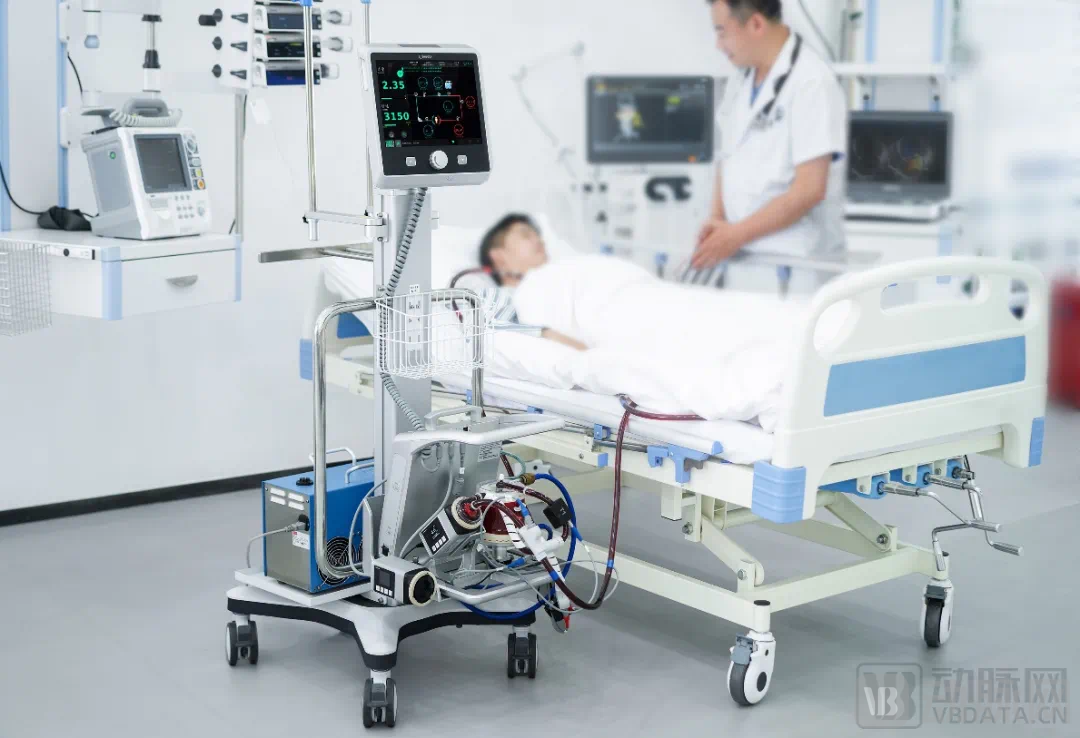
2. The primary care market is emerging as a “new market” for the development of critical care medical services, driving new demand for ECMO devices.
Taking Gansu Province as an example, in 2023, the province enhanced critical care capabilities at 86 county-level hospitals. “Each hospital has established at least 10 critical care beds, with oxygen supply facilities and information systems fully meeting clinical needs. All project hospitals have procured essential medical equipment in accordance with standards, including bedside monitoring systems, ventilators, defibrillators, flexible bronchoscopes, laryngoscopes, sputum excretion machines, and syringe pumps, and have formed critical care teams.” Furthermore, “the occupancy rate of critical care beds exceeded 50% in 30 of these hospitals, reaching a maximum of 96.8%,” which undoubtedly demonstrates the strong demand for critical care services at the grassroots level.
Currently, referral and transport services are largely supported by tertiary hospitals or regional medical centers. In view of the need for rapid patient care, primary healthcare markets may further adopt ECMO equipment in the future to better support patients, offering a lifeline to those with critical cardiopulmonary failure.
3. Support from policies such as interest-subsidized loans for medical equipment and trade-in programs has truly made it possible to expand the market for peri-ICU devices, including ECMO.
As early as 2022, the Chinese government began exploring the introduction of fiscal interest-subsidized loans for the upgrading and renovation of medical equipment. The relevant interest subsidy loan policy was, in principle, fully opened to all public and private medical institutions, with each hospital eligible for a loan amount of no less than RMB 20 million. The loans could be used for the procurement of various types of medical equipment, including those for diagnosis and treatment, clinical laboratory testing, critical care, rehabilitation, and scientific research translation.
In March this year, the State Council released the Action Plan for Promoting Large-Scale Equipment Renewal and Trade-Ins of Consumer Goods, which aims to accelerate the renewal and upgrading of medical equipment in healthcare institutions. The plan specifically highlights “promoting the renovation and improvement of hospital wards to address shortcomings in ward environments and facilities.” Such policy support and promotion have made it possible for hospitals to implement the deployment of equipment for critical care disciplines.
Medical device consumables and the foundational base of medical talent have been firmly established,
The ECMO Field Is Poised for Rapid Development
The development of intensive care units (ICUs) has undoubtedly created a favorable market environment for the advancement of peri-ICU equipment, including extracorporeal membrane oxygenation (ECMO) devices. However, whether the ECMO sector can achieve rapid growth is closely tied to factors such as the supply of ECMO consumables and the availability of professionals proficient in ECMO application.
Whether the ECMO sector can achieve rapid development hinges critically on the localization and promotion of ECMO devices and consumables.
Domestically produced ECMO devices and consumables have significantly shortened the equipment supply cycle during the construction of ICU beds in China.
Over the past two decades, imported brands such as Maquet and Medtronic have long dominated the domestic market for ECMO devices and consumables. In January 2023, with the approval of Shenzhen Hanuo Medical Technology Co., Ltd.’s (hereinafter referred to as “Hanuo Medical”) domestically produced complete ECMO console and associated consumables, China became the fourth country in the world, after the United States, Germany, and Italy, capable of independently manufacturing entire ECMO systems. It is reported that Hanuo Medical’s Lifemotion®Since its introduction, ECMO systems have been clinically applied in nearly 100 hospitals across China, successfully treating hundreds of patients and earning widespread recognition from clinicians. This demonstrates that domestically produced ECMO products can effectively break the monopoly held by imported brands. Meanwhile, Chinese brands, with features such as portability and extended battery life, have facilitated the referral and treatment of critically ill patients at the primary care level, serving as a “powerful tool” for decentralizing critical care resources and further extending their coverage to grassroots healthcare facilities.
Currently, at the payment level, domestically produced ECMO consumables are being included in medical insurance coverage based on the specific circumstances of each province and region. According to the “2022 Report on Medical Quality Control for Extracorporeal Life Support in China,” published in the June 2023 issue of the Chinese Circulation Journal, the average cost for hospitalized patients receiving ECMO support has shown a significant downward trend. The cost in 2021 decreased by 10.4% compared to 2020. Another positive factor is that with the emergence of domestically produced ECMO devices and consumables in 2023, the cost of ECMO support is expected to decline further. Furthermore, according to research reports from Huaxi Securities and other institutions, the average expenditure for patients receiving ECMO support in China is approximately one-third of that in foreign countries, which also facilitates the broader market adoption and promotion of ECMO devices.
As market promotion and clinical application continue to advance, ECMO technology and domestically produced products will further deepen their penetration. Enterprises that prioritize breakthroughs in import substitution in alignment with national policy directives are poised to gain a competitive advantage in the future landscape.
Overall, China has established a relatively comprehensive training system, laying the foundation for the promotion of ECMO device technology.On one hand, in 2020, the state issued the "Specifications for Clinical Application and Management of Extracorporeal Membrane Oxygenation (ECMO) Technology," which set requirements for the clinical application of ECMO in four aspects: medical institutions, personnel, technical management, and training management. It also specified requirements for physician training and training institutions intending to carry out ECMO technology, promoting the development of specialized ECMO training in China. On the other hand, China has successfully established dozens of national-level Extracorporeal Membrane Oxygenation (ECMO) training bases and continues to hold high-frequency ECMO theory and simulation sessions nationwide each year, covering an estimated thousands of physicians annually, rapidly enhancing the capability of ECMO technology application across various regions. Thanks to this training, the number of ECMO cases in China has continued to rise. According to data from the Extracorporeal Life Support Committee of the Chinese Medical Doctor Association, the number of ECMO cases in China increased from 2,826 in 2017 to 13,491 in 2022, with a compound annual growth rate as high as 36.7%.
From a societal perspective, the pace of ECMO training across China has accelerated, with various medical associations conducting their training programs in full swing. Domestically produced ECMO devices have been widely utilized in these training initiatives.Relevant data indicate that between 2014 and 2019, the Extracorporeal Circulation Branch of the Chinese Society of Biomedical Engineering (CSECLS) organized a total of 36 ECMO simulation training courses. According to the CEECLS official WeChat account, as of May 22, 2024, CSECLS had conducted 37 ECMO theory and simulation training courses across China, with the geographic coverage and number of participants continuing to expand. Notably, domestically produced ECMO devices have been widely utilized in these training programs. For instance, at the 2024 Zhijiang ECMO Technology Conference concluded in May, hundreds of physicians received training using Chinese-made ECMO systems. Furthermore, the training curriculum is gradually incorporating facilities such as large-animal simulation centers. By simulating and practicing various scenarios encountered during ECMO therapy, these initiatives help medical personnel more rapidly master ECMO device operation and cannulation skills, thereby reducing the time required for clinical proficiency and shortening the learning curve.
From a corporate perspective, companies are also leveraging simulated digital patient systems to further enhance physicians’ procedural skills.For example, at the end of 2023, Hannuo Medical, with Lifemotion®The ECMO-based simulated digital patient system provides comprehensive digital teaching support for the Extracorporeal Membrane Oxygenation (ECMO) technical training organized by the Oriental Critical Care Society. The simulated digital patient system showcased in this demonstration allows for the pre-setting of patient physiological parameters during training, with automatic progression along a predefined timeline. This enables the simulation of real-life scenarios outside the operating room and facilitates outcome assessment. Furthermore, the system can be connected to virtual reality (VR)/augmented reality (AR) devices to deliver immersive training experiences, leveraging Lifemotion®Operation of the ECMO system, with real-time assessment and timely feedback on trainees' performance, to enhance their abilities in clinical analysis, judgment, and management.
With the rapid rise of critical care medicine, particularly domestic ECMO brands, and the further improvement of ECMO-related talent training, coupled with policy-driven promotion of ICU bed construction and enhanced financial support for hospitals, the ECMO niche sector is undoubtedly poised to enter a phase of accelerated growth.