

ChunPure Biotech Completes Pre-A Round Funding, Pioneering Disruptive Innovations in CGT Purification Technologies
CDH
Strategic Investment Institutions and Asset Management Companies

Wuxi Capital Group
State-owned venture capital institutions
In recent years, the cellular and gene therapy (CGT) industry has witnessed breakthrough growth. According to incomplete statistics, more than 50 CGT therapies have been approved for marketing worldwide. CGT products are gradually transitioning from clinical validation to in-depth application, breaking boundaries across multiple dimensions and expanding into diverse therapeutic areas with unmet clinical needs.
Despite the booming development of the cell and gene therapy (CGT) industry, it still faces numerous challenges, such as high R&D and manufacturing costs, complex production processes, and uncertainties regarding long-term safety and efficacy. Among these,In the manufacturing process, downstream separation and purification is one of the key steps in product production., which involves isolating genetically modified cells from the original cell culture and removing unnecessary cellular impurities to obtain a high-purity product with stable activity suitable for clinical use. Separation and purification are also among the key factors affecting the quality, yield, and cost of biopharmaceutical products; data show that downstream separation and purification costs account for approximately 20%–40% of total production costs.
Currently, in the downstream separation and purification processes of cell and gene therapy (CGT), physical methods such as centrifugation and filtration, as well as chemical methods like chromatography and precipitation, are key techniques for achieving the separation and purification of nucleic acid viruses. Despite the rapid advancement of biopharmaceutical technology, China’s downstream separation and purification technologies lag significantly behind upstream processes, with critical technologies, equipment, and certain raw materials relying on imports. Meanwhile, as an emerging therapeutic modality, CGT therapies are under close regulatory scrutiny regarding purity, safety, and efficacy. Therefore, developing cost-effective and efficient separation and purification processes is crucial for the successful production and commercialization of CGT products.
Wuxi Cuichun Biomaterial Technology Co., Ltd. (hereinafter referred to as “Cuichun Technology”), established in 2022, is a representative company in the field of CGT purification.。
Cuichun Technology is a biotechnology company focused on purification processes and materials in the CGT field., its core team hails from prestigious domestic and international institutions such as Tsinghua University, forming an interdisciplinary group with industrial expertise spanning physics, materials chemistry, separation and purification processes, biology, and other fields.
To date,Cuichun Technology has achieved a series of results in purification matrices, ligand discovery, and process package development.. First,The company has developed novel purification resins specifically for nucleic acid viruses and possesses process development and characterization capabilities in “wet suspension polymerization of microsphere resins” and “honeycomb-like ceramic mold casting.”.Secondly, regarding the separation and purification of traditional lentiviruses and enveloped VLP viruses,The company pioneered the Extpure ACC affinity convective chromatography solution, which integrates the high selectivity of affinity ligands with the speed and robustness of convective chromatography.. In addition,Cuichun Technology is dedicated to enhancing chromatography efficiency, having successively launched platform-based purification solutions for carriers (LVV, VLP) and circular RNA purification processes, thereby providing downstream customers with superior purification process options.。
Currently, CGT delivery vectors are broadly categorized into viral and non-viral vectors, with viral vectors being the predominant type used in most CGT projects. Therefore, unlike other biopharmaceutical products such as proteins, antibodies, and vaccines, the target substances for downstream separation and purification of CGT products are primarily nucleic acids, viral vectors, and mRNA.
Lentivirus (LV), adeno-associated virus (AAV), and adenovirus (AdV) are common viral vectors. Taking lentivirus as an example, its downstream purification process has evolved from traditional vaccine downstream purification processes. Current processes primarily employ density gradient centrifugation, anion exchange chromatography, and tangential flow filtration. However, these methods still have certain limitations, such as multiple process steps, prolonged processing times, and limited yields, which subsequently affect viral concentration, purity, and overall recovery, ultimately impacting the safety and efficacy of cell and gene therapy (CGT) products.
To this end,Cuichun Technology has developed an innovative virus purification process—Extpure ACC—for the downstream separation and purification of traditional lentiviruses and enveloped VLP viruses.。
Extpure ACC integrates knowledge from four major disciplines—materials science, mechanical engineering, biology, and chemical engineering. Unlike traditional packing preparation processes, its development has overcome key challenges such as mechanical/channel design, coupling chemistry, affinity ligand screening, and protein coupling technologies. Notably,Extpure ACC purification media employs convective chromatography columns and utilizes highly selective "Affinity" ligands.. The combination of the two enables higher nucleic acid binding capacity, better compatibility with enveloped viruses (lentiviruses), faster processing speed, and reduced usage of affinity resins, ultimately achieving the separation and purification of nucleic acids and viral vectors.
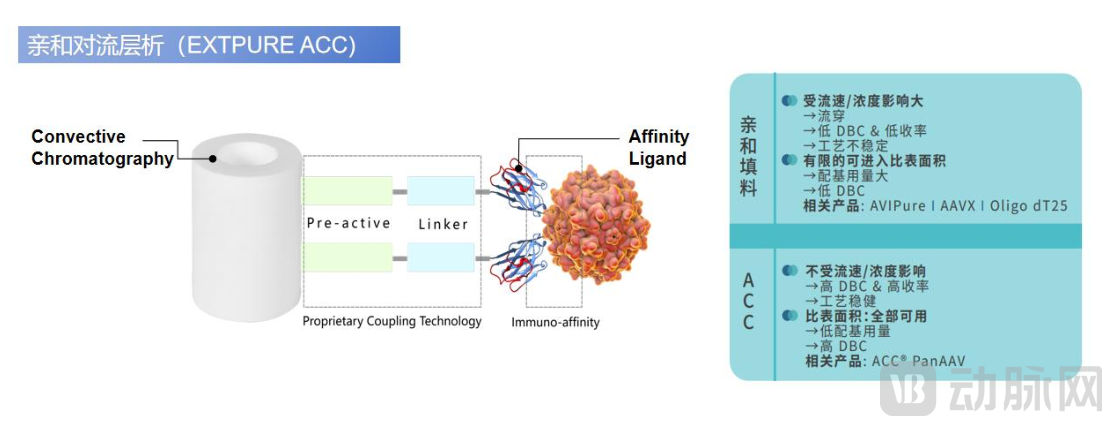 Image source: Cuichun Technology
Cuichun Technology stated that Extpure ACC has been tested at multiple CDMO and biotech companies in China. Test data show that,Extpure ACC’s AAV affinity convection product delivers a dynamic binding capacity that is twice that of leading global counterparts, with a five-fold increase in volumetric processing speed and a 3%–5% improvement in yield. While the overall yield for viral vectors currently stands at only approximately 30%, Extpure ACC overcomes the traditional trade-off between binding capacity and yield inherent to affinity microspheres, achieving both high yield and high binding capacity simultaneously.。
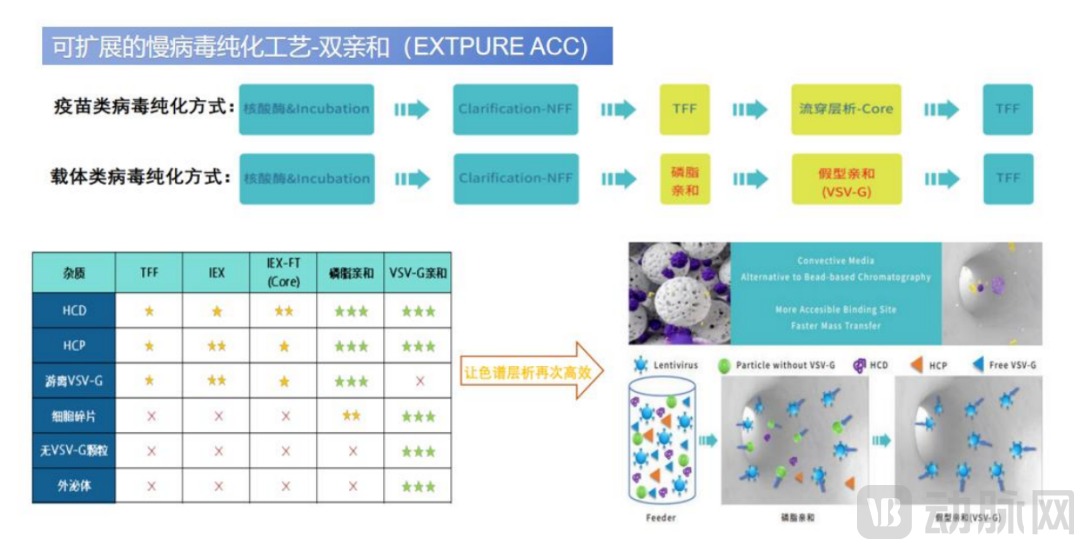
In addition, building upon the Extpure ACC technology, Cuichun Technology continues to innovate,Introducing a Brand-New, Scalable Lentiviral Purification Solution: Dual-Affinity Convective Purification Process, i.e., by combining "phospholipid affinity" and "pseudotyped protein affinity," the downstream purification process can be completed within 8 hours. The sequential application of these two affinity steps yields lentiviral vectors with higher purity, characterized by a higher ratio of total particles to infectious particles (TP/IP) and lower impurity levels, thereby enhancing safety. Furthermore, both affinity steps allow elution under mild conditions, thus maximizing the preservation of viral activity.
Cuichun Technology’s Affinity and Convective Purification Process | Image source: Cuichun Technology
In addition to the standard, universal EXTPURE affinity ligands, Cuichun Technology also offers purification process development services, including vector-based purification development (for non-VSV-G pseudotyped viral vectors, exosomes, VLPs, LNPs, etc.) and circular RNA purification process development, with customizable affinity-denaturation chromatography designs.
Leveraging its team strengths and technological expertise, Cuichun Technology has earned market recognition and attracted investor interest.
May 2024,Cuichun Technology Announces Completion of Pre-A Financing Round, Led by CDH with Follow-on Investment from Wuxi Capital Group’s New Venture Team; Funds to Be Used for R&D in Product Processes, Building a Marketing and Business Development Team, and Commercial Promotion of ProductsIn the same month, Cuichun Technology was honored with the “Rising Star Award for Process and Manufacturing Solutions in the CGT Sector.”
Currently, Cuichun Technology has completed multiple initiatives, including the development of purification matrix materials and ligands, the development of proprietary equipment, and the establishment of a process control system, thereby providing one-stop purification solutions for nucleic acids and viruses. Among these,Extpure ACC series products and new process solutions for lentiviruses will be launched to the market successively。
However, Cuichun Technology has not rested on its laurels; instead, it continues to pursue product innovation and upgrades. Building on its existing technological foundation, the company has developed novel alkali-resistant AAV affinity convection columns, exosome affinity convection columns, and lentivirus affinity convection columns, thereby providing customers with high-quality and efficient purification solutions. Furthermore, the company is actively expanding its workforce to attract more technical talent and strengthen its team, accelerating the global commercialization of its candidate products.
For a long period, the domestic market for CGT purification technologies was predominantly occupied by overseas enterprises. The process of achieving import substitution for domestic brands has faced numerous challenges, with persistent gaps in technological innovation, R&D capabilities, and market acceptance. However, this situation has gradually improved. In recent years, innovative companies have continuously emerged in the downstream purification sector of biopharmaceuticals, driving the iterative upgrading of technologies and products. Furthermore, the Chinese government has continuously issued relevant policies to strengthen safety research and standardized clinical management for CGT.
Currently, the CGT industry has entered a phase of rapid development. According to statistics from the American Society of Gene & Cell Therapy (ASGCT), as of the third quarter of 2022, there were 2,031 CGT pipelines under investigation globally, showing a quarter-on-quarter upward trend. The FDA has previously stated that it expects to approve 10–20 CGT therapies annually starting in 2025, reflecting its positive stance and high expectations for CGT treatments. Furthermore, Frost & Sullivan predicts that the global market size for CGT therapies will reach $30.54 billion by 2025. This multi-billion-dollar sector will attract more capital and enterprises, while the vast market potential will create greater development opportunities for providers of downstream purification processes in the CGT industry.
Regarding future development, Cuichun Technology stated that its goals in the field of downstream purification processes for cell and gene therapy (CGT) extend beyond merely replacing imported products with domestic alternatives. The company’s team aims to achieve a leap from “cross-disciplinary integration to reinvention,” simplifying purification processes and ultimately enabling CGT therapies to benefit more patients.