

Cai Lei & Shenji Changhua ALS Drug R&D Joint Laboratory: Realizing Dreams Through Multi-Party Collaboration
Cai Lei fired another bullet.
On June 3, Cai Lei, whose condition had slightly improved, attended the ““Cai Lei-SINEUGENE Joint Laboratory for ALS Drug R&D”Signing Ceremony and Online Address. Three years on, the collaboration between Cai Lei and SINEUGENE has been upgraded once again—from Cai Lei serving as a member of SINEUGENE’s Scientific Advisory Committee to the joint establishment of a collaborative laboratory. Through this partnership, they aim to drive new breakthroughs in ALS drug development across depth, speed, and breadth, thereby providing effective treatment options for patients.
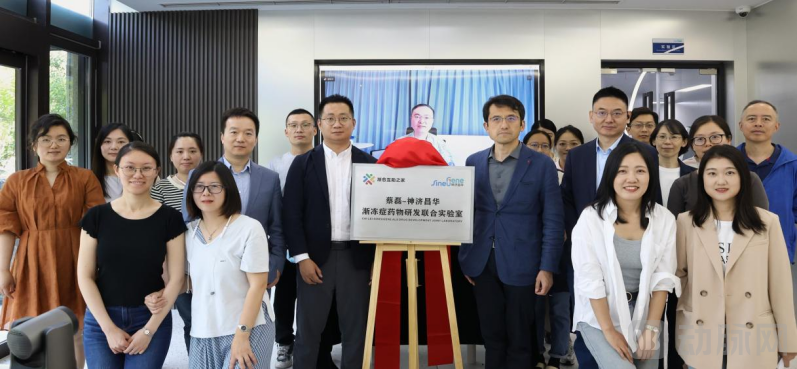 “Cai Lei–SINEUGENE Joint Laboratory for ALS Drug Development” signing ceremony. Photo provided by the interviewee
Since falling ill, Cai Lei has been relentlessly dedicated to the research and development of drugs for amyotrophic lateral sclerosis (ALS), regarding it as his final entrepreneurial venture. Along this journey, Cai Lei and his team have undertaken numerous initiatives: volunteering as “guinea pigs,” securing investment and partnering with enterprises, building scientific data platforms, pathological sample banks, and collaborative scientific networks, and engaging in live-streamed e-commerce. Their ultimate goal is to help nearly 500,000 ALS patients worldwide “find” and “develop” treatments.
For over four years, media coverage of this ALS fighter has often been couched in the metaphor of a “god.” Only Cai Lei knows clearly,“I am not the ‘Dying to Survive’ protagonist, nor am I a hero.” For him, the key to making dreams a reality for ordinary people lies in integrating scientists, medical experts, pharmaceutical companies, investors, and patient communities.。
Layout
The challenges facing amyotrophic lateral sclerosis (ALS) drug development are multifaceted, encompassing the complexity of disease mechanisms, the rapid progression of the disease, difficulties in conducting clinical trials, a lack of effective therapeutic targets, and high R&D costs. These challenges collectively constrain the progress of developing therapeutic drugs for ALS.
At a very early stage, Cai Lei realized that,The primary responsibility for drug development does not lie with physicians, but rather with research institutions, scientists, and pharmaceutical companies; however, very few research institutions and pharmaceutical companies are dedicated to developing drugs for rare diseases such as amyotrophic lateral sclerosis (ALS).。
In the interview, Cai Lei expressed satisfaction with the recent progress in the development of SNUG01, a gene therapy drug by SINEUGENE. However, he quickly pointed out that there are still many industry-wide challenges to overcome in ALS drug research and development. For instance, the limited number of treatment samples restricts more in-depth studies and testing, while insufficient corporate financing affects the continuity and depth of research.
Superficial measures cannot solve any problems. Facing a shortage of samples, Cai Lei spearheaded an initiative for patient body donation, announcing in 2022 that he would donate his brain and spinal cord tissues free of charge for medical research after his death. To address the lack of funding for scientific and pharmaceutical research, Cai Lei raised money through live-stream e-commerce and invested in joint laboratories established collaboratively by scientists and technology-driven enterprises.
Cai Lei told Chengguo Bureau,The purpose of establishing a joint laboratory is to unite the world’s leading scientists and accelerate the processes of drug research, regulatory approval, and clinical trials for amyotrophic lateral sclerosis (ALS).。
VCBeat has observed that Cai Lei is accelerating the implementation of his “co-establishing joint laboratories” strategy this year. In addition to the recent laboratory collaboration with SINEUGENE, the Cai Lei-Yuyan Technology Joint Research Laboratory for Proteomic Functional Targets in Amyotrophic Lateral Sclerosis (ALS) was established in March. In April, Cai Lei and Zhongmei Ruikang founded a Joint Laboratory for ALS Drug Development to advance the research and development of the new drug RAG-17. Notably, regarding technological pathways, Cai Lei’s earliest ventures were also in cutting-edge fields such as genomic analysis, proteomics, and RNA interference (RNAi) therapy.
Cai Lei revealed that the "Jianyu Mutual Aid Home" will also collaborate with various research institutions and pharmaceutical companies in the future.
Expansion
There are approximately 500,000 patients with amyotrophic lateral sclerosis (ALS) worldwide, about 90% of whom have sporadic ALS with no identifiable genetic mutations or clear etiology. Professor Jiachang Jia, a tenured professor at Tsinghua University, Vice Dean of the School of Basic Medical Sciences, and founder of SINEUGENE, told VCBeat thatThe team is investigating the pathogenesis of amyotrophic lateral sclerosis (ALS) and developing effective therapeutic strategies based on gene therapy approaches.。
In 2023, SINEUGENE advanced SNUG01, a gene therapy drug utilizing adeno-associated virus (AAV) as a vector and targeting a globally exclusive therapeutic mechanism, into clinical trials. In May this year, the one-year follow-up of the first patient treated under compassionate use was completed, demonstrating favorable safety and efficacy. The patient’s overall condition has remained stable since receiving SNUG01 treatment.
In the view of Professor Ji Yichang,As research into the mechanisms of amyotrophic lateral sclerosis (ALS) deepens, the “Cai Lei–SINEUGENE ALS Drug R&D Joint Laboratory” will see further expansion in the future, encompassing both technological collaboration and the broadening of indications.
In the treatment of amyotrophic lateral sclerosis (ALS), scientists worldwide are conducting in-depth explorations across multiple technological fields. For instance, brain-computer interface (BCI) technology is being utilized to treat patients with ALS or high-level paraplegia, while the application of artificial intelligence (AI) in disease diagnosis demonstrates significant promise. As a small team within the global ALS research community, Professor Jia Yichang stated that SINEUGENE is also collaborating with various technical teams and is currently attempting to leverage computer-aided technologies to accelerate new drug development.
Certainly, the professor, who has been deeply immersed in the scientific research community for many years, also believes that the “Cai Lei-SINEUGENE Joint Laboratory for ALS Drug R&D” conducts research on disease mechanisms starting from amyotrophic lateral sclerosis (ALS) but is not limited to it. In his research, some pathogenic mechanisms associated with ALS are also present in other neurological disorders. Meanwhile, SINEUGENE is not only researching ALS but also striving to tackle other neurological diseases such as Alzheimer’s disease.
Man-Made Dreams
Achieving a complete cure for ALS remains a dream.
Both Cai Lei and Professor Ji Yichang are dream chasers. During the interview, Professor Ji Yichang repeatedly emphasized:Drug development for amyotrophic lateral sclerosis (ALS) and other rare diseases requires collaborative efforts from scientists, industry stakeholders, clinical researchers, patients, and their families.. Each party plays an indispensable role in this process.
Drug development is a cyclical process. Scientists conduct in-depth research into disease pathogenesis to identify novel therapeutic targets, thereby providing the scientific rationale for drug development. Pharmaceutical companies are responsible for translating these scientific findings into tangible drug products. Clinical researchers play pivotal roles in conducting clinical trials and managing patients, ensuring the scientific rigor and regulatory compliance of these studies. Patients are essential participants in drug development; their needs and feedback serve as critical references. Furthermore, they provide direct support to drug development efforts through participation in clinical trials and other means.
In reality, the R&D cycle for ALS drugs in China is far from ideal.
Professor Jia Yichang told VCBeat, “Patient samples are crucial for research into disease mechanisms and drug development. Although China has a large patient population, it faces numerous restrictions and challenges in body donation and sample collection, making it difficult for researchers to access patient samples.” As a scientific researcher, he aims to call on society to increase attention to and prioritize body donation, break down existing restrictions and barriers, and establish a clear pathway for body donation from patients to researchers, thereby enabling scientists to better access these valuable resources.
On another front, the scarcity of research funding for amyotrophic lateral sclerosis (ALS) and other rare diseases in China is a significant issue that cannot be overlooked.
“R&D for rare diseases should not rely solely on individual efforts; the state should increase investment in this area, including providing financial support and policy incentives, to encourage more enterprises and research institutions to participate in disease research.”“Professor Jia Yichang stated.
All of this takes time. Basic scientific research and drug development are inherently long-term and arduous endeavors, let alone for rare diseases such as amyotrophic lateral sclerosis (ALS).
Cai Lei and Professor Jia Yichang, who have collaborated for many years, both deeply feel thatAccelerating collaboration among patients, enterprises, clinical researchers, and scientists is the optimal path forward.