

Exclusive Interview with Vice Dean Liu Chang: The Rise of Southwest China's Medical Imaging Innovation – What’s Driving It This Time?
In the long course of medical device development, medical imaging is undoubtedly the most unique branch.
It has expanded the perspective of medical practitioners, from macro to micro, and from external to internal, even sparking a new revolution. Devices such as endoscopes, radiotherapy machines, and surgical robots have successively entered clinical practice due to its advancements. This has not only promoted the development of precision medicine but also laid the foundation for the emergence of minimally invasive medicine.
As a critical pillar of modern medical diagnostic technology, medical imaging will evolve toward greater accuracy and clarity in the future.The advancement of medical imaging is inseparable from the integration and cross-pollination of technologies across various fields, making it particularly crucial to pool wisdom and resources to form a powerful collaborative force for research and development.
Just recently,Tianfu Jincheng Laboratory Medical Equipment Innovation Platform(hereinafter referred to as the “Innovation Platform”) has been established in Chengdu, focusing on proof-of-concept and technology transfer for medical imaging equipment by providing services such as technology development, prototype fabrication, and product registration, thereby offering robust support for the innovation and commercialization of medical imaging technologies.
Liu Chang, Deputy Director of the Chengdu Tianfu Jincheng Frontier Medical Equipment Research InstituteTell Chengguo Bureau: “The platform must not only build a bridge to gather resources from all parties, but also pave the way for scientific and technological achievements to cross the ‘Valley of Death.’”
I. Four Cutting-Edge Laboratories
Scientific research achievements form the foundation for translation, and well-equipped, advanced laboratories are a key prerequisite for the development of innovative technologies.
Currently, the innovation platform boasts a range ofElectromagnetic-Acoustic Imaging and Sensing Laboratory, Imaging Genomics and Precision Medicine Laboratory, Ultrasound Laboratory for Precision Medicine, Imaging and Sensors Laboratoryincluding multiple state-of-the-art laboratories, providing robust hardware support for researchers to breakthrough key underlying technologies and conduct related innovative R&D.
At the innovation platform, each laboratory has clearly defined roles. For instance, in the Laboratory for Imaging Genomics and Precision Medicine, researchers integrate gene research techniques such as gene knockout and single-cell injection to advance precision imaging technologies. The Laboratory for Imaging and Sensors focuses on core components integral to imaging products. The Laboratory for Precision Medicine Ultrasound applies engineering principles to investigate the applications of ultrasound mechanical effects and cavitation effects. Finally, as its name suggests, the Laboratory for Electromagnetic-Acoustic Imaging and Sensing explores the application of energies such as photothermal and electromagnetic forces in functional ultrasound.
The four major laboratories address nearly all the fundamental technical challenges in current medical imaging development and enable collaborative advancement across multiple disciplines.
Comprehensiveness is only one of the major features of the innovation platform. Unlike traditional laboratories, the innovation platform not only houses common instruments but also possesses equipment with “unique” characteristics. As Director Liu introduced:“Many of the cutting-edge instruments in the laboratory were independently developed by the platform.”
Currently, the platform’s independently developed ultrasound robots, telemedicine communication systems, AI data acquisition tools, and databases are all available to teams hosted on the platform. In addition, the platform’s self-developed chip R&D and storage equipment have reached a leading level in China, providing hardware support for researchers.
II. A Robust “Think Tank”
In addition to advanced scientific research equipment, the innovation platform’s robust pool of expert resources can also serve as a “think tank” for innovative projects.
Medical imaging is characterized by a distinct integration of medicine and engineering; therefore, the team not only includes clinical research professionals but also engineering experts capable of providing technical guidance.
InClinical Research, multiple renowned Chinese ultrasound professors, including the Director of the Department of Ultrasound Diagnosis at Peking University Third Hospital and the Director of the Department of Ultrasound Medicine at West China Hospital of Sichuan University, will serve as specially appointed researchers to participate in the platform’s development. They will not only assist the team in validating clinical feasibility but also provide new insights closely aligned with clinical needs.
andIn the field of engineering, the inventor of China’s first clinically standardized smart handheld ultrasound device, along with several professors who have led or participated in national-level research projects, can assist the team in overcoming technical challenges and jointly promote the application of new technologies in the field of medical imaging.
In addition to joining innovation platforms at the individual level, research expertsMany scientific research institutions and universities have also established strong collaborative partnerships with the platform., such as West China Hospital, Peking University Third Hospital, Peking Union Medical College Hospital, and Zhongshan Hospital. This not only provides the platform team with abundant clinical information but also brings more opportunities for collaboration.
Medical innovation must originate from clinical practice and ultimately return to it. President Liu stated, ““In the future, we will forge a new path that moves from clinical practice to research, and then from the market back to clinical practice. This will enable more innovative forces to return to and serve the clinical setting.”
III. Full Lifecycle Commercialization Advisory
Research support is merely the first step for the platform. Currently, the innovation platform has established a comprehensive pathway that serves the entire lifecycle of translating scientific research achievements into practical applications.
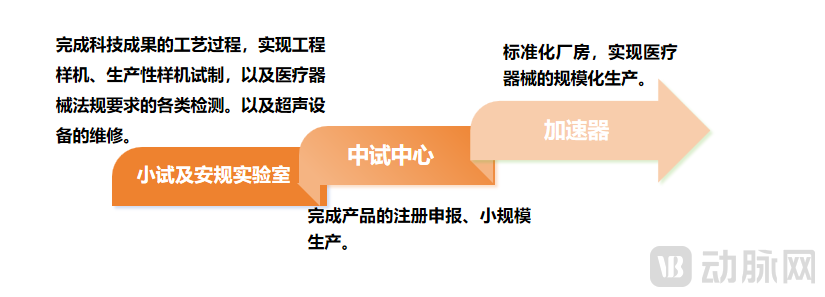 The platform provides full-lifecycle coaching services.
To help projects navigate the “Valley of Death” in commercializing research outcomes, the innovation platform begins supporting them from the project initiation phase.Proof of Concept. Proactively identify potential risks in the translation process, covering aspects such as market size, clinical demand, subsequent regulatory approval and normalization, and commercialization model design.
From a development perspective, engineering prototypes are an essential step in the translation process. Currently, the platform is not only capable of producing engineering prototypes but also equipped with a dedicated technical public relations team to assist projects in transitioning from concept to reality. Meanwhile, the innovation platform can also providePilot-Scale and Intermediate-Scale Trial Centers, and Regulatory Submission Support Team, thereby facilitating the team’s regulatory approval process. This approach not only reduces the financial costs associated with registration but also accelerates the timeline for project commercialization.
Finally, as the project approaches market entry, financial support is indispensable. Currently, the innovation team has been equipped with a dedicated finance team to facilitate this throughInvestment and Financing Services...to provide the team with support in terms of funding and market resources.
“Once the project is implemented, push it one step further.” In President Liu’s view, translation and implementation are only the first step; to truly apply the results in clinical practice, the platform must help teams promote marketization. Under this model, the innovation platform, established less than six months agoEight projects are currently in incubation, four of which have entered the registration and approval stage.
IV. Building a Bridge for Communication Among All Parties
The process of translation is not only led by researchers; enterprises are also important participants.
In the future, the innovation platform will further expand corporate collaborations. By adopting a model in which enterprises articulate their needs and research teams deliver tailored solutions, every scientific achievement can be precisely matched to market entry. The innovation platform aims to serve not only as an incubator for scientific outcomes but also as a central hub that integrates resources across various fields.
Only by breaking down barriers between disciplines and building bridges for communication among all stakeholders can we truly become an open-source hub for medical imaging innovation and a research institute with the capacity to incubate achievements. This is what the Medical Equipment Innovation Platform of Tianfu Jincheng Laboratory is currently doing, and it is also the pursuit it will steadfastly uphold in the future.