

Xi'an Jiaotong University's Xu Yeyin Team Unveils Novel Artificial Heart with Hydrodynamic Thrust Bearing Technology
Submitted by Xu Yeyin's team from Xi'an Jiaotong University in October 2023A Patent for a Dynamic Pressure Impeller-Convergent Inner Duct Thrust Bearing and Artificial Heart.
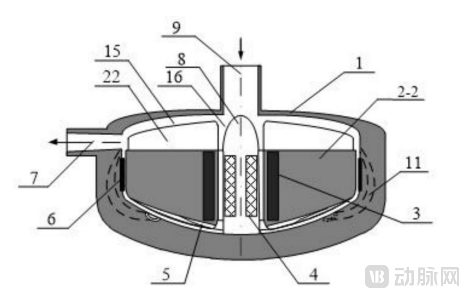
Patent for Dynamic Pressure Impeller, Convergent Inner Duct Thrust Bearing, and Artificial Heart; image sourced from the patent specification
The team utilized a dynamic pressure impeller–convergent inner duct thrust bearing to generate axial supporting force for the artificial heart rotor in the axial direction, while also reducing blood compression by the axial thrust bearing.Simultaneously ensuring smooth blood flow at the base of the artificial heart, thereby enhancing the hemolytic, thrombotic, and hemorrhagic resistance of the hydraulically suspended artificial heart pump.. This patent entered the publication stage in January 2024.
Domestic Research Boom: Four Products Already on the Market
HumanAs one of the frontier fields in medicine, multiple companies in China have already made strategic moves in artificial hearts.Relevant data show that, as of 2022, the total number of patent applications related to artificial hearts in China amounted to 1,134. Among these, Core Medical held the largest number of patents, with 47, followed by Aerospace Taixin Technology (42) and Anhui Tongling Bionic Technology (29). At least 10 Chinese companies are engaged in the research and development of artificial hearts, including Corheart Medical, Xinqing Medical, Core Medical, Aerospace Taixin Technology, and Changzhi Jiuan Artificial Heart Technology Development Co., Ltd.
From the perspective of product launches,, China has successively launched four left ventricular assist device (LVAD) products. In August 2019, Yongrenxin’s implantable left ventricular assist system, EVAHEART I, received market approval, becoming China’s first approved artificial heart; in 2021, Tongxin Medical’s independently developed fully magnetically levitated implantable left ventricular assist system was approved for market launch, with key performance indicators reaching parity with international counterparts, while featuring a smaller blood pump size and reduced invasiveness during implantation;
In 2022, Taixin Aerospace’s artificial heart, the HeartCon implantable left ventricular assist system, received market approval. In 2023, Core Medical’s implantable left ventricular assist system, Corheart® 6, was approved. Its motor utilizes a single set of stator coils to simultaneously control rotor rotation and levitation, resulting in a simpler structure, lighter weight, smaller size, and lower power consumption, thereby reducing the risk of thrombosis caused by heat generation from the blood pump.
It is worth noting that only the medical products of Yongrenxin have been approved for long-term assistive use.; Suzhou Tongxin, Hangtian Taixin, and Shenzhen Hexin have all received approval, but only for short-term support. This is because left ventricular assist devices (LVADs) are implanted products intended for long-term use, and Chinese regulatory authorities impose stringent requirements on their safety and stability. Moreover, the U.S. FDA maintains equally rigorous standards for approving long-term support indications; to date, only HeartMate II, HeartMate 3, and HVAD have obtained FDA approval for long-term support.
Exploring Intelligence and Miniaturization
From the perspective of artificial heart deployment, continuously expanding its application scope through technological innovation to help more heart failure patients regain a healthy life has become the long-term goal of artificial heart technology development.
Future artificial hearts will evolve toward wireless, miniaturized, and intelligent designs, enabling fully implantable systems that further reduce procedural invasiveness and provide patients with more advanced remote management capabilities.This not only enables more effective management of patients using artificial hearts, but also facilitates effective monitoring and treatment guidance for their other comorbidities.
Consequently, researchers in academia are making numerous cutting-edge breakthroughs. In 2021, Professor Huang Xian’s team at the School of Precision Instruments and Optoelectronics Engineering, Tianjin University, successfully developed a fully flexible magnetic levitation pump capable of high-speed rotation and fluid pumping. This wearable, flexible, micro-centrifugal pump opens up possibilities for the “flexible development” of medical devices requiring high-speed rotation and fluid transport, laying the foundation for future wearable and implantable applications in the human body.