

Professor Ai Hua of Sichuan University Highlights Broad Applications and Clinical Progress of ECM-Based Regenerative Biomaterials
In the medical field, as a significant marker of human civilization’s progress and an essential element of scientific and technological development, every breakthrough in materials has brought about major industry transformations, spawning new medical devices and revitalizing traditional ones. Bio-regenerative materials represent a segment within regenerative medicine that currently exhibits faster clinical progress, stronger commercial certainty, and a clearer pathway for technology transfer. Their applications in orthopedics, trauma repair, and medical aesthetics are becoming increasingly mature.
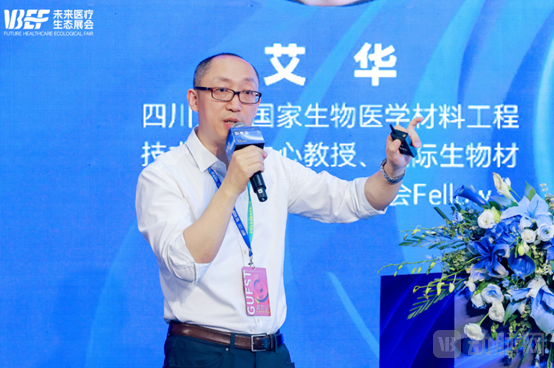
On May 10, 2024, at the Biomaterials for Regeneration Forum held during the VBEF Future Healthcare Ecosystem Exhibition organized by VCBeat, Professor Ai Hua, a professor at the National Engineering Research Center for Biomaterials of Sichuan University and a Fellow of the International Union of Societies for Biomaterials Science and Engineering, delivered an insightful presentation on the theme “Opportunities and Challenges in Regenerative Biomaterials,” drawing on cutting-edge advancements in the field.
The development of the tissue-engineered regenerative biomaterials industry is driven by clinical needs. Currently, extracellular matrix materials have broad application scenarios, and organs derived from gene-edited animals offer new hope. However, there are two technical challenges: first, the heterogeneity of human tissues; second, the properties of surface and interface materials. These two considerations are crucial to tissue engineering. Furthermore, throughout the product development cycle, standard definition, imaging evaluation, and regulatory science are all of paramount importance.
Clinical Demand: Taking China as an example, 300,000 patients await organ transplantation annually, yet only approximately 20,000 actually receive transplants, representing a mere 1/15 of the demand. Among these, the need for kidney transplantation is the highest, with additional demands for liver, heart, lung, and pancreas transplants.
In the field of regenerative biomaterials, extracellular matrix (ECM) materials are biological scaffolds prepared from allogeneic or xenogeneic tissues by removing cellular components through physical, chemical, or biological methods. These materials are typically derived from sources such as pigs and sheep. The key to their successful clinical application lies in achieving a balance between reducing immunogenicity and preserving biological activity.
The applications of extracellular matrix materials are extensive, spanning tendons, muscles, cartilage, and the cardiovascular system. Overseas, some renowned universities and companies focus on areas such as corneal transplantation, wound repair, and nerve repair. In China, companies have established a presence in fields including corneal transplantation, tendon repair, nerve defect repair, and extra-abdominal wall repair.
When discussing the current state of the ecosystem for the commercialization of regenerative biomaterials, Ai Hua pointed out that industry-academia-research collaboration is a path that leverages complementary strengths.
Ai Hua cited the Stem Cell and Tissue Engineering Research Center of the State Key Laboratory of Biotherapy at West China Hospital, Sichuan University, as an example. Professor Xie Huiqi’s team at West China Hospital has focused on the translational research and development of extracellular matrix (ECM) materials. Over more than two decades, they have established safe and effective technologies for decellularization, structural optimization, and composite fabrication. The ECM materials developed by their team contain significantly lower levels of immunogenic substances compared to mainstream international products, while also demonstrating marked improvements in mechanical strength and resistance to degradation. Furthermore, the team has conducted in-depth mechanistic studies. Leveraging this robust foundation in basic research, five ECM-based products have already obtained Class III medical device registration certificates from the National Medical Products Administration, with another five currently undergoing multicenter clinical trials.
Subsequently, Ai Hua addressed the issue of surface/interface material properties. Citing B. Braun’s knee cartilage repair product as an example, he pointed out that this unique biological-device combination product is used to repair knee joint cartilage (femoral condyles and trochlear groove). It was approved in the European Union in 2003 and has been successfully applied in clinical practice. The entire treatment process takes three weeks and involves two surgical procedures, with over 8,000 patients reportedly benefiting from it.
The implantation of this product involves a four-step clinical protocol: the first step is articular cartilage biopsy, the second is chondrocyte isolation and expansion, the third is preparation of engineered articular cartilage patches, and the final step is surgical implantation.
Between the stages of articular cartilage biopsy and chondrocyte isolation and expansion, critical issues regarding surface/interface material properties that require professional attention become prominent. One side of the patch features a porous, sponge-like structure that facilitates chondrocyte dispersion within the scaffold, while the other side consists of a dense collagen layer designed to provide wear resistance. During device manufacturing, it is essential to clearly specify which side should face the damaged tissue site to prevent errors during surgical implantation, thereby demonstrating meticulous attention to detail.
The third key consideration in product design is to account for the heterogeneity of human tissues. Taking the intervertebral disc as an example, the contents of proteoglycans, collagen, and water differ significantly among the nucleus pulposus, annulus fibrosus, and cartilage endplates. Consequently, traditional manufacturing processes are inadequate for fabricating artificial intervertebral discs. Therefore, whether employing 3D printing or other advanced manufacturing technologies, it is essential to match the composition and mechanical properties of human tissues to achieve optimal outcomes.
The fourth point of note concerns organs derived from gene-edited animals. On January 7, 2022, a team led by Dr. Muhammad Mohiuddin at the University of Maryland School of Medicine performed the first transplantation of a gene-edited pig heart into David Bennett, a 57-year-old patient with congestive heart failure. The patient survived for two months post-transplantation. The suspected cause of death was latent porcine cytomegalovirus/porcine roseolovirus (PCMV/PRV) present in the xenotransplanted pig heart. The donor pig, provided by United Therapeutics, had four pig genes knocked out and six human genes inserted.
A comparison of pre- and post-operative chest X-rays revealed that the patient’s various functions and indicators were normal at 19 days post-surgery; however, by 49 days post-surgery, cardiac function began to decline, with abnormal longitudinal strain and thickening of the ventricular wall. This underscores that preventing retroviral recombination and cross-species transmission is crucial to the success of xenotransplantation.
The fifth point is to prioritize imaging assessment. As a dynamic, non-invasive modality, imaging allows for long-term postoperative evaluation of product efficacy.
The sixth key point is regulatory science. Ai Hua believes that regulatory science is of paramount importance. It is used to evaluate the entire lifecycle of medical device products by employing new standards, tools, and methodologies. Its purpose is to facilitate the translation of innovations by generating scientific evidence through research to ensure the safety and efficacy of medical devices, thereby providing a sound basis for regulatory decision-making.
The final point to note is the importance of definitions and standards, which should take precedence. The first internationally recognized definition of biomaterials was established in 1987 under the leadership of European and American experts, with no participation from Asian countries. More than three decades later, in 2018, Academician Zhang Xingdong, then President of the International Union of Societies for Biomaterials Science and Engineering (IUSBSE), convened over 50 experts worldwide to formulate a second definition of biomaterials. The Chinese and English versions of this definition have been disseminated globally and serve as an authoritative reference for government regulation, inspection and evaluation, and corporate production in the field of biomaterials.
Finally, Ai Hua introduced the group standards released by the Chinese Society for Biomaterials in 2023, noting that a key focus for companies expanding overseas is international standards. He recommended that enterprises not only excel in product development but also strategically position themselves to play a greater role in the formulation of international standards.