

Weiming Shiguang Breaks Transmembrane Protein Synthesis Barrier: Recombinant Collagen XVII Secures Class II Medical Device Certification and Patent

Synthetic biology
Medical Aesthetics Skincare Developer
Recombinant collagen, as a new focal point in the anti-aging sector, continues to attract widespread attention from both industry players and investors. Recently, the recombinant collagen industry has been further ignited!
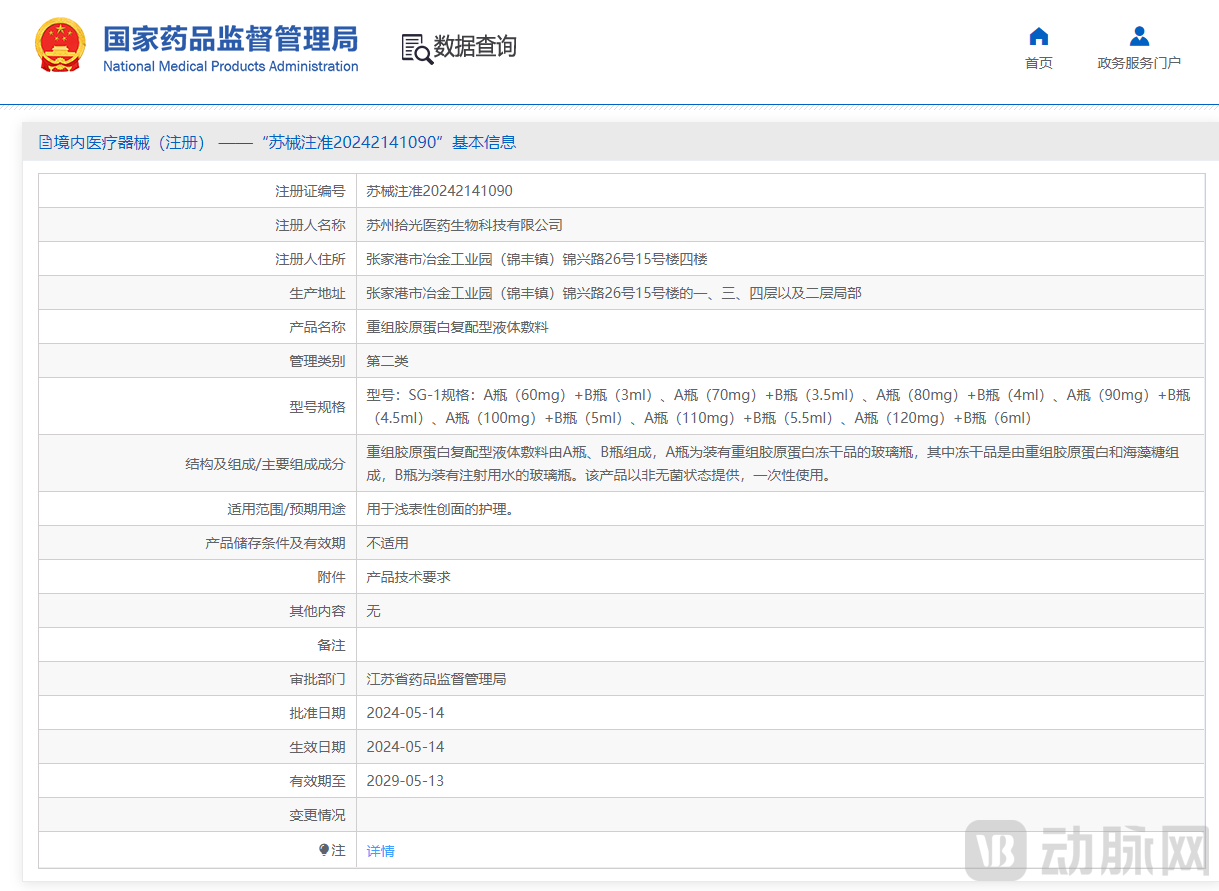
On May 14, 2024, Suzhou Shiguang Pharmaceutical Biotechnology Co., Ltd., a wholly-owned subsidiary of the synthetic biology enterprise Weiming Shiguang, obtained the Class II Medical Device Registration Certificate (Su Xie Zhu Zhun 20242141090) for recombinant Type XVII collagen. Meanwhile, Weiming Shiguang also received patent authorization for an invention titled “Recombinant Type XVII Collagen and Its Expression System” (Patent No.: 202410281582.9).

Type XVII Collagen (Collagen XVII, Type 17 Collagen), also known as COL17, is a transmembrane protein that plays a crucial role in maintaining the connection between intracellular and extracellular structures involved in epidermal adhesion.
Type XVII collagen is expressed in various tissues, with the highest expression levels found in the skin. It plays a crucial role in combating skin aging and maintaining hair follicle stem cell homeostasis. Type XVII collagen facilitates the connection between intracellular keratin filament networks and extracellular proteins of the basement membrane, thereby establishing adhesion between epithelial cells and the underlying basement membrane, which promotes epidermal turnover and stabilizes the basement membrane.
Furthermore, a growing body of research demonstrates that the root cause of hair follicle aging or damage is the deficiency of type XVII collagen. Type XVII collagen maintains the activity of hair follicle stem cells, preventing hair follicle miniaturization; sustains melanocyte stem cell homeostasis, thereby preventing gray hair formation; and clears senescent cells from the scalp, promoting scalp health.
Wielding the two trump cards of “basal anti-aging” and “hair loss prevention and strengthening,” Type XVII collagen has surged to become the “top-tier star” in the collagen sector and as an ingredient in beauty and personal care products.
The unique transmembrane structure is the essence that endows type XVII collagen with superior properties distinct from other collagens, but it also directly poses challenges for its synthesis.Chen Jiayue, co-founder of Synthetic Biology, told VCBeat that transmembrane proteins such as type XVII collagen are extremely rare in humans and animals. As a non-secreted collagen with a high molecular weight, it is difficult to obtain through traditional animal extraction methods. In recent years, advances in synthetic biology have made the synthesis of type XVII collagen possible; nevertheless, the synthesis of transmembrane proteins remains a significant challenge in the field of protein synthesis.
Type XVII collagen is “anchored in the cell membrane,” with one end extending into the extracellular space and the other residing within the cell. This “transmembrane domain” structure renders its intracellular synthesis, folding, and secretion processes more complex than those of non-transmembrane proteins. Furthermore, the transmembrane architecture necessitates specific cellular mechanisms for its intracellular transport and localization. These factors collectively pose significant challenges to the synthesis of type XVII collagen.
If Type XVII collagen is synthesized using the methods for Type I and Type III collagen, the resulting protein will lack a normal structure, thereby failing to exert the specific efficacy of Type XVII collagen. Furthermore, if the transmembrane domain is not fully synthesized but only partially produced, the resulting Type XVII collagen will be “soulless” and devoid of actual function.
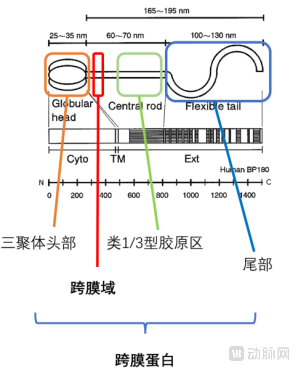
The Complex Structure of Type XVII Collagen[1]
Through nanodisc and natural lipid vesicle technology,
Synthesis of Recombinant Type XVII Collagen with a Unique Transmembrane Structure
Protein Structure Determines Function. Chen Jiayue told VCBeat that, as a transmembrane collagen, type XVII collagen cannot be produced through simple microbial fermentation like type I or type III collagen. Therefore, the recombinant type XVII collagen previously available on the market mainly consisted of fragments corresponding to the “green regions” similar to those in type I and type III collagens. However, the absence of other critical structural domains prevents these fragments from exerting the full functional capacity of intact type XVII collagen.
Synthetic Biology has developed a platform capable of synthesizing complex transmembrane proteins. By leveraging its proprietary nanodisc and natural lipid vesicle technologies, the company successfully synthesized macromolecular Type XVII collagen with an intact structure and secured invention patents for this achievement. Within this technical platform, the transmembrane domain of recombinant Type XVII collagen is encapsulated by the lipid bilayer of nanodiscs or natural vesicles, thereby preserving its complete structural integrity. This synthesis technology was published in the premier materials science journal Advanced Materials (Impact Factor = 32.086), setting a new industry record for impact factor at the time.
The patent also states that this structurally intact type XVII collagen offers significant efficacy advantages. Experiments have demonstrated its superior stability and prolonged retention in the human body following medical aesthetic procedures, thereby promoting the synthesis of endogenous type I, type III, and type XVII collagen, and increasing dermal density and thickness in the face.
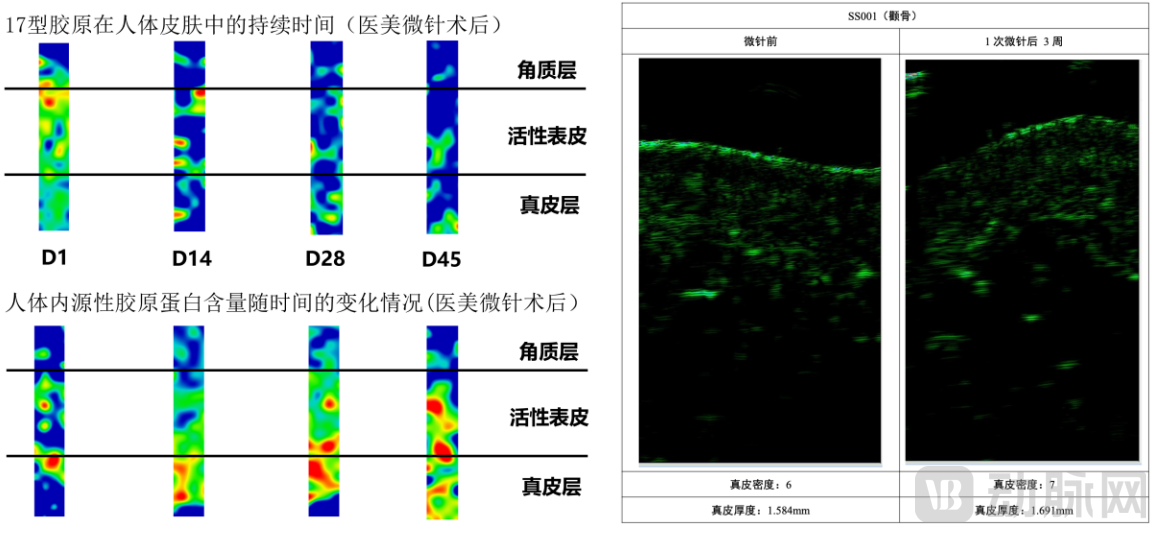
Human Efficacy of Synthetic Biology Recombinant Type XVII Collagen
Chen Jiayue explained that the most complex aspect of type XVII collagen is its transmembrane integration. The synthesis of transmembrane proteins relies on membrane structures. These proteins are formed within the cell membrane, akin to embroidering a pattern onto fabric; the membrane structure is essential for maintaining their proper conformation. The correct structure of type XVII collagen is constituted by both the protein and the membrane itself. During synthesis, transmembrane insertion occurs concurrently with protein synthesis, as these two processes are inextricably linked. Only in this way can type XVII collagen achieve its proper structure and exert its true biological efficacy.
Nanodiscs and natural lipid vesicle technology are the key “weapons” enabling Synthetic biology to achieve successful transmembrane delivery. Nanodiscs are small disc-shaped structures containing phospholipid bilayers that act like a membrane scaffold for embroidery, assisting in the synthesis of transmembrane proteins by providing them with a stable structure. Natural lipid vesicle technology simulates the cellular environment by using natural cell membranes derived from plants and animals. This approach not only creates the necessary conditions for collagen to cross the cell membrane but also promotes the fusion of collagen with the cell membrane, mimicking its functional process in the human body. Furthermore, these lipid vesicles share an identical, fully natural structure with cell membranes, making them applicable to the synthesis of a wide variety of complex membrane proteins.
Leveraging successfully synthesized Type XVII collagen, Synthetic Biology utilized its proprietary natural bioactive molecule database (containing tens of billions of entries) and combined it with high-throughput screening methods such as computer-based deep learning, virtual screening, and phage display technology to identify the most critical signaling fragment within human Type XVII collagen. This fragment was then produced via DNA recombination and biosynthesis techniques, resulting in the launch of “Time-Col17,” a small-molecule Type XVII collagen. While preserving the key active functions of Type XVII collagen, this innovation enables absorption through topical skincare application, significantly expanding the application scenarios and product forms for downstream skincare brands.
Meanwhile, leveraging the reparative efficacy of type XVII collagen, Synthetic biology also plans to develop wound repair products for post-microneedling recovery, patch dressings resembling facial masks for daily skincare, and single-use care products for home application.
In addition to the recombinant type XVII collagen approved in this instance, Synthetic Biology also possesses other recombinant functional proteins, including recombinant type III collagen, recombinant fibronectin, recombinant mussel adhesive protein, and recombinant elastin.
The vision of Synthetic biology does not stop there; its goal is to become a global supplier of biomaterials.
“Previously, neither the medical aesthetics industry nor the cosmetics industry had such a platform system. The discovery of many raw materials was based on chance or some rational design, but these methods made it difficult to systematically produce new ingredients.” Based on this understanding, Synthetic biologyBy integrating artificial intelligence with digital technologies, we have independently established platforms including a database of natural active molecules from plants, microbes, and humans, as well as high-throughput screening, biosynthesis, and biomimetic design platforms.Built an end-to-end platform and, based on this, constructed“Ingredient Discovery—Efficacy Evaluation—Large-Scale Production”of the full innovation chain in bio-intelligent manufacturing.
“We have established a tiered, platform-based R&D system for novel biomaterials. At the base lies the core technology platform; derived from it are intermediate products; and at the top are specific products tailored to diverse application scenarios,” Zhao Yaran, founder of Synthetic Biology, told VCBeat. The Synthetic Biology platform encompasses three stages: material design, evaluation, and mass production.
First, the aforementioned database platform enables the rapid discovery of novel materials that meet specific needs; these materials are often innovative and capable of addressing previously unsolvable problems. Second, new evaluation systems, such as AI simulations and transdermal absorption platforms based on human in vivo skin, are employed to assess material suitability, ensuring the performance of these new materials in specific application scenarios. Finally, leveraging a multi-dimensional synbio platform, diverse production methods—including animal-, plant-, and microbial-based synthesis, as well as cell-free synthesis—are utilized to mass-produce these bioactive materials, while guaranteeing their structural integrity, functionality, and cost-effectiveness.
“This end-to-end R&D platform enables us to rapidly launch a diverse range of recombinant protein products, such as recombinant Type XVII collagen, Type I collagen, and Type III collagen. The research, development, and production of these products all rely on our platform capabilities, allowing us to select development directions based on market demand and quickly introduce innovative biomaterials,” added Chen Jiayue.
Zhao Yaran emphasized that Weiming Shiguang is not merely a synthetic biology company, but rather a technology enterprise driven by innovation in biomaterials. “For us, biosynthesis itself is a production technology,” she stated, highlighting the company’s strong focus on upstream design and discovery in materials science, as well as on application-oriented material evaluation systems.
In less than three years since its founding, the young company Synthetic Biology has secured four rounds of financing, with existing shareholders ZhenFund and Jiacheng Capital continuously increasing their investments in each round—a rarity in today’s speculative funding environment.
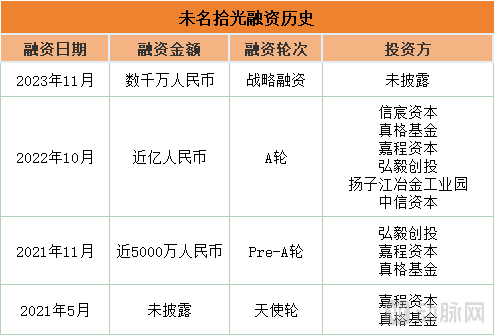
Synthetic biology focuses on the consumer healthcare and beauty wellness industries. The company’s business is primarily B2B, mainly providing upstream raw materials and products for the beauty and health sectors, including cosmetic ingredients, functional food ingredients, and medical devices. At present, the company’s main revenue comes from the cosmetics industry, while it is also expanding into the medical aesthetics and functional food markets.
It is reported that in October 2023, Synthetic Biology’s production base in Zhangjiagang, Suzhou, commenced operations, establishing an industrial triangle spanning Beijing, Hangzhou, and Suzhou. Building on this foundation, Synthetic Biology will simultaneously expand its application scenarios and distribution channels, gradually extending from cosmetic ingredients to contract manufacturing of medical devices and functional food ingredients.
References:
[1] Yoshiaki Hirako et al., Demonstration of the Molecular Shape of BP180, a 180-kDa Bullous Pemphigoid Antigen and Its Potential for Trimer Formation, 1996