

Key Consensus from the BD Buyer-Seller Panel Discussion at the 2024 China Gene and Cell Therapy Summit
On June 15, at the 2024 China Summit on Gene and Cell Therapy (CSGCT), co-hosted by the CSGCT Special Committee and Hangzhou Jingke, VBInsight co-organized “Forum 7: Entrepreneurship, Investment, and Global Collaboration,”In the final highlight session, Dr. Xia Mingde, Chairman and CEO of InnoLake Pharma, presided over the event, bringing together buyers and sellers for BD transactions to engage in dynamic discussions on stage.。
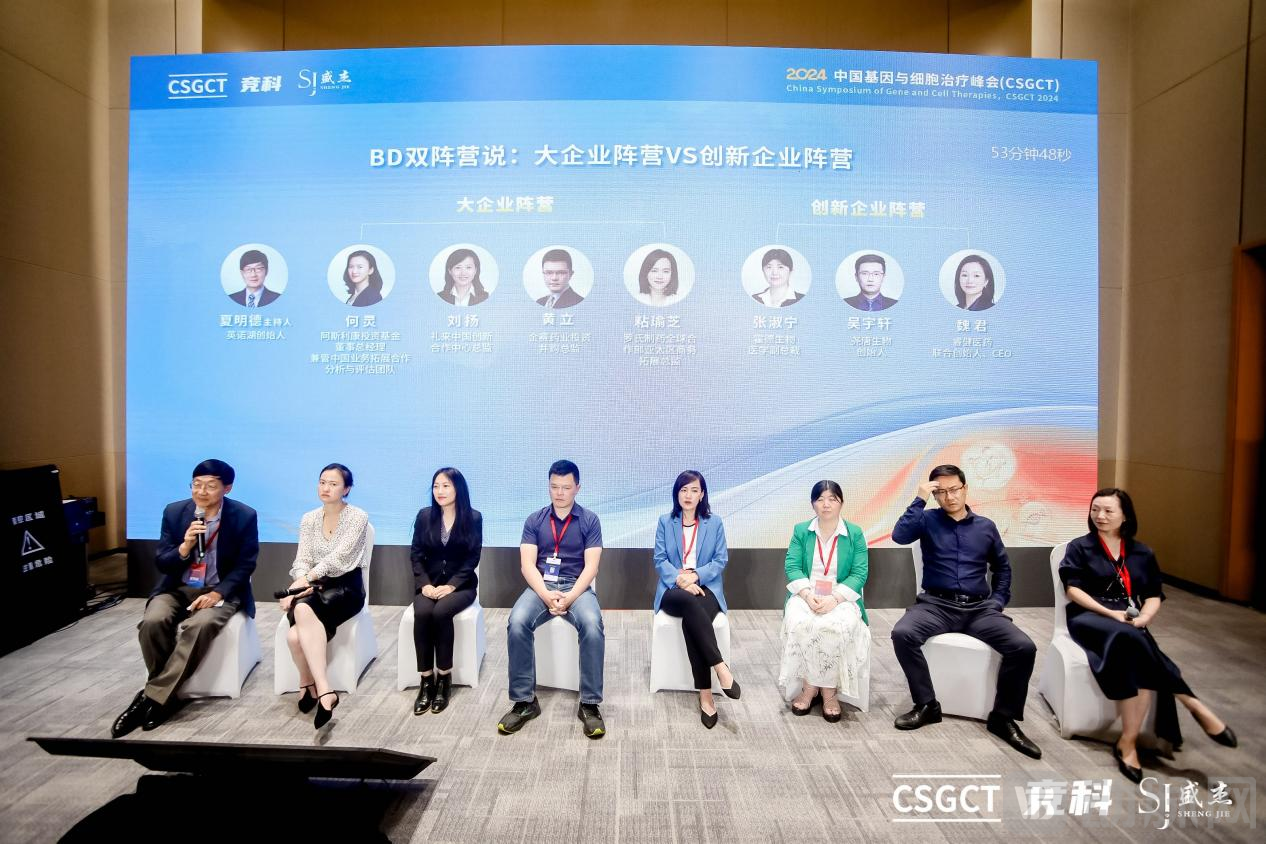
Host: Xia Mingde | Chairman and CEO of InnoLake Pharma
Large Enterprise Camp: 4 Large Enterprises’ BD
He Ling | Managing Director, AstraZeneca Investment Fund
Liu Yang | Director, Eli Lilly China Innovation Collaboration Center
Huang Li | Investment and M&A Director, GenSci Pharmaceutical
Nian Yuzhi | Director of Business Development, Asia-Pacific, Global Partnerships China, Roche
Innovative Enterprise Camp: 3 CGT Pharmaceutical Companies
Zhang Shuning | Vice President, Huode Biologics
Wu Yuxuan | Founder of Yaotang Biotech
Wei Jun | Co-founder and CEO of Ruijian Medicine
Dr. Xia Mingde introduced key business development (BD) strategies and various conferences related to international BD. This was followed by an engaging discussion, with selected highlights summarized below:
Xia Mingde: Whether acting as a buyer or a seller, what are the most “bizarre” buyers or sellers you have ever encountered?
He Ling: At a recent conference, a representative from an ophthalmology company stopped me to introduce his long-established firm and one of its ophthalmic products. I sensed that he had not done adequate preparation beforehand; since AstraZeneca’s current business development (BD) priorities do not lie in ophthalmology, he effectively approached the wrong person. While I appreciate such aggressive outreach, failing to understand the counterpart’s basic needs in advance can waste both parties’ time.
Liu Yang: We have actually also encountered those who had not done their homework.In BD transactions, it is more appropriate for both parties to discuss non-confidential information during the initial communications.. However, a situation may still arise where, despite our request for non-confidential materials, the materials provided by the other party still contain documents marked as confidential. In such cases, we are not permitted to review or view them and must either delete or return them.
Huang Li: Currently, we have observed that many biotech companies are initiating fundraising efforts in parallel with advancing their business development (BD) activities. To secure funding rapidly, biotech firms must effectively manage the overall pace and rhythm of these processes.Once the strategy is clearly defined, proceed with determination under the premise of no major changes, avoiding repeated hesitation and losing sight of the overall picture by focusing on one aspect at the expense of another.。
Successful fundraising or business development (BD) ultimately hinges on seizing the right timing. However, before such an opportunity arises, biotech companies must proactively and objectively evaluate their product pipelines and establish clear valuations for their assets. This preparation enables them to act swiftly and make appropriate decisions when opportunities present themselves. Although the chosen path may not prove to be optimal in hindsight, it represents the best possible decision at that moment.
Nian Yuzhi: I’d like to share a recent case. During business development (BD) negotiations, each company operates at its own pace. In our communications with one company, discussions about the project proceeded smoothly; however, when it came to disclosing the target, the counterpart insisted on signing a Confidential Disclosure Agreement (CDA) before revealing it. Without key project information such as the target, it is difficult for us to internally assess our level of interest in the project. I am sharing this experience for your reference. While I recognize that everyone maintains a rigorous scientific foundation when initiating projects, I also hope you can understand the procedural workflows of large companies.Both parties can also engage in open communication during the early stages, holding preliminary discussions on topics such as therapeutic targets and the current competitive landscape. This will help us further evaluate the project.。
Zhang Shuning: I would like to share some international multi-regional clinical trial (MRCT) projects involving license-in arrangements that I have previously participated in. Generally, when a product undergoes an MRCT, the Chinese population should account for 15%–20% of the sample size. In one particular project, during discussions on regional sample size allocation, the counterparty’s Chief Scientific Officer (CSO) stated that they would only allocate a sample size of five cases to us. We hoped to increase the sample size, but the company explained that a previous project had incurred high costs, yet poor data from a specific region ultimately compromised the integrity of the entire dataset. This response left us with a profound sense of discrimination.
Wu Yuxuan: I believe that fundraising is similar to business development (BD). Fundraising is a tedious and meticulous process. Having gone through multiple rounds of financing, we have learned to approach the counterpart’s detailed and complex inquiries with a calm mindset. BD transactions are inherently detail-oriented and procedural; thereforeBusiness development should also be conducted with an open, inclusive, and even empathetic mindset. By adjusting your attitude to collaborate effectively with the other party, negotiations will proceed more smoothly.. Many biotech founders come from R&D backgrounds and tend to place excessive emphasis on data confidentiality, making them reluctant to share information extensively. However, I believe we must overcome this mindset. While technical and process-related details should remain confidential, clinical data and other such information can be communicated with an open mind.
Mr. Wei: During negotiations with a pharmaceutical company, the counterpart explicitly stated that they only wanted our investigational drug and were unwilling to sign any agreements. Although they merely required our drug as test material, we could still engage in discussions regarding costs and other related matters. However, if they refuse to execute an NDA or any other agreement and simply seek to obtain our materials, it will be difficult to advance this collaboration. Subsequently, we also learned that the counterpart is preparing to launch a pipeline identical to ours.
“Sincerity is a game-changer.” Therefore, I hope both parties can be more candid in their communication and clearly clarify the specific circumstances.. We are also highly willing to collaborate with an open mindset, working with more industry peers to advance our product pipeline into clinical development through our iPSC platform and other cell therapy platforms.
Xia Mingde: Whether for first-in-class or best-in-class projects, data is critically important. Generally speaking, projects targeting known mechanisms require clinical data to benchmark against other leading programs with the same target. Clinical data becomes increasingly costly in later stages, whereas early-stage projects are characterized by higher risk but lower costs. How, then, do we balance the volume of data required when evaluating a project? Do pipelines with clinical data hold greater value for business development (BD)? And how should we assess the value of first-in-class (FIC) projects that lack clinical data?
He Ling: I believe it is certainly difficult to make decisions without data. Generally, if the deal size is substantial, clinical data support remains necessary. However, as Dr. Xia pointed out, the higher the certainty of clinical-stage data, the higher the price buyers must pay.If a product boasts an outstanding technical platform and R&D strategy, buyers may still be willing to engage in corresponding business development (BD) transactions at a lower cost, even in the absence of human clinical data or even proof-of-concept (POC) data.. However, the quality of data always affects project valuation. For a drug pipeline, I believe some basic data, such as proof-of-concept (POC) data or early-phase clinical trial data in humans, is still necessary.
Liu Yang:For preclinical projects lacking clinical data, I believe their valuation is also tied to the company’s development strategy.. For example, at Eli Lilly, we place significant emphasis on the field of diabetes and metabolism. In this area, we are highly interested in emerging projects, even if they only have preclinical data from animal studies.
Huang Li: I believeFocusing on one’s own core therapeutic areas is the primary factor in assessing pipeline value. As GenSci’s product portfolio is primarily focused on pediatric growth, we have reviewed nearly all relevant global projects in this field, enabling us to identify which products can be intervened at an early stage.However, in areas where the company has no products but seeks to establish a presence, I believe its strategy should prioritize prudence.。
Since not all members of GenSci’s business development (BD) team have a scientific research background—with the majority coming from product commercialization backgrounds—we first engage in internal discussions with the team to address the future commercialization and accessibility of any early-stage project under consideration. The quality of the project’s data is a secondary factor; the primary consideration is whether the project can successfully survive and grow. However, once a portfolio gradient is established, clinical data, such as proof-of-concept (POC) data, become the key evaluation criteria. Different companies have varying needs at different stages of development. We formulate a priority development plan based on our current needs. Consequently, it may happen that although an early-stage product is promising, it does not align with the company’s current strategic focus, making it unsuitable for GenSci to pursue BD opportunities related to that project.
Nian Yuzhi: Compared with a few years ago, I feel that Roche currently has relatively greater flexibility in this area. Our value assessment of preclinical projects,First and foremost, the primary focus is on the technical platform itself, target selection, and whether the product possesses the potential to address unmet clinical needs within the current global competitive landscape.. Additionally,Clinical data integrity of the asset itself, post-phase clinical development strategy, indication selection, and alignment with Roche’s internal pipelineare also key factors we consider.
Xia Mingde: As representatives of innovative biotech companies, how do you handle data preparation and external collaborations? What kind of data can meet the requirements of buyers?
Zhang Shuning: When engaging in business development (BD) transactions, products in Phase I clinical trials often offer the best cost-effectiveness, as this stage has already validated preliminary safety. However, cost-effectiveness actually declines in later stages. Nevertheless, it is undeniable that the closer a product is to the New Drug Application (NDA) and commercialization stages, the fewer potential issues it is likely to encounter.
However, current BD transactions indicate that products are moving “increasingly upstream,” with most deals occurring at the IND-enabling stage or even earlier. For instance, AbbVie partnered with Mingji Bio on a product in preclinical development, and several high-profile BD deals closed this January were also concentrated at the IND or preclinical stages. The key drivers behind these successful collaborations include the superior and distinctive attributes demonstrated by products in early stages, such as improved half-life and compliance, enhanced target-binding activity, more favorable pharmacokinetics (PK), and lower anti-drug antibody (ADA) incidence.
Wu Yuxuan: At Yaotang Bio, we initially adopted a conservative approach to target selection in the development of in vivo gene editing therapeutics. While gene editing offers the potential for a one-time, lifelong cure, any issues with the chosen target could pose significant risks. Currently, the global development of in vivo gene editing drugs remains in the early clinical stages. Therefore, not only we but also our U.S. counterparts have exercised considerable caution in their initial target selection.
When selecting its initial two pipeline candidates, Yaotang Biotech opted for highly conservative targets. For instance, we only chose targets for our inaugural pipeline if their safety had been previously validated through human genetic data—indicating that even in the event of systemic variation, there would be no health risks—or if their safety had already been confirmed in prior small nucleic acid drug studies. In the future, as proof-of-concept (POC) validation data accumulates, we may explore more innovative targets.Innovation is not limited to targets alone; it also encompasses delivery vectors, gene compilers, and more. I believe that drugs ultimately developed through such innovations can also be considered first-in-class therapeutics.。
Wei Jun: Let me share the strategic thinking behind the project initiation at Ruijian Medicine. Whether pursuing a first-in-class or best-in-class asset, it is essential to establish a robust strategy at the outset. First, in formulating the R&D strategy, we must anticipate the competitive landscape at the time of market entry and identify the specific dimensions on which we can demonstrate superior data compared to competitors. Working backward from this goal to the R&D phase, we must then determine which technological platforms can minimize costs while maximizing product efficacy. Furthermore, we must have the courage to conduct head-to-head studies against international products, benchmarking our asset against those of multinational corporations even during the preclinical stage. From R&D through Investigational New Drug (IND) application to Phase I clinical trials, Ruijian Medicine has consistently maintained a close focus on various international competitors, including medical devices, pharmaceuticals, and gene therapy products.
Secondly,For innovative pharmaceutical companies, buyers’ requirements and recommendations regarding data and collaboration serve as valuable guidance for development.Currently, some potential acquirers are evaluating Ruijian Medicine’s clinical-stage projects, but the one attracting the most attention is another product in the preclinical stage. Shortly after the initiation of this preclinical program, preliminary validation data became available, prompting interest from potential acquiring companies. At that time, an overseas pharmaceutical company provided us with extensive constructive feedback, such as identifying additional questions we needed to address regarding technical aspects, efficacy, and manufacturing processes, as well as specifying further regulatory qualifications required. Consequently, after this pipeline asset received Orphan Drug Designation (ODD), the same company re-engaged in negotiations with us. Although the two parties ultimately did not reach a deal on this project, we gained many valuable insights throughout the process.
Xia Mingde: Do large pharmaceutical companies evaluate projects with a “want-it-all” mindset? They want: indications with a substantial market size; they also want: demonstrable druggability potential of the target; and furthermore, they want: a leading position in global R&D progress for the same target. During deal negotiations, there are certain differences between large pharmaceutical companies and biotech firms in terms of style, decision-making, and strategy. As BD representatives from large pharmaceutical companies, how do you view these differences?
He Ling: From the buyer’s perspective, I believe no pharmaceutical company will abandon its “have-it-all” approach. In terms of competitiveness, pharma companies consider the global market as a whole; therefore, they will not select a product that lags behind the third-best globally. If a product ranks fourth or fifth worldwide but boasts outstanding data, it still has a chance of being selected. Meanwhile, pharma companies will benchmark partnered assets against their internal portfolios. Without differentiation or complementary value, external assets are unlikely to outcompete internal pipelines, making collaboration difficult. Furthermore, strategies and perspectives vary across companies. After acquiring a product, pharma companies can leverage their ample capital to explore new indications or markets. For sellers, when a product is sufficiently fast-to-market and high-quality, buyers may extend an olive branch.
Liu Yang“The imperative to ‘have it all’ is a strict, harsh, yet authentic reality. For us, in balancing internal and external demands, we must exclusively pursue the world’s top three projects; those ranked fourth or fifth are barely acceptable, while anything beyond that is virtually unattainable. Furthermore, I believe that if there is any flexibility within this ‘have it all’ framework, its application scenarios can be adjusted. Currently,”There are few off-the-shelf products in the field we aim to develop, allowing us to expand its application scenarios to other levels. If the product’s data demonstrates development potential, this presents a viable opportunity for collaboration.。
Huang Li: Unlike multinational pharmaceutical giants, GenSci aims to introduce more products through business development (BD) partnerships. When selecting projects, we do not require the disclosure of all data at the current stage. Although a product may demonstrate best-in-class potential based on existing data, it could be surpassed by other products in the future. From a commercialization perspective, if a product can achieve rapid market launch and quickly capture market share, subsequent products of the same generation will find it difficult to outperform it. This is also one of the key factors contributing to successful collaborations.In the domestic market, “speed is paramount” is one of the competitive principles for products to gain a first-mover advantage.。
Nian Yuzhi: For Roche, the “wanting this, that, and more” approach represents three key dimensions of focus and consideration, though it recognizes that achieving this ideal state is no easy feat. In the current macro environment,We aim to maintain continuous and seamless communication with domestic companies in the realm of business development (BD). Furthermore, we expect these companies to engage in efficient discussions regarding the basic product profile and core differentiators during BD negotiations.. I have observed that, at present, no company in China may have fully met the criteria across these three dimensions of the ideal state. Therefore, I recommend that during business development (BD) negotiations, you fully highlight to potential partners the product’s differentiated advantages, development potential, and flexibility in project collaboration, which may help facilitate successful partnerships.
Xia Mingde: Biotech companies may hope to bring their products to market quickly in niche indications, while large pharmaceutical companies prefer to see applications in broader indications. As sellers, how do you address this conflict?
Zhang Shuning: For biotech companies, particularly innovative drug developers like Huode Biopharma that are at this clinical stage, the most effective way to secure autonomy or leverage in business development (BD) negotiations isFirst and foremost, innovation is essential; the technological platform, indications, target population, and other aspects must all demonstrate innovativeness.. Huode Bio has chosen to enter the therapeutic area of ischemic stroke, a highly disabling disease with significant social and familial impact, substantial unmet clinical needs, and broad market demand. Furthermore, Huode Bio’s iPSC differentiation platform can address needs across various fields, including central nervous system disorders, metabolic diseases, and oncology. Secondly,Differentiated development should be driven by clinical needs, rather than pursued for the sake of differentiation alone.. Huode Biopharma has also been committed to pursuing truly meaningful differentiation, focusing on product excellence, solidifying clinical data, and strengthening its core capabilities while awaiting the right opportunity.
Wu Yuxuan: Xia Bo’s issue pertains to the choice between large and small drug pipelines. Based on our business development (BD) experience over the past two years, I believe that multinational corporations (MNCs) do not necessarily favor large pipelines; some MNCs are even more interested in distinctive small pipelines than in large ones with limited differentiation. Therefore, I thinkDifferentiation and clinical needs are the two more important factors.。
However, biotech companies cannot focus solely on narrow pipelines. For instance, while many gene-editing firms initially target hereditary rare diseases, they should not limit themselves to this area; instead, they must build a balanced portfolio. Yaotang Biotechnology is currently developing in vivo gene-editing therapies delivered via lipid nanoparticles (LNPs). Given the low side-effect profile and toxicity of LNPs, and their ability to facilitate the expansion of gene-editing drugs from rare diseases to common conditions when targets are well-defined, Yaotang Biotechnology’s current pipeline comprises both rare and common diseases. Nevertheless, pipelines targeting common diseases carry relatively higher risks, particularly during clinical development. Many small biotech firms may be unable to bear these risks, making it essential to establish business development (BD) partnerships early on.
Mr. Wei: Ruijian Pharma initially targeted a major indication—Parkinson’s disease, which is also one of the strategic directions for Ruijian Pharma’s development. Parkinson’s disease is an indication with Chinese characteristics; it is included in China’s List of Rare Diseases, whereas in the United States, it is considered a subtype.Therefore, Ruijian Pharma’s strategy is to leverage two different indications for the same product, simultaneously safeguarding market share and maintaining development speed.。
Furthermore, in response to buyers’ demands of “wanting it all,” I believe that a large market size for the seller’s product does not guarantee buyer interest, as both biotech companies and multinational corporations (MNCs) exhibit certain preferences when selecting projects and markets. When collaboration between the two parties yields a synergistic effect where 1+1>2, the success rate of business development (BD) transactions will accordingly increase. Therefore, in terms of BD strategy,Factors such as whether the product truly meets the buyer’s needs and whether a win-win outcome can be achieved for both parties need to be considered.. In addition,From the perspective of a seller's market, we must prioritize market analysis before formulating strategies; otherwise, our efforts may prove futile.。
Xia Mingde: The surge in business development (BD) transactions in China, spanning antibody-drug conjugates (ADCs), small nucleic acid therapies, and protein degraders. Please summarize in one or two sentences your perspective on how to identify and capitalize on BD opportunities.
Mr. Wei:“Data Is King, Sincerity Is Secondary"This is a crucial strategy for both buyers and sellers."
Wu Yuxuan: BD is not something that can be built overnight,BD should be considered from the very inception of a biotech company., it is crucial to establish a rigorous, meticulous, and efficient system that can provide buyers with the various details and data they require.
Zhang Shuning: BD is not merely about selling products or supplementing cash flow; it is also a crucial avenue for biotech companies to enter international markets and broaden their global perspective.To achieve an ideal business development (BD) deal, both buyers and sellers should align on shared objectives. Furthermore, biotech companies must formulate a strategic plan that supports their long-term growth.。
Nian Yuzhi:The focus of business development (BD) lies in establishing frank, long-term, and continuous communication between both parties, enabling the buyer to stay informed of project progress in a timely manner.Furthermore, during business development (BD) negotiations between both parties, participants should appropriately gauge the extent of data sharing during candid exchanges, thereby facilitating smoother project-related communications.
Huang Li:If you are considering business development (BD) collaborations, engage early with target partner companies or those interested in your products.. Meanwhile, under the premise of maintaining confidentiality, proactively share company product information and expressions of interest in collaboration with external parties at an early stage, enabling potential partners to gain a quicker understanding of your organization and thereby facilitating the efficient and expeditious progression of the entire business development (BD) transaction process.
Liu Yang:BD Requires Mutual Trust and Seamless Communication, promptly and thoroughly understand the other party’s demands during negotiations, ultimately leading to a successful business development (BD) agreement at an appropriate time.
He Ling:BD decisions may be made in a split second when the timing, location, and human factors are all aligned, yet they require substantial long-term preparation behind the scenes.. While each company faces unique challenges, thorough upfront preparation is most critical.
Xia Mingde: Currently, Europe and the United States have a relatively mature business development (BD) ecosystem, with clear linkages and division of labor between biotech companies and multinational corporations. However, China’s overall innovation ecosystem remains underdeveloped. While expanding globally through BD is an imperative path for us, we still face numerous challenges in executing BD initiatives.In the future, building a robust innovation ecosystem for biopharmaceuticals and a vibrant business development (BD) circle will require joint efforts from industry, academia, research institutions, government, healthcare providers, and investors, to help more Chinese innovative drug pipelines with genuine competitiveness go global!
During the event, four major enterprises also expressed strong interest in the business development (BD) sector; interested parties are welcome to make contact.:
AstraZeneca: ADCs, Radiopharmaceuticals, CGT, Weight Management
Eli Lilly: Diabetes and metabolism, oncology, immunotherapy, neurodegenerative diseases (unrestricted by molecular format); and gene therapy
GenSci Pharmaceutical: Pediatrics, Women's Health (Gynecology, Assisted Reproductive Technology), Dermatology (Dermatitis, etc.), Endocrinology and Metabolism (e.g., Gout), Oncology (Urologic, Breast)
Roche: Oncology, Immunology, Metabolism (Cardiovascular and Renal Diseases), Infectious Diseases, Neurodegenerative Diseases, Ophthalmic Rare Diseases, and Innovative Technology Platforms