

Pien Tze Huang Announces Milestone Progress in Innovative Drug Pipeline with PZH2113 Capsule Entering Clinical Trials
Recently, Zhangzhou Pientzehuang Pharmaceutical Co., Ltd. (hereinafter referred to as “Pientzehuang Pharmaceutical”) announced that it had received the “Notice of Approval for Drug Clinical Trials” for PZH2113 Capsules, approved and issued by the National Medical Products Administration, granting permission to conduct clinical trials for this product.
PZH2113 capsules are a Class 1 innovative chemical drug with independent intellectual property rights developed by Zhangzhou Pientzehuang Pharmaceutical Co., Ltd., intended for the treatment of relapsed/refractory non-Hodgkin lymphoma, primarily diffuse large B-cell lymphoma (DLBCL). According to the Cortellis database, there are currently no marketed or investigational drugs with the same target and indication either domestically or internationally, placing this product at the forefront of global development progress.
"Old Chinese Medicine Practitioners" Love Innovation,
Seven Innovative Drugs Are Undergoing Clinical Trials
Diffuse large B-cell lymphoma (DLBCL) is the most common type of non-Hodgkin lymphoma. Approximately 30%–40% of patients experience relapse, and an additional 10% have refractory disease. Currently, there is no clearly defined optimal treatment regimen for relapsed/refractory DLBCL; existing therapeutic options are either suboptimal in efficacy or prohibitively expensive.
PZH2113 capsules utilize protein degradation technology,Protein degradation is a revolutionary technology in the biopharmaceutical field in recent years and has been listed as a key development priority in the “14th Five-Year Plan” for the Development of the Pharmaceutical Industry. In accordance with the relevant registration regulations for Class 1 innovative drugs under the new classification system for chemical drugs, Zhangzhou Pientzehuang Pharmaceutical Co., Ltd. has completed studies on the drug substance and drug product of PZH2113 capsules, including pharmaceutical, pharmacological and toxicological, and non-clinical safety evaluations. The results indicate that PZH2113 capsules demonstrate favorable safety profiles, druggability, and clinical development value.
In addition to the PZH2113 project, Zhangzhou Pientzehuang Pharmaceutical Co., Ltd. currently has four innovative traditional Chinese medicines (TCMs) and three innovative chemical drugs undergoing clinical trials, while two innovative chemical drugs and four classical prescriptions are in the preclinical research stage, covering multiple therapeutic areas including oncology, pain management, and neuropsychiatry.
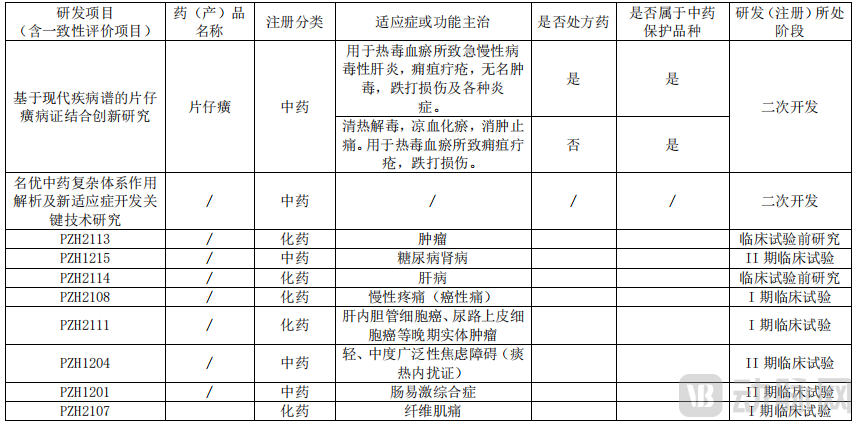
Basic Information on Major R&D Projects of Pientzehuang Pharmaceutical, Source: 2023 Annual Report
(Note: PZH2113 is currently at the IND approval stage.)
Among them, PZH2108 is an innovative drug for cancer pain developed by Pientzehuang, which received clinical trial approval from the NMPA in November 2020. At the end of 2023, Pientzehuang announced that PZH2108 had completed its Phase I clinical trial. The study results demonstrated that the drug exhibited good safety and tolerability across all dose groups in healthy Chinese subjects. As of that time, no drugs with the same target and indication had been approved for marketing either domestically or internationally.
PZH2111, another key innovative pipeline asset, is an innovative drug developed by Pientzehuang for the oncology sector and is currently in Phase I/II clinical trials. The indications under investigation include advanced solid tumors such as intrahepatic cholangiocarcinoma and urothelial carcinoma. According to the Drug Clinical Trial Registration and Information Publicity Platform, Pientzehuang is conducting an open-label, multicenter, Phase I/II clinical study to evaluate the safety, efficacy, and pharmacokinetic profile of PZH2111 tablets in patients with advanced solid tumors harboring FGFR genetic abnormalities and in patients with advanced intrahepatic cholangiocarcinoma featuring FGFR2 gene fusions/mutations.
In addition, Pientzehuang has also laid out a pipeline of innovative products, including the new traditional Chinese medicine (TCM) drug Wendan Tablets for generalized anxiety disorder, the new TCM drug Changji’an Capsules for diarrhea-predominant irritable bowel syndrome, the TCM candidate PZH1215 for diabetic nephropathy, the liver disease drug PZH2114, and the novel fibromyalgia drug PZH2107.
It seems that, while few were paying attention, the well-known “old Chinese medicine practitioners” have long been quietly making rapid strides in the field of innovative drugs, with remarkable results.
According to its 2023 annual report, Zhangzhou Pientzehuang Pharmaceutical Co., Ltd. conducted 11 clinical studies on the secondary development of Pientzehuang and its advantageous proprietary Chinese medicines, completing three of them; it advanced 34 research projects covering pharmacology, efficacy, and toxicology of Pientzehuang and its advantageous proprietary Chinese medicines, completing 10 studies including those on the mechanism of Pientzehuang’s effects on bile acid metabolism and hepatoprotective and anti-inflammatory actions; and published 25 new research papers.
Behind these abundant achievements lies indispensable financial support; in 2023, Zhangzhou Pientzehuang Pharmaceutical Co., Ltd. invested RMB 232 million in research and development. As of the announcement date (June 21), the cumulative R&D investment in the PZH2113 project amounted to approximately RMB 39 million (unaudited).
has become a trend,
Leading TCM Companies Aggressively Target Innovative Drugs
In fact, the public is more familiar with Zhangzhou Pientzehuang Pharmaceutical Co., Ltd., which has made a name for itself in the field of traditional Chinese medicine.
In December 1999, Zhangzhou Pientzehuang Pharmaceutical Co., Ltd. was established through the restructuring of the former Zhangzhou Pharmaceutical Factory, which had been founded in 1956. The company was listed on the Shanghai Stock Exchange in June 2003, raising a total of RMB 342 million in its initial public offering. In 2006, Pientzehuang Pharmaceutical was recognized by the Ministry of Commerce as one of the first batches of “China Time-Honored Brands.” In 2011, the “Zhangzhou Pientzehuang Production Technique” was included in the third batch of the “National List of Intangible Cultural Heritage.”
Zhangzhou Pientzehuang Pharmaceutical Co., Ltd. has long been producing more than 20 types of Chinese proprietary medicines, including Pientzehuang, Angong Niuhuang Wan, Compound Pientzehuang Lozenges, and Yindan Pinggan Capsules.Pientzehuang, the core product, is a nationally protected traditional Chinese medicine of Class I. Its traditional manufacturing technique has been included in the National List of Intangible Cultural Heritage. For many consecutive years, it has ranked among the top single varieties of exported Chinese proprietary medicines, earning the reputation as a “Chinese symbol” on the “Maritime Silk Road.”
Pientzehuang’s formula and manufacturing process are classified as state secrets and have never been disclosed. It is listed as a Class I nationally protected traditional Chinese medicine (TCM) product, representing the highest level of protection for proprietary Chinese medicines in China. In 2005, five ministries and commissions, including the State Forestry Administration, the National Medical Products Administration, and the State Administration for Industry and Commerce, jointly issued an announcement stipulating that only a few proprietary Chinese medicines, such as Pientzehuang, may continue to use natural musk; all other proprietary Chinese medicines not included in the announcement are prohibited from using natural musk, further enhancing the preciousness of Pientzehuang. Since July 1, 2005, each pill of Pientzehuang has been affixed with a uniquely numbered “Special Mark for China’s Wildlife Management,” and its production has been subject to quotas. In May 2023, Zhangzhou Pientzehuang Pharmaceutical Co., Ltd. announced a price increase, raising the price per tablet to RMB 760, leading many to compare it to gold.
The product’s explosive popularity has generated substantial revenue and also boosted sentiment in the secondary market. According to Zhangzhou Pientzehuang Pharmaceutical Co., Ltd.’s 2023 annual report, the company achieved annual revenue of RMB 10 billion in 2023, a year-on-year increase of 15.7%; net profit attributable to shareholders of the listed company amounted to RMB 2.8 billion, up 13% year on year.
Despite generating annual revenue of tens of billions, Pientzehuang Pharmaceutical, the “leader” in traditional Chinese medicine (TCM), has not rested on its laurels but is actively pursuing innovation.Prioritize the secondary development of key proprietary products centered on Pientzehuang,Thereby strengthening the planning and pipeline of new products, including innovative traditional Chinese medicine (TCM) drugs, classic TCM formulas, and innovative chemical drugs. From the perspective of TCM’s clinical advantages in specific disease categories, Zhangzhou Pientzehuang Pharmaceutical Co., Ltd. focuses on indications such as oncology and digestive system diseases, continuously exploring the clinical strengths of its flagship and specialized product portfolio, including Pientzehuang, Angong Niuhuang Wan, Compound Pientzehuang Ointment, Compound Pientzehuang Hemorrhoid Ointment, Compound Pientzehuang Lozenges, and Yindan Pinggan Capsules.
In fact, in addition to Zhangzhou Pientzehuang Pharmaceutical Co., Ltd. discussed in this article, well-known traditional Chinese medicine (TCM) enterprises such as Yunnan Baiyao, Yiling Pharmaceutical, Guangzhou Baiyunshan Pharmaceutical, Kanion Pharmaceutical, Tasly, China Resources Sanjiu, Tongrentang, Kuichua Pharmaceutical, Jilin Aodong, and Dong-E-E-Jiao have all been actively laying out innovative products in recent years. These major TCM companies have concurrently focused their efforts on the same domain, driven by a shared core objective: to achieve breakthroughs beyond their traditional areas of strength and elevate their financial performance to new heights.
In addition to leveraging inherent strengths and seeking breakthroughs, traditional Chinese medicine (TCM) enterprises may face profit pressure in the future as healthcare cost containment measures advance. On the other hand, while a few TCM companies with exclusive blockbuster products enjoy sustained differentiated advantages, the TCM sector overall is crowded with numerous participants and characterized by intense market competition. Consequently, investing in innovative drugs is undoubtedly a major direction for the transformation of TCM enterprises, a shift that has been frequently signaled by supportive policies at the national level.
Since 2021, the traditional Chinese medicine (TCM) industry has entered a period of policy dividend release, gradually becoming an important pillar in comprehensively advancing the construction of a Healthy China. In February 2023, the General Office of the State Council issued the Implementation Plan for Major Projects on the Revitalization and Development of Traditional Chinese Medicine, accelerating the transition from a “disease-centered” approach to a “people’s health-centered” model, and leveraging the significant role of TCM in maintaining health throughout the entire life cycle and in the prevention and treatment of major diseases.
With the continuous deepening of reforms in the drug review and approval system and the gradual improvement of accelerated marketing authorization procedures, investment in the research and development (R&D) of innovative traditional Chinese medicine (TCM) drugs in China has been steadily increasing, further accelerating the market entry of innovative therapies with proven efficacy that are urgently needed in clinical practice. In 2023, the National Medical Products Administration (NMPA) approved a total of seven new TCM drugs for marketing, marking the advent of a harvest period for R&D among domestic pharmaceutical companies and indicating that innovative TCM drugs are gradually maturing.
Reference: Yaozhi Data, “Pientzehuang’s ‘Class 1 New Anti-Tumor Drug’ Approved for Clinical Trials”