

Professor Huang Hui of Zhongshan Eighth Hospital Unveils Novel Mechanism of Hypertensive Vascular Injury and Advances Integrated Drug-Device Solutions
Hypertension is one of the most common chronic diseases. According to World Health Organization statistics, an estimated 1.28 billion adults aged 30–79 worldwide had hypertension as of 2023, making it a significant threat to health. AndThere are approximately 245 million hypertensive patients in China., the number of cases continues to increase year by year, with a concurrent trend toward younger demographics.
On the surface, hypertension presents no particularly obvious symptoms, and many people believe it does not directly cause life-threatening harm. However, 25–40% of patients develop target organ damage due to hypertension, such as heart failure, renal impairment, and aneurysms, thereby endangering their lives.Hypertensive vascular damage is a central link in the pathogenesis of multiple target organ injuries and serves as a critical entry point for early prevention and intervention.
If this high-risk population can be identified, the precision prevention and control of cardiovascular diseases in hypertensive patients willFrom tens of millions to millions. This not only conserves medical resources but also enables the provision of higher-quality treatment regimens for patients.
The Huang Hui Team from the Eighth Affiliated Hospital of Sun Yat-sen UniversityWith over two decades of research in cardiovascular diseases, our team has recently identified inflammaging as a key mechanism underlying hypertensive vascular injury.Professor Huang Hui told VCBeat, “This is the key to unlocking precise prevention and control of vascular damage in hypertension.”
I. Challenging the Inevitable Link Between Hypertension and Vascular Damage
In the common perception, blood vessels are akin to a network of “water pipes” within the human body, serving merely to convey blood from one end to the other. However, Professor Huang Hui contends that “we have all overlooked the intrinsic regulatory functions of blood vessels.”
For certain symptoms, healthy blood vessels can self-regulate and repair; however, as blood vessels age, their reparative capacity gradually diminishes, leading to a sharp increase in cardiovascular diseases. Therefore, research by Huang Hui’s team has found thatElevated blood pressure is only one of the contributing factors to cardiovascular disease; vascular aging itself is a more significant factor.
Using this as a starting point, the team conducted continuous in-depth research. Ultimately, it was discovered thatSenescence of endothelial and vascular smooth muscle cells leads to phenotypic transformation, promoting vascular remodeling and subsequently resulting in cardiovascular and cerebrovascular diseases.. The aging of these two cell types is closely linked to telomere homeostasis. Based on this, the team has elucidated a novel mechanism by which metabolic inflammation accelerates vascular injury in hypertension.
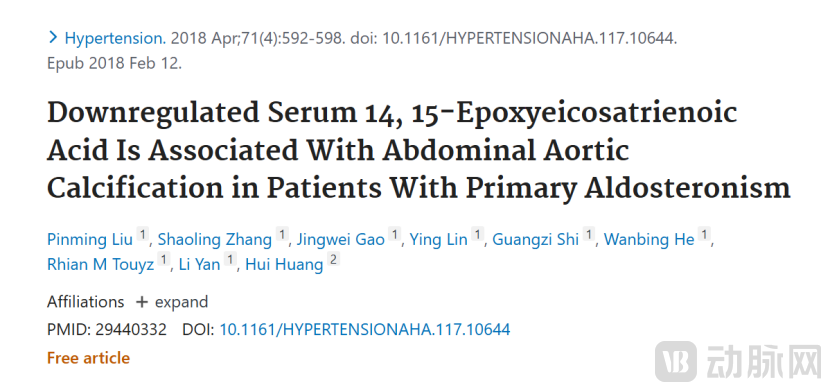 Screenshot of the paper (Image source: Hypertension)
This study was published inHypertensionsparked widespread attention in the international scientific research community. It was subsequentlyFeatured on the Homepage as “Funded Achievements” by the National Natural Science Foundation of China, receiving awards including the International Society of Hypertension’s Excellent Original Chinese Research Award.
However, breakthroughs in new mechanisms are not the team’s ultimate goal. As a group assembled by clinicians, they are more eager to translate theory into truly useful products that serve patients. To this end, the team has leveraged the new mechanism as its theoretical foundation to drive translational efforts in areas such as pharmaceuticals and medical devices.
II. Launching a Simultaneous Offensive on Pharmaceuticals and Medical Devices
In a comprehensive disease management program, early screening, prevention, and treatment are all indispensable. These three components are closely interconnected and mutually supportive, collectively contributing to improved patient cure rates and quality of life.Huang Hui’s team has also developed a series of medical protocols for the diagnosis and treatment of cardiovascular and cerebrovascular diseases, following a “three-step” approach.
1Early Screening: AI Precisely Assesses Vascular Risk at Every Site
In conventional understanding, patients with hypertension can only prevent cardiovascular and cerebrovascular diseases in their daily lives by monitoring blood pressure and taking medication. However, even when strictly adhering to medical advice for medication, there is still a risk of cardiovascular and cerebrovascular diseases. Many patients consequently develop a sense of complacency: “I’ve already taken my medicine; the rest is up to fate.”
However, cardiovascular diseases do have certain early warning signs. The team discovered that a series of biomarkers, represented by pigment epithelium-derived factor and arachidonic acid epoxides, can be used for early screening of vascular injury in patients with hypertension. Additionally, hemodynamic data such as pulse wave velocity and the ankle-brachial index can also reflect early vascular injury and predict the risk of cerebrovascular and cardiovascular events.
Therefore,By integrating assessments of vascular stiffness, imaging evaluations, and monitoring of cellular biomarkers, it is possible to determine the probability of a patient developing cardiovascular and cerebrovascular diseases.In clinical practice, however, it is difficult for clinicians to achieve this on their own: on the one hand, the sheer volume of data makes it challenging for physicians to render rapid judgments; on the other hand, their opinions are subjective and cannot guarantee absolute accuracy.
Based on this, the team leveraged AI technology to design a software capable of predicting the likelihood of patients developing cardiovascular and cerebrovascular diseases. After completing routine examinations,AI can automatically analyze the risk level of cardiovascular disease in patients, and even accurately predict the likelihood of disease occurrence in each individual blood vessel.
In this way, high-risk patients can undergo precise prevention and control through medical interventions, thereby improving their health status and quality of life; meanwhile, low-risk patients need not experience excessive worry or anxiety, but should instead maintain healthy lifestyle habits and undergo regular medical check-ups.
Furthermore, Professor Huang Hui believes that the target users of this software extend far beyond patients with hypertension: “Individuals in a sub-health state should also remain vigilant against cardiovascular diseases.” By employing multi-dimensional screening and AI-based assessment, starting from fundamental pathological conditions, the system can provide predictive evaluations for cerebrovascular and cardiovascular diseases to nearly the entire population.
It is reported that no similar products have yet appeared in clinical practice.The software has currently completed internal and external validation on a database of 100,000 cases, and its sensitivity and specificity have gained recognition from many clinicians.
2Prevention: Providing the Most Suitable Guidelines for Exercise Therapy
For patients at high risk of cardiovascular and cerebrovascular diseases, prevention becomes the top priority. Pharmacological prophylaxis is one component, but healthy lifestyle habits can significantly enhance its efficacy.
Studies have shown that appropriate exercise can lower blood pressure, thereby reducing vascular stress, while also helping to reduce inflammation and improve lipid profiles. According to the new mechanism discovered by Huang Hui’s team, the occurrence of hypertensive cardiovascular and cerebrovascular diseases is directly related to metabolic inflammation.Appropriate exercise is an effective method for preventing cardiovascular and cerebrovascular diseases.
Patients vary in their physical constitution and health status; how can one determine the most appropriate exercise dosage and modality?
To address this issue, the team developed a wearable device with biofeedback functionality.After the patient wears the device, it can automatically identify basic physiological information such as blood pressure and heart rate, and provide exercise guidance. During exercise, the device continues to monitor the user's cardiopulmonary function, scientifically assessing whether the exercise is suitable for the user's physical condition, thereby enhancing therapeutic effects.
However, the majority of patients with hypertension-related cardiovascular and cerebrovascular diseases are concentrated in the elderly population; some patients find it difficult to perform high-intensity exercises, while others are unable to engage in physical activity at all.To meet the needs of this patient population, the device can also be connected to exercise rehabilitation equipment, allowing exercises to be performed entirely through the device., thereby playing a role in the prevention and pre-treatment of cardiovascular and cerebrovascular diseases.
3Treatment: Discovery of New Drug Targets
Early screening and prevention can only reduce the risk of disease onset; patients who have already developed vascular damage still require pharmacological intervention.
During their investigation into novel mechanisms, the team discovered that delaying or reversing vascular cell senescence yields promising therapeutic effects for hypertensive vascular diseases. In the years following the disclosure of this new mechanism, the team conducted further in-depth research and ultimately identified that a series of natural compounds can retard the aging process through mitochondrial pathways and cytochrome P450 epoxygenase metabolism of arachidonic acid, suggesting these may represent novel therapeutic targets for hypertension-induced vascular injury.
Based on this, the team carried out modifications to it,Developed the small-molecule compound C1632, which inhibits the senescence-associated secretory phenotype.Laboratory data predict that this small-molecule compound may mitigate, or even reverse, vascular damage in the future, emerging as a key therapeutic agent for hypertension and cardiovascular and cerebrovascular diseases.
To date, research findings have been published in prestigious journals including Circulation (2022, 2023), J Clin Invest (2021, 2022), Hypertension (2018, 2021, 2022), Signal Transduction and Targeted Therapy (STTT) (2022, 2023, 2024), Kidney International (2024), and Cardiovascular Research (2023). These publications have been recognized as ESI Highly Cited Papers, included in the Top 100 High-Value Papers, and featured as cover stories.
III. Cardiovascular Disease Research Is a “Lifelong Commitment” Mission
Currently, the team is simultaneously advancing the development of three products.and has obtained more than ten domestic and international patents, while the second-generation prototype of the motion assessment device has also been developed.
The development of medical devices and pharmaceuticals is an extremely complex and protracted process. It involves multiple stages, including research and development, clinical trials, and regulatory approval, each of which requires substantial investments of time, human resources, and material assets. However, the primary responsibility of clinicians is to treat diseases and save lives, thereby safeguarding patients’ safety and health.This dual responsibility has further prolonged the product development process.
Huang Hui’s team comprises numerous highly accomplished experts in the fields of cardiovascular and cerebrovascular diseases. The team has led the development of one clinical consensus statement and conducted multiple clinical studies, and has been honored with awards including the Outstanding Young Scholar Award of the Chinese Pharmaceutical Development Award, the Golden Bridge Award from the China Technology Market Association, the Industry-University-Research Cooperation Innovation Award, the Chinese Medical Science and Technology Award, the Guangdong Medical Science and Technology Award, and the Shenzhen Science and Technology Progress Award.It holds a certain degree of influence in driving technological advancement and evaluating clinical practice.
However, when it comes to commercialization, the experts become “novices.” The team unanimously agreed that “industrialization and marketization should be left to professional marketing talent.”
To this end, the team is actively seeking partners to further advance product commercialization.For the team, research on cardiovascular and cerebrovascular diseases is a lifelong mission and duty. Whether in clinical practice or scientific research, they never forget the Hippocratic Oath and always prioritize patient health.
In the future, the team looks forward to accelerating the product’s entry into clinical stages within the integrated framework of “industry, academia, research, and certification,” bringing hope for better health to more patients with hypertension and cardiovascular and cerebrovascular diseases.