

Hunan University Unveils Patent for Auxetic Shape-Memory Biodegradable Cardiac Stent
Hunan UniversityPublicly disclosed in September 2023 aNegative Poisson's Ratio Shape-Memory Biodegradable Cardiac StentPatent. This patent pertains to a biodegradable stent that, compared with traditional metal stents, avoids the adverse consequences of local inflammatory responses. Meanwhile, its personalized design enables precise medical solutions for individual patients.
Negative Poisson’s ratio shape memory materials are characterized by high-temperature deformability, low-temperature fixation, and high-temperature recovery. Therefore, heart stents fabricated from these materials can remain in a compressed state prior to implantation and autonomously expand to recover their memorized shape after being implanted into the body, triggered by stimuli such as near-infrared light, ultrasound, or microwaves.Reducing Implantation Difficulty and Inaccurate Fixation...and other issues arise.
Additionally, the patent enables fabrication via 3D printing technology to achieve personalized customization of cardiac stents.Reduce the incidence of complications such as vascular injury, thrombosis, and coronary dissection caused by mismatch between stent diameter and vessel diameter.
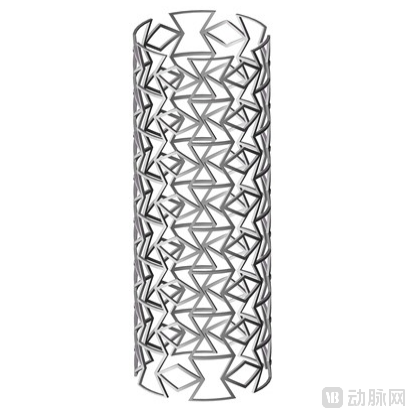
Auxetic Shape-Memory Biodegradable Cardiac Stent (Image source: Patent Specification)
I. Biodegradable Cardiac Stents Drive the Development of Upstream Metals and Polymer Materials
Around 2011, research teams worldwide almost simultaneously turned their focus to bioresorbable coronary stents. Compared with traditional coronary stents, innovations in materials are even more critical for bioresorbable stents, beyond differences in drug-eluting methods and fabrication techniques. This has also drivenUpstream Suppliers of Metals, Polymer Materials, and Pharmaceuticalsdevelopment.
Currently, the upstream sector of the cardiac stent industry primarily consists of medical material suppliers, including Euroflex, North China Pharmaceutical Group, TE Connectivity, and Prince Izant. The midstream sector comprises stent manufacturers, such as Boston Scientific, Abbott, MicroPort Medical, and Sino Medical Sciences Technology. The downstream sector includes major healthcare institutions.
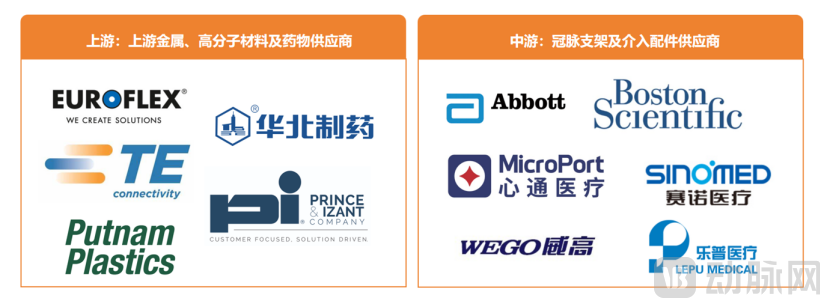 Schematic Diagram of the Upstream and Midstream Segments of Cardiac Stents
Additionally, includingFuwai Hospital of Cardiovascular Diseases, Chinese Academy of Medical Sciences; Central Iron and Steel Research Institute; Changchun Institute of Applied Chemistry, Chinese Academy of Sciences; Peking UniversityResearch institutions, among others, have also established dedicated teams to develop biodegradable cardiac stents.
II. Multiple Products Already Launched in China
With continuous technological advancements and the broader adoption in clinical practice, bioresorbable coronary stents are poised to become one of the mainstream options for the treatment of cardiovascular diseases in the future.
A wide range of biodegradable coronary stents are currently available on the market. Leading global players in the research, development, and manufacturing of bioresorbable stents include Japan’s Igaki Medical Planning Co., Ltd., the U.S.-based Guidant Corporation, and Bioabsorbable Therapeutics, Inc.
The world's first biodegradable coronary stent was launched by Abbott in 2016.Absorb GT1 BVS StentThis is a heart stent made of poly-L-lactide material, which can be slowly absorbed by the human body within about three years. Professor Wang Yunbing, a Chinese scientist, participated in its research and development.
China’s First Biodegradable Cardiac Stent Is Independently Developed by Lepu MedicalNeoVas Stent, which was approved in 2019. This stent is made of polylactic acid polymer and degrades safely and slowly over approximately three years.
In addition, the biodegradable stents currently approved in China include those from Yuanxin Technology.IBS Angel™ Iron-Based Bioresorbable Scaffold System, this is the world's first vascular stent system with iron-based materials as the main body, mainly used for minimally invasive treatment of congenital heart disease,Has passed the NMPA Special Approval Procedure for Innovative Medical Devices and obtained EU CE MDR certification.
The domestically produced bioresorbable coronary stent with the highest market share in China is the one launched by Academician Ge Junbo’s team from Zhongshan Hospital, Fudan University, and Shandong Huaan Biotechnology.Xinsorb Bioresorbable Scaffold. This stent was approved in 2020 and is naturally metabolized and absorbed by the human body within 2 to 4 years. It has been successfully implanted in more than 28,000 patients across over 700 hospitals.